1500+ Large Enterprises & Mid-Sized Businesses Have Created Value Via HighRadius Autonomous Accounting Software
Join Them Now- Best Overall Trintech Alternative for Mid-Market & Enterprise: HighRadius
- Best for Enterprise Consolidation & Reporting: OneStream
- Best Trintech Alternative for Legacy Close Management: BlackLine
- Best for Small, Growing Businesses with Limited Entities: FloQast
- Best for Regulated Financial & SEC Reporting: Workiva
- Best for ERP-Agnostic Finance Process Automation: Redwood
- Best for Unified Close and Planning: Planful
Trintech's Cadency and Adra suites have long served reconciliation and financial close needs for enterprise and mid-market accounting teams. But as organizations scale across more entities, currencies, and ERPs, many run into friction with Cadency's rule-based matching architecture and the segmented nature of Trintech's product line, Cadency for large enterprise, Adra for mid-market, and separate standalone tools (ReconNET, Frontier, Accurate, DATAFlow) layered on top. Trintech excels at high-volume transaction matching for regulated industries like banking and insurance, but falls critically short when finance teams need record-to-report unified with the rest of the CFO stack, not managed as a standalone reconciliation silo.
For finance teams that want one unified platform rather than a portfolio of products split by company size, this guide maps out the top 7 Trintech alternatives available in 2026.
How We Selected the Best Trintech Alternatives
In our selection of the best Trintech competitors, we considered several factors:
- Comprehensiveness: We looked for platforms that unify financial close, reconciliation, consolidation, and reporting without forcing teams to navigate separate products based on company size.
- Scalability Across Segments: We searched for cloud-based platforms architected to scale from mid-market to global enterprise without a hard product-line switch.
- Agentic AI Capability: We prioritized platforms that go beyond legacy rule-based matching, focusing instead on Agentic AI systems capable of executing reconciliations, journal entries, and variance analysis autonomously without preset rule templates.
- Ease of Use: We prioritized solutions that don't require extensive custom rule-building or heavy IT involvement to handle exceptions.
- Integration and Compatibility: We gave priority to platforms with deep, bi-directional ERP integrations, not just flat-file transfers, including native connectors for both mid-market systems (NetSuite, Sage Intacct, Workday) and enterprise-grade deployments (SAP S/4HANA, Oracle).
When evaluating alternatives in this category, it's worth understanding a common post-implementation friction point. Teams often adopt Trintech's Cadency for its enterprise-grade reconciliation depth, only to find that the same rigidity that provides control also slows down exception handling and requires ongoing rule maintenance as transaction patterns shift. A true alternative needs to balance strong governance and audit-readiness with a matching engine that adapts without constant manual reconfiguration.
Top Trintech Alternatives At A Glance for 2026
| Platform | Target Market Segment | Primary Best-For Use Case | Pros | Cons |
| HighRadius | Mid-Market & Enterprise | Unified O2C, AP, Treasury & R2R Automation | 22+ Pre-built R2R AI Agents; AI agent builder that auto-generates from existing Excel workflows as per company requirements. | Overkill for single-entity, low-volume businesses. |
| OneStream | Large Enterprise | Complex Global Consolidation & Reporting | Deep configurability, strong governance, and audit trail. | Steep learning curve; heavy custom rule reliance. |
| BlackLine | Mid-Market & Enterprise | Reconciliation & Close Management | Large review base; strong core reconciliation automation. | Pricing runs well above market average. |
| FloQast | Small Business & Limited Entities | Close Task Tracking & Checklists | Fast, self-serve setup on existing workflows. | Not built for multi-entity, high-volume matching. |
| Workiva | Enterprise, Regulated Industries | SEC/XBRL Reporting & Compliance | Best-in-class audit trail and connected reporting. | Reporting-focused, not a deep close engine. |
| Redwood | Mid-Market & Enterprise | Cross-ERP Finance Process Orchestration | Vendor-agnostic automation across SAP, Oracle, Workday, and Infor; strong orchestration/scheduling engine (RunMyJobs). | More oriented toward process orchestration than purpose-built reconciliation matching depth. |
| Planful | Mid-Market & Enterprise | Unified Close and FP&A Planning | Intuitive interface; unifies close and planning. | Implementation lags on ambitious enterprise rollouts. |
Top Trintech Alternatives: Deep Dive
With the at-a-glance comparison in mind, here's a deeper look at what each of these seven platforms brings to the table, and where each one falls short.
1. HighRadius: The Best Trintech Alternative for Mid-Market & Enterprise Businesses
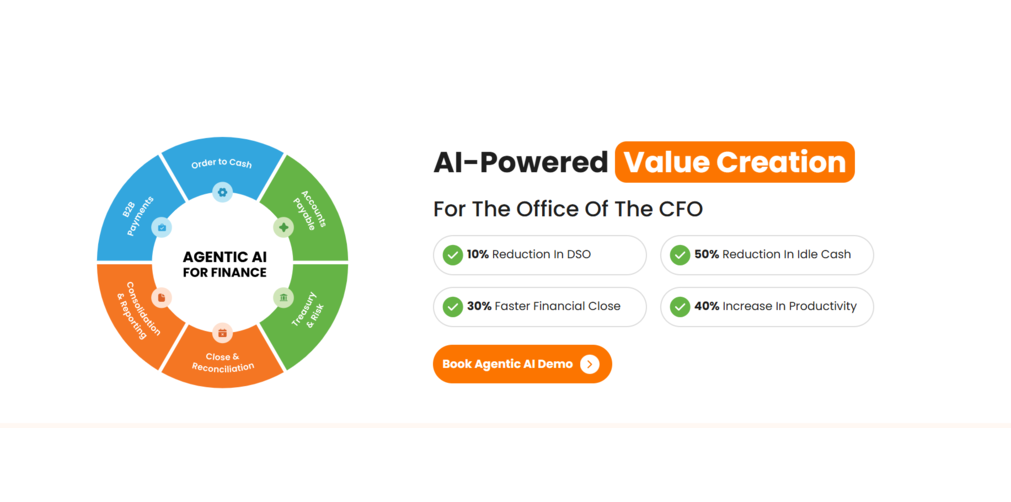
HighRadius stands out as the platform built for finance teams outgrowing segmented, size-based product tiers. Rather than splitting capability across separate enterprise and mid-market products the way Trintech does with Cadency and Adra, HighRadius runs Accounts Receivable, Treasury, Accounts Payable, and Record-to-Report on a single AI-native platform that scales by configuration, not by product swap
Within R2R, HighRadius complements its library of pre-built AI agents with the R2R Agent Builder, which creates organization-specific AI agents from a company's existing close processes. Instead of rebuilding workflows as rules, finance teams can upload their existing Excel-based close and consolidation workflows, allowing the platform to automatically generate custom AI agents tailored to each distinct process. For example, a large enterprise uploading more than 2,000 Excel workflows could generate 200+ organization-specific AI agents, enabling 60%+ close automation from the outset.
This differs fundamentally from Cadency's approach. While Cadency allows Excel to be used as a data source, reconciliation logic must still be configured and maintained within a centralized rule engine that administrators update as transaction patterns evolve. HighRadius, by contrast, derives its AI agents directly from each organization's existing workflows, reducing the need to manually translate business processes into rule sets before automation can begin.
- Pros: Unified platform spanning O2C, AP, Treasury, and R2R rather than separate size-tiered products; 22 pre-built R2R AI agents; native Excel-to-agent builder; pre-built connectors for SAP, Oracle, NetSuite, and 50+ ERPs; outcome-based pricing with $0 implementation fees until go-live.
- Cons: The full platform breadth can be more than a business with a single entity and low transaction volume needs.
- Best For: Fast-growing mid-market finance teams that don't want to "graduate" into a heavier enterprise product later, and multinational enterprises wanting O2C, AP, Treasury, and R2R unified under one vendor relationship.
- Pricing: Outcome-Based Pricing (OBP) with $0 implementation fees and $0 fees until the system goes live. Post-go-live fees are structured as a gain-share percentage calculated against a Mutually Agreed Success Criteria (MASC).
- Review Summary: Users consistently highlight the platform's automation depth, ERP integration quality, and responsive account teams, with some noting that certain advanced reports require support-team customization and that batch-based integrations (rather than fully real-time sync) can introduce minor sync delays.
2. OneStream: Best for Enterprise Consolidation and Reporting
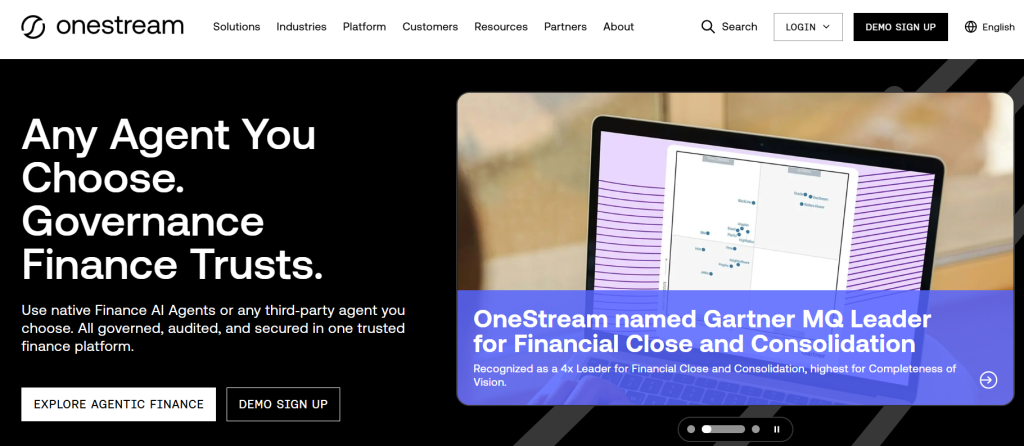
OneStream is built for organizations managing complex financial consolidation and planning across multiple entities. It serves as a single system of record by replacing spreadsheets and standalone consolidation tools with a unified Corporate Performance Management (CPM) platform. By combining financial consolidation, planning, data quality, and reporting in one solution, OneStream enables enterprises to streamline the financial close while supporting broader consolidation, compliance, and reporting requirements.
- Pros: Deep configurability and flexible business rules that support complex intercompany elimination and multi-GAAP reporting; strong governance with built-in workflows, audit trails, and approvals; frequently praised for consolidating financial data into a single source of truth
- Cons: Steep learning curve, particularly for new admins and developers; heavy reliance on custom business-rule configuration; interface is functional but was described by reviewers as dated relative to newer cloud-native tools; implementations can span 6-18 months.
- Best For: Large corporate enterprises prioritizing consolidation and statutory reporting depth over closing-cycle speed or agility.
- Pricing: Enterprise pricing requires a scoping consultation.
- Review Summary: Reviewers frequently praise the platform's single-source-of-truth architecture and configurability, while consistently flagging cost, implementation complexity, and the learning curve as the main friction points.
3. BlackLine: Best Trintech Alternative for Legacy Close Management
BlackLine is one of the most established platforms for financial close and account reconciliation, offering a comprehensive suite of automation capabilities backed by a large and mature enterprise customer base. Rebuilt around its Studio360 data layer and Verity AI agents, it remains one of the closest like-for-like alternatives to Trintech Cadency in terms of enterprise scale and depth. BlackLine is particularly well-suited for large organizations looking to replace spreadsheet-driven, legacy close processes with a modern, automated financial close platform.
- Pros: Large, well-established review base; reliable core reconciliation and close-task automation; strong process control and compliance accuracy.
- Cons: Third-party pricing estimates put BlackLine 26–42% above the market average; may lack deeper native FP&A/planning tools relative to unified platforms.
- Best For: Mid-sized to enterprise companies wanting collaborative close management with a long-established reconciliation vendor.
- Pricing: Custom, quote-based; not publicly listed.
- Review Summary: Users consistently cite BlackLine's reliability and reduction in manual reconciliation work as core strengths, with pricing being the most commonly cited drawback.
4. FloQast: Best for Small, Growing Businesses with Limited Entities

FloQast is a financial close management platform designed to enhance existing accounting workflows rather than replace them. It focuses on task management, checklists, and team collaboration while allowing finance teams to continue working within familiar spreadsheet-based processes. This approach makes FloQast well-suited for small and mid-sized businesses seeking to improve close visibility and coordination without the complexity of an enterprise-scale financial automation platform.
- Pros: Fast, self-serve onboarding; user-friendly checklist dashboards; integrates directly with QuickBooks Online, NetSuite, Sage Intacct, and Google Drive.
- Cons: Not built for multi-entity enterprise scaling or high-volume, complex sub-ledger matching; teams sometimes maintain workarounds outside the system for more advanced needs.
- Best For: Small business finance teams with limited subsidiaries who want a lightweight overlay on existing Excel-based processes.
- Pricing: Tiered, user-based subscription (publicly cited starting around $999/month).
- Review Summary: Heavily praised for ease of onboarding and its accountant-friendly design, with reviewers noting it functions best as a task-tracking layer rather than a full automation engine.
5. Workiva: Best for Regulated Financial and SEC Reporting
Workiva is a connected reporting platform that brings together data from ERPs, spreadsheets, and third-party systems to streamline financial and regulatory reporting. Its core focus is on audit-ready reporting, SEC/XBRL compliance, and ESG disclosures rather than financial close and reconciliation. As a result, it serves as an alternative to Trintech primarily for public companies that need to tightly integrate their close process with external filing and disclosure obligations.
- Pros: Best-in-class audit trail and version control; connected data model keeps numbers synchronized across linked reports; strong collaborative, real-time editing for reporting teams.
- Cons: Reporting and compliance-centric rather than a deep transactional close/reconciliation engine; pricing and configuration typically run through administrative setup rather than self-serve.
- Best For: Enterprises in heavily regulated industries where SEC filing accuracy and audit defensibility are the top priority.
- Pricing: Available upon request.
- Review Summary: Reviewers consistently rate Workiva highly for audit trail integrity and SOX-compliant workflows, with setup coordination cited as a tradeoff for that level of process control.
6. Redwood: Best for ERP-Agnostic Finance Process Automation
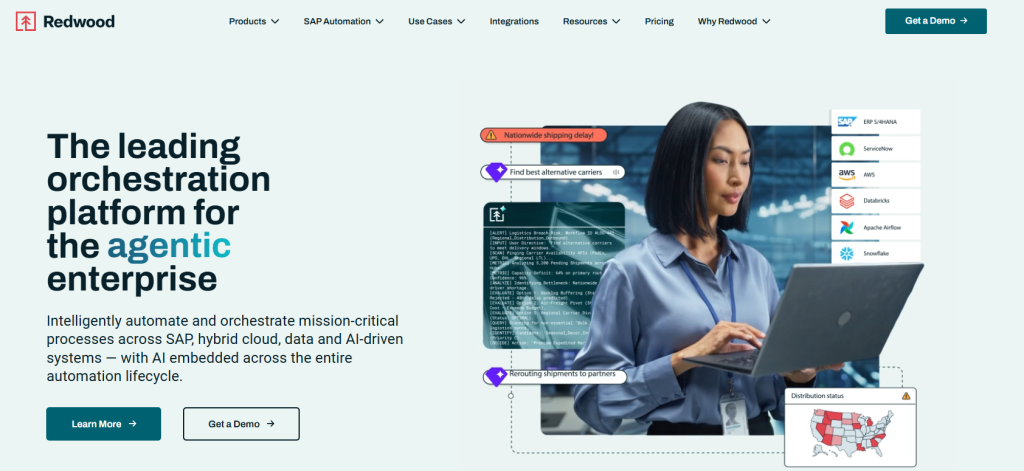
Redwood (Finance Automation by Redwood, powered by RunMyJobs) is a process orchestration and automation platform that connects and automates finance workflows across ERPs, spreadsheets, and other business applications rather than anchoring teams to a single new system of record. Instead of requiring a front-end switch for reconciliation or FP&A, Redwood orchestrates existing tools, SAP, Oracle, Workday, Infor, and more, into automated, auditable end-to-end processes spanning record-to-report, procure-to-pay, and order-to-cash.
- Pros: Vendor-agnostic orchestration across hybrid, multi-ERP environments; strong automated scheduling, managed file transfer, and exception-handling capabilities; extends automation beyond R2R into broader finance and IT processes.
- Cons: Positioned more toward process orchestration and automation than purpose-built account reconciliation matching depth or native FP&A planning functionality; realizing full value typically requires upfront process mapping.
- Best For: Finance and shared-services teams running hybrid, multi-ERP environments who want to automate and orchestrate close, reconciliation, and adjacent finance processes without replacing existing systems.
- Pricing: Custom, quote-based; available upon request.
- Review Summary: Users highlight Redwood's flexibility in orchestrating processes across disparate ERPs and reducing dependency on manual work and IT tickets, with feedback noting that full value depends on upfront process-design effort.
7. Planful: Best for Unified Close and Planning

Planful (formerly Host Analytics) is a cloud-based CPM platform that unifies financial close, consolidation, budgeting, forecasting, and broader FP&A processes. Centered on its Continuous Planning approach, it appeals to organizations looking to manage close and planning on a single platform instead of relying on separate point solutions. It competes with Trintech primarily among finance teams seeking an integrated close and planning experience rather than a standalone financial close platform.
- Pros: Intuitive, modern interface; unifies close and planning rather than treating them as separate tools; collaborative forecasting features.
- Cons: Implementation satisfaction has trailed some competitors on more ambitious enterprise deployments, which may reflect deployment complexity more than product capability.
- Best For: Enterprises wanting financial close and FP&A planning in a single platform rather than stitched-together point solutions.
- Pricing: Available upon request; third-party sources note it runs above market average
- Review Summary: Reviewers highlight the modern interface and collaborative planning features as standout strengths, with implementation scope cited as the main variable in satisfaction scores.
Why HighRadius Is the Best Trintech Alternative to Enable Scalable Finance Operations
Evaluating financial close and reconciliation software means recognizing the dividing line between point solutions segmented by company size and platforms built to scale continuously. Trintech's Cadency/Adra split works well until a mid-market company outgrows Adra and has to migrate onto a materially different enterprise product. HighRadius avoids that transition entirely by unifying Order-to-Cash, Accounts Payable, Treasury, and Record-to-Report on one architecture that scales through configuration rather than a product swap — while matching Trintech's enterprise-grade claims on ERP integration depth, SOX compliance, and multi-entity reconciliation.
FAQs On Trintech Alternatives & Competitors
1. What are the main reasons companies look for Trintech alternatives?
Finance teams typically evaluate Trintech alternatives due to the platform's segmented product architecture (Cadency for enterprise, Adra for mid-market), its reliance on rule-based matching that requires ongoing maintenance, and a desire for a single platform that scales without switching products as the company grows.
2. What is the best alternative to Trintech for financial close automation?
For mid-market and enterprise teams wanting unified automation across the entire CFO office, HighRadius is a leading alternative given its agentic AI architecture and single-platform approach across O2C, AP, Treasury, and R2R. For enterprises prioritizing consolidation and statutory reporting, OneStream is a strong fit. Smaller teams with simpler needs may prefer FloQast.
3. How does HighRadius compare to Trintech's Cadency specifically?
Cadency is built around a centrally configured rule engine: reconciliation logic is set up by a systems admin and has to be manually maintained and re-tuned as transaction patterns or entities change. HighRadius takes the opposite approach with its R2R Agent Builder — teams upload their existing Excel-based close and consolidation workflows (let's say, 2,000+ at once, for larger organizations) and the platform auto-generates 200+ AI agents, one per use case, without requiring the process to be re-built as a rule set first. HighRadius reports this drives 60%+ close automation directly from that agent generation step, before any further tuning.
4. Are there Trintech alternatives designed specifically for mid-market companies?
Yes. HighRadius offers pre-built configurations for mid-market ERPs like NetSuite and Sage Intacct with faster deployment timelines, while Redwood and Planful also serve mid-market finance teams well — Redwood for teams wanting cross-ERP process orchestration, and Planful for those looking to unify close with FP&A planning.
5. How does the cost of Trintech alternatives compare to Trintech's pricing?
Trintech uses custom, quote-based pricing for both Cadency and Adra. Most alternatives in this list — HighRadius, OneStream, BlackLine, Workiva, Redwood, and Planful — also use custom quotes. FloQast is the exception with more transparent, publicly cited starting pricing for smaller teams.
6. What is the implementation timeline when migrating off Trintech?
Timelines vary by platform complexity. Lightweight tools like FloQast can connect within weeks. Mid-market-focused platforms typically require a few months of guided implementation. Enterprise platforms — including OneStream and full-scale HighRadius enterprise deployments — generally involve longer rollouts, particularly across multiple entities and ERP instances, though pre-built ERP connectors can meaningfully shorten that window.
7. Do major Trintech competitors support native integrations with ERPs like SAP and NetSuite?
Integration depth varies. HighRadius, BlackLine, OneStream, and Redwood all offer deep, native integrations with SAP, Oracle, and NetSuite — Redwood in particular is built to orchestrate processes across hybrid, multi-ERP environments. FloQast connects well with mid-market ERPs and accounting platforms like QuickBooks, NetSuite, and Sage Intacct, but is less commonly deployed against the largest, most complex SAP/Oracle enterprise environments.
8. What is the difference between a niche point solution and a full-suite Trintech competitor?
Niche alternatives like Workiva (reporting/compliance) or Redwood (cross-ERP process orchestration) focus on a specific slice of the finance function. Full-suite alternatives like HighRadius replace the broader close infrastructure, unifying credit, collections, cash application, AP, and R2R in a single ecosystem rather than requiring teams to stitch together multiple point tools.