Best B2B Payment Software Platforms in 2026: A Guide for Mid-Market and Enterprise Finance Teams
Last Updated: 12 May, 2026
•
Shahid Baig Finance Industry Thought Leader
S
Shahid Baig
Shahid Baig specializes in finance and payments, focusing on building strategic narratives for B2B SaaS products that support organic and digital marketing strategies. As a CFO Tech Product Specialist, he works at the intersection of growth, product, and strategy for HighRadius' O2C & AP products, translating industry concepts into clear, insight-driven content that enables informed decision-making. His work is rooted in combining domain knowledge with user-centric storytelling to create content that is both accessible and impactful for business audiences.
Beyond his professional work, Shahid draws from a background in writing and theatre, bringing a distinct narrative depth, storytelling prowess, and clarity to his content. His approach remains focused on one principle: making complex ideas simple, without losing their strategic essence.
Analyst Recognition
HighRadius Named a Leader in the 2024 Gartner® Magic Quadrant™ for Invoice-to-Cash Applications
Positioned highest for Ability to Execute and furthest for Completeness of Vision for the third year in a row, HighRadius continues to lead in B2B payments automation.
Managing B2B payments has become one of the most operationally demanding challenges for finance teams today — regardless of company size. For mid-market businesses scaling from $50M to $1B in revenue, the pressure is about doing more with lean AR teams, eliminating check dependency, and offering customers a modern payment experience without a costly IT overhaul. For global enterprises, the challenge is fundamentally different: reconciling payments across multiple ERPs, optimizing interchange costs running into the millions, and maintaining PCI DSS compliance across jurisdictions.
The global B2B payments market is on track to grow from $4.6 billion in 2024 to $57.6 billion by 2030, and the gap between organizations that have modernized payment operations and those that haven't is widening fast.
Yet most businesses: mid-market and enterprise alike and are still running fragmented payment stacks that were never designed to work together. This guide covers the top B2B payment platforms in 2026, with a clear lens on what each segment actually needs to solve.
Key Takeaways
B2B payment modernization is critical for reducing DSO, improving cash flow, and eliminating manual payment inefficiencies.
Mid-market and enterprise finance teams require different payment automation capabilities based on operational complexity and scale.
Agentic AI is transforming B2B payments through intelligent routing, automated reconciliation, fraud detection, and interchange optimization.
HighRadius stands out by combining embedded payments, ERP-native automation, and AI-driven payment orchestration in a single platform.
Top B2B Payment Platforms at a Glance
With many B2B payment processing companies offering different capabilities, selecting the right platform can be challenging. Some providers focus on digital invoicing and supplier payments, while others deliver broader B2B payment processing capabilities that include payment orchestration, ERP integration, and automation across multiple payment channels.
The table below highlights some of the top B2B payments companies and their primary focus areas to help finance teams quickly compare the platforms.
Global payment processing and multi-currency payment operations
Contact For Pricing
Each of these B2B payment processors offers capabilities designed to streamline payment workflows, automate parts of the invoice payment process, and support businesses as payment volumes grow. In the next section, we’ll look at what B2B payment processing software is and how it helps organizations modernize payment operations.
What Is A B2B Payment Software?
B2B payment software is a platform that helps businesses manage, process, and automate payments between companies. Instead of relying on manual workflows, emails, and disconnected banking systems, these platforms centralize the entire invoice payment process, allowing finance teams to capture, authorize, process, and reconcile payments from a single system.
Modern B2B payment platforms support multiple payment rails: ACH, wire, credit card, virtual card, and digital portals, and integrate directly with ERP and accounting systems to auto-post payment data. Most leading platforms now incorporate Agentic AI to optimize payment routing, detect fraud patterns, automate reconciliation, and improve authorization success rates.
The key distinction in 2026 is not whether a platform supports digital payments, most do. The real differentiator is how deeply it embeds into your existing financial infrastructure, how intelligently it reduces processing costs, and whether it serves the specific operating model of a lean mid-market AR team or a multi-entity enterprise treasury function.
The State of B2B Payments in 2026
The numbers tell a clear story about where the market is and where it's heading.
B2B volume on the ACH Network grew 9.9% in 2025, reaching 8.1 billion payments, with Nacha's CEO stating: "Both of those statistics point to businesses large and small turning their backs on checks, a trend that only continues to grow." Yet the transition is far from complete. Checks still account for approximately 30–35% of B2B payments by count in North America, creating significant processing overhead for the AR teams that still handle them manually.
Three in every four companies experience late B2B payments, directly impacting cash flow, and 79% of companies reported being targets of payment fraud attempts in 2024. Meanwhile, companies using advanced payment automation now settle invoices days or even weeks faster than those relying on paper checks.
For mid-market organizations, the cost of inaction shows up as DSO creep and AR headcount pressure. For enterprises, it's interchange costs running unchecked and reconciliation backlogs that eat into month-end close cycles.
Mid-Market vs. Enterprise: Two Very Different Sets of Problems
Before selecting a platform, it's important to map it to your organization's actual operating reality. The pain points, must-have features, and expected outcomes differ significantly by segment.
What Mid-Market Finance Teams Are Dealing With
Mid-market companies — typically distributors, manufacturers, and services firms with $50M to $1B in revenue — are running lean AR teams, often of two to ten people, on mid-tier ERPs like NetSuite or Sage. The most common friction points:
Checks are still the dominant payment method in many of these businesses, creating high processing overhead, slow clearing, and hours of manual reconciliation every week. Customers pay through three or four different methods with no unified portal, making it nearly impossible for a small team to track what's outstanding in real time. Card fees quietly erode margins, with no surcharging mechanism to offset them. And there's no scalable way to grow collections capacity without growing headcount.
The solution mid-market teams need isn't another point tool — it's an embedded payment experience that connects directly to the ERP and removes manual steps without requiring IT resources to deploy.
What Enterprise Finance Teams Are Dealing With
Global enterprises, typically Global 2000 companies with complex multi-entity, multi-currency AR operations, face a different class of problem. Their buyers are often on different payment channels. Payments flow through five or more ERPs with no consistent reconciliation workflow. Card interchange fees run into millions of dollars annually with no automated optimization. PCI compliance gaps exist across geographies. Processor failures cause revenue leakage with no automatic retry logic. And manual surcharge management creates compliance exposure in regulated states.
What enterprise teams need is an AI-orchestrated payment infrastructure: one that routes transactions intelligently, qualifies interchange at L2/L3 automatically, handles surcharging compliantly across jurisdictions, and posts settlement journals without human intervention.
10 Best B2B Payment Software Platforms in 2026
As organizations modernize their financial operations, selecting the right payment platform becomes essential. The top B2B payments companies offer a range of capabilities, from automating the invoice payment process to enabling secure B2B payment processing across multiple payment channels. Below are some of the leading B2B payment processing companies businesses use to manage and scale their payment operations.
1. HighRadius
HighRadius is an IDC MarketScape-recognized Agentic AI platform for B2B payments, built to serve both mid-market and enterprise finance teams within their existing ERP and AR workflows. It is the only platform in this list purpose-built to close the full invoice-to-cash loop — from payment capture and processing through to ERP reconciliation — for both lean AR teams and complex global treasury operations.
For Mid-Market Teams
Mid-market organizations using HighRadius get an embedded payment portal with multi-rail support — ACH, credit/debit card, eCheck, and virtual card — accessible directly from invoices, with no separate customer login and no IT buildout required. The platform connects to NetSuite, Sage, and other mid-tier ERPs in weeks, not months. Payments auto-reconcile in the ERP, and AR headcount doesn't need to grow as the business scales.
The real-world impact is measurable. Konica Minolta Business Solutions deployed HighRadius B2B Payments and reached 83% e-payment adoption across its customer base, translating to $3.5M saved through payment efficiencies, $2M annually in credit card fee savings, and a 9-day reduction in DSO — all without adding headcount. CFO Holly DeSantis credited HighRadius with unlocking millions in working capital and enabling the team to refocus on growth rather than payment operations.
Other mid-market customers include DXP Enterprises, BSN Sports, Ring Container Technologies, and Johnsonville Sausage LLC.
For Enterprise Teams
For global enterprises, HighRadius delivers an AI-powered payment gateway with L2/L3 interchange optimization, intelligent processor routing, automated surcharging, and multi-MID tokenization. It integrates natively with SAP, Oracle, and NetSuite across entities and supports 150+ currencies and 40+ card processors.
Enterprises recover significant card processing costs through automated interchange qualification while reducing payment decline rates. Settlement journals post automatically, eliminating month-end reconciliation backlogs. Danone North America is one benchmark example: HighRadius helped Danone achieve straight-through cash posting on payments and recover $20M annually in invalid deductions through automated payment matching and exception handling. The team maintained 96% cash forecasting accuracy — an outcome cited by IDC MarketScape as a benchmark example of enterprise-grade payment automation.
Key Features
Agentic AI Payment Orchestration: automatically selects optimal processor, routing path, and retry strategy to maximize authorization success
Embedded Payment Portal: multi-rail support (ACH, credit/debit card, eCheck, virtual card) with direct ERP integration, no IT buildout required
L2/L3 Interchange Fee Optimizer: automatically enriches transactions with invoice-level data to qualify for lower interchange categories; enables up to 100% interchange fee recovery for eligible transactions
Surcharge Management: configures and applies compliant surcharging rules with 100% transaction coverage for eligible payments
Multi-MID Tokenization: manages payment credentials securely across multiple merchant IDs and entities
ERP-Integrated Reconciliation: connects directly with SAP, Oracle, and NetSuite to auto-post settlements and match payments to invoices
100% Global PCI DSS Compliance: across all payment channels and geographies
Support for 150+ currencies and 100+ payment methods globally
Recognized as Leader in IDC MarketScape: Worldwide Embedded Payment Applications 2024–2025
2. Billtrust
Billtrust provides payment and digital invoicing capabilities designed to help businesses manage accounts receivable workflows. The platform enables organizations to deliver digital invoices and accept payments through multiple channels.
Key Features
Digital invoice presentment and payment portals
Multiple payment acceptance methods
Integration with accounting and ERP systems
Payment tracking and reporting tools
Customer payment management features
3. AvidXchange
AvidXchange focuses on automating accounts payable workflows and supplier payments for businesses. The platform helps organizations digitize invoice approvals and manage vendor payments more efficiently.
Key Features
Automated invoice capture and approvals
Supplier payment automation
Integration with accounting systems
Payment tracking and reporting capabilities
Fraud prevention controls
4. Bill.com
Bill.com provides payment automation tools designed for small and mid-sized businesses. The platform enables users to manage invoices, approvals, and payments from a centralized dashboard.
Key Features
Digital bill management and payment scheduling
ACH and card payment capabilities
Approval workflows for payment authorization
Integration with accounting platforms
Payment tracking and reporting
5. Versapay
Versapay offers collaborative accounts receivable solutions with integrated payment capabilities. The platform enables businesses to manage customer communications, invoices, and payments within a unified system.
Key Features
Customer payment portals
Digital invoicing and payment acceptance
Collaboration tools for dispute management
ERP integrations
Payment tracking and reporting
6. TreviPay
TreviPay specializes in B2B payments and trade credit solutions that support global buyer-supplier relationships. The platform focuses on enabling businesses to offer flexible payment options to commercial customers.
Key Features
Trade credit and net terms management
Global B2B payment support
Buyer and supplier onboarding
Risk assessment and credit management
Payment processing capabilities
7. Flywire
Flywire focuses on enabling global payments across industries that require international transaction processing. The platform helps organizations manage cross-border payments and currency conversions.
Key Features
Cross-border payment processing
Multi-currency payment support
Payment tracking and reporting tools
Integration with financial systems
Security and compliance features
8. Payoneer
Payoneer provides global payment services that help businesses send and receive payments internationally. The platform is commonly used by companies working with global partners and marketplaces.
Key Features
International B2B payment processing
Multi-currency payment accounts
Global payment network
Payment tracking and reporting
Cross-border transaction capabilities
9. Stripe
Stripe offers payment infrastructure that allows businesses to accept and manage digital payments through APIs and payment gateways. Many organizations use Stripe to support online and embedded payment experiences.
Key Features
Payment gateway and API integrations
Support for multiple payment methods
Global payment acceptance
Fraud detection and security controls
Payment reporting and analytics
10. Airwallex
Airwallex provides global payment processing capabilities designed to help businesses manage international transactions and multi-currency payments.
Key Features
Global payment processing infrastructure
Multi-currency accounts and transfers
Cross-border payment support
Integration with business systems
Transaction monitoring and reporting
How to Choose the Best B2B Payment Software (Mid-Market & Enterprises)
The right choice depends on where your organization sits and what problem you are actually trying to solve. Use the following framework.
For Mid-Market Organizations ($50M–$1B Revenue)
If you're a lean AR team running on NetSuite or Sage, still accepting checks, and growing faster than your collections infrastructure can handle, the most important evaluation criteria are: embedded payment experience (can customers pay directly from the invoice without a separate login?), ERP integration speed (days or weeks, not quarters), and auto-reconciliation capability. Surcharging and payment portal configurability become important if margins are under pressure from card fees. Look for vendors with documented mid-market deployments and measurable DSO outcomes.
For Enterprise Organizations (Global 2000 / Multi-Entity)
If you're managing payment operations across five or more ERPs, processing card volume in the tens or hundreds of millions, and operating across multiple geographies, your evaluation criteria should be weighted toward: L2/L3 interchange optimization (automated, not manual), intelligent processor routing with retry logic, PCI DSS compliance coverage across all entities and channels, multi-MID support, and the ability to handle 150+ currencies without manual intervention. Case studies from companies of comparable complexity — not just logos — are the right proof point to request.
Reporting and Payment Visibility — real-time dashboards, not batch reports; finance teams need to act on data, not wait for it
Support for Multiple Payment Methods — ACH, credit/debit card, virtual card, eCheck, and wire; all from a unified platform
ERP and Accounting System Integration — automated invoice matching and settlement posting, not just data export
Automation Across the Invoice Payment Process — from capture and authorization through reconciliation and reporting
Agentic AI and Intelligent Payment Optimization — routing, retry logic, fraud detection, and anomaly identification without manual configuration
Security and Compliance — PCI DSS compliance, tokenization, and fraud monitoring; not optional at any company size
Global Payment Processing — multi-currency support and cross-border transaction capability for companies with international customers
How AI Is Transforming B2B Payment Operations
The shift from rule-based payment automation to Agentic AI is the defining trend in B2B payments in 2026. Traditional platforms automated specific tasks. Agentic AI orchestrates decisions — routing payments dynamically, retrying failed transactions at optimal windows, qualifying interchange in real time, and posting settlements without human review.
AI-powered systems can instantly match invoices, detect duplicates, and assess payment risk across cross-border payments — capabilities that used to require dedicated operations staff. The result is that finance teams can scale payment volume without scaling headcount, which is the core unlock for both mid-market organizations managing growth and enterprise teams operating under shared services models.
AI adoption in B2B payment systems is predicted to save businesses $2.6 billion annually, and cash flow forecasting becomes 30% more accurate with automation tools in place.
Security and compliance automation are also evolving rapidly. Though only 5% of AP departments utilized AI-driven anomaly detection as of late 2023, the adoption rate is increasing significantly as overall AI adoption grows. Platforms that have already embedded AI-powered fraud detection and real-time monitoring — rather than treating it as a roadmap item — will be the ones that enterprise procurement teams prioritize.
Conclusion
Managing business payments has become increasingly complex as companies work with larger vendor networks, global customers, and multiple payment channels. Relying on manual workflows and disconnected systems often slows down the invoice payment process, creates reconciliation challenges, and limits visibility into transaction activity. Modern B2B payment processing platforms help businesses centralize payment operations, automate financial workflows, and improve control over payment data.
Not all B2B payment processors offer the same level of automation, scalability, and intelligence. Enterprises increasingly require platforms that go beyond basic transaction processing to deliver end-to-end payment orchestration, secure global processing, and intelligent cost optimization.
HighRadius addresses these needs by combining enterprise-grade B2B payment processing, AI-driven automation, and deep ERP integration into a unified platform. By automating payment capture, routing, reconciliation, and settlement workflows, the platform helps finance teams simplify payment operations while improving cash flow outcomes.
As businesses continue to modernize financial infrastructure, investing in the right B2B payments solutions in 2026 will play a critical role in improving operational efficiency, strengthening financial visibility, and enabling scalable payment operations.
FAQs on Best B2B Payment Software
1. What is B2B payment software?
B2B payment software is a platform that helps businesses send, receive, and manage payments between companies. These solutions automate the invoice payment process, support multiple payment rails including ACH, cards, virtual cards, and wires, and integrate with ERP or accounting systems to streamline the entire payment lifecycle. Modern platforms also incorporate Agentic AI to optimize routing, reduce costs, and automate reconciliation.
B2B payment software is a platform that helps businesses send, receive, and manage payments between companies. These solutions automate the invoice payment process, support multiple payment rails including ACH, cards, virtual cards, and wires, and integrate with ERP or accounting systems to streamline the entire payment lifecycle. Modern platforms also incorporate Agentic AI to optimize routing, reduce costs, and automate reconciliation.
2. How does B2B payment processing work?
The process begins when an invoice is generated and shared with a customer. Once the payment is initiated through ACH, card, wire, or a digital portal, it is processed through the selected payment gateway, authorized, settled through banking networks, and then automatically reconciled with the corresponding invoice in the ERP. Intelligent platforms handle retry logic, fraud detection, and settlement posting without manual intervention.
The process begins when an invoice is generated and shared with a customer. Once the payment is initiated through ACH, card, wire, or a digital portal, it is processed through the selected payment gateway, authorized, settled through banking networks, and then automatically reconciled with the corresponding invoice in the ERP. Intelligent platforms handle retry logic, fraud detection, and settlement posting without manual intervention.
3. What is the difference between mid-market and enterprise B2B payment needs?
Mid-market teams — typically 2–10 AR staff on lean ERPs — need embedded payment portals, fast ERP integration, and auto-reconciliation without IT resources. Enterprise teams managing multi-entity, multi-currency operations need L2/L3 interchange optimization, intelligent processor routing, PCI DSS compliance across geographies, and automated surcharge management.
Mid-market teams — typically 2–10 AR staff on lean ERPs — need embedded payment portals, fast ERP integration, and auto-reconciliation without IT resources. Enterprise teams managing multi-entity, multi-currency operations need L2/L3 interchange optimization, intelligent processor routing, PCI DSS compliance across geographies, and automated surcharge management.
4. How do B2B payment platforms reduce DSO?
Modern platforms reduce DSO by embedding payment options directly into invoices, making it easier for customers to pay immediately. Automated reminders, multi-rail payment acceptance, and real-time cash application further accelerate the cash conversion cycle. Companies that deploy embedded payment portals with ERP integration have seen DSO reductions of up to 10 days.
Modern platforms reduce DSO by embedding payment options directly into invoices, making it easier for customers to pay immediately. Automated reminders, multi-rail payment acceptance, and real-time cash application further accelerate the cash conversion cycle. Companies that deploy embedded payment portals with ERP integration have seen DSO reductions of up to 10 days.
5. What is interchange fee optimization in B2B payments?
Interchange fee optimization refers to the automatic enrichment of credit card transactions with Level II (billing address, tax amount) and Level III (line-item detail, invoice data) information, which qualifies those transactions for lower interchange rate categories set by card networks. For high-volume enterprise processors, this can recover a significant portion of card processing costs. HighRadius’s platform enables up to 100% interchange fee recovery for eligible transactions and up to 30% overall interchange reduction.
Interchange fee optimization refers to the automatic enrichment of credit card transactions with Level II (billing address, tax amount) and Level III (line-item detail, invoice data) information, which qualifies those transactions for lower interchange rate categories set by card networks. For high-volume enterprise processors, this can recover a significant portion of card processing costs. HighRadius’s platform enables up to 100% interchange fee recovery for eligible transactions and up to 30% overall interchange reduction.
6. What does Agentic AI mean in the context of B2B payments?
Agentic AI refers to AI systems that take autonomous action — not just surface recommendations. In B2B payments, it means the platform dynamically selects the optimal processor and routing path for each transaction, retries failed payments at the optimal time window, enriches transactions with interchange data in real time, flags anomalies without requiring manual review, and posts settlement journals without human configuration. HighRadius is the only IDC MarketScape-recognized platform to offer Agentic AI across the full B2B payments lifecycle.K
Agentic AI refers to AI systems that take autonomous action — not just surface recommendations. In B2B payments, it means the platform dynamically selects the optimal processor and routing path for each transaction, retries failed payments at the optimal time window, enriches transactions with interchange data in real time, flags anomalies without requiring manual review, and posts settlement journals without human configuration. HighRadius is the only IDC MarketScape-recognized platform to offer Agentic AI across the full B2B payments lifecycle.K
7. How important is PCI DSS compliance when selecting a B2B payment platform?
PCI DSS compliance is non-negotiable for any organization processing credit card transactions. For enterprises operating across multiple geographies and entities, full global PCI DSS compliance across all payment channels — not just the primary processor — is essential. Compliance gaps in secondary channels create liability exposure that can be significant. Verify compliance coverage across all payment rails and geographies, not just the primary gateway.ey
PCI DSS compliance is non-negotiable for any organization processing credit card transactions. For enterprises operating across multiple geographies and entities, full global PCI DSS compliance across all payment channels — not just the primary processor — is essential. Compliance gaps in secondary channels create liability exposure that can be significant. Verify compliance coverage across all payment rails and geographies, not just the primary gateway.ey
8. What payment methods should a B2B payment platform support?
A complete platform should support ACH transfers, credit and debit cards, virtual cards, eChecks, and wire transfers — all accessible through a single payment portal. Enterprise platforms should additionally support multi-currency processing (ideally 150+ currencies), 40+ card processors for routing flexibility, and 100+ payment methods for global buyer coverage.
A complete platform should support ACH transfers, credit and debit cards, virtual cards, eChecks, and wire transfers — all accessible through a single payment portal. Enterprise platforms should additionally support multi-currency processing (ideally 150+ currencies), 40+ card processors for routing flexibility, and 100+ payment methods for global buyer coverage.
9. Which B2B payment platforms integrate with SAP and Oracle?
HighRadius offers native integration with SAP, Oracle, and NetSuite at the enterprise level. Most enterprise-grade platforms advertise ERP integration, but the depth varies significantly — look specifically for automated settlement posting, not just data sync. Mid-market teams on NetSuite or Sage should verify whether integration is native or requires middleware.
HighRadius offers native integration with SAP, Oracle, and NetSuite at the enterprise level. Most enterprise-grade platforms advertise ERP integration, but the depth varies significantly — look specifically for automated settlement posting, not just data sync. Mid-market teams on NetSuite or Sage should verify whether integration is native or requires middleware.
10. How do B2B payment platforms handle payment fraud?
Modern platforms use AI-powered anomaly detection to flag unusual transaction patterns, combined with tokenization to protect stored payment credentials, real-time monitoring to catch fraud as it occurs, and automated retry logic to distinguish legitimate payment failures from fraudulent activity. Platforms with continuous ACH fraud monitoring — aligned with new Nacha rules — provide an additional layer of protection for high-volume ACH environments.
Modern platforms use AI-powered anomaly detection to flag unusual transaction patterns, combined with tokenization to protect stored payment credentials, real-time monitoring to catch fraud as it occurs, and automated retry logic to distinguish legitimate payment failures from fraudulent activity. Platforms with continuous ACH fraud monitoring — aligned with new Nacha rules — provide an additional layer of protection for high-volume ACH environments.
Resource Library
Resource Hub
Loved by brands, trusted by analysts
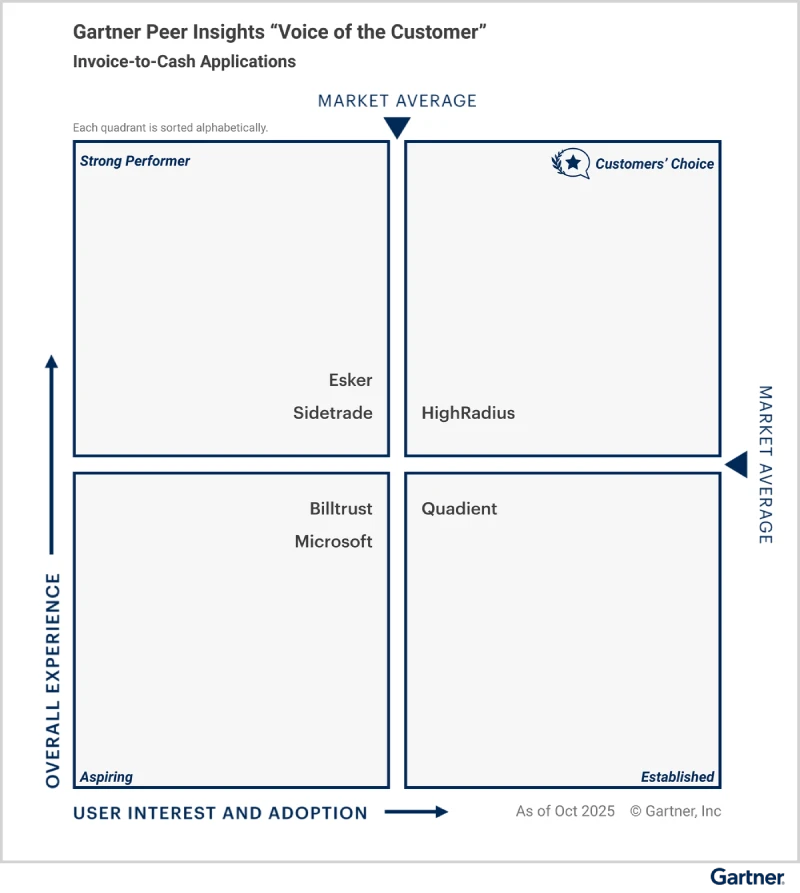
Recognized as the Only Vendor named a Customers’ Choice in the 2025 Gartner® Peer Insights™ Voice of the Customer for Invoice-to-Cash Applications
Positioned highest for delivering comprehensive automation across collections, credit, deductions, disputes, and multi-ERP integration - enabling standardized, scalable I2C transformation.
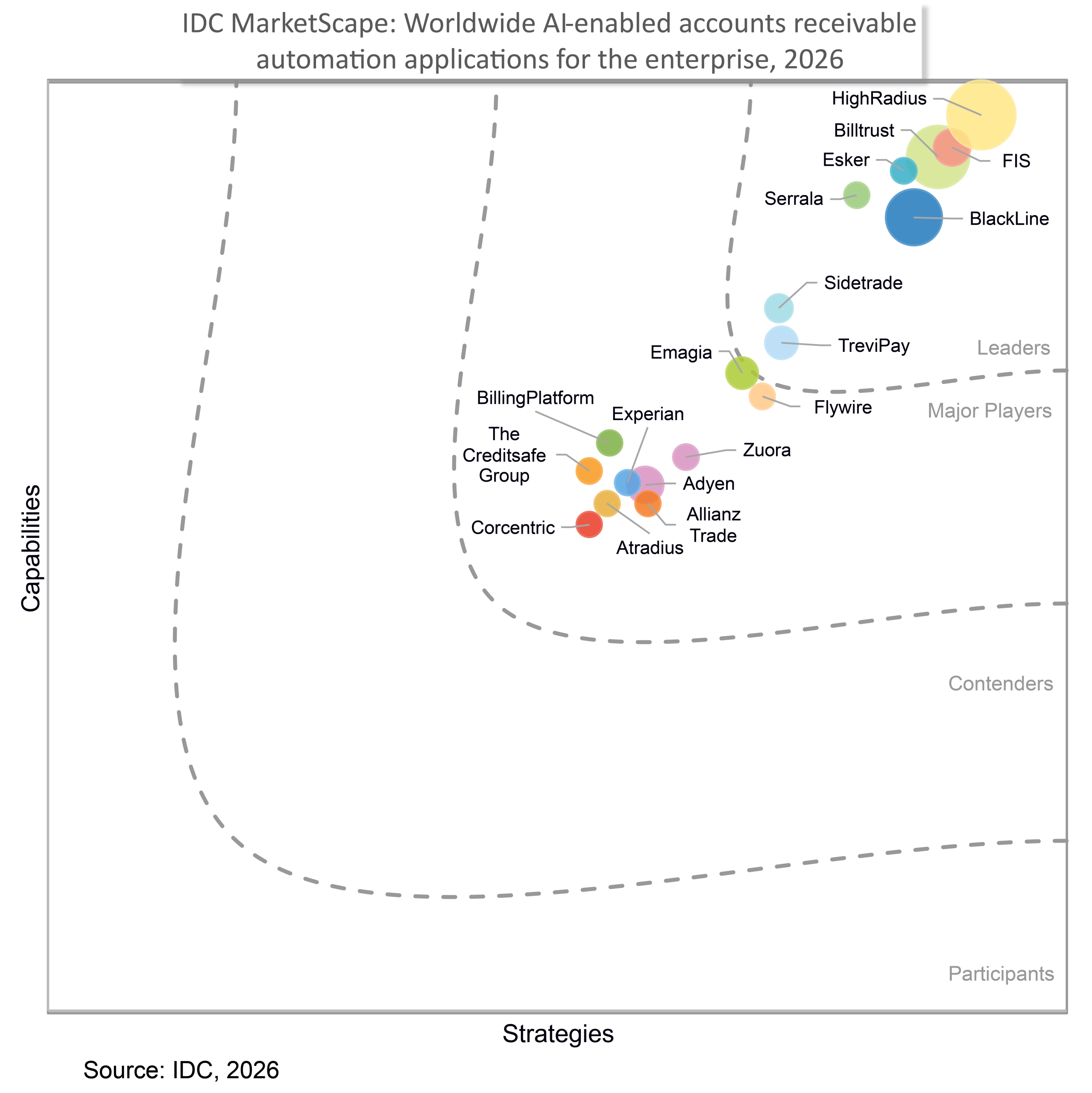
HighRadius recognized as a "Leader" in IDC Marketscape: Worldwide AI-enabled accounts receivable automation applications for the enterprise 2026 vendor assessment
Recognized as a Leader in 2026 Vendor Assessment for unifying credit, collections, cash application, deductions, e-invoicing, and payments on one AI platform to advance enterprise-wide invoice-to-cash transformation.
Forrester Recognizes HighRadius in The AR Invoice Automation Landscape Report, Q1 2023
Forrester acknowledges HighRadius’ significant contribution to the industry, particularly for large enterprises in North America and EMEA, reinforcing its position as the sole vendor that comprehensively meets the complex needs of this segment.