11 Best Financial Close Software Platforms In 2026
Last Updated: 31 July, 2026
•
Arjobi Gautam Finance Content Expert
A
Arjobi Gautam
Arjobi specializes in finance transformation, crafting content that bridges the gap between traditional financial operations and modern, technology-driven processes. With a strong focus on automation, efficiency, and strategic value creation, Arjobi brings clarity to complex transformation journeys within the B2B SaaS and FinTech landscape. Leveraging deep domain expertise, Arjobi translates evolving financial practices into actionable insights for forward-thinking finance teams. Beyond work, Arjobi has a keen interest in exploring emerging trends in digital finance and enjoys content that challenges conventional thinking. Their writing style combines analytical depth with a practical, results-oriented perspective on the future of finance.
Analyst Recognition
HighRadius Named a Challenger in 2026 Gartner® Magic Quadrant™ for Financial Close and Consolidation Solutions
Discover how HighRadius brings practical, results-driven AI to record-to-report processes with automation, anomaly detection, and continuous close capabilities.
Financial close software helps finance teams automate month-end close activities, improve financial accuracy, and gain real-time visibility across the close process.
The best financial close software depends on your organization’s ERP environment, automation goals, scalability requirements, and the complexity of your financial operations.
While some platforms specialize in close management, others offer broader capabilities across account reconciliation, financial consolidation, reporting, and Record-to-Report (R2R) automation.
When comparing financial close software, prioritize automation capabilities, AI functionality, ERP integrations, scalability, compliance, and ease of implementation over feature count alone.
HighRadius stands out for organizations seeking AI-powered financial close automation with end-to-end Record-to-Report capabilities for both mid-market and enterprise finance teams.
The global financial close software market is projected to grow from USD 928.9 million in 2026 to USD 1.24 billion by 2035, at a CAGR of 10.1%, as organizations increasingly invest in automation, AI-powered accounting workflows, and real-time financial reporting. This growth reflects the increasing demand for automation as finance teams move beyond spreadsheets, manual checklists, and disconnected workflows.
However, not every platform that calls itself "financial close software" actually closes the gap. As transaction volumes grow, ERP environments multiply, and compliance requirements tighten, many close "solutions" still leave the reconciliations, journal entries, and exception handling to the finance team. The platform simply tracks the task while the human has to do the work.
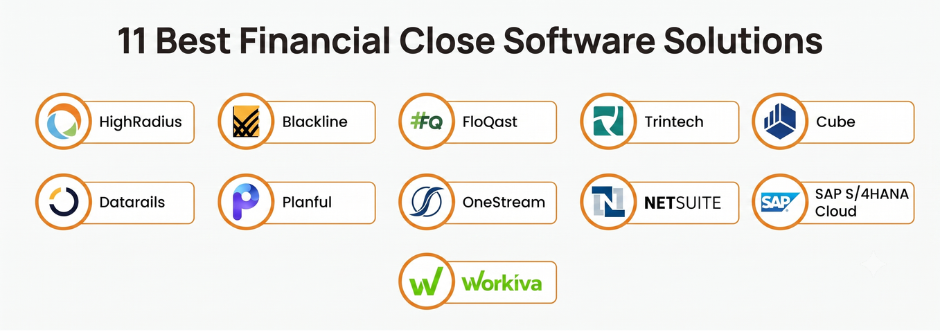
In this guide, we've compared the 11 best financial close software solutions based on their automation capabilities, AI functionality, ERP integrations, scalability, and enterprise readiness. Whether you're replacing manual close processes or evaluating a new platform, this guide will help you identify the solution that best fits your organization's needs.
Best Financial Close Tools At A Glance
Choosing the best financial close software depends on your organization's size, ERP environment, automation goals, and the complexity of your financial close process. While some solutions are purpose-built for close management, reconciliations, and accounting workflows, others extend their capabilities into broader finance transformation areas such as financial consolidation, reporting, planning, compliance, and ERP-based financial operations.
This guide is designed for Corporate Controllers, CFOs, Accounting Directors, Close Managers, and finance transformation leaders evaluating enterprise and mid-market financial close solutions. The comparison below highlights leading platforms across these categories to help finance teams identify the solution that best aligns with their business requirements.
Organizations requiring connected reporting, compliance, and audit management capabilities.
** This blog reviews 11 financial close solutions; the 1–11 sequence is for reference only and does not indicate ranking or quality.
How We Evaluated The Financial Close Software Platforms
Financial close software helps finance teams manage and automate critical accounting activities across the close cycle, including close task management, reconciliations, journal entries, approvals, reporting, and financial controls. These solutions help organizations reduce manual effort, improve accuracy, and gain greater visibility into the progress and status of their financial close process.
Organizations are increasingly investing in financial close software to overcome challenges such as:
Manual and spreadsheet-driven workflows: Finance teams often rely on disconnected spreadsheets, emails, and manual checklists to manage close activities, increasing the risk of errors and limiting visibility.
Lengthy close cycles: Complex reconciliations, journal entries, approvals, and review processes can delay month-end and quarter-end close completion.
Increasing accounting complexity: Growing transaction volumes, multiple ERP systems, global operations, and evolving compliance requirements make traditional close processes difficult to scale.
Limited visibility and control: Without centralized close management, finance leaders may lack real-time insight into task progress, bottlenecks, exceptions, and overall close performance.
Resource constraints: Accounting teams spend significant time on repetitive manual activities instead of strategic analysis and decision-making.
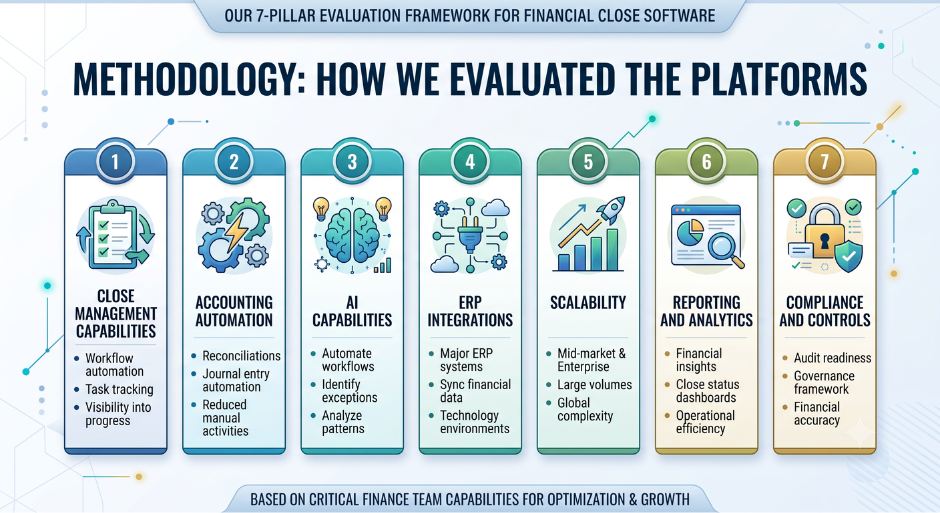
Given these common challenges, we evaluated the platforms featured in this guide based on the capabilities finance teams need to improve close efficiency, automate accounting workflows, and strengthen financial controls:
Close management capabilities: Workflow automation, task tracking, approvals, and visibility into close progress.
Accounting automation: Capabilities such as reconciliation, journal entry automation, and reducing manual accounting activities.
AI capabilities: Use of artificial intelligence to automate workflows, identify exceptions, and improve decision-making.
ERP integrations: Ability to connect with major ERP systems and existing finance technology environments.
Scalability: Suitability for mid-market and enterprise organizations with complex financial operations.
Reporting and analytics: Ability to provide insights into financial performance, close status, and operational efficiency.
Compliance and controls: Features that support audit readiness, governance, and financial accuracy.
Ebooks
Make a Confident Financial Close Software Decision
Navigate vendor selection with a practical guide covering the capabilities, integrations, and AI innovations shaping modern accounting operations.
Identify critical features for an efficient close process
Understand how AI is transforming accounting workflows
Evaluate vendors with a structured selection framework
Accounting automation software helps accounting teams speed up reconciliations, reduce errors, and gain real-time visibility into their close process. The platforms below represent a range of financial close solutions, from dedicated close automation software to broader enterprise finance platforms that include financial close capabilities. Each solution offers a different combination of automation, reconciliation, reporting, compliance, and ERP integration features, making it important to evaluate them against your organization's specific finance priorities, existing technology ecosystem, and long-term transformation goals.
1. HighRadius
HighRadius is an AI-powered financial close platform built to replace manual, batch-based close sprints with Autonomous Accounting, for both Mid Market and Enterprise organizations. It automates data extraction, reconciliations, accruals, anomaly detection, and journal postings to accelerate the close by up to 30% while ensuring 100% audit readiness.
For growing mid-market firms, HighRadius delivers out-of-the-box automation to eliminate Excel dependency and manual process risk. Autonomous Accrual and Bank-to-GL Recon Agents automate 50% of accrual entries and achieve a 96% auto-match rate for bank reconciliations, improving close productivity by 50% without adding headcount.
For global enterprises managing multi-ERP complexity, HighRadius automates intercompany AR/AP reconciliation and provides real-time visibility through a unified trial balance. It integrates seamlessly with SAP, Oracle, and NetSuite, as well as BI tools, enabling real-time data sync, direct transactional data pulls, and bi-directional posting of reconciliations and journal entries back into source systems.
Key Features:
Reduces close time by up to 30%
Automate close tasks by up to 50%
Automates 95% of journal postings and reconciliations
AI agents streamline accruals, flag anomalies, and post journals in real time
Enhances productivity and accuracy for large enterprises
Provides complete visibility into the close process
Best-in-class AI-based software to detect anomalies and suggest resolutions.
Transform Complex Financial Close into an Autonomous, AI-Powered Process
Reduce days to close by 30%, automate 50% of close tasks, and achieve 95% journal posting automation with real-time visibility across your financial close process.
BlackLine is a cloud-based financial close and automation platform that streamlines reconciliations, journal entries, and task management. With strong ERP integrations and centralized reporting, it provides real-time visibility, enhanced compliance, and improved productivity across global finance teams.
Key Features:
Automates reconciliations, close, and transaction matching
Real-time dashboards improve visibility and tracking
ERP and financial system integration
Built-in controls ensure compliance
3. FloQast
FloQast is an accounting close management software built to streamline reconciliations, checklists, and task tracking. Designed for teams that rely heavily on Excel, it integrates seamlessly with existing workbooks, enhances visibility across the close process, and strengthens collaboration and compliance.
Key Features:
Automates reconciliations and checklist tasks
Includes ready-to-use tools for checklists, reconciliations, and flux analysis.
Centralized platform with full visibility into the close status
Strong Excel integration for familiar workflows
Adds controls and sign-offs for compliance
4. Trintech
Trintech is a cloud-based financial close and reconciliation platform that automates key accounting processes, including journal entries, reconciliations, intercompany eliminations, and compliance tasks. It provides strong analytics, ERP integration, and centralized workflow management to improve efficiency, accuracy, and visibility throughout the close cycle.
Key Features:
Automates financial close and reconciliation processes, reducing manual effort
User-friendly interface and straightforward setup for faster onboarding
Streamlines reconciliation with high auto-match rates and improved control
Centralized, auditor-friendly repository simplifies compliance and audit processes
5. Cube
Cube is an FP&A platform that blends the flexibility of spreadsheets with the power of automation. Integrating directly with Excel and Google Sheets allows finance teams to keep their familiar workflows while gaining real-time data synchronization, automated reporting, and collaborative planning features. Cube is especially useful for businesses looking to accelerate budgeting, forecasting, and scenario analysis without heavy IT dependency.
Key Features:
Seamless Excel and Google Sheets integration
Automates data consolidation and reporting tasks
Real-time data sync ensures accuracy and consistency
Supports collaborative financial planning and forecasting
Customizable templates for scenario analysis
6. Datarails
Datarails is a financial planning and analysis platform built for SMEs. It offers powerful Excel integration, letting finance teams continue working in a familiar environment while adding automation, data visualization, and consolidation capabilities. It simplifies reporting and enhances financial analysis with interactive dashboards and strong customer support.
Key Features:
Seamless Excel integration for easy adoption
Advanced reporting and data visualization tools
Excellent customer support and onboarding experience
Efficient data consolidation from multiple sources
7. Planful
Planful is a financial planning and analysis (FP&A) platform that automates budgeting, forecasting, and reporting for finance teams. With a familiar Excel-like interface, real-time ERP integrations, and powerful multi-dimensional reporting, it helps finance teams speed up close cycles, improve accuracy, and scale operations as businesses grow.
Key Features:
Familiar Excel-style interface for easier adoption
Automates reporting, budgeting, and forecasting
Real-time ERP integration for accurate data
Multi-dimensional analysis for deeper insights
Workforce planning modules for headcount management
Scalable solution tailored
8. OneStream
OneStream is a unified corporate performance management (CPM) platform that combines financial consolidation, planning, reporting, and reconciliation into a single solution. It offers high customization and scalability to handle complex financial processes, though it requires significant time, cost, and training to implement effectively.
Key Features:
Unified platform for consolidation, planning, reporting, and reconciliation
Highly customizable through the OneStream MarketPlace
Scalable for bigger firms with complex structures
Ensures accuracy with a single source of financial data
Strong analytics and reporting tools enhance decision-making
9. NetSuite
NetSuite is a cloud-based ERP and financial management solution that provides end-to-end functionality for accounting, supply chain, CRM, and e-commerce. Known for its scalability and real-time visibility, it is well-suited for growing businesses but comes with a higher cost and steep learning curve.
Key Features:
Comprehensive ERP functionality, including accounting, CRM, and e-commerce
Real-time financial and operational visibility with robust reporting
Scalable and flexible to support growth across industries
Automates workflows like revenue recognition and order management
Cloud-based accessibility for remote teams with enhanced security
10. SAP S/4HANA Cloud
SAP S/4HANA Cloud is a next-generation ERP and accounting solution designed to unify financial operations on a single, intelligent platform. It provides real-time insights, automation, and streamlined processes that help finance teams operate faster and more accurately. Its scalability and modern interface make it well-suited for large firms and growing organizations, though implementation and integration can be complex.
Key Features:
Simplifies financial processes with integrated modules (GL, AP, AR)
Automates repetitive tasks with workflows and RPA
Cloud deployment reduces hardware and IT costs
Scalable and agile to support business growth
Regular updates with access to AI and predictive analytics
11. Workiva
Workiva is a cloud-based platform designed for financial reporting and compliance. Its features include real-time data linking, integrated audit trails, version control, and collaboration tools for streamlined financial workflows.
Key Features:
Real-time, cloud-based collaboration with live updates
Centralized hub for financial reporting and compliance documents
User-friendly interface for most users
Strong data integrity with audit trails and consistency checks
Integrates with ERP and accounting systems for efficient data handling
How to Choose the Best Financial Close Software
Selecting the best financial close software goes beyond comparing features or pricing. The right solution should address your organization's current close challenges while supporting long-term finance transformation goals. As you evaluate different platforms, consider the following factors:
Evaluation Criteria
Identify Your Financial Close Challenges
Pain Point: If your close process is delayed by manual reconciliations, spreadsheet dependency, or journal entry bottlenecks, start by identifying which activities consume the most time.
Look For: A solution that directly addresses those bottlenecks through automation and standardized workflows.
Evaluate the Level of Automation
Pain Point: Many platforms automate close task tracking but still rely on accountants to perform reconciliations, journal entries, and exception handling manually.
Look For: Software that automates repetitive accounting activities in addition to orchestrating the close process.
Assess ERP and System Integrations
Pain Point: Disconnected ERP systems and manual data transfers increase the risk of errors and slow down the close process.
Look For: Native integrations with your ERP, accounting applications, and financial data sources to ensure seamless data flow.
Look for AI-Powered Capabilities
Pain Point: Reviewing large transaction volumes and identifying exceptions manually is time-consuming and prone to oversight.
Look For: AI capabilities such as anomaly detection, intelligent transaction matching, workflow recommendations, and predictive insights that improve efficiency and accuracy.
Consider Scalability and Compliance
Pain Point: As organizations expand, close processes become more complex due to multiple entities, higher transaction volumes, and increasing compliance requirements.
Look For: A platform that supports enterprise scalability with audit trails, approval workflows, role-based access controls, and compliance features.
Evaluate Implementation and User Adoption
Pain Point: Lengthy implementations and poor user adoption delay time-to-value and reduce the impact of new software.
Look For: An intuitive solution with a straightforward implementation process, comprehensive training, and responsive vendor support.
The best financial close software is the one that aligns with your organization's finance processes, technology ecosystem, automation objectives, and future growth plans. By evaluating solutions against these criteria, finance leaders can confidently select a platform that accelerates the financial close, improves accuracy, strengthens financial controls, and supports long-term operational excellence.
Choose the Right Financial Close Software with Confidence
Use a structured evaluation framework to compare vendors, assess critical capabilities, and identify the right platform to transform your close process.
Financial close software helps finance teams streamline the entire close process, improve financial accuracy, and scale operations as business complexity grows. By automating repetitive accounting activities and providing real-time visibility into close progress, organizations can achieve measurable operational and business improvements.
Accelerate Financial Close Cycles - Reducing manual reconciliations, journal processing, and approval delays helps finance teams complete month-end and year-end close faster while meeting reporting deadlines with greater consistency.
Improve Financial Accuracy - Standardized workflows and automated validation reduce the risk of manual errors, improving confidence in financial reporting and helping ensure more reliable financial statements.
Strengthen Audit Readiness - Centralized documentation, approval histories, and complete audit trails simplify compliance activities, making it easier to prepare for internal and external audits.
Increase Visibility Across the Close Process - A centralized view of close activities enables finance leaders to monitor progress, identify bottlenecks early, and make informed decisions before delays impact reporting timelines.
Improve Finance Team Productivity - Reducing time spent on repetitive accounting activities allows finance professionals to focus on financial analysis, exception resolution, business partnering, and other higher-value initiatives.
Scale Financial Operations Efficiently - As organizations expand into new entities, business units, or geographies, financial close software helps finance teams manage increasing operational complexity without proportionally increasing manual effort.
Standardize Financial Close Processes - Consistent workflows, approvals, and accounting controls help ensure every entity follows the same close process, improving governance, reducing variability, and creating a more predictable financial close across the organization.
Ebooks
See How Leading Finance Teams Apply AI Across the Financial Close
Discover how AI helps finance teams eliminate repetitive accounting tasks, reduce close bottlenecks, and deliver faster, more accurate financial reporting.
AI use cases transforming financial close and reconciliation
Real examples of how AI reduces manual effort and improve close efficiency
Best practices for building a faster, more accurate, and audit-ready close process
Selecting the best financial close software starts with understanding your organization's close process, automation priorities, and long-term finance objectives. While every platform offers a different combination of capabilities, the right solution should address today's operational challenges while providing the scalability, visibility, and automation needed to support future growth.
Whether your goal is to shorten close cycles, improve financial accuracy, strengthen governance, or modernize accounting operations, choosing a platform that aligns with your business requirements will help finance teams operate more efficiently and deliver greater strategic value to the organization.
Why Choose HighRadius Financial Close Software?
For organizations looking to automate more than just close task management and have a need for a solution that automates repetitive accounting activities, improves financial accuracy, scales with business growth, and provides real-time visibility across the close process, HighRadius' Financial Close Software combines AI-powered accounting automation with enterprise-grade financial close capabilities to help finance teams accelerate close cycles, improve accuracy, and strengthen financial controls. HighRadius is designed to help mid-market and enterprise organizations achieve these outcomes through AI-powered financial close automation.
End-to-End Financial Close Automation
Unlike traditional financial close platforms that primarily orchestrate close tasks, HighRadius automates the accounting work behind the close. From close task management and account reconciliations to journal entries, variance analysis, approvals, and exception management, HighRadius helps finance teams automate the entire financial close process from a single platform.
As accounting teams take on more entities, higher transaction volumes, and more complex reporting requirements, manual processes and rigid point solutions quickly become a bottleneck. HighRadius is built to scale with that growth, supporting multi-entity, multi-currency, and multi-ledger operations without a corresponding increase in manual effort or headcount. Whether a mid-market company is expanding into new markets or a global enterprise is consolidating across dozens of business units, the platform adapts to increasing complexity while keeping the close process consistent and controlled.
Seamless ERP Connectivity
HighRadius integrates directly with major ERP systems (over 50+ ERPs), including SAP, Microsoft Dynamics 365, Oracle, NetSuite, Sage Intacct, and Workday, so finance teams don't have to rework their existing tech stack to adopt automation. This connectivity allows GL and sub-ledger data to be pulled in automatically for reconciliation and reporting, and lets approved journal entries be posted straight back to the ERP in the correct format, closing the loop between analysis and action without manual re-entry or data exports.
Proven Business Outcomes
Up to 95% reconciliation automation
Up to 95% automated journal posting
Up to 30% reduction in days to close
Improved finance team productivity
Greater visibility across the close process
HighRadius is recognized as a 2X Gartner® Magic Quadrant™ Challenger for Financial Close and Consolidation Solutions and combines AI-powered automation with enterprise-grade financial controls to help finance teams modernize the financial close process. Whether your priority is accelerating month-end close, improving financial accuracy, or building a more autonomous finance function, HighRadius provides the capabilities to support both today's accounting needs and tomorrow's growth.
Take a deep dive into HighRadius’ R2R solutions
Getting granular visibility and control into your accounting process is just a click away.
Achieve up to 90% transaction auto-match with out-of-the-box matching rules
Financial Close Management
Reduce days to close by 30% with a detailed checklist for month-end close
Anomaly Management
Resolve 80% of anomalies with auto-suggested actions.
Frequently Asked Questions (FAQs)
1. What is financial close automation software?
Financial close automation software is a platform that automates reconciliations, journal entries, task workflows, approvals, and close reporting to help accounting teams complete month-end faster, with fewer errors. Tools like HighRadius deliver visibility and control across every stage of the close.
Financial close automation software is a platform that automates reconciliations, journal entries, task workflows, approvals, and close reporting to help accounting teams complete month-end faster, with fewer errors. Tools like HighRadius deliver visibility and control across every stage of the close.
2. How do I choose the best financial close software?
Choose financial close software based on your organization’s automation needs, ERP environment, scalability, AI capabilities, compliance requirements, and ease of implementation. The best solution should align with your finance team’s current challenges and long-term growth objectives.
Choose financial close software based on your organization’s automation needs, ERP environment, scalability, AI capabilities, compliance requirements, and ease of implementation. The best solution should align with your finance team’s current challenges and long-term growth objectives.
3. What features should I look for in financial close software?
Look for automated reconciliations, journal entry automation, close task management, AI-powered anomaly detection, ERP integrations, financial reporting, audit trails, approval workflows, and real-time dashboards. These features help improve efficiency, accuracy, and financial control.
Look for automated reconciliations, journal entry automation, close task management, AI-powered anomaly detection, ERP integrations, financial reporting, audit trails, approval workflows, and real-time dashboards. These features help improve efficiency, accuracy, and financial control.
4. What are the benefits of financial close software?
Financial close software helps organizations shorten close cycles, improve financial accuracy, increase finance team productivity, strengthen audit readiness, enhance visibility into the close process, and scale financial operations with less manual effort.
Financial close software helps organizations shorten close cycles, improve financial accuracy, increase finance team productivity, strengthen audit readiness, enhance visibility into the close process, and scale financial operations with less manual effort.
5. What is the difference between financial close software and financial close management software?
Financial close management software primarily helps teams plan, track, and coordinate close activities. Financial close software often goes further by automating reconciliations, journal entries, approvals, reporting, and other accounting processes across the financial close.
Financial close management software primarily helps teams plan, track, and coordinate close activities. Financial close software often goes further by automating reconciliations, journal entries, approvals, reporting, and other accounting processes across the financial close.
6. Can financial close software integrate with ERP systems?
Yes. Most financial close software integrates with leading ERP systems such as SAP, Oracle, NetSuite, and Microsoft Dynamics. These integrations automate data synchronization, reduce manual data entry, and improve the accuracy of financial reporting.
Yes. Most financial close software integrates with leading ERP systems such as SAP, Oracle, NetSuite, and Microsoft Dynamics. These integrations automate data synchronization, reduce manual data entry, and improve the accuracy of financial reporting.
7. Is financial close software suitable for mid-market businesses?
Yes. Modern financial close software helps both mid-market and enterprise organizations automate accounting processes, improve financial visibility, and scale operations. Many platforms offer capabilities that support growing businesses as financial complexity increases.
Yes. Modern financial close software helps both mid-market and enterprise organizations automate accounting processes, improve financial visibility, and scale operations. Many platforms offer capabilities that support growing businesses as financial complexity increases.
8. What is the difference between financial close software and financial consolidation software?
Financial close software focuses on managing and automating the close process, while financial consolidation software combines financial data from multiple entities to produce consolidated financial statements. Many modern platforms support both capabilities within a unified Record-to-Report process.
Financial close software focuses on managing and automating the close process, while financial consolidation software combines financial data from multiple entities to produce consolidated financial statements. Many modern platforms support both capabilities within a unified Record-to-Report process.
9. What is the best financial close software?
The best financial close software depends on your organization’s size, ERP landscape, automation goals, and finance complexity. HighRadius, BlackLine, FloQast, Trintech, and OneStream are among the leading solutions, each offering different strengths across financial close automation, reconciliations, reporting, consolidation, and compliance.
The best financial close software depends on your organization’s size, ERP landscape, automation goals, and finance complexity. HighRadius, BlackLine, FloQast, Trintech, and OneStream are among the leading solutions, each offering different strengths across financial close automation, reconciliations, reporting, consolidation, and compliance.
Resource Library
Resource Hub
ASSETS
Cash Flow Calculator (FREE)
Track operating and net cash flow while forecasting balances to maintain liquidity and financial control.
HighRadius Named an IDC MarketScape Leader for the Second Time in a Row For AR Automation Software for Large and Midsized Businesses
HighRadius stands out as an IDC MarketScape Leader for AR Automation Software, serving both large and midsized businesses. The IDC report highlights HighRadius’ integration of machine learning across its AR products, enhancing payment matching, credit management, and cash forecasting capabilities.
Forrester Recognizes HighRadius in The AR Invoice Automation Landscape Report, Q1 2023
Forrester acknowledges HighRadius’ significant contribution to the industry, particularly for large enterprises in North America and EMEA, reinforcing its position as the sole vendor that comprehensively meets the complex needs of this segment.