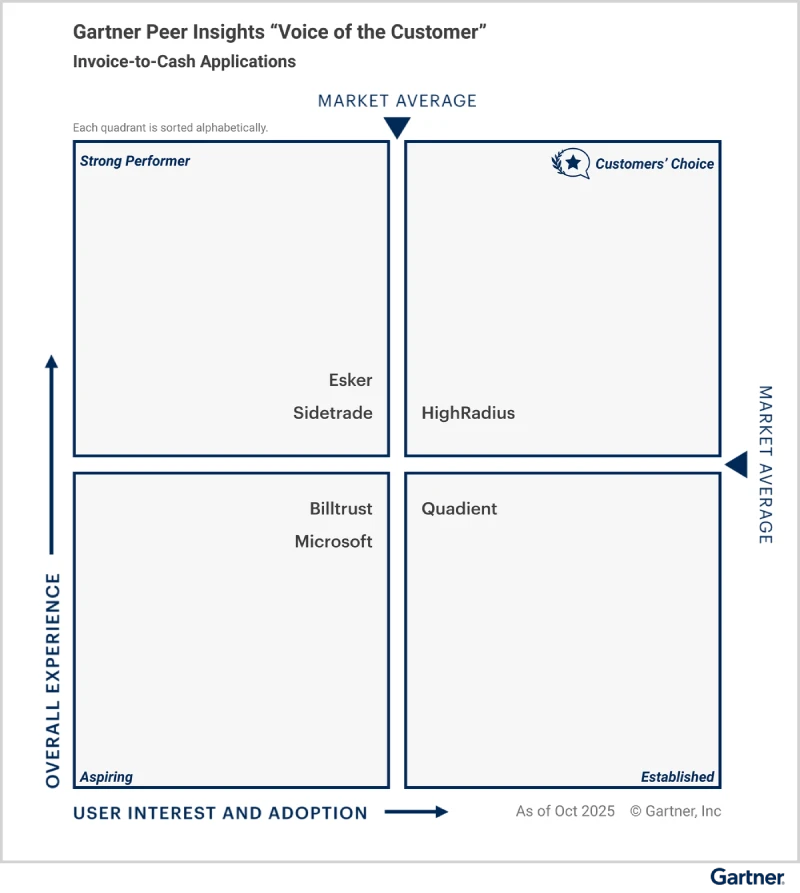
HighRadius Named a Challenger in Gartner® Magic Quadrant™ for Financial Close and Consolidation Solutions
Get the Report- This guide evaluates the top 10 financial reporting platforms based on their ability to support real-time ERP-to-report data syncing, eliminate manual errors, generate audit-ready narratives and automate the full reporting lifecycle.
- HighRadius Agentic AI Reporting software supports all growth stages. Mid-market teams eliminate manual data aggregation for real-time dashboards and 70% Accelerated Decision Making. Global enterprises with complex multi-entity reporting eliminate maximum errors, shifting to a continuous, audit-ready process.
- Financial reporting is shifting from a backward-looking, manual and month-end exercise to autonomous reporting layers. Organizations are replacing static spreadsheets with systems that provide self-service access to live financial data without increasing headcount or setup costs.
Today's finance tools are built for the people who produce reports, not for the people who need to act on them. When a business unit head wants to query their numbers mid-quarter, they can't. They go back to finance, who pulls the data, runs the report, exports it and emails a static file. By the time it arrives, the numbers have moved. Self-service reporting promised to fix this loop. In practice, it handed non-finance stakeholders a dashboard they couldn't interpret. According to a Gartner survey, finance teams spend most of their time on data gathering and report production, leaving less time for the actual analysis that drives decisions.
The result? Finance function Stuck in reactive report production delivering outdated information, causing leaders to make delayed strategic decisions. Un-automated organizations are 2x more likely to face material reporting delays. The Best Financial Reporting Platforms break this by empowering finance as proactive strategic partners and giving business stakeholders direct, intuitive data access without involving finance.
This guide evaluates the top Financial Reporting Tools in 2026 based on automation depth, ERP integration and scalability for finance teams, CFOs, and business leaders who need faster, more reliable reporting.
Table of Contents
- Best Financial Reporting Tools at Glance
- What is Financial Reporting Software?
- Top 10 Financial Reporting Tools
- How We Evaluated Best Financial Reporting Tools: Our Selection Framework
- Key Features to Look For in a Financial Reporting Tool
- How to Choose the Best Financial Reporting Tools for Your Business
- Benefits of Financial Reporting Tools
- How Modern Financial Reporting Tools Enhance Accuracy and Insights in 2026
- How Can HighRadius Help in Accelerating Reporting Timelines?
- FAQs
Best Financial Reporting Tools at Glance
Selecting the Best Financial Reporting Platform is crucial for streamlining reporting processes, improving accuracy, and supporting compliance. Below is a curated financial reporting tools list of 10 leading platforms, along with their best-fit use cases.
Best Financial Reporting Tools
| Platform | Best For |
| HighRadius | Financial reporting for mid-market and enterprise using Agentic AI. HighRadius was recognised as a Challenger in the 2026 Gartner® Magic Quadrant™ for accelerating decision-making by 70% and eliminating 100% of reporting errors. |
| Anaplan | Organisations that need connected planning and scenario modeling. |
| Datarails | Finance teams using Excel-based workflows who want automated consolidation and reporting |
| NetSuite | Multi-entity organisations requiring a unified ERP and financial reporting platform |
| Planful | Organisations seeking streamlined FP&A, automated close, rolling forecasts, and scenario analysis. |
| Prophix | Mid-sized to large finance teams looking for automated consolidation and reporting. |
| Sage | Businesses seeking multi-dimensional reporting and audit-ready workflows. |
| SAP (BPC / Analytics Cloud) | Companies that require consolidation and multi-entity, multi-standard financial reporting. |
| Vena | Mid-sized, Excel-centric teams looking for workflow automation and template-based reporting |
| Workday | Businesses needing unified FP&A and multi-entity reporting with real-time insights |
*List of leading financial reporting tool, arranged in no particular order
What is Financial Reporting Software?
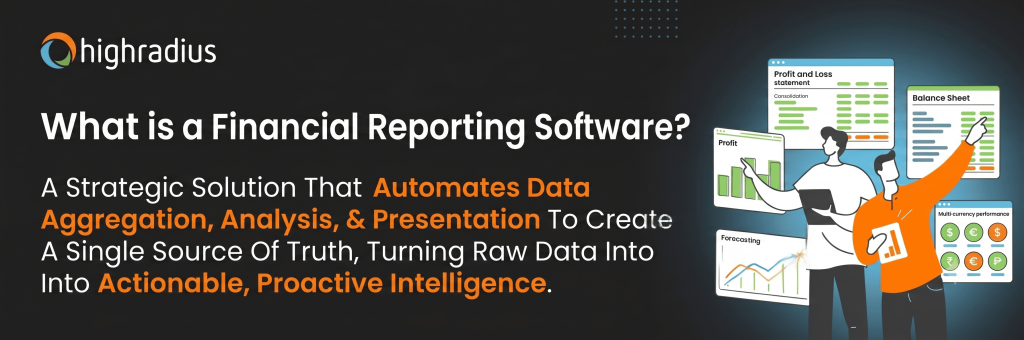
A Financial Reporting tool is a strategic platform designed to automate the aggregation, analysis, and presentation of financial data. For the modern Office of the CFO, Financial Reporting Software acts as a single source of truth, reducing manual silos and turning raw data into actionable intelligence.
Beyond basic automation, next generation reporting solutions provide:
- Real Time Visibility: Instant access to financial performance metrics through customizable, executive grade dashboards.
- Scalable Data Processing: The ability to clean, transform, and summarize massive datasets without the risk of manual error.
- Secure Cloud Architecture: Ensuring global, remote access to financial insights while maintaining rigorous data governance and compliance standards.
Ultimately, these Financial Reporting Tools empower finance leaders to pivot from reactive data gathering to proactive, data driven storytelling that aligns with long-term strategic business goals.
Top 10 Financial Reporting Tools
1. HighRadius
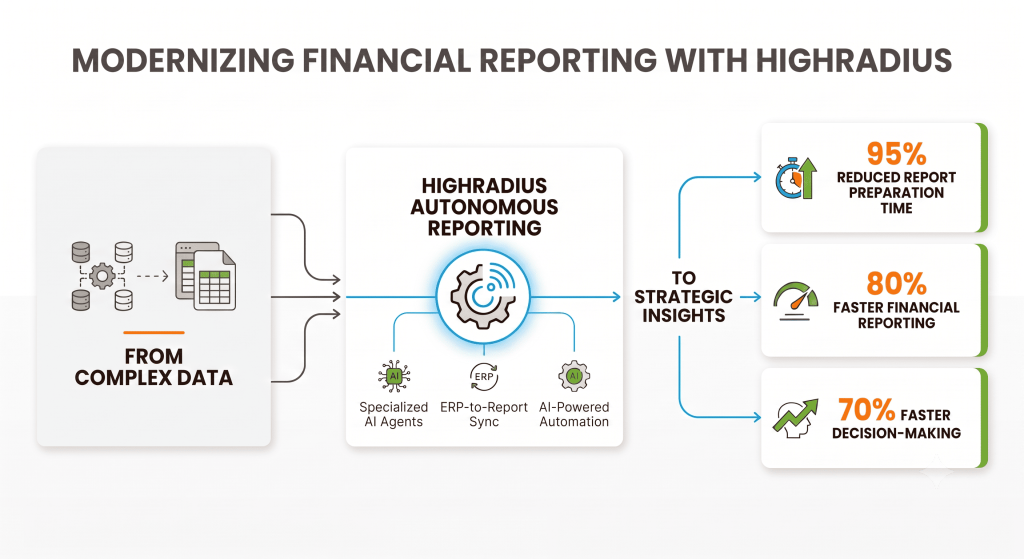
HighRadius automates the entire Financial Reporting lifecycle from ERP data syncing to reports and board-ready dashboards for both growing mid-market teams and global enterprises. Recognized as a Challenger in the 2026 Gartner® Magic Quadrant™ for Financial Close and Consolidation, HighRadius deploys specialized AI agents that reduce report preparation time by 95% and enable finance teams to shift bandwidth from report production to strategic decision-making. .
For growing Mid-Market organizations seeking Financial Reporting Platform, HighRadius replaces static Excel workbooks with real-time, drill-down dashboards eliminating the manual data aggregation that consumes the majority of reporting bandwidth. Teams can now customize reports faster without creating a bottleneck for the finance team. With 80% faster financial reporting, finance functions can deliver high-impact insights to leadership without increasing headcount.
For Organizations looking for Enterprise grade Financial Reporting Platform, HighRadius deploys an autonomous reporting layer that automates across complex multi-ERP environments replacing the fragmented processes that introduce inconsistencies across consolidated reports. With faster report customization, enterprise finance teams can respond to stakeholder requests in real time rather than working through weeks-long reporting cycles.
Key Features:
- Reduces report preparation time by 95% through automated data aggregation and direct ERP-to-report syncing, enabling 80% faster financial reporting, 90% faster variance analysis and 70% faster decision-making
- Provides real-time drill-down dashboards that give department heads self-service access to live financial data removing the reporting bottleneck from finance teams
- Integrates seamlessly with SAP, Oracle, Microsoft Dynamics, NetSuite, and 50+ ERP systems with no upfront setup fees
HighRadius' clients have claimed to achieve the following value from the software
Carestream Health: Achieved 98% faster report consolidation by replacing manual data aggregation with HighRadius' Agentic AI-powered Financial Reporting platform, enabling the global medical imaging company to deliver real-time, board-ready financial reports without increasing headcount.
- 98% Faster Report Consolidation: Dramatically reduced the time spent on manual report generation and cross-entity data compilation.
- 100% GAAP Compliance Achieved: Intelligent onboarding and configuration agent enforces standardized accounting policies from day one, eliminating compliance gaps across all entities.
- 98% Reduction In Consolidation Runtime: AI data ingestion agent automates aggregation at scale, compressing end-to-end consolidation from 2.5 hours to under 2 minutes.
- 50% Faster Consolidation & Month-End Close: Accelerated the close cycle, enabling the finance team to prioritize strategic analysis over manual consolidation.
HighRadius Named a Challenger In 2025 Gartner® Magic Quadrant™ for Financial Close and Consolidation Solutions
A 3X Leader in Gartner® Magic QuadrantTM Invoice-To-Cash Expands into FCCS
Get The Report2. Anaplan
Anaplan is a cloud-based financial reporting and analysis software platform designed for connected planning across finance, sales, supply chain, and HR. It enables scenario modeling and real-time collaboration across departments.
Key features:
- Real-time planning and scenario modeling
- Centralized data hub for multiple business units
- Dynamic dashboards and reporting with drill-down capabilities
- Integration with ERP, CRM, and other financial systems
3. Planful
Planful (formerly Host Analytics) offers cloud-based financial planning, analysis, and corporate reporting solution. It focuses on accelerating close cycles and improving forecasting accuracy.
Key features:
- Streamlined financial consolidation and close
- Rolling forecasts and scenario planning
- Real-time dashboards and executive reporting
- Integrates with ERP and HR systems for a unified view
4. Prophix
Prophix delivers corporate performance management solutions, including budgeting, planning, and reporting. It emphasizes automation and workflow-driven processes for finance teams.
Key features:
- Automated financial consolidation and reporting
- Budgeting, forecasting, and scenario analysis
- Workflow automation for approvals and processes
- Integration with major ERPs and Excel
5. SAP (SAP Analytics Cloud / SAP BPC)
SAP offers One of the leading Financial Reporting Systems, including SAP Analytics Cloud for planning and SAP BPC for consolidation. Ideal for large enterprises with complex structures.
Key features:
- Unified planning, analysis, and reporting
- Real-time data connectivity with SAP and non-SAP systems
- Advanced scenario modeling and predictive analytics
- Multi-currency, multi-entity, and multi-standard support
6. NetSuite
NetSuite offers integrated financial reporting system within its cloud ERP suite, providing organizations with a centralized view of financial data across all entities. Its customizable dashboards and real-time reporting features help finance teams monitor performance efficiently.
Key features
- Live financial reporting with instant generation and customizable dashboards
- Hundreds of prebuilt standard reports with country-specific formats
- Multi-book feature that supports multiple sets of books for different accounting standards
- Automated compliance with global standards like GAAP and IFRS
7. Sage
Sage combines accounting functionality with financial reporting suited for mid-sized businesses. It allows users to generate compliance-ready reports and manage multi-currency transactions efficiently.
Key features
- Built-in financial reports let users drill down to source transactions
- Customizable dashboards show performance metrics through interactive charts and graphs in real time
- Supports variance analysis and month-end close procedures
- Intelligent GL outlier detection spots unusual transactions to prevent errors and fraud
8. Datarails
Datarails enhances financial reporting for Excel users by automating data collection, consolidation, and version control. It’s a strong choice for FP&A teams seeking better visibility without leaving their spreadsheet environment.
Key features
- Smooth integration with any ERP, CRM, and HRIS system
- Automated data consolidation from disparate sources into a centralized database
- Version control tracks every cell change with a complete history
- Live reporting with drill-down capabilities
9. Workday
Workday provides advanced financial and operational reporting within its broader enterprise management suite. Its strength lies in data unification and real-time insights for large global organizations.
Key features
- Immediate reporting for any business dimension
- A single system that unifies financial, worker, operational, and sales information
- Simple drag-and-drop analysis with complete drill-down options
- Reports written in business language instead of traditional accounting strings
10. Vena
Vena integrates financial reporting and planning with Excel, enabling teams to automate workflows while maintaining the familiar usability of spreadsheets. It supports budgeting, forecasting, and performance tracking with centralized data controls.
Key features
- Excel serves as the primary interface through native Microsoft 365 integration
- Ready-to-use templates support executive, month-end, and board reporting
- A central database removes the need for manual data consolidation
- Direct connections to ERPs like NetSuite, Microsoft Dynamics, Sage Intacct
How We Evaluated Best Financial Reporting Tools: Our Selection Framework
Choosing the right Best Financial Reporting Tools for your business is a high-stakes decision. We didn't just look at feature lists; we looked for tools that actually make a Monday morning feel manageable. To narrow down the 10 best, we measured every platform against four critical pillars that define modern financial excellence.
- Scalability: In 2026, scalability isn't just about 'handling more data', it’s about handling complexity. We looked for tools that don't flinch when you add a new international subsidiary or pivot to a recurring revenue model. A truly scalable tool supports multi-entity consolidation and multi-currency reporting without requiring a complete system overhaul. We prioritized platforms that grow with your ambition, ensuring that the tool you use today won't become a bottleneck when you’re twice the size tomorrow.
- ERP Integration Your financial reporting is only as good as the data feeding it. We evaluated tools based on their 'ecosystem empathy', how well they play with others. The Best Financial Reporting Platforms offer certified, bi-directional connectors to major ERPs like SAP S/4HANA, Oracle NetSuite, and Microsoft Dynamics 365. We looked for 'frictionless' sync capabilities where data flows in real-time, eliminating the dreaded data silos and ensuring your reports reflect the ground truth of the business at any given second.
- Automation Depth: We’ve moved past simple rule-based automation. For our 2026 list, we assessed the cognitive depth of each tool. Can it detect a reconciliation anomaly before you even open the dashboard? Does it use Agentic AI to draft the initial narrative for your board slides? We favored tools that automate the 'grunt work' of data entry and validation, freeing your team to focus on high-value storytelling and strategic forecasting. The Best Financial Reporting Automation Tools automate repetitive reporting activities while enabling finance professionals to focus on strategic analysis.
- Enterprise Readiness: When you’re operating at an enterprise level, 'good enough' isn't an option for security. Our selected tools meet the gold standard of 2026 readiness, including SOC 2 Type II compliance, advanced PII redaction, and granular audit trails. We looked for features that satisfy both the CFO and the CISO: version control that tracks every single cell change and 'read-only' transparency for auditors, ensuring your most sensitive financial data stays exactly where it belongs.
Key Features to Look For in a Financial Reporting Tool
The selection of a financial reporting tool begins with identifying a platform that provides resilient reporting capabilities and turns raw data into actionable information. The Best Financial Statement Reporting platform should allow users to drill down through data from performance metrics to the journal level.
Financial reporting tools should provide users with the capability to process data in real-time, enabling quick decisions and offering customization options that align with business requirements. It should automate repetitive tasks, reducing errors, allowing teams to focus on strategic activities.
Here are the must-have capabilities every financial reporting solution should provide:
- Multi-entity support with intercompany elimination features
- Currency translation and multi-currency support
- Workflow management with status monitoring
- Predefined data integration with source systems
- Compliance with financial reporting standards (GAAP, IFRS)
- Immediate dashboards and reporting tools
The right financial reporting automation tools should centralize and make financial information easily accessible. It should automatically collect data from various sources and include customizable dashboards that enable immediate monitoring of key metrics. Furthermore, strong vendor support and detailed training resources are essential for a successful implementation.
How to Choose the Best Financial Reporting Tools for Your Business
Choosing the right financial reporting tool is a pivot point for the Office of the CFO. It is the difference between simply managing data and driving strategic enterprise value. When evaluating platforms, prioritize these five pillars of Autonomous Finance:
- Seamless ERP Integration & Time to Value: Ensure the software provides out of the box connectivity with your existing ERP (SAP, Oracle, NetSuite). A tool is only as good as its ability to ingest clean data without manual middleware.
- Enterprise Grade Scalability: The platform must handle increasing data complexity and volume as your organization expands into new markets or acquisitions.
- Cloud Native Agility: Prioritize cloud based solutions to ensure secure, real-time visibility across global teams, enabling a continuous close regardless of geography.
- Autonomous AI & Predictive Insights: Look beyond standard automation. The best tools leverage Agentic AI to not just report the past, but to proactively detect anomalies and generate forward looking narratives.
- Rigorous Data Governance & Security: In an evolving regulatory landscape, enterprise level encryption, SOC compliance, and multi factor authentication are non-negotiable to maintain data integrity.
Benefits of Financial Reporting Tools
Modern Financial Reporting Tools deliver far more than organized data; they transform how finance teams operate. Companies that optimize their reporting processes can shorten their financial close cycle by up to 40%, enabling faster, data-driven decisions.
Its impact on accuracy is equally significant. Organizations using Automated Financial Reporting Solution experience up to 90% fewer errors than those relying on manual processes. This higher precision enables finance teams to make more informed strategic decisions and maintain compliance with confidence.
Automation also redefines how time is spent. Traditionally, finance professionals dedicate about 75% of their efforts to data collection and only 25% to analysis. With streamlined reporting, this ratio flip allows teams to spend up to 60% more time on strategic insights and business growth.
Additional benefits include:
- Enhanced stakeholder trust - Companies with strong financial reporting receive higher valuations and better financing terms
- Reduced compliance burden - Businesses using advanced reporting spend 45% less time on compliance tasks
- Improved audit readiness - Automated systems create clear audit trails that keep businesses prepared for examinations
Financial reporting automation tools ultimately gave companies a competitive edge in volatile markets. This enables organizations to respond quickly to opportunities while meeting regulatory requirements.
How Modern Financial Reporting Tools Enhance Accuracy and Insights in 2026
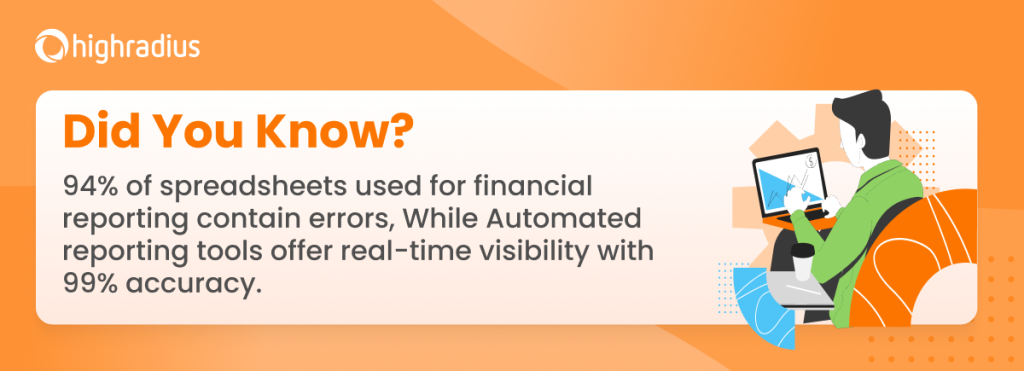
In 2026, Financial Reporting and Consolidation tools must deliver more than accurate numbers. It must turn data into insight. Leading platforms now embed real-time reporting engines that integrate live data feeds, automate report cycles, and deliver dynamic dashboards. For CFOs and controllers, this means faster insight into performance, tighter compliance, and a consistent source of truth across entities without spreadsheet inefficiency.
Advanced Reporting Engines That Turn Raw Financials into Real-Time, Actionable Intelligence
Modern Financial Consolidation and Reporting platform goes beyond static statements by connecting live data sources, automating reporting schedules, and enabling drill-downs across entities, accounts and periods. With built-in analytics, configurable dashboards, and narrative reporting modules, these tools help CFOs uncover trends faster, simplify compliance, and standardize disclosures across the organization without manual spreadsheet manipulation.
How Can HighRadius Help in Accelerating Reporting Timelines?
1. Accelerated reporting cycles: Reduces report preparation time by up to 95%, enabling 80% faster financial reporting and driving 70% faster decision-making across the organization.
2. Real-time financial visibility: Offers live dashboards and interactive reports, allowing stakeholders to access up-to-date financial data instantly.
3. AI-powered accuracy: Utilizes AI to automate reconciliations and variance analysis, cutting time-to-variance analysis by 90% while minimizing manual errors and ensuring compliance with standards like GAAP and IFRS.
4. Seamless ERP integration: Integrates with existing ERP systems to consolidate data across multiple entities, currencies, and jurisdictions, facilitating comprehensive and compliant reporting.
HighRadius’s Financial Close and Account Reconciliation Software further enhances reporting accuracy by automating close tasks, standardizing reconciliations, and providing a real-time audit trail, ensuring that financial reports are always complete, timely, and trustworthy.
FAQs
Q1. What are the key benefits of using financial reporting tools?
Financial reporting tools help finance teams automate data collection, reduce manual errors, and accelerate report generation. By replacing spreadsheets and manual consolidation processes, these solutions improve reporting accuracy, strengthen compliance, enhance audit readiness, and free up finance teams to focus on analysis and strategic decision-making rather than report preparation.
Q2. How do I choose the right Financial Reporting Software for my business?
When evaluating Financial Reporting Platforms, consider your organization's size, reporting complexity, existing ERP environment, and future scalability requirements. Look for capabilities such as automated data consolidation, real-time reporting, customizable dashboards, audit trails, and seamless integration with business systems. The Best Financial Reporting solution should align with both your current reporting needs and long-term growth plans.
Q3. Can financial reporting tools integrate with ERP and other business systems?
Yes, most modern financial statement reporting platform can integrate with various business systems, such as ERPs, CRMs, and HRIS. For example, Highradius provides ERP-agnostic integration. This integration capability ensures seamless data flow and eliminates the need for manual data entry across different systems. Strong ERP integration eliminates manual data transfers, improves reporting accuracy, and enables faster access to real-time financial information across the organization.
Q4. Is cloud-based Financial Reporting Software secure?
Most cloud-based Financial Reporting Platforms use enterprise-grade security measures such as data encryption, role-based access controls, multi-factor authentication, and continuous security monitoring. When selecting a solution, organizations should evaluate the vendor's security certifications, compliance standards, and data governance practices to ensure sensitive financial information remains protected.
Q5. How can AI improve financial reporting automation?
AI-powered financial reporting automation tools help finance teams automate repetitive reporting tasks, identify anomalies, generate insights faster, and improve forecasting accuracy. By reducing manual intervention in data preparation and report creation, AI enables finance professionals to focus more on business analysis, performance management, and strategic planning.
Q6. What features should the Best Financial Reporting Solutions Include?
The Best Financial Reporting solutions should provide automated data consolidation, real-time reporting, configurable dashboards, drill-down analysis, audit-ready workflows, ERP integration, and collaborative reporting capabilities. These features help organizations improve reporting accuracy, reduce manual effort, and deliver timely financial insights to stakeholders.
Q7. How do Financial Reporting tools support better decision-making?
Financial reporting tools provide finance leaders and business stakeholders with timely visibility into key metrics such as revenue, expenses, profitability, cash flow, and performance trends. With access to accurate, up-to-date information, organizations can identify risks earlier, uncover growth opportunities, and make faster, data-driven decisions.
Q8. What is the best tool for compiling and finalizing finance reports?
The best tool for compiling and finalizing Finance Reports is one that brings together data collection, consolidation, report generation and review workflows in a single platform while integrating smoothly with existing ERP systems. For finance teams that need to reduce manual effort and close reports faster without sacrificing accuracy, HighRadius is a strong choice because it combines automation, scalability and audit-ready reporting in one solution.