Are You Among the 60% of Finance Organizations Relying on Manual Consolidation?
With HighRadius Automate financial consolidation, accelerate close cycles, and gain real-time financial visibility.
Request a DemoNo challenges found.
Despite decades of Digital Transformation, around 60% of Finance Organizations still rely on Manual Spreadsheet Manipulation based on PwC Finance Benchmark Report. At the same time, Gartner found that 59% of Accountants make several Financial Errors every month. As Organizations expand across multiple legal Entities, ERP systems, Currencies and Reporting Frameworks, Manual Consolidation becomes Increasingly difficult to manage. Every Spreadsheet, Reconciliation, Intercompany Elimination, and Currency Conversion adds Complexity that slows the Close and Financial Consolidation.
The real cost of Manual Financial Consolidation extends far beyond labor. It creates three layers of hidden costs. Operational Costs emerge through inefficient workflows, repetitive manual tasks and prolonged Close cycles. Financial Costs accumulate through rising labor requirements, audit effort, compliance activities and the growing expense of correcting errors. Strategic Costs are often the most overlooked, limiting real-time financial visibility, delaying executive decision-making, and making it increasingly difficult for finance to scale alongside the business. The question for today's CFOs is no longer whether manual financial consolidation can still produce accurate financial statements. It is whether a spreadsheet-driven close can support the speed, governance, and strategic insight that modern finance organizations are expected to deliver.
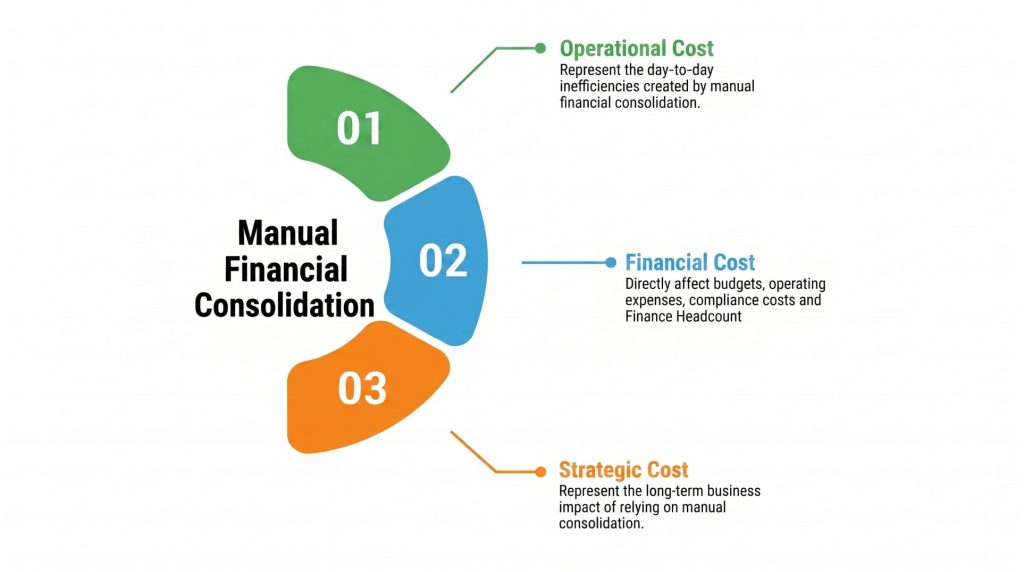
When finance leaders evaluate their consolidation process, they often focus on how many days it takes to Close the Books. The real operational cost of manual financial consolidation lies in the time finance teams spend collecting, validating, reconciling, and correcting data instead of generating business insight.
Before consolidation, finance teams waste days requesting trial balances, exporting data across multiple ERPs, validating spreadsheets, and chasing subsidiaries. Each new entity adds dependency and complexity to this fragmented process. Instead of analyzing performance, skilled accountants are relegated to data collection, consuming time that should be dedicated to driving strategic business insights.
Spreadsheets, while flexible, hinder consolidation through fragmented data, broken formulas, and manual versioning, often making validation as time-consuming as reporting. With 60% of finance teams still relying on these manual methods, the result is heightened error risks. Ultimately, finance teams spend more time verifying data than providing the strategic insights businesses truly need.
Business growth often leads to fragmented ERP landscapes involving multiple systems like SAP, Oracle, and NetSuite, each with unique data models and reporting structures. Without automation, finance teams are forced to manually extract and standardize this data every month. This manual effort grows exponentially with organizational complexity, making the consolidation process increasingly unsustainable as new entities are added.
Maintaining a single Chart of Accounts across entities is rare, forcing finance teams to manually map inconsistent subsidiary accounts every period. This routine task creates a significant operational burden. With every organizational change or acquisition, mapping rules grow in complexity, increasing the ongoing effort required for validation and heightening the risk of reporting errors and inconsistencies.
International expansion adds significant operational complexity, requiring teams to manage exchange rates, currency translations, and compliance with IFRS and GAAP frameworks. As organizations grow, manual currency management compounds this burden. According to The Hackett Group, such complexity hampers productivity, forcing finance teams to spend excessive time validating manual calculations rather than analyzing and interpreting vital financial results.
Intercompany reconciliation is a highly resource-intensive process, requiring teams to match, investigate, and eliminate internal transactions like loans and inventory transfers for accurate reporting. As transaction volumes grow, finance teams become bogged down tracking discrepancies and resolving mismatches. This shifts highly qualified talent away from strategic planning and toward error-prone manual investigation, creating significant opportunity costs.
The impact of manual financial consolidation rarely appears as a single line item in the budget. Instead, it is dispersed across finance headcount, audit fees, consulting spend, overtime and the hidden cost of correcting errors. The irony is that many organizations view manual consolidation as a cost-saving approach because spreadsheets require little technology investment. In reality, the largest expense is not the software they avoid purchasing, it's the finance capacity they continuously consume to keep manual processes running.
Manual consolidation's true cost is the inefficient use of skilled finance talent. Instead of focusing on forecasting and strategy, teams waste reporting cycles on manual data collection, spreadsheet validation, and error resolution. Research from The Hackett Group confirms that automation allows finance teams to achieve faster closes and lower costs by shifting focus from transaction processing to value-added strategic initiatives.
Ideally, business growth should improve economies of scale, yet manual consolidation often hinders this. Each acquisition adds new ERPs, entities, and intercompany transactions, forcing organizations to simply expand finance headcount to handle the administrative burden rather than redesigning processes. For CFOs, this creates a challenging reality where finance costs scale linearly with complexity, rather than productivity.
Spreadsheets appear affordable, but they hide significant maintenance costs. Managing complex workbooks including formulas, versioning and account mapping drains resources. Researchers estimate employees waste over 10 hours weekly on manual data preparation rather than strategic analysis. These recurring tasks consume thousands of hours of skilled labor, inflating operational expenses while remaining invisible as a direct technology cost.
Reporting errors cost far more than just formula fixes. A single inconsistency triggers costly investigations, reconciliation, reviews, and document revisions across subsidiaries, consuming valuable finance capacity under tight deadlines. Research shows that catching errors later during reporting rather than data preparation is exponentially more expensive, highlighting the critical need for automated validation to maintain accuracy and efficiency.
Rising regulatory standards and lower tolerance for errors demand complete traceability for all financial adjustments. When audit evidence is scattered across manual spreadsheets and emails, compliance becomes labor-intensive and costly. As governance and transparency requirements intensify, compliance transforms from a mere obligation into a significant operational burden that manual consolidation processes only exacerbate.
The true cost of manual financial consolidation is lost business agility. Modern CFOs must provide real-time insights, manage risks, and drive strategic growth, yet many still rely on outdated consolidation processes built for simpler organizations. While research emphasizes the need for finance leaders to act as strategic advisors rather than mere record-keepers, manual consolidation prevents this shift. It forces teams to prioritize basic number-crunching over the high-level interpretation and strategic guidance that modern businesses require to compete effectively.
Business growth boosts value but heightens financial complexity. Each acquisition introduces new ERP systems, entities, and intercompany transactions. Instead of scaling, manual consolidation adds spreadsheets and headcount, creating unsustainable workloads. Ultimately, this approach forces finance teams to prioritize tedious data management over strategic analysis, leaving them unable to keep pace with the organization's evolving needs.
As businesses grow, governance becomes a competitive advantage. Finance teams must maintain full transparency over adjustments and consolidation rules, but manual spreadsheet processes scatter critical data across disconnected files, hindering traceability. According to KPMG's research on the evolving role of internal audit, organizations are placing greater emphasis on governance, transparency, and effective internal controls. However, manual consolidation makes achieving this level of visibility increasingly difficult with every cycle.
Financial consolidation serves as the foundation for critical executive decisions, including budgeting, forecasting, and capital allocation. Every day spent consolidating delays these processes across the organization. World-class finance teams deliver trusted information faster, enabling leadership to act quickly. In volatile markets, the speed of financial insight is a decisive factor in maintaining business agility.
Manual consolidation creates significant technical debt. Every spreadsheet, custom macro, and manual workaround becomes a dependency that teams must maintain, evolving into a fragmented, costly operating model. This forces finance to spend more time sustaining outdated processes than building new capabilities. CFOs must decide if these manual efforts can truly support their organization's future growth.
Organizations outgrow manual financial consolidation not because spreadsheets fail, but because they cannot scale. The true tipping point arrives when reporting demands increasing headcount, longer close cycles, and constant manual intervention. Rather than scaling resources, top finance organizations automate their record-to-report processes to lower costs, improve accuracy, and sustain business growth.
| Challenges | Manual Financial Consolidation | Automated Financial Consolidation |
| Financial Data Collection | Financial data is manually collected from multiple ERP systems and subsidiaries every reporting cycle. | Automatically aggregate data from all ERP systems through real-time integrations. |
| Month-End Close | Month-end close continues to get longer despite increasing finance headcount. | Reduce close cycles through AI-driven data aggregation, validation, and consolidation. |
| Spreadsheet Dependency | Excel spreadsheets are your primary consolidation tool, causing version control issues and manual rework. | Replace spreadsheets with a centralized, governed Consolidation platform. |
| Chart of Accounts (CoA) Mapping | Chart of Accounts (CoA) mapping is repeated every month after acquisitions or organizational changes. | Standardize and automate CoA mapping across all entities using AI. |
| Multi-Currency Consolidation | Multi-currency consolidation depends on manual exchange rate updates and spreadsheet calculations. | Automate FX rate synchronization, currency translation, and CTA calculations. |
| Intercompany Reconciliation | Intercompany reconciliation takes days because teams manually investigate mismatched transactions. | Automatically match, reconcile, and eliminate intercompany transactions. |
| Audit & Compliance | Audit preparation requires collecting spreadsheets, approvals, and supporting documentation manually. | Maintain built-in audit trails, approval workflows, and role-based governance. |
| Scalability | Finance headcount continues growing simply to manage reporting complexity. | Scale consolidation through automation not additional resources. |
HighRadius transforms the Financial Consolidation as well as the entire Record-to-Report process with an Agentic AI architecture that centralizes data collection, standardization, reconciliation, Currency Conversion, and governance. Moving beyond mere acceleration, the platform systematically eliminates the hidden operational, financial, and strategic costs of manual consolidation.
Unlike traditional spreadsheet-reliant methods, HighRadius integrates directly with 50+ ERPs such as SAP, Oracle, Dynamics 365, NetSuite, Workday and Sage Intacct to automate real-time financial data aggregation. AI agents handle complex tasks like Chart of Accounts mapping, Foreign currency synchronization, Intercompany Eliminations, and Top-Side Adjustments, generating audit-ready financial statements while removing the manual labor that typically hampers finance teams.
The measurable outcomes reflect that transformation:
HighRadius' clients claimed to have achieved the following value from the software
Carestream Health: Achieved 98% faster consolidation using HighRadius Agentic AI-powered Financial Consolidation, eliminating the time spent on Consolidation Runtime and enabling the finance team to consolidate financial data across entities with significantly greater speed and accuracy.
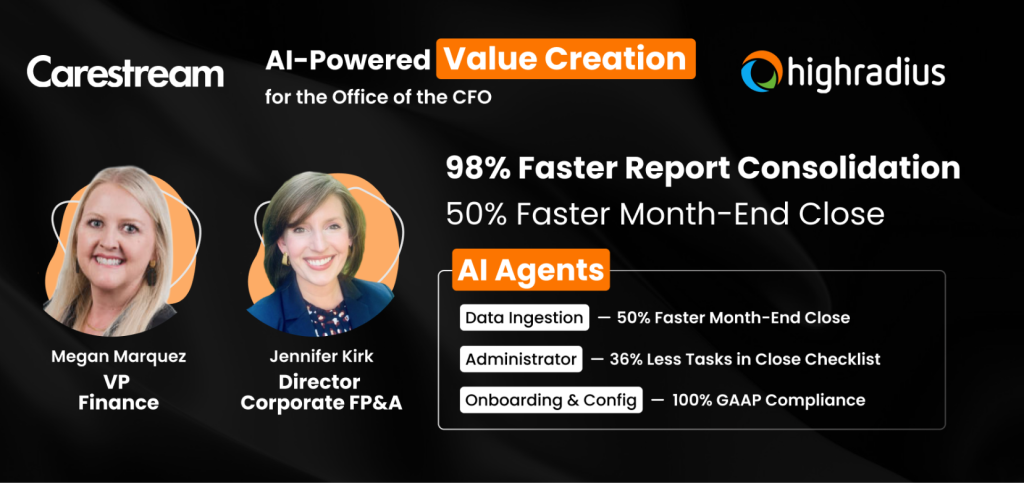
HighRadius strengthens governance while drastically reducing audit preparation time. Freed from the cycle of spreadsheet validation and reconciliation, finance leadership gains continuous visibility into performance. This allows teams to shift focus from manual number-crunching to high-impact activities like forecasting, strategic capital allocation, and business decision-making. Ultimately, HighRadius enables CFOs to move from reactive, spreadsheet-driven processes to an AI-powered operating model that delivers robust governance and real-time financial intelligence at scale.
The Cost of Manual Financial Consolidation extends far beyond Spreadsheet work. Organizations lose time through Manual Data Collection, Chart of Accounts (CoA) Mapping, Intercompany Reconciliations, Currency Conversions and repeated Error correction. These Operatioal Inefficiencies translate into higher Finance labor costs, longer Audit cycles and delayed Decision-making. As Organizations grow, these hidden costs also Increase significantly faster.
Business Growth introduces new Subsidiaries, ERP systems, Currencies, Reporting requirements and Intercompany Transactions. Manual Consolidation scales by adding spreadsheets and Finance Headcount rather than Improving Productivity. Every new Entity Increases Data preparation, Reconciliation and Reporting Complexity, making the Consolidation process progressively slower, more expensive and harder to Govern.
Financial Consolidation Software Automates Data Aggregation, Account Mapping, Intercompany Eliminations, Currency Conversions and Report Generation across all Entities simultaneously. Instead of waiting for Spreadsheets from multiple business units, Finance teams receive Standardized Financial Data in real time. HighRadius customers achieve up to 95% faster Data Aggregation, 60% greater Consolidation Efficiency and 30% fewer days to Close through AI-driven Automation.
Spreadsheets work well for analysis but were never designed to manage enterprise-scale financial consolidation. As organizations expand, spreadsheet-based processes introduce version control issues, broken formulas, duplicate data, manual reconciliations, and limited audit visibility. Modern finance organizations require automated workflows, embedded governance, and real-time financial visibility that spreadsheets cannot provide at scale.
Modern financial consolidation software should automate multi-entity data aggregation, Chart of Accounts mapping, intercompany eliminations, multi-currency consolidation, and financial reporting while integrating seamlessly with leading ERP systems. It should also provide built-in audit trails, role-based approvals, GAAP and IFRS compliance, and real-time dashboards that support faster, more informed decision-making.
AI automates repetitive consolidation activities such as data validation, account mapping, intercompany transaction matching, foreign exchange conversions, and top-side journal adjustments. Rather than replacing finance professionals, AI reduces manual effort so teams can focus on forecasting, variance analysis, and strategic planning. This enables faster financial closes while improving reporting accuracy and governance.
Finance teams often struggle with collecting data from multiple ERP systems, maintaining consistent Charts of Accounts, applying accurate exchange rates, calculating Currency Translation Adjustments (CTA), and eliminating intercompany transactions. Automation addresses these challenges by standardizing financial data, synchronizing live FX rates, and applying predefined consolidation rules across every reporting period.
Automated Financial Consolidation embeds Governance directly into the Close process through Maker-checker workflows, Role-based Security, Approval workflows, Version control and complete Audit trails. Every Adjustment, Journal Entry and Consolidation rule is fully traceable, reducing Manual Audit preparation while strengthening compliance with frameworks such as GAAP and IFRS.
Organizations should start evaluating Automated Financial Consolidation when month-end Close Cycles continue to lengthen, Financial Data is manually collected from multiple ERP systems, Intercompany Reconciliations delay Reporting, or Finance teams spend more time preparing Reports than Analyzing business performance. These are clear Indicators that the Existing Consolidation process can no longer support business growth Efficiently.
HighRadius uses Agentic AI to Automate the entire Financial Consolidation lifecycle from real-time Data Aggregation and AI-powered Chart of Accounts mapping to Intercompany Eliminations, Multi-currency Consolidation, Top-side Adjustments and Reporting. Organizations using HighRadius achieve up to 95% faster Data Aggregation, 99% Accurate Intercompany Eliminations, 85% fewer manual Adjustments and 100% Audit-ready Compliance, helping Finance teams shift from Manual processing to strategic Decision-making.
Resource Library

Track operating and net cash flow while forecasting balances to maintain liquidity and financial control.
Calculate Cash Flow
Automate reconciliation, reduce manual effort, and improve accuracy in matching bank statements with cash records.
Download Free Template
Streamline close processes with a structured checklist that ensures timely, accurate, and well-coordinated financial reporting.
Download Free Checklist
Understand how AI transforms record-to-report by improving efficiency, enabling insights, and reducing manual workloads.
Download Free GuideHighRadius stands out as a challenger by delivering practical, results-driven AI for Record-to-Report (R2R) processes. With 200+ LiveCube agents automating over 60% of close tasks and real-time anomaly detection powered by 15+ ML models, it delivers continuous close and guaranteed outcomes—cutting through the AI hype. On track for 90% automation by 2027, HighRadius is driving toward full finance autonomy.

HighRadius leverages advanced AI to detect financial anomalies with over 95% accuracy across $10.3T in annual transactions. With 7 AI patents, 20+ use cases, FreedaGPT, and LiveCube, it simplifies complex analysis through intuitive prompts. Backed by 2,700+ successful finance transformations and a robust partner ecosystem, HighRadius delivers rapid ROI and seamless ERP and R2R integration—powering the future of intelligent finance.

HighRadius is redefining treasury with AI-driven tools like LiveCube for predictive forecasting and no-code scenario building. Its Cash Management module automates bank integration, global visibility, cash positioning, target balances, and reconciliation—streamlining end-to-end treasury operations.

1100+
Customers globally
3400+
Implementations
$18.9 T.
Transactions annually
37
Patents/ Pending
6
Continents
Explore our products through self-guided interactive demos
Visit the Demo CenterPlease fill in the details below
Please fill in the details below

We have seen financial services costs decline by $2.5M while the volume, quality, and productivity increase.

Colleen Zdrojewski
Trusted By 1300+ Global Businesses
