See How HighRadius Increases Consolidation Efficiency By 60%
Download Feature GuideAs organizations expand, multi-entity consolidation becomes a challenge where finance teams must consolidate more financial data. The Issue is that every new entity can introduce additional dependencies, governance, exceptions and coordination requirements into a process that is often still managed through spreadsheets, manual reviews, and disconnected workflows. 56% of organizations still use spreadsheets to reconcile and consolidate financial data according to PwC. Over time, the complexity of entity consolidation can grow faster than the organization itself.
Manual multi entity consolidation process does not simply slow the financial close. It can require finance teams to add more effort as the organization adds more entities, turning growth into additional administrative work rather than a scalable financial process. Finance teams can become increasingly focused on coordinating inputs and resolving issues created by the consolidation process itself.
The challenge is not just consolidating entities faster, It is to build a multi entity consolidation process that can absorb organizational growth without requiring a proportional increase in manual work. This article examines why manual multi-entity consolidation becomes harder to manage as organizations expand, the challenges that create the greatest operational burden, and how Multi Entity Consolidation Software can help finance teams build a more scalable and controlled approach to entity consolidation.
- Multi-entity consolidation becomes complex as businesses add entities, systems, currencies, ownership structures, and intercompany transactions.
- Manual processes amplify this complexity, increasing reconciliation, exception handling, and close coordination as the organization grows.
- A scalable approach combines standardization, automation, and governance to reduce repetitive work while keeping critical financial controls in place.
- HighRadius simplifies multi-entity consolidation by automating data collection, CoA mapping, currency conversion, intercompany eliminations, and adjustments, helping finance teams scale without increasing manual work.m
What is Multi Entity Consolidation?
Multi-entity consolidation is the process of combining financial data from multiple legal entities or business units into a unified view of the organization’s financial performance and position. While individual entities maintain their own financial records, the entity consolidation process brings those records together according to the group’s reporting structure and accounting requirements. A typical multi entity consolidation process involves collecting and validating financial data, mapping local accounts to the group chart of accounts, translating balances where different currencies are involved, reconciling and eliminating intercompany transactions, and recording consolidation-level adjustments before generating consolidated financial reports.
The objective of multi-entity consolidation is not simply to aggregate numbers from multiple entities, but to create a consistent and controlled financial view despite differences in how individual entities operate and maintain their books. As organizations grow, the process becomes increasingly dependent on standardized rules, connected workflows, and clear visibility into exceptions. Multi entity consolidation software can support this by automating repeatable activities and helping finance teams focus their attention on the areas that require financial judgment and review.
Why Multi Entity Consolidation becomes Complex?
As organizations add entities, finance teams must manage a growing number of data structures, ownership relationships, reporting requirements, currencies, intercompany transactions, and close dependencies. When these differences are managed through spreadsheets and disconnected workflows, the consolidation process increasingly depends on manual coordination and exception resolution.
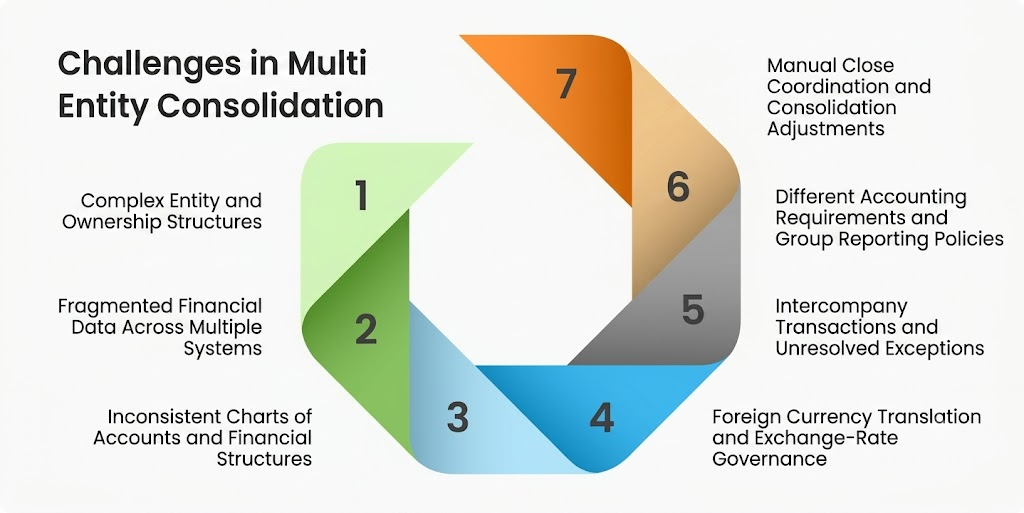
1. Complex Entity and Ownership Structures
As organizations grow through acquisitions, expansion, and restructuring, their legal entity structures rarely remain static. Parent-child relationships, ownership percentages, changes in control, partially owned subsidiaries, and effective dates can all affect how entities are included in consolidation.
The challenge is maintaining a governed entity structure that accurately reflects the organization at each reporting period. When entity hierarchies and ownership information are managed manually, finance teams may need to repeatedly validate consolidation scope and reporting relationships. Changes such as acquisitions or reorganizations can then create significant downstream rework across the entity consolidation process.
2. Fragmented Financial Data Across Multiple Systems
Different entities often operate on different ERP and financial systems, particularly after acquisitions or regional expansion. The resulting challenge is not simply collecting data from multiple sources. Financial data can arrive in different formats, levels of detail, accounting periods, and structures, requiring validation before it can be used for consolidation.
When this process depends on manual downloads and spreadsheet transformations, finance teams become responsible for repeatedly moving and validating data rather than analyzing it. The greater the number of systems and entities involved, the greater the number of potential data exceptions that must be resolved before consolidation can proceed.
3. Inconsistent Charts of Accounts and Financial Structures
Different charts of accounts are not inherently a problem. Subsidiaries may require local account structures because of regulatory requirements, legacy systems, or historical acquisitions. The complexity arises when finance teams do not have a consistent way to translate those local structures into a common group reporting framework.
Without governed mapping rules, teams may rely on spreadsheets to maintain account relationships and manually resolve new or unmapped accounts during each close. This makes entity consolidation increasingly dependent on individual knowledge and creates a risk that financial information is interpreted inconsistently across the organization.
4. Foreign Currency Translation and Exchange-Rate Governance
When entities operate across currencies, finance teams must apply consistent translation policies to produce consolidated results in the group's reporting currency. The operational challenge extends beyond currency conversion itself. Teams need clear governance over approved rates, translation rules, reporting periods, and the treatment of translation differences.
Manual processes can make these controls difficult to maintain consistently across entities and reporting cycles. As the number of currencies and entities increases, finance teams must manage more translation exceptions and validation requirements, increasing the effort required to complete multi entity consolidation.
5. Intercompany Transactions and Unresolved Exceptions
Intercompany activity creates complexity because two entities may record the same economic transaction differently. Timing differences, currency differences, inconsistent transaction references, missing counterparties, or differences in accounting treatment can create balances that do not immediately match.
The business impact is not limited to the reconciliation effort itself. Unresolved exceptions can delay eliminations and compress the time available for final consolidation and reporting. A scalable entities consolidation process requires finance teams to identify exceptions early, assign ownership for resolving them, and maintain clear controls over adjustments and eliminations.
6. Different Accounting Requirements and Group Reporting Policies
Individual entities may follow local statutory requirements while the organization uses a separate framework and group policies for consolidated reporting. Finance teams must therefore determine how locally prepared financial information should be adjusted or presented within the group reporting structure.
The complexity increases when these adjustments depend heavily on individual expertise or undocumented processes. Without consistent policies, governance, and review workflows, similar transactions may be treated differently across entities, increasing the risk of inconsistent group reporting.
7. Manual Close Coordination and Consolidation Adjustments
The final stage of multi entities consolidation often becomes a coordination problem. Corporate finance may depend on multiple entities to submit data, resolve exceptions, approve adjustments, and complete activities according to a shared close timeline. Delays in one entity can create downstream pressure across the rest of the process.
Consolidation-level adjustments can add another layer of governance complexity, particularly when entries are managed through spreadsheets and email. Finance leaders need visibility into who created an adjustment, why it was made, what evidence supports it, and who approved it. Without controlled workflows, manual coordination can increase not only the time required for consolidation but also the effort required to maintain a reliable audit trail.
How Complex Is Your Multi-Entity Consolidation?
Answer these 5 questions to assess the complexity of your current multi-entity consolidation process.
How to simplify Multi Entity Consolidation?
The objective is to create a common consolidation framework that can accommodate differences between entities while standardizing the activities that should be consistent. As organizations grow, the most scalable approach is to automate repeatable work, establish clear governance, and direct finance teams toward exceptions that require judgment rather than routine processing.
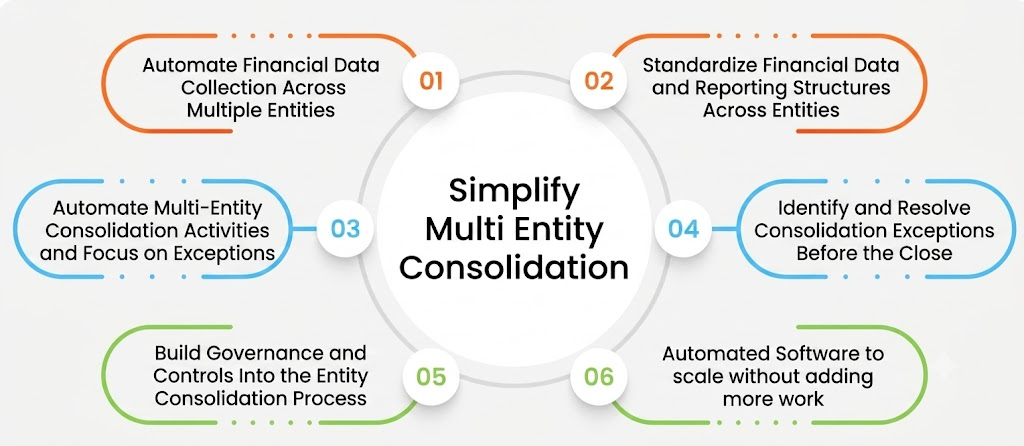
Automate Financial Data Collection Across Multiple Entities
The consolidation process should not begin with corporate finance manually collecting files from individual entities. Financial data needs to move from source systems into the consolidation workflow through structured, repeatable processes, with validation occurring before the data reaches the final consolidation stage.
A strong entity consolidation framework connects data collection with validation, so missing, incomplete, or inconsistent information can be identified early. This reduces downstream rework and prevents corporate finance from discovering data issues only when the close is already underway.
HighRadius supports this approach through automated financial data extraction using its, helping finance teams bring data from ERP systems into a centralized consolidation process. This creates a more consistent starting point for multi entity consolidation while reducing dependency on repeated manual data collection.
Standardize Financial Data and Reporting Structures Across Entities
A scalable process does not require subsidiaries to abandon their local charts of accounts or operating structures. Instead, finance teams need a governed group-level framework that translates entity-level data into a consistent reporting structure.
This includes maintaining standardized account mappings, entity hierarchies, ownership structures, and group reporting rules. The goal is to manage differences systematically rather than requiring finance teams to interpret those differences manually during every close.
For example, HighRadius' Chart of Accounts Mapping Agent helps standardize account mappings across entities, reducing the effort required to translate local financial structures into the group reporting framework. As new entities are added, this approach can help entities consolidation scale without requiring finance teams to rebuild reporting structures from scratch.
Automate Multi-Entity Consolidation Activities and Focus on Exceptions
The most effective use of automation in multi entity consolidation is not to remove financial judgment. It is to remove the repetitive work surrounding it. Currency conversion, transaction matching, eliminations, and recurring consolidation adjustments often follow defined rules. When these activities are performed manually, finance teams spend significant time executing processes that can be standardized.
Automation enables a different operating model: automate the standard and investigate the exception. Routine activities can follow predefined rules, while mismatches, unusual transactions, and policy exceptions are surfaced for finance teams to review.
This is where multi-entity consolidation software can have the greatest impact. HighRadius applies automation to activities such as FX currency conversion, intercompany eliminations, and top-side adjustments, helping teams reduce manual processing while maintaining control over the exceptions that require review and approval.
Identify and Resolve Consolidation Exceptions Before the Close
Many consolidation delays are caused not by the consolidation calculation itself, but by issues discovered too late. Missing entity submissions, unmapped accounts, data validation failures, and intercompany mismatches can all accumulate until the final stages of the close, when finance teams have the least time to resolve them.
A more scalable entity consolidation process identifies these issues as early as possible and assigns clear ownership for resolution. Instead of allowing exceptions to remain buried in spreadsheets or email chains, finance teams should be able to track the issue, understand its status, and determine who is responsible for resolving it.
By structuring workflows around early detection and resolution, organizations can prevent routine exceptions from becoming period-end bottlenecks.
Build Governance and Controls Into the Entity Consolidation Process
As multi-entity consolidation becomes more automated, governance becomes more important, not less. Finance leaders need confidence that automated processes follow approved rules and that manual interventions remain visible and controlled.
This requires clear workflows for consolidation adjustments, approvals, supporting documentation, and change tracking. Activities such as top-side adjustments should be governed through defined controls, including maker-checker reviews and a complete record of who made a change, why it was made, and how it was approved.
HighRadius supports controlled consolidation workflows by providing audit trails and manual controls around consolidation adjustments. This helps finance teams reduce spreadsheet dependency without sacrificing accountability or traceability.
Use Automated Software to scale without adding more work
The real value of automation is not simply completing entity consolidation faster. A process can be faster and still become increasingly difficult to manage as more entities are added.
The stronger objective is scalability: building a multi entity consolidation process in which adding an entity does not require a proportional increase in manual data collection, account mapping, reconciliation, or close coordination. Multi entity consolidation software can provide the connected workflows needed to manage this growth by standardizing recurring activities and giving finance teams visibility into the areas that require intervention.
Fragmented vs Automated Financial Consolidation
| Fragmented Approach | Organizational Impact | Automated Approach | Organizational Impact |
| Entity data collected manually via email, shared drives, or manual ERP exports | Close timelines stretch with every new entity; corporate finance spends days chasing submissions. | Financial data pulled automatically from connected ERPs into a centralized consolidation workflow | Data collection time stays flat even as entity count grows, keeping global consolidation predictable |
| Chart of accounts mapping maintained in spreadsheets by individual analysts | Institutional knowledge sits with a few people; unmapped accounts surface late and derail the close | Chart of accounts mapping governed centrally and applied consistently across entities | Subsidiary consolidation becomes repeatable, not dependent on any one person's memory |
| Currency translation applied manually, with rates and methods varying by preparer | Translation differences go undetected until late in the cycle, creating rework in reported numbers | Currency conversion automated against configurable, approved rates and translation rules | Global financial consolidation reflects one consistent policy, not several informal ones |
| Intercompany balances reconciled line-by-line after the fact | Mismatches are discovered under time pressure, forcing rushed eliminations or unexplained adjustments | Intercompany transactions matched systematically, with exceptions flagged early for review | Intercompany consolidation shifts from firefighting to structured exception management |
| Consolidation adjustments made through email approvals and disconnected spreadsheets | Audit trails are incomplete; explaining "who changed what and why" becomes reconstructive work | Adjustments routed through controlled, maker-checker workflows with built-in documentation | Every adjustment is traceable, defensible, and audit-ready without extra effort |
| Each new entity added manually rebuilds parts of the process | Growth directly increases headcount-equivalent effort; scaling the business means scaling the workload | New entities onboarded into an existing standardized framework | Multi entity consolidation software absorbs growth without a proportional rise in manual work |
What a Scalable Multi Entity Consolidation process looks like?
A scalable multi-entity consolidation process is not defined by how quickly it can complete a single close. It is defined by whether the process can absorb new entities, currencies, systems, and transaction volume. When evaluating multi-entity consolidation software, finance leaders should therefore look beyond individual automation features and assess whether the platform can create a connected, governed process across the full consolidation lifecycle.
Key Capabilities to Look for in Multi-Entity Consolidation Software
- Ability to connect with multiple ERPs, accounting systems, and data sources to bring entity-level financial data into a centralized consolidation process.
- Automated checks to identify missing, incomplete, duplicate, or inconsistent data before it enters the consolidation process.
- Ability to map different entity-level charts of accounts to a common group reporting structure while supporting local, statutory, and management reporting requirements.
- Support for complex entity hierarchies, ownership percentages, changes in ownership, and consolidation scope across reporting periods.
- Automated currency translation with configurable exchange rates, translation methods, and treatment of foreign currency differences.
- Ability to match intercompany transactions across entities, identify discrepancies, manage exceptions, and automate eliminations.
- Controlled workflows for top-side and other consolidation adjustments, including approvals, supporting documentation, and change tracking.
- Complete audit trails, role-based access, approval workflows, and visibility into changes made throughout the consolidation process.
- Ability to onboard new entities, systems, currencies, and reporting requirements without requiring a proportional increase in manual effort or rebuilding the consolidation process.
HighRadius provides these capabilities through a connected approach to entity consolidation, using automation to support financial data collection, account mapping, currency conversion, intercompany eliminations, and consolidation adjustments. Its AI Agents help automate repeatable activities while maintaining controls over the exceptions and approvals that require finance judgment.
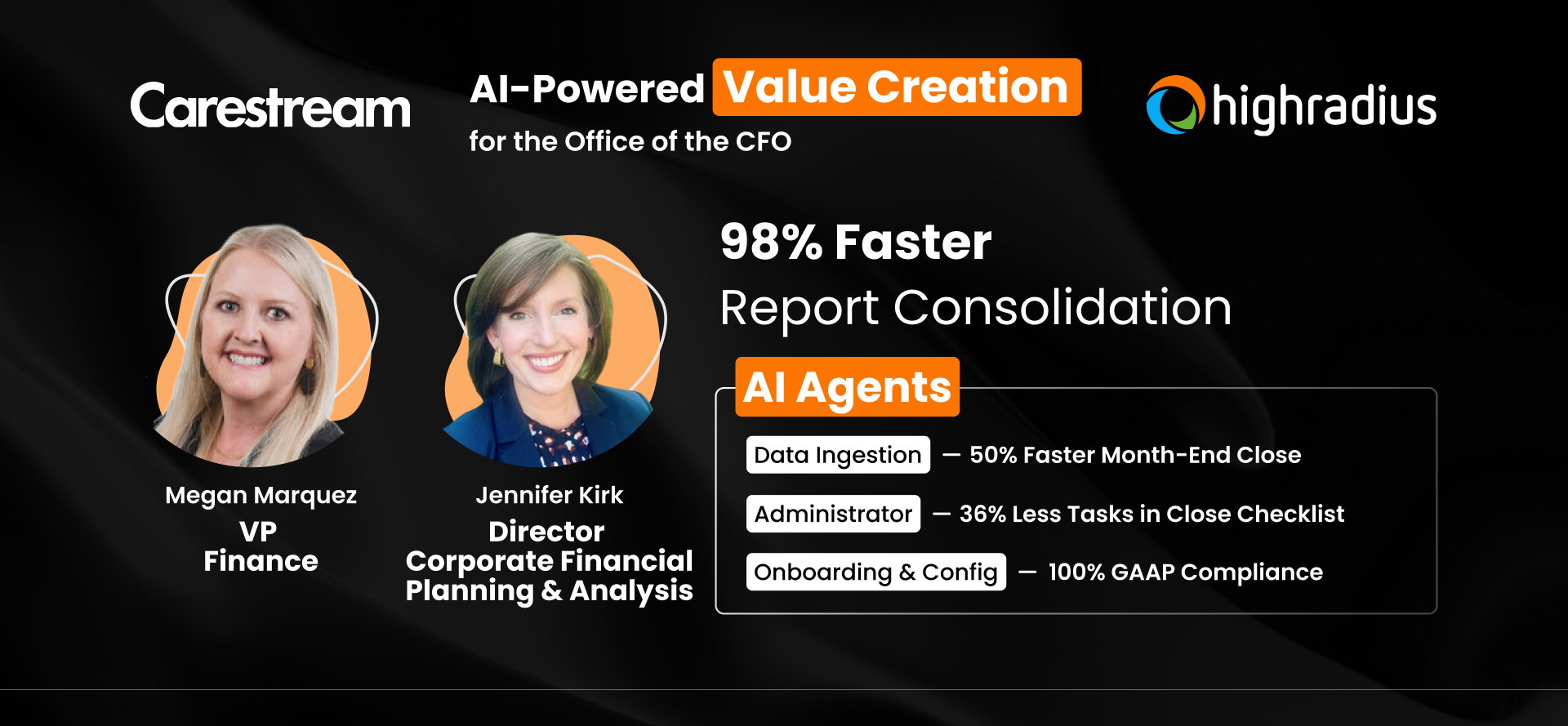
The Ultimate test of entity Consolidation Software is whether it reduces the operational burden created by grwoth. Carestream health, a Global medical imaging company, is a clear example.
Before Automatiom, CareStream ran Cosolidation manually across entities which was slow, Spreadsheet dependent, and increasingly hard to sustain as the Business scaled. After adopting HighRadius' AI powered consolidation platform, the results were direct.
- 98% reduction in Consolidation runtime: from 2.5 hours down to under 2 minutes
- 50% faster Consolidation and month-end Close
- 100% GAAP Compliance across entities, enforced Automatically at onboarding
- No increase in headcount to achieve any of the above
The same finance team that once spent hours compiling and reconciling data now delivers real-time, board-ready reports.
That last point is the real takeaway. The goal of multi entity consolidation isn't just speed, it's decoupling growth from added headcount and hours. Carestream is a useful benchmark for what that looks like in practice. For CFOs and VPs of Finance, these outcomes point to the larger objective of multi entity consolidation: building a process that scales with the organization without allowing financial complexity to scale at the same rate.
Frequently Asked Questions (FAQs)
1. What is Multi Entity Consolidation?
Multi Entity Consolidation is the process of combining the financial results of multiple legal entities into a single set of consolidated financial statements. It typically involves collecting financial data, standardizing charts of accounts, translating currencies, eliminating intercompany transactions and recording consolidation adjustments. For global organizations, it provides a unified view of financial performance across subsidiaries and business entities.
2. Why is Multi Entity Consolidation difficult for global companies?
Multi Entity Consolidation becomes complex when subsidiaries operate across different countries, currencies, ERP systems, accounting standards, and reporting calendars. Finance teams must standardize these differences before completing global consolidation, which can make data collection, reconciliation, currency translation, and reporting time-consuming when managed manually.
3. What are the biggest challenges in Multi Entity Consolidation?
The biggest Multi Entity Consolidation challenges include foreign currency translation, inconsistent charts of accounts, fragmented ERP data, intercompany mismatches, different accounting standards, varying close calendars, manual consolidation adjustments, and limited audit visibility. As the number of entities increases, these challenges can create longer close cycles and increase the workload associated with entity consolidation.
4. How does Multi Entity Consolidation handle different currencies?
Multi Entity Consolidation requires financial information from foreign subsidiaries to be translated from their functional currencies into the parent company’s presentation currency. Organizations need standardized FX rates and currency translation rules to maintain consistency across global financial consolidation. Automating currency translation can reduce manual calculations and help finance teams manage FX differences more efficiently.
5. How are intercompany transactions managed in Multi Entity Consolidation?
During Multi Entity Consolidation, intercompany transactions between subsidiaries must be identified, matched, and eliminated so they do not distort consolidated financial results. A structured intercompany consolidation process can automatically identify matching transactions, flag exceptions, and route unresolved differences for review before elimination.
6. How can companies perform Multi Entity Consolidation across different ERP systems?
Companies can perform Multi Entity Consolidation across different ERP systems by establishing automated data integrations and a standardized consolidation data structure. Financial data from systems such as SAP, Oracle, Microsoft Dynamics, or regional ERPs can be collected, validated, and mapped into a common framework. This reduces manual data preparation and creates a consistent foundation for subsidiary consolidation.
7. How can finance teams simplify Multi Entity Consolidation?
Finance teams can simplify Multi Entity Consolidation by automating financial data collection, standardizing charts of accounts, automating currency translation and intercompany matching, and establishing controlled workflows for consolidation adjustments. Standardized processes reduce repetitive work and help finance leaders improve the speed and consistency of global consolidation.
8. What should companies look for in Multi Entity Consolidation software?
When evaluating multi entity consolidation software, finance leaders should look for capabilities that support automated financial data collection, multi-currency consolidation, chart of accounts mapping, intercompany matching and eliminations, consolidation adjustments, entity management, reporting, workflow controls, and audit trails. The solution should also integrate with existing ERP systems and scale as the organization adds more entities.
9. What is the difference between Multi Entity Consolidation and Subsidiary Consolidation?
Multi Entity Consolidation is a broader process of combining financial information from multiple entities into a unified group view, while subsidiary consolidation focuses specifically on incorporating subsidiary financial results into the parent company’s consolidated statements. In multinational organizations, subsidiary consolidation is often an important component of a broader multi-entity and global consolidation process.
10. How does automation improve Multi Entity Consolidation?
Automation improves Multi Entity Consolidation by reducing work across data collection, account mapping, currency conversion, intercompany reconciliation, and consolidation adjustments. It can also provide standardized workflows, exception management, approval controls, and audit trails. For CFOs and VPs of Finance, this creates a more scalable entity consolidation process that can support business growth without increasing manual consolidation effort at the same rate.