Master your monthly finances—get the CFOs financial reporting template!
Download Now- Statutory Reporting Ensures Compliance with IFRS and GAAP Standards, while Management Reporting equips timely Insights to monitor Performance, Variances and make Strategic Business Decisions.
- According to a PwC’s Report, 60% of Finance Organizations still rely on Manual Spreadsheets during Financial Processes, resulting in Slower Reporting Cycles and Increased Compliance risk.
- HighRadius Financial Reporting Automates Statutory, Management and Personalized Reporting to achieve 80% Faster Financial Reporting, 90% Faster Variance and Eliminate Manual Reporting Errors.
Finance leaders are responsible for ensuring regulatory compliance, providing real-time visibility into business performance, supporting board-level decision-making and helping the organization respond quickly to changing market conditions. This growing mandate has made statutory reporting and management reporting equally critical. While one builds confidence with regulators, auditors and investors, the other enables executives to monitor performance, identify risks, and steer business strategy with confidence.
Despite significant investments in ERP systems, finance teams still face challenges in producing timely and reliable reports. According to PwC's 2025 Slovak CFO Survey, 53% of CFOs identified the time-consuming and resource-intensive nature of report preparation as a significant concern, driven by predominantly manual processes. The survey also highlights data quality and the timeliness of management reporting as key priorities for finance leaders.
Table of Contents
- Statutory vs Management Reporting: Key Differences
- The Real Challenge of Statutory and Management Reporting for Organizations
- How AI Modernizes Both Reporting Frameworks
- HighRadius Financial Reporting Software: AI-Powered for Statutory and Management Reporting
Statutory vs Management Reporting: Key Differences
Although Statutory Reporting and Management Reporting are often discussed together, they are designed to answer fundamentally different questions. One is intended to demonstrate financial compliance to external stakeholders, while the other helps leadership understand business performance and make informed decisions. Understanding where these reporting frameworks differ and how they complement one another is essential for building an effective financial reporting strategy.
What Is Statutory Reporting?
Statutory reporting is the process of preparing and publishing financial statements that comply with regulatory and accounting standards established by governing bodies. These reports are intended for external stakeholders, including regulators, investors, auditors, lenders, and tax authorities, and provide a standardized view of an organization's financial position and performance.
Unlike internal business reports, statutory reports must adhere to prescribed accounting frameworks such as Generally Accepted Accounting Principles or International Financial Reporting Standards (GAAP or IFRS). They are typically generated at monthly, quarterly, or annual intervals and are subject to rigorous governance, audit requirements, and approval workflows.
What Is Management Reporting?
Management reporting is the process of generating internal financial and operational reports that help business leaders evaluate performance, monitor key metrics and support strategic decision-making. Unlike statutory reporting, management reports are not governed by external accounting regulations and can be tailored to meet the specific needs of executives, business units, or departments.
These reports provide timely insights into financial performance by comparing budgets, forecasts, actual results, and operational KPIs. They enable CFOs and finance leaders to identify trends, investigate variances, allocate resources effectively, and respond proactively to changing business conditions.
Key Differences
| Criteria | Statutory Reporting | Management Reporting |
| Primary Purpose | Meet regulatory and legal compliance requirements | Support strategic and operational decision-making |
| Primary Audience | Regulators, investors, auditors, tax authorities, lenders | CFOs, CEOs, Controllers, department heads, business leaders |
| Reporting Standards | IFRS, GAAP, local accounting regulations | Internal business policies and reporting requirements |
| Report Frequency | Monthly, quarterly, annually | Daily, weekly, monthly, or on demand |
| Flexibility | Low; standardized reporting formats | High; customizable based on business needs |
| Level of Detail | Consolidated financial statements | Entity, department, product, customer, or transaction-level analysis |
| Decision Support | Demonstrates financial compliance and corporate governance | Enables performance analysis, forecasting, and business planning |
| Time Sensitivity | Period-end reporting | Continuous and real-time reporting |
| Governance | Strict approval workflows, audit trails, regulatory validation | Internal review processes with flexible collaboration |
| Success Metric | Accuracy, compliance, and audit readiness | Faster insights, improved decision-making, and business performance |
The Real Challenge of Statutory and Management Reporting for Organizations
Statutory reporting and management reporting serve different purposes, but they should not require separate reporting processes. Statutory reports ensure regulatory compliance and external transparency, while management reports help business leaders monitor performance, identify risks, and make strategic decisions. The real challenge for finance organizations isn't maintaining two reporting frameworks, it's producing both from fragmented systems, manual workflows, and inconsistent financial data.
Many finance teams manually extract and reconcile data from various ERP systems to create separate reports for different stakeholders. This redundant process covering data collection, validation, and translation becomes costly and inefficient as organizations scale across multiple entities and geographies. Gartner estimates finance teams spend 70% of their time on data collection and validation, leaving only 30% for analysis. This delay in insight delivery hinders executive decision-making. Furthermore, spreadsheet-heavy reporting increases the risks of manual errors, inconsistent calculations, and governance gaps, undermining confidence in financial data.
Common Challenges in Statutory and Management Reporting
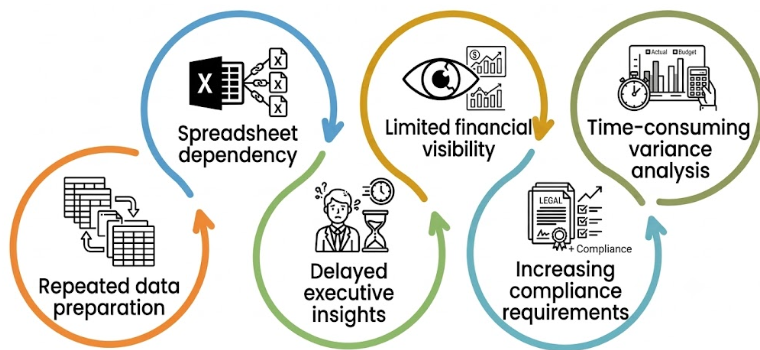
- Repeated data preparation: Finance teams repeatedly extract, validate, and transform the same financial data to produce statutory reports, management reports, board packs, and ad hoc reports.
- Spreadsheet dependency: Manual spreadsheets create version control issues, broken formulas, duplicate work, and higher reporting risk across reporting cycles.
- Delayed executive insights: By the time management reports are finalized, key business trends, cash flow changes, and operational issues may already require action.
- Limited financial visibility: Static reports provide historical snapshots but make it difficult to drill into transactions, investigate variances, or monitor performance continuously.
- Increasing compliance requirements: Evolving reporting standards such as IFRS, GAAP, SEC, and ESG disclosures require greater accuracy, traceability, and audit readiness than manual processes can efficiently support.
- Time-consuming variance analysis: Finance professionals spend hours identifying and explaining reporting variances instead of delivering forward-looking insights, forecasting, and strategic recommendations.
How AI Modernizes Both Reporting Frameworks
Modern AI-powered financial reporting platforms deliver value across both reporting frameworks by enabling:
Automated Report Generation
AI automatically collects validated financial data from ERP systems, consolidates it where required, and generates statutory financial statements, management reports, and executive dashboards without repetitive spreadsheet preparation or manual report compilation.
Real-Time Financial Visibility
Instead of waiting until month-end, AI continuously synchronizes financial data from connected systems, giving finance leaders access to live dashboards that monitor revenue, profitability, cash flow, working capital, and other key KPIs in near real time.
AI-Driven Variance Analysis
AI automatically compares actual results against budgets, forecasts, prior periods, and business targets to identify significant variances, surface unusual trends, and generate contextual explanations that help finance teams investigate issues faster.
Faster Report Customization
AI-powered report builders enable finance teams to create statutory reports, management reports, board packs, and ad hoc financial reports using configurable templates, dynamic dimensions, and drill-down capabilities without relying on IT or manually rebuilding spreadsheets.
Continuous Audit Readiness
AI embeds governance directly into the reporting process through automated validation rules, approval workflows, role-based access controls, version management, and comprehensive audit trails. Every financial adjustment and report modification remains fully traceable for regulatory compliance.
AI-Powered Financial Insights
Beyond producing financial statements, AI transforms financial data into actionable insights by identifying trends, forecasting performance, highlighting risks, and supporting scenario analysis helping CFOs make faster, data-driven business decisions.
Ultimately, AI shifts financial reporting from a reactive, period-end activity to a continuous, intelligence-driven process. Finance teams spend less time preparing reports and more time delivering the insights that drive business growth.
| Impact Area | Manual Statutory Reporting | Automated Statutory Reporting | Manual Management Reporting | Automated Management Reporting |
| Data & Report Preparation | Finance teams manually extract, validate, reconcile and format data from multiple systems to prepare regulatory reports. | Automated data ingestion, validation and standardized workflows accelerate financial statement preparation. | Teams manually gather and manipulate data from ERP systems, spreadsheets and business function to create performance reports. | Automated data ingestion and report generation provide faster access to current financial and operational data. |
| Accuracy & Consistency | Manual data handling and spreadsheet based processes increase the risk of errors and inconsistencies in regulatory submissions. | Automated validation and standardized reporting rules improve accuracy and consistency across reporting periods. | Manual calculations and disconnected data sources can result in inconsistent figures across reports and stakeholders. | Synchronized data and automated calculations help maintain consistent financial information across management reports. |
| Compliance & Governance | Maintaining audit trails, approvals and supporting documentation requires significant manual effort. | Automated audit trails, approval workflows and role-based controls strengthen compliance and audit readiness. | Decentralized spreadsheets can make it difficult to track changes, validate data and maintain a single version of the report. | Centralized reporting, role-based access and change tracking improve governance and transparency. |
| Reporting Speed | Manual data collection and validation can slow statutory reporting cycles and regulatory submissions. | Automated workflows accelerate the preparation and delivery of statutory financial statements. | Recurring reports may take days to prepare as finance teams consolidate data from multiple sources. | Automated report generation and real-time dashboards enable faster access to business performance insights. |
| Analysis & Insights | Statutory reporting focuses primarily on standardized financial statements and regulatory compliance, limiting time available for deeper analysis. | Drill-down capabilities enable finance teams to investigate financial data while maintaining reporting controls. | Finance teams spend significant time preparing data before analyzing budgets, forecasts and performance variances. | Automated variance analysis and drill-downs help finance teams identify performance drivers and trends faster. |
| Decision Making | Reporting delays can limit timely visibility into financial performance and emerging issues. | Faster access to accurate financial information improves financial oversight and reporting responsiveness. | Delayed management insights can slow executive responses to changing business conditions. | Real-time dashboards and performance insights enable data driven business decisions. |
| Finance Team Productivity | Skilled finance professionals spend valuable time on repetitive data preparation and validation. | Automation reduces repetitive reporting tasks, allowing teams to focus on analysis and strategic activities. | Finance teams spend time building recurring reports instead of interpreting business performance. | Automation shifts finance capacity toward forecasting, analysis and strategic decision support. |
HighRadius Financial Reporting Software: AI-Powered for Statutory and Management Reporting
HighRadius Financial Reporting Software combines purpose-built AI agents to help finance teams deliver accurate, audit-ready statutory reports and insight-driven management reports from a shared financial data foundation. Rather than relying on disconnected spreadsheets and manual reporting cycles, organizations can automate report preparation, strengthen governance and accelerate executive decision-making. The platform includes specialized AI agents designed to support different reporting requirements while maintaining consistency, transparency, and data integrity across the reporting process.
AI-Powered Statutory Reporting
The Statutory Reporting Agent automates the preparation of regulatory financial statements while supporting compliance with global accounting standards such as IFRS and GAAP. Built-in audit trails, standardized calculations and governed approval workflows help organizations improve reporting accuracy while reducing compliance risk.
AI-Powered Management Reporting
The Management Reports Agent enables finance leaders to generate business-focused reports that support performance monitoring and strategic decision-making. Management reporting provides executives with deeper visibility into financial performance, enabling faster identification of trends, risks and business opportunities.
Value Creation

Carestream Health Achieved faster and improved report consolidation by replacing manual data aggregation with HighRadius' Agentic AI-powered Financial Reporting platform, enabling real-time, board-ready financial reports without increasing headcount.
- 98% Faster Report Consolidation
- 100% GAAP Compliance Achieved
- 98% Reduction In Consolidation Runtime
- 50% Faster Consolidation & Month-End Close
Frequently Asked Questions (FAQs)
1. What is the difference between statutory reporting and management reporting?
Statutory reporting is prepared to meet legal and regulatory requirements and follows accounting standards such as GAAP or IFRS. It is primarily intended for external stakeholders, including regulators, investors, auditors and tax authorities. Management reporting, on the other hand, is created for internal stakeholders such as CFOs, executives, and department heads. It focuses on business performance, budgeting, forecasting and operational decision-making, with flexible reporting formats tailored to organizational needs.
2. Why do organizations need both statutory reporting and management reporting?
The two reporting frameworks serve different purposes. Statutory reporting demonstrates financial compliance and builds confidence with external stakeholders, while management reporting provides the operational and financial insights executives need to optimize performance and guide business strategy. Together, they provide a complete view of an organization’s financial health.
3. Is management reporting mandatory?
It is an essential practice for organizations that want to monitor financial performance, evaluate business operations, improve forecasting accuracy, and make informed strategic decisions. It is designed for internal stakeholders such as CFOs, executives, and department heads to monitor business performance, analyze financial results, and support strategic decision-making.
4. Why is management reporting more frequent than statutory reporting?
Management reporting is generated more frequently because it supports day-to-day business operations and strategic decision-making. Executives often require daily, weekly or monthly insights into financial performance, cash flow, budgets and key performance indicators (KPIs). Statutory reporting, however, follows regulatory reporting schedules and is typically prepared monthly, quarterly or annually in accordance with accounting standards such as GAAP or IFRS.
5. How often should statutory and management reports be generated?
The reporting frequency depends on their purpose. Statutory reports are usually prepared monthly, quarterly or annually to meet regulatory and financial reporting obligations. Management reports are generated more frequently – weekly or monthly to provide business leaders with timely insights into financial performance, cash flow, budgets and operational metrics. HighRadius AI-powered financial reporting software enables organizations to generate both report types on demand using real-time financial data.
6. How does AI improve financial reporting?
AI improves financial reporting by automating repetitive tasks such as data aggregation, validation, report generation and variance analysis. It can also provide AI-generated commentary, identify anomalies, support real-time dashboards, and maintain comprehensive audit trails. This enables finance teams to reduce manual effort, improve reporting accuracy, and deliver faster business insights.
7. What are the benefits of AI-powered financial reporting software?
AI-powered financial reporting software automates data collection, report generation, variance analysis and compliance workflows, significantly reducing manual effort and improving reporting accuracy. By integrating directly with ERP and accounting systems, it enables finance teams to generate statutory reports, management reports and customized executive/personalized reports faster while maintaining complete audit trails and regulatory compliance.
8. What should organizations look for in financial reporting software?
When evaluating financial reporting software, organizations should prioritize solutions that offer Seamless ERP integration, Automated statutory and management reporting, Support for GAAP and IFRS, Real-time dashboards and analytics, AI-powered variance analysis, Custom report builders, Comprehensive audit trails and Multi-entity and multi-currency Consolidation. Selecting a platform with these capabilities helps finance teams improve reporting efficiency while maintaining compliance and governance.
9. Can HighRadius financial reporting software automate both statutory and management reporting?
Yes. HighRadius financial reporting software can automate both reporting frameworks by integrating with ERP systems, validating financial data, generating financial statements, creating management reports and maintaining audit trails. HighRadius also supports real-time dashboards, variance analysis, role-based collaboration and multi-standard reporting to improve reporting accuracy and efficiency.
10. Does HighRadius statutory reporting support both GAAP and IFRS reporting?
Yes. HighRadius Statutory reporting supports Generally Accepted Accounting Principles (GAAP) and International Financial Reporting Standards (IFRS). This enables multinational organizations to generate compliant financial statements for different jurisdictions while maintaining a consistent reporting process. HighRadius platforms also support multi-entity consolidations, multi-currency reporting and configurable reporting templates to simplify global financial reporting.