AI has moved beyond the buzz — it’s here, and treasury and finance teams are already putting it to work inside their treasury management software. One of the most important shifts we’re seeing is the rise of treasury AI and AI agents in treasury operations. These are smart, decision-making systems that don’t just automate tasks – they actively learn, adapt, and take autonomous decisions, helping finance teams enhance treasury operations efficiency and accuracy.
In this blog, we’ll unpack what AI agents really do, how they work behind the scenes, and how they’re changing the way treasury departments run.
Table of Contents
What Are AI Agents in Treasury Operations?
How is Agentic AI Transforming Treasury Management
Autonomous Finance Agents in Action
Benefits of AI-Driven Treasury Automation
AI Capabilities vs Human Accountability
From Transformation to Intelligence: The Future of Treasury
How HighRadius Agentic AI Make Treasury Operations Easier
What Are AI Agents in Treasury Operations?
At their core, AI agents are like digital assistants but smarter and more independent. They can scan environments, understand data, and carry out tasks on their own. In a treasury setting, that means they are helping teams stay on top of processes, such as:
Real-time cash forecasting
Investment recommendations
Intercompany lending
Risk detection and alerts
What separates AI agents from existing automation tools is their ability to improve over time. They are built on technologies like machine learning solutions, natural language processing, and generative AI, which means they can pick up on trends, interpret both numbers and language, drive document and narrative automation, and adjust their actions accordingly.
Picture a virtual analyst — one that never gets tired, doesn’t need breaks, and scales easily across teams, regions, and time zones. From improving cash visibility to making proactive suggestions, AI agents are proving to be a game-changer for forward-thinking finance teams.
AI Is Reshaping Treasury — 7k+ Finance Pros Have Downloaded This Guide to Get Ahead
Explore 5 real AI use cases in cash forecasting and treasury management.
How is Agentic AI Transforming Treasury Management
The role of agentic AI in treasury management goes far beyond automation. It’s changing how treasury teams think, plan, and act. Here’s where it’s making the biggest impact:
Real-time cash forecasting
AI agents pull data from internal systems, past trends, and even market signals to build up to the minute, predictive cash flow forecasts with AI agents for cash flow forecasting, among the most reliable cash forecasting tools available today. That helps finance teams stay one step ahead of potential shortfalls or surpluses.
Smarter liquidity allocation
AI agents do not just show where cash and liquidity sit, they suggest where it should go. By analyzing inflows, outflows, and rates, they can move money around in real time to optimize returns and reduce idle balances.
Better scenario planning
AI agents spot issues before they become real problems. Whether it is a cash mismatch, an overdraft risk, or a compliance red flag, these systems alert treasury managers and teams early enough to act.
Risk detection and early alerts
AI agents spot issues before they become real problems. Whether it’s a cash mismatch, an overdraft risk, or a compliance red flag, these systems alert treasury teams early enough to act.
With AI agents to their aid, treasury leaders are spending less time on routine tasks and more time on shaping strategy. This results in a clear shift from operational gatekeeping to proactive decision making.
Payments and Fraud Controls
AI agents streamline payment workflows and validate formats like ISO 20022, pain.001, and NACHA. Through continuous monitoring, they prevent fraud by instantly flagging anomalies, stopping duplicate payments, and automating sanctions screening to ensure complete compliance.
Bank Account Management
Managing numerous global accounts requires complete bank account visibility. AI systems simplify this by centralizing bank account information and improving bank connectivity across institutions. They assist treasury teams with account opening and closing procedures as well as signatory management. Through continuous monitoring of account activity, AI agents identify dormant accounts and recommend account rationalization strategies to reduce costs and complexity.
Foreign Exchange Risk and Hedging
AI agents transform how treasury teams manage global currency volatility. They automate FX exposure identification and provide continuous currency exposure monitoring across all operations. By accurately forecasting currency requirements, these systems offer proactive hedge recommendations tailored to market conditions. Agents also evaluate hedge effectiveness in real time to protect against adverse exchange rate changes. This ensures all actions align with policy based decision making to secure corporate profit margins.
Autonomous Finance Agents in Action
Autonomous finance agents are already making their way into real-world treasury workflows. These aren’t theoretical tools — they’re working behind the scenes and quietly managing high-stakes tasks with little to no human intervention.
Here is how practical applications of AI in treasury management are transforming daily operations:
Daily cash positioning
Input: Bank balances, ERP data, AR/AP data and scheduled payments.
Analysis: Agent consolidates balances and identifies surplus/deficit positions.
Decision: Determines required liquidity levels.
Action: Recommends or initiates appropriate fund movements.
Monitoring: Continuously updates the position as transactions occur.
Intercompany lending
Input: Business unit balances, corporate lending policies, and applicable interest rates.
Analysis: Identifies surplus and deficit positions across various business units.
Decision: Recommends appropriate loans and calculates required interest.
Action: Generates accounting entries and schedules repayments automatically in line with company policy.
Monitoring: Tracks outstanding loan balances and verifies repayment execution.
Investment ideas
Input: Idle cash balances, real time market conditions, and company risk profiles.
Analysis: Evaluates idle cash against available market opportunities and risk limits.
Decision: Suggests optimal investment options based on the analysis.
Action: Executes investment moves directly through integrated platforms.
Monitoring: Tracks ongoing investment performance and shifting market conditions.
FX risk & hedging
Input: Financial forecasts, market exchange rates, internal guidelines, and global currency exposure data.
Analysis: Assesses foreign exchange risks across global operations to evaluate ongoing currency exposure.
Decision: Suggests appropriate hedging strategies based on current forecasts and internal risk limits.
Action: Triggers hedges automatically to mitigate currency risks.
Monitoring: Continuously tracks foreign exchange markets and ongoing currency exposure.
Ebooks
Turn Financial Data into Real-Time Intelligence with AI
Discover how forward-thinking finance teams use AI to unlock real-time insights, reduce reporting delays, and drive smarter decisions.
At HighRadius, we have seen firsthand how AI solutions and treasury technology deliver real value, not just in theory but in measurable results. Here is what companies are experiencing:
1. 95% global inflows forecast accuracy
Agentic AI delivers highly accurate cash inflow forecasts—up to 95%—giving finance teams the confidence to plan with precision. This reduces guesswork and supports better investment and working capital decisions.
2. 95% global outflows forecast accuracy
With equal accuracy on the outflow side, businesses can better predict financial obligations, minimize the risks of shortfalls, and ensure timely payments—improving operational efficiency and vendor trust.
3. 90% time saving per scenario analysis
By automating data modeling and reporting, agentic AI reduces the time required for scenario analysis time by 90%. Finance teams can quickly run multiple what-if models and respond faster to market changes.
4. 50% reduction in idle cash
Improved cash visibility enables smarter fund allocation, helping reduce idle cash by 50%. Businesses can reinvest freed-up capital or improve liquidity planning across global entities.
5. 70% boost in productivity
Automation of routine finance tasks leads to a 70% productivity gain. Teams spend less time on manual work and more on strategic insights and value-added activities.
AI Capabilities vs Human Accountability
Treasury is a highly risk sensitive function where trust is critical, which means every serious source stresses what AI does not decide and exactly where human control remains. To avoid overclaiming autonomy, businesses must state boundaries honestly. Here is a breakdown of what AI prepares versus what humans continue to own:
Approval boundaries: Analytical systems prepare data and recommend actions, but authorized treasury roles strictly approve all funding, payments, and hedges.
Human accountability: Professionals maintain complete accountability for final strategies and execution. The technology highlights trends, but human leaders make the final call on all critical decisions to ensure compliance and build trust.
Responsible AI controls: Organizations implement strict governance frameworks so algorithms never overstep their intended advisory role. These controls guarantee the technology supports operations without independently deciding outcomes or overclaiming autonomy.
Audit trails: Every analytical step prepared by the AI and every final approval executed by an authorized human is meticulously logged. This provides transparent oversight to prove human control remains firmly intact across all corporate financial movements.
From Transformation to Intelligence: The Future of Treasury
The treasury function is not just changing but leveling up, moving beyond traditional treasury processes toward new treasury operating models. AI agents are no longer just helpful tools since they are becoming trusted strategic partners. As the shift toward AI in treasury management continues to speed up, early adopters are already reaping the rewards.
What’s next?
AI-powered treasury management software will become the norm.
Integration with ERPs and banks will be tighter.
Treasury decisions will be faster, more data-driven, and more confident.
How HighRadius Agentic AI Make Treasury Operations Easier
HighRadius offers a cloud-based Treasury and Risk software that streamlines and automates treasury operations, including cash forecasting, cash management, and treasury payments. We have empowered the world's leading companies, like Danone, HNTB, Harris, and Konica Minolta, to optimize their cash forecasting accuracy, make decisions faster with real-time bank data, and reduce bank fees.
Our AI powered cash flow forecasting software leverages advanced technologies such as artificial intelligence and machine learning and integrates with banks and ERPs to get AR/AP data, improve ML prediction rates, and enable treasurers to achieve accurate, real time cash forecasting. Businesses can forecast cash into any category or entity on a daily, weekly, and monthly basis with up to 95% accuracy, perform what if scenarios, and compare actuals versus forecasted cash.
Our automated cash management software automates the reconciliation process between bank statements and internal financial records, reducing manual effort and errors and increasing cash management productivity by 70%. With our treasury and risk solutions, treasury professionals gain instant, personalized insight into their cash positions with unparalleled global visibility.
Our automated treasury payments software enables finance teams to centralize and automate outbound payments across entities, banks, and geographies while enforcing payment policies and mitigating fraud risk. With seamless ERP integration, multi bank connectivity, and intelligent approval workflows, treasurers gain full control and visibility over payment processes, ensuring a 30% reduction in bank fees, security, accuracy, and compliance at scale.
Transform Treasury Operations with HighRadius
Harness AI to automate daily cash positions and deliver precise cash forecasts.
Achieve complete global visibility and personalized insights into real-time cash positions.
Cash Forecasting
Predict cash flows by category or entity with 95% accuracy on daily, weekly, or monthly timelines.
Treasury Payments
Simplify payment processes with a centralized system for both automated and manual transactions.
FAQ
1. What are AI agents in treasury operations?
AI agents in treasury operations are intelligent, autonomous systems that execute tasks such as cash positioning, risk management, and forecasting with minimal oversight. These agents are transforming treasury workflows by enabling real time, data driven decisions.
AI agents in treasury operations are intelligent, autonomous systems that execute tasks such as cash positioning, risk management, and forecasting with minimal oversight. These agents are transforming treasury workflows by enabling real time, data driven decisions.
2. How is agentic AI transforming treasury management?
AI in treasury management is enabling treasury and finance teams to automate core processes such as cash flow forecasting, liquidity tracking, and fraud detection. Leveraging AI agents accelerates treasury operations, enhances accuracy, and is strategically impactful.
AI in treasury management is enabling treasury and finance teams to automate core processes such as cash flow forecasting, liquidity tracking, and fraud detection. Leveraging AI agents accelerates treasury operations, enhances accuracy, and is strategically impactful.
3. What are autonomous finance agents in treasury?
Autonomous finance agents are AI powered systems designed to operate independently across treasury tasks like cash forecasting, risk analysis, and liquidity management. These agents drive treasury digital transformation and enable intelligent operations.
Autonomous finance agents are AI powered systems designed to operate independently across treasury tasks like cash forecasting, risk analysis, and liquidity management. These agents drive treasury digital transformation and enable intelligent operations.
4. What are examples of AI agents in treasury operations?
Examples of AI agents in treasury operations include predictive cash flow forecasting, payment anomaly detection, automated investment recommendations, and AI driven risk scoring. These use cases showcase how AI agents improve treasury automation and efficiency.
Examples of AI agents in treasury operations include predictive cash flow forecasting, payment anomaly detection, automated investment recommendations, and AI driven risk scoring. These use cases showcase how AI agents improve treasury automation and efficiency.
5. How does AI improve cash flow forecasting in treasury?
AI improves cash flow forecasting by analyzing historical data, AR/AP records, and market trends to deliver up to the minute predictions. This allows treasury teams to achieve up to 95% accuracy and make proactive liquidity decisions.
AI improves cash flow forecasting by analyzing historical data, AR/AP records, and market trends to deliver up to the minute predictions. This allows treasury teams to achieve up to 95% accuracy and make proactive liquidity decisions.
6. How does AI help in preventing fraud and managing risk in treasury?
AI systems continuously monitor transactions to detect unusual payment patterns and flag anomalies in real time. They also automate sanctions screening and validate payments to prevent unauthorized or duplicate transactions before they occur.
AI systems continuously monitor transactions to detect unusual payment patterns and flag anomalies in real time. They also automate sanctions screening and validate payments to prevent unauthorized or duplicate transactions before they occur.
7. What are some practical use cases for AI in treasury operations?
Practical use cases include automating daily cash positioning, providing investment and hedging recommendations, streamlining intercompany lending, and managing bank account rationalization.
Practical use cases include automating daily cash positioning, providing investment and hedging recommendations, streamlining intercompany lending, and managing bank account rationalization.
8. What should be considered when implementing AI in treasury?
When implementing AI in treasury, companies must prioritize human oversight, establish clear approval boundaries, and ensure robust responsible AI controls. Maintaining comprehensive audit trails is also critical for compliance and risk management.
When implementing AI in treasury, companies must prioritize human oversight, establish clear approval boundaries, and ensure robust responsible AI controls. Maintaining comprehensive audit trails is also critical for compliance and risk management.
Resource Library
Resource Hub
ASSETS
5 AI Use Cases in Treasury (FREE)
Discover how AI helps treasury teams automate forecasting, improve visibility, and make faster, data-driven cash decisions.
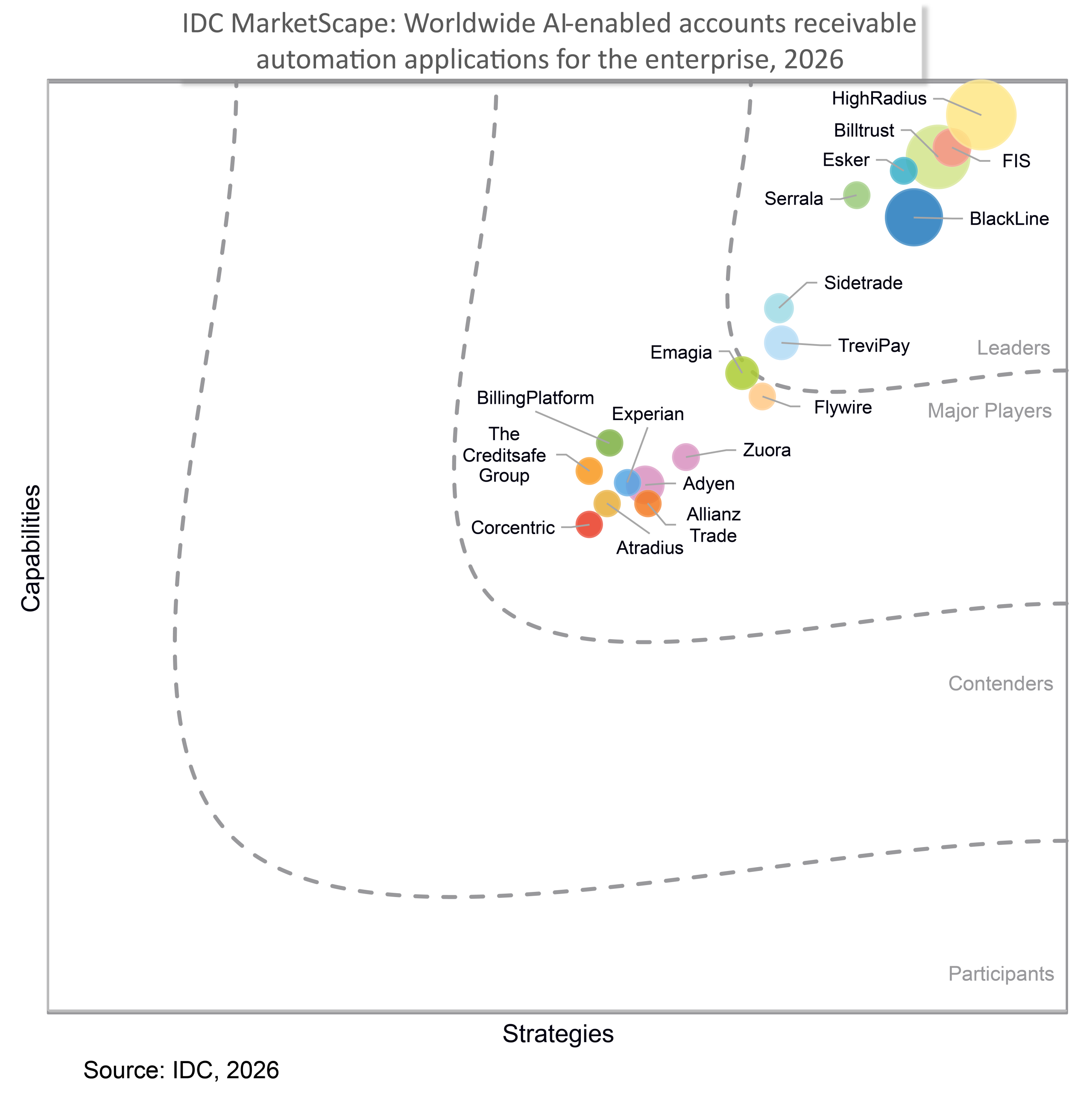
HighRadius recognized as a "Leader" in IDC Marketscape: Worldwide AI-enabled accounts receivable automation applications for the enterprise 2026 vendor assessment
Recognized as a Leader in 2026 Vendor Assessment for unifying credit, collections, cash application, deductions, e-invoicing, and payments on one AI platform to advance enterprise-wide invoice-to-cash transformation.
Forrester Recognizes HighRadius in The AR Invoice Automation Landscape Report, Q1 2023
Forrester acknowledges HighRadius’ significant contribution to the industry, particularly for large enterprises in North America and EMEA, reinforcing its position as the sole vendor that comprehensively meets the complex needs of this segment.