Here is a number that reframes the entire conversation about how businesses move money: the ACH Network processed 35.2 billion payments valued at $93 trillion in 2025, averaging 141 million transactions every single business day. That is not a niche payment rail. That is the backbone of American commerce. And yet, despite that scale, a staggering number of finance teams still manage ACH payments through manual bank portals, disconnected ERP workflows, and spreadsheet-based reconciliation, absorbing costs and delays that modern ACH payment processing platforms eliminated years ago.
The shift is accelerating. B2B volume on the ACH Network grew 9.9% from 7.4 billion to 8.1 billion payments in 2025, making it the fastest-growing major segment on the network. Paper checks now account for just 25% of B2B payment volume, down from a majority share less than a decade ago, and 75% of organizations that plan to eliminate checks cite manual processing inefficiency as the primary reason. In other words, the market has already made its decision. The businesses still debating what ACH payment processing can do for them are already behind the curve.
This guide is a complete reference for finance leaders, AR and AP teams, and enterprise decision-makers who need to understand ACH payments from the ground up — how they work, how they compare to wire transfers and EFT payments, what ACH processing times look like across different transaction types, and what modern ACH payment software delivers that traditional banking portals simply cannot.
Whether you're evaluating ACH payment solutions for the first time or looking to modernize an existing ACH payment processing workflow, this guide covers everything you need to know about ACH in 2026.
An ACH payment, short for Automated Clearing House payment, is an electronic funds transfer that moves money between bank accounts through the ACH Network, the centralized US payment infrastructure governed by NACHA.
Rather than processing transactions individually and immediately (as wire transfers do), the ACH Network batches transactions together, validates them, and clears them in scheduled processing windows throughout the business day.
At its most fundamental level, what ACH means in practice is this: instead of writing a check, handing over a card, or initiating an expensive wire transfer, a business or individual instructs their bank to electronically move a specific amount from one account to another. The ACH Network handles the messaging, routing, and settlement, all through a highly regulated, standardized infrastructure that every US bank and credit union participates in.
What does ACH mean for businesses specifically? ACH is one type of EFT payment; Electronic Funds Transfer is the broad category, and ACH is one specific method within it. This distinction matters because the terms are often conflated. An EFT payment includes ACH transfers, wire transfers, card transactions, and direct deposits, while ACH refers specifically to transactions that route through the Automated Clearing House network. So when someone asks, "Is ACH the same as EFT?", the accurate answer is that ACH is a type of EFT, but not all EFT payments are ACH.
ACH transactions come in two directions:
Both directions flow through the same ACH infrastructure, but they have different risk profiles, return windows, and use cases that finance teams need to understand when designing payment workflows.
The ACH Network processes transactions in batches, not individually — and that batch architecture is the source of both its cost efficiency and its processing timeline. Here is the end-to-end flow of a standard ACH payment:
The business or individual sending the payment) initiates the transaction through their bank, called the Originating Depository Financial Institution (ODFI). This can be done through a bank portal, an ACH payment platform, or an ERP-integrated ACH payment processing system. The originator submits an ACH file that includes the recipient's routing number, account number, transaction amount, and Standard Entry Class (SEC) code identifying the payment type.
The ODFI aggregates ACH entries into a batch file and submits it to an ACH Operator either the Federal Reserve (FedACH) or The Clearing House (TCH). This submission occurs at scheduled windows throughout the business day. Standard ACH entries submitted before the relevant cut-off time are processed in the next available batch.
The ACH Operator validates entries for formatting, routing number accuracy, and compliance requirements. Invalid entries are returned with standardized ACH return codes that identify the specific issue such as R01 (Insufficient Funds), R02 (Account Closed), or R10 (Customer Advises Originator Not Authorized).
The ACH Operator routes validated entries to the Receiving Depository Financial Institution (RDFI) the recipient's bank. Settlement timing depends on the ACH entry type: standard ACH entries typically settle in one to two business days; Same Day ACH entries submitted before specific daily cut-off times settle the same business day.
The RDFI posts the funds to the recipient's account. For ACH credits, Nacha rules require that funds be made available by the opening of business on the settlement date. For ACH debits, the RDFI has a return window typically two business days for most entry types during which it can return a transaction if there are issues.
Once settled, the transaction must be matched to the original invoice or payment record in the payer's financial system. Modern ACH payment software automates this step ingesting settlement data, matching payments to invoices, and posting GL entries without manual intervention.
The ACH Network supports multiple transaction types, each identified by a Standard Entry Class (SEC) code. Understanding the different types of ACH payments helps finance teams select the right format for each use case and ensure compliance with Nacha operating rules.
PPD (Prearranged Payment and Deposit): The most common consumer ACH format, used for payroll direct deposit and recurring consumer bill payments. Requires written or standing authorization from the account holder.
CCD (Corporate Credit or Debit): The standard format for B2B ACH payments. Used for business-to-business vendor payments, supplier settlements, and intercompany transfers. B2B payments are the ACH Network's most significant growth segment, and CCD is the format that carries the majority of that volume.
CTX (Corporate Trade Exchange): An enhanced B2B format that supports up to 9,999 addenda records per transaction — enabling businesses to include detailed remittance information (invoice numbers, line items, purchase order references) alongside the payment. Particularly valuable for complex AR/AP workflows where remittance data is needed for automated reconciliation.
WEB (Internet-Initiated Entries): Used for payments authorized via the internet, including online bill pay, e-commerce transactions, and digital payment portals. Internet-initiated ACH payments reached 11.41 billion transactions in 2025, making it the fastest-growing consumer payment channel on the ACH Network.
Same Day ACH is the accelerated tier of ACH payment processing that enables funds to be initiated, settled, and made available on the same business day. In 2025, there were 1.4 billion Same Day ACH payments valued at $3.9 trillion, a 16.7% increase in volume and a 21.4% increase in value over 2024.
The current per-payment limit for Same Day ACH is $1 million, and Nacha has proposed increasing this limit to $10 million, a change that would dramatically expand Same Day ACH's applicability for high-value B2B transactions currently routed through more expensive wire transfers.
Same Day ACH processes through three daily settlement windows, with the final window enabling funds availability by 5:00 PM local time at the receiving institution. For businesses that need faster ACH payment processing time without incurring wire transfer costs, Same Day ACH is frequently the optimal solution.
An eCheck payment, also called an electronic check payment, is a digital version of a paper check that uses the ACH debit system underneath. Rather than processing a physical check, the payer authorizes an electronic debit from their bank account by providing their routing and account number. That authorization is then submitted into the ACH Network as a debit entry, processed and settled through the same infrastructure as standard ACH transactions.
eCheck payment processing offers a digital check-like experience using ACH debit under the hood, making it significantly more modern and efficient than paper checks while following similar timing to standard ACH entries.
For B2B use cases, electronic check payments are particularly useful when customers are accustomed to check-based workflows but a business wants to eliminate paper handling, reduce NSF exposure, and accelerate remittance data capture. eCheck payment processing typically takes one to two business days, the same as standard ACH debit entries.
International ACH payments, also called Global ACH or Cross-Border ACH, are ACH transfers that move funds from a US-domiciled bank account to a bank account in another country. An International ACH Transfer uses local equivalents of ACH in different regions, EFT in Canada, SEPA in Europe, BACS in the UK, or BECS in Australia, to facilitate settlement on the recipient side.
Every international ACH payment is classified under the IAT (International ACH Transaction) SEC code, a regulatory designation required by Nacha and OFAC for all transactions entering or exiting the US. The IAT code ensures cross-border payments meet compliance standards, including data requirements for OFAC screening.
International ACH transfers typically cost between $0 and $10 per transaction compared to up to $75 for international wire transfers, making it a significantly more cost-effective option for businesses making regular international payments to suppliers, contractors, or subsidiaries. Settlement time for international ACH transfers ranges from one to five business days, depending on the destination country and the receiving banking system.
One of the most common questions finance teams face is what the difference between ACH and wire transfer is, and when to use each. The answer is not simply "use ACH for small payments and wires for large ones." The right choice depends on a combination of factors: urgency, transaction size, reversibility requirements, cost tolerance, and whether the payment is domestic or international.
Here is a comprehensive comparison:
| Factor | ACH Payment | Wire Transfer |
| Processing Speed | 1–2 business days (standard); same-day available | Same day, often within hours |
| Cost | $0.20–$1.50 per transaction typically | $25–$50 domestic; up to $75 international |
| Reversibility | Reversible within return window | Generally irreversible once sent |
| Geographic Reach | Primarily domestic US (international ACH available but limited) | Global — domestic and international |
| Transaction Limits | Up to $1M per Same Day ACH entry (standard has no federal limit) | Higher limits; ideal for large-value transactions |
| Settlement Certainty | Batch-processed; subject to returns | Point-to-point; final once received |
| Fraud Risk | Lower; governed by Nacha rules with consumer protections | Higher; irreversibility makes wires prime fraud targets |
| Best For | Recurring payments, payroll, vendor bills, B2B settlements | Urgent high-value payments, international wires, real estate |
ACH and EFT are often used as if they mean the same thing, but they refer to different levels of the same system. EFT is the broad category that includes all electronic money movement, while ACH is one specific method within that category. For finance teams, this distinction is important because choosing the right payment rail affects cost, speed, and control across payment workflows.
| Aspect | EFT (Electronic Funds Transfer) | ACH (Automated Clearing House) |
| Definition | Umbrella category for all electronic money transfers | A specific type of EFT processed through the ACH network |
| Scope | Includes ACH, wire transfers, card payments, direct deposits, and real-time payments like FedNow | Limited to bank-to-bank transfers via the ACH network |
| Nature | Broad classification, not a single payment method | A defined payment rail with standardized processing rules |
| Processing | Varies depending on method (real-time, same-day, or delayed) | Typically batch-processed, with standard or same-day settlement |
| Cost | Can range from low to high depending on method (wires are expensive, cards have fees) | Generally low-cost, especially for high-volume transactions |
| Speed | Depends on the rail used (instant for RTP, same-day or longer for others) | Usually 1–2 business days, or same day for eligible transactions |
| Reversibility | Depends on method (wires are irreversible, some EFTs are not) | Can be reversed within defined return windows |
| Common Use Cases | Broad usage including all types of electronic payments | Payroll, vendor payments, recurring billing |
In simple terms, ACH vs EFT is not a comparison of two competing options. EFT is the category, and ACH is one of the most commonly used methods within it. When finance teams evaluate EFT options, they are deciding which specific rail to use, and ACH is often the preferred choice for cost-efficient, high-volume domestic transactions.
ACH payment processing time is one of the most common questions from finance teams evaluating whether ACH can meet their operational requirements. The answer depends on which ACH entry type is being used and when the payment is submitted relative to daily cut-off windows.
Entries submitted before the ODFI's cut-off time are typically settled within one to two business days. Same-business-day submission before the cut-off results in next-day settlement for most standard ACH credits. ACH debits generally settle in one to two business days after the submission date.
Same Day ACH payments averaged 5.8 million per day in 2025, and 7.8 million per day in December 2025 - a clear indicator that businesses are actively shifting time-sensitive payments to faster ACH rails rather than defaulting to expensive wire transfers. Same Day ACH processes through three windows: 10:30 AM ET, 2:45 PM ET, and 4:45 PM ET, with funds available by 5:00 PM local time on the settlement date.
Settlement for international ACH transfers ranges from one to five business days depending on the destination country, the local clearing system used, and any compliance holds that trigger additional screening.
Cut-off windows matter enormously
A payment submitted five minutes after the ODFI's batch cut-off time misses that processing window and waits for the next one, adding an extra business day to settlement. Modern ACH payment platforms address this by automating submission timing to always catch the earliest available window for each transaction.
Bank holidays and weekends
Bank holidays and weekends add settlement days, as the ACH Network only processes on banking business days. Payments initiated on a Friday afternoon may not settle until the following Tuesday if the intervening days include a federal holiday.
Return windows must be factored in
While funds may appear settled, ACH debits carry a two-business-day return window for most entry types, meaning a payment that appears settled on Monday could still be returned by Wednesday if the RDFI rejects it.
For AR and AP teams at mid-market and enterprise businesses, ACH payment processing is not just a payment method, it is an operational strategy. B2B payments are the fastest-growing major ACH segment at nearly 10% annual volume growth, reflecting the ongoing corporate migration away from paper checks.
The economics are compelling. ACH transaction fees are typically a fraction of a dollar per transaction, compared to $25–$50 for wire transfers and 2–3% interchange for card payments. For an enterprise processing 10,000 B2B payments per month, the cost difference between ACH and wire for routine vendor settlements can amount to hundreds of thousands of dollars annually.
Beyond cost, ACH payments for B2B offer several operational advantages that are driving adoption across enterprise finance teams:
CTX-format ACH entries support thousands of addenda records, enabling businesses to include detailed invoice-level remittance data alongside the payment. This data can be ingested directly by ACH payment software for automated cash application, dramatically reducing the manual matching work that makes high-volume AR operations expensive.
The ACH Network transferred 8.74 billion direct deposits in 2025, and payroll direct deposit remains the most universal ACH use case. For businesses with distributed or international workforces, ACH payment processing for payroll provides cost-effective, reliable, and auditable payment delivery.
ACH debits enable businesses to automate recurring collections, whether monthly subscription charges, installment payments, or recurring service fees. Compared to card-based recurring billing, ACH payment processing for recurring collections reduces decline rates dramatically. Recurring ACH payments reduce payment declines by 80% or more compared to credit card transactions, a critical metric for AR teams managing recurring revenue streams.
ACH B2B transactions exceeded 8 billion in 2025, representing $63 trillion in value, and check replacement is the primary driver. Businesses processing checks for routine vendor payments absorb mailing costs, fraud risk, manual handling, and reconciliation overhead that ACH eliminates entirely.
As businesses expand internationally, international ACH payments provide a cost-effective alternative to SWIFT wire transfers for cross-border B2B payments to markets where ACH-equivalent infrastructure exists.
A global ACH or international ACH transfer moves funds across borders using ACH-like systems by relying on a network of domestic clearing houses to process international payments through local infrastructure. A US business initiating an international ACH transfer to a supplier in Germany, for example, would route through the US ACH network to SEPA in Europe, with the recipient receiving funds in their local bank account through the European clearing system.
Every international ACH payment from the US must be classified under the IAT (International ACH Transaction) SEC code. The IAT code ensures cross-border payments meet compliance standards, including data requirements for OFAC screening. The IAT format requires enhanced data fields, including the originator's details, the recipient's country, intermediary bank information, and the purpose of payment, beyond what standard domestic ACH entries require.
International ACH transfers typically cost between $0 and $10 per transaction, compared to up to $75 for international wire transfers, a cost advantage that compounds significantly for businesses making large volumes of regular international payments to contractors, suppliers, or overseas entities.
Coverage is not universal. Not every country's banking system accepts US ACH-originated payments, and even where coverage exists, settlement timelines are longer than domestic ACH, ranging from one to five business days depending on the corridor. For high-value, time-sensitive cross-border payments, wire transfers remain more appropriate. For regular, lower-value international payments to covered markets, international ACH transfers deliver meaningful cost savings.
Despite its advantages, ACH payment processing is not without friction — particularly at the enterprise scale where payment volumes are high and reconciliation complexity is significant.
ACH returns are a routine but operationally intensive aspect of payment processing. When the RDFI cannot process an ACH entry — due to insufficient funds, a closed account, incorrect routing numbers, or customer authorization disputes — it returns the entry with a standardized return code. Managing returns at scale requires both the technical infrastructure to receive and classify return files and the operational workflow to resolve exceptions, retry eligible transactions, and communicate with customers or suppliers.
One of the persistent challenges of ACH payment processing for AR teams is the disconnect between payment settlement and remittance data. Standard ACH credits often arrive with minimal identifying information — making it difficult for AR teams to match incoming payments to open invoices automatically without manual intervention. This is why remittance-rich formats like CTX and addenda-supported entries are critical for enterprise B2B use cases.
Missing ACH batch cut-off windows by even a few minutes delays settlement by a full business day — a consequence that can create cash flow disruptions for time-sensitive payments. Manually managing cut-off times across multiple banking relationships and payment runs is error-prone. Modern ACH payment platforms automate submission timing to ensure entries are always captured in the earliest available processing window.
While ACH is more secure than wire transfers in many respects, ACH fraud is not negligible. Unauthorized debit entries, account takeovers, and business email compromise attacks targeting ACH payment instructions are real and growing threats. Nacha has introduced enhanced fraud monitoring rules in 2026 requiring ODFIs to implement risk-based monitoring for ACH transactions — a regulatory shift that adds compliance requirements for businesses originating ACH payments.
International ACH payment processing introduces additional complexity beyond domestic transactions: IAT formatting requirements, OFAC screening, correspondent banking handoffs, and variable settlement timelines across markets. Without ACH payment software that automates IAT compliance and cross-border settlement tracking, international ACH operations quickly become manually intensive.
With many ACH payment platforms and processing solutions available in 2026, selecting the right one requires evaluating capabilities against your specific payment profile, transaction volumes, and operational requirements.
The single highest-value capability of enterprise ACH payment software is native ERP integration. A platform that connects directly to SAP, Oracle, or NetSuite — capturing payment data, matching settlements to invoices, and posting GL entries automatically — eliminates the manual export/import workflow that makes high-volume ACH operations expensive and error-prone.
For AR teams, the ability to ingest ACH settlement files with rich remittance data and automatically match payments to invoices is transformative. Look for ACH payment processing software that supports CTX addenda parsing, automatic exception routing, and AI-powered matching for remittances that arrive without complete invoice-level data.
If settlement speed matters for any portion of your payment volume, confirm that the platform fully supports Same Day ACH submission across all three daily processing windows. Some ACH payment platforms only support standard ACH and require separate workflow management for Same Day entries.
For businesses with international payment requirements, verify the platform's IAT compliance capabilities — including automated OFAC screening, IAT formatting validation, and multi-currency settlement support. Platforms that handle IAT compliance automatically reduce the manual burden of international ACH payment processing significantly.
Robust return handling is often underweighted in ACH platform evaluations. Confirm the platform can automatically receive, classify, and route ACH return codes — and that it supports both immediate exception resolution workflows and retry logic for retriable returns.
Verify that the ACH payment processing software meets Nacha's origination requirements, supports dual-approval workflows for payment authorization, and includes account validation features such as micro-deposit verification or bank account validation services to reduce unauthorized debit risk.
The ACH Network is growing fast, and the direction is clear. In 2025, it processed 35.2 billion payments worth $93 trillion, marking the 13th straight year of more than $1 trillion in value growth. This is not just scale, it signals how central ACH has become to modern payment infrastructure. Going forward, a few key shifts will shape how ACH evolves.
Nacha has proposed increasing the per-transaction limit for Same Day ACH from $1 million to $10 million. If implemented, this would allow a much larger share of high-value B2B payments to move through ACH instead of wires. For finance teams, that means faster payments without the high cost typically associated with urgent transactions.
AI is being applied across ACH processing to remove manual effort and improve accuracy. It can optimize submission timing to meet cut-off windows, predict returns before they happen, match remittance data automatically, and detect anomalies. This is especially valuable for high-volume B2B environments where reconciliation has traditionally been slow and manual.
With systems like FedNow and RTP growing, real-time payments are becoming more accessible. But instead of replacing ACH, they are working alongside it. Real-time rails handle urgent, time-sensitive payments, while ACH continues to dominate for high-volume, cost-sensitive transactions.
As ISO 20022 standards become more common, ACH payments will carry richer and more structured remittance data. This makes it easier to automate reconciliation, improves straight-through processing rates, and reduces the need for manual exception handling.
International ACH capabilities are growing as more countries adopt ACH-like systems and cross-border processing becomes more streamlined. This makes ACH a more practical alternative to SWIFT wires for many cross-border B2B payments, especially where cost efficiency matters more than speed.
HighRadius helps finance teams operationalize ACH payments at scale by combining automation, intelligence, and seamless ERP integration into a unified platform. The result is faster processing, lower costs, and greater control over payment operations.
Automate the full ACH payment lifecycle, from payment initiation to settlement and reconciliation. Reduce manual intervention and ensure consistent processing across high-volume transactions.
Route payments through the most efficient rail based on cost, urgency, and business rules. Ensure ACH is used where it delivers maximum value, while maintaining flexibility for other payment methods when needed.
Ingest remittance data and settlement files automatically, match payments to invoices, and post entries to the general ledger without manual effort. Improve accuracy and reduce the time spent on cash application.
Ensure adherence to Nacha rules with embedded compliance checks, authorization tracking, and audit trails. Strengthen governance with configurable approval workflows and role-based access controls.
Gain complete visibility into payment status, exceptions, and cash flow impact. Use real-time dashboards and reporting to support better decision-making and faster issue resolution.
Handle large-scale ACH payment volumes without performance bottlenecks. Support growing transaction volumes while maintaining speed, accuracy, and reliability
For finance teams looking to eliminate check dependency, accelerate cash application, and scale payment operations without scaling headcount, HighRadius delivers the ACH payment solution purpose-built for enterprise requirements.

An ACH payment is an electronic funds transfer processed through the Automated Clearing House network, the US payment infrastructure governed by Nacha. ACH payments move money between bank accounts in batches, supporting both ACH credits (push payments, like payroll) and ACH debits (pull payments, like recurring billing). They are used for direct deposit, vendor payments, bill pay, B2B settlements, and eCheck payment processing.
ACH stands for Automated Clearing House, the centralized US electronic payment network that processes bank-to-bank transfers between financial institutions. When people ask what does ACH mean on a bank statement, it indicates a payment was processed through this network rather than via a wire, card, or paper check.
The key differences between ACH vs wire transfer are speed, cost, reversibility, and reach. ACH payments take one to two business days (or same-day with Same Day ACH) and cost pennies per transaction. Wire transfers settle in hours and cost $25–$50 domestically. ACH is reversible within the return window, while wire transfers are generally irreversible. Wire transfers can be sent internationally, while standard ACH is primarily domestic, though international ACH exists via IAT.
ACH payment processing time depends on the entry type. Standard ACH entries typically settle in one to two business days. Same Day ACH entries submitted before daily cut-off windows settle the same business day. International ACH transfers take one to five business days depending on the destination country. eCheck payment processing time follows the same timeline as standard ACH debit entries.
EFT (Electronic Funds Transfer) is the broad category for any electronic movement of money, including wire transfers, card transactions, direct deposits, and ACH payments. ACH is one specific type of EFT that processes through the Automated Clearing House network. So ACH vs EFT is not a comparison between two competing options. ACH is a subset of EFT.
An eCheck payment, or electronic check payment, is a digital payment that uses the ACH debit system underneath. The payer provides their bank routing and account number, authorizes an electronic debit, and the payment is processed through the ACH Network, eliminating the paper check while retaining the familiar bank-account-based payment experience. eCheck payment processing typically takes one to two business days.
An international ACH transfer, also called a Global ACH, is an ACH payment that crosses US borders, moving funds from a US bank account to a recipient in another country through that country's local clearing system. Every international ACH payment is classified under the IAT (International ACH Transaction) SEC code and is subject to OFAC screening and additional compliance requirements. International ACH transfers typically cost $0–$10 per transaction, compared to up to $75 for international wires.
ACH payment processing refers to the end-to-end workflow of initiating, batching, routing, settling, and reconciling ACH transactions through the Automated Clearing House network. Modern ACH payment processing software automates this entire flow, from payment file generation and cut-off time management to return handling, remittance matching, and ERP posting.
Yes, direct deposit is a specific application of ACH payment processing. Is ACH the same as direct deposit? Not exactly. ACH is the underlying network and payment rail, while direct deposit is one of many use cases that runs on it. Payroll direct deposit uses ACH credits to push funds from an employer's bank account to employee accounts through the ACH Network. So all direct deposits are ACH transactions, but not all ACH transactions are direct deposits.
When evaluating ACH payment software or ACH payment processing software, businesses should prioritize ERP-native integration for automated reconciliation, Same Day ACH support, robust return file management with automated exception routing, remittance data parsing for cash application automation, IAT compliance for international ACH payments, dual-approval security workflows, and Nacha compliance certification. Enterprise-grade ACH payment platforms combine all of these capabilities with AI-driven automation for high-volume B2B payment operations.

Positioned highest for delivering comprehensive automation across collections, credit, deductions, disputes, and multi-ERP integration - enabling standardized, scalable I2C transformation.
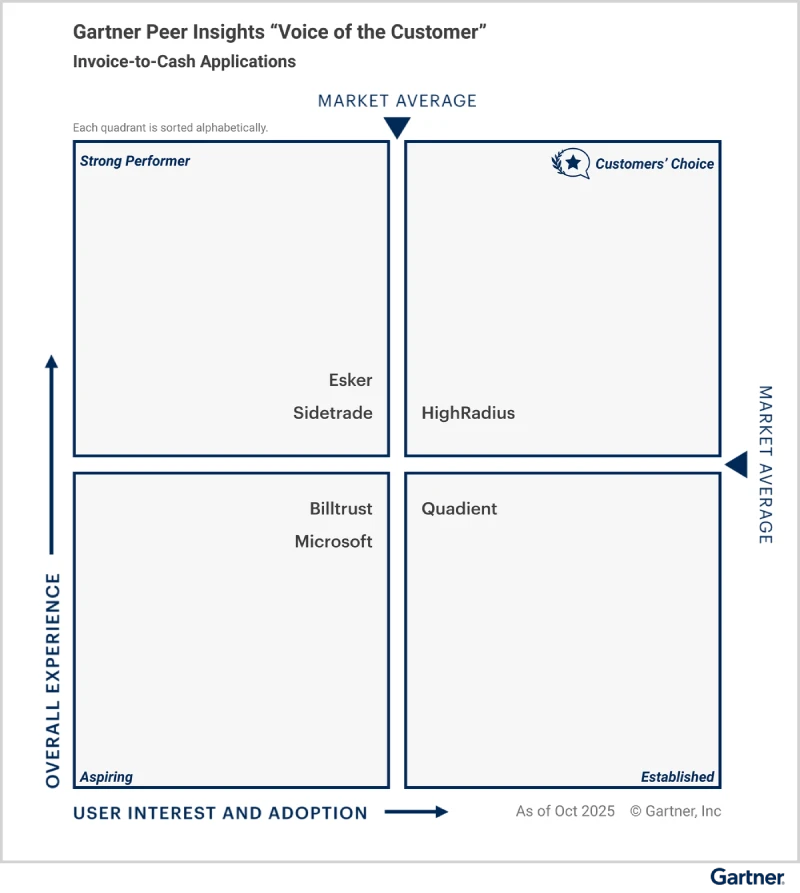
Explore why HighRadius has been a Digital World Class Vendor for order-to-cash automation software – two years in a row.

HighRadius stands out as an IDC MarketScape Leader for AR Automation Software, serving both large and midsized businesses. The IDC report highlights HighRadius’ integration of machine learning across its AR products, enhancing payment matching, credit management, and cash forecasting capabilities.

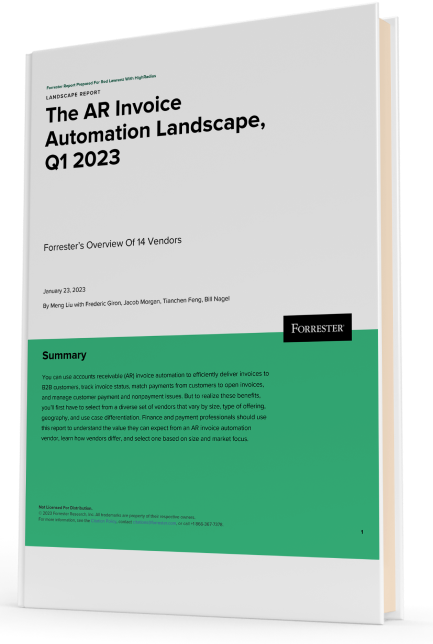
Forrester acknowledges HighRadius’ significant contribution to the industry, particularly for large enterprises in North America and EMEA, reinforcing its position as the sole vendor that comprehensively meets the complex needs of this segment.
Customers globally
Implementations
Transactions annually
Patents/ Pending
Continents
Explore our products through self-guided interactive demos
Visit the Demo CenterPlease fill in the details below
Please fill in the details below

We have seen financial services costs decline by $2.5M while the volume, quality, and productivity increase.

Colleen Zdrojewski
Trusted By 1300+ Global Businesses


