Shahid Baig specializes in finance and payments, focusing on building strategic narratives for B2B SaaS products that support organic and digital marketing strategies. As a CFO Tech Product Specialist, he works at the intersection of growth, product, and strategy for HighRadius' O2C & AP products, translating industry concepts into clear, insight-driven content that enables informed decision-making. His work is rooted in combining domain knowledge with user-centric storytelling to create content that is both accessible and impactful for business audiences.
Beyond his professional work, Shahid draws from a background in writing and theatre, bringing a distinct narrative depth, storytelling prowess, and clarity to his content. His approach remains focused on one principle: making complex ideas simple, without losing their strategic essence.
Analyst Recognition
HighRadius Named a Leader in the 2024 Gartner® Magic Quadrant™ for Invoice-to-Cash Applications
Positioned highest for Ability to Execute and furthest for Completeness of Vision for the third year in a row, HighRadius continues to lead in B2B payments automation.
The global cross-border B2B payments market is valued at $1.67 trillion in 2026, and growing at a CAGR of 10.79% through 2035, according to Global Growth Insights. The scale of that number tells one story. But here's the more revealing one: 63% of businesses say they demand faster settlements, 58% cite a lack of transparency as a key pain point, and 49% report serious reconciliation inefficiencies in their cross-border payment operations. In other words, despite enormous market growth, most finance teams are still wrestling with the same broken workflows that have plagued international payments for decades.
This is exactly the problem that modern cross-border payment software is built to solve. Today's best international payment platforms don't just move money: they automate the entire payment lifecycle from multi-rail routing and FX optimization to real-time reconciliation and ERP posting, all within a single system. Powered by AI, the leading cross-border B2B payment solutions now dynamically select the most cost-effective payment rail for every transaction, automatically match settlements to invoices, and flag exceptions before they become month-end headaches.
In this guide, we review the 10 best cross-border payment platforms in 2026 - what they do, how they compare, and what to look for when evaluating international B2B payment software for your enterprise. Whether you're a CFO looking to reduce FX leakage, an AR leader trying to eliminate manual reconciliation, or a finance transformation lead evaluating B2B payment software for a global rollout, this breakdown will give you a clear picture of what the market looks like, and who leads it.
Table of Contents
Top Cross-Border Payment Platforms at a Glance
What Is a Cross-Border Payment Platform?
Why Businesses Need a Cross-Border Payment Platform?
10 Best Cross-Border Payment Platforms in 2026
How to Choose the Right Cross-Border Payment Software?
The Future of Cross-Border B2B Payments: How AI Is Transforming International Payment Operations
Conclusion
Top Cross-Border Payment Platforms at a Glance
With many cross-border payment solutions offering different capabilities, selecting the right platform can be challenging. Some providers focus on FX transparency and international transfers, while others deliver broader cross-border B2B payment processing capabilities including multi-rail routing, ERP integration, and end-to-end automation.
The table below highlights some of the top international payment platforms and their primary focus areas to help finance teams quickly compare the options.
API-based cross-border infrastructure for fintechs and financial platforms
Contact For Pricing
Each of these cross-border payment solutions offers capabilities designed to streamline international payment workflows, support multiple currencies and payment rails, and help businesses manage global transaction volumes more efficiently.
In the next section, we'll look at what a cross-border payment platform actually is and how it helps organizations modernize their international payment operations.
What Is a Cross-Border Payment Platform?
A cross-border payment platform is software that helps businesses send, receive, and manage payments across international borders. Rather than relying on manual wire instructions, disconnected banking portals, and spreadsheet-based FX tracking, these platforms centralize the entire international payment process: from payment capture and currency conversion to settlement and reconciliation, into a single system.
Modern international payment platforms support multiple payment rails, including SWIFT, SEPA, RTP, Faster Payments, BECS, and local direct debit, allowing businesses to route transactions through the most efficient and cost-effective channel for each market. They also integrate directly with ERP and accounting systems to automatically post payment data, reconcile settlements against invoices, and maintain accurate financial records across currencies and entities.
What separates today's best cross-border payment software from legacy banking tools is intelligence. AI-powered routing engines can now analyze transaction patterns, assess FX spreads, and dynamically select the optimal processing path in real time, helping businesses reduce payment costs and maximize success rates across global payment corridors.
Why Businesses Need a Cross-Border Payment Platform?
As global trade volumes grow and supplier and customer networks expand across borders, managing international payments manually becomes increasingly difficult. Finance teams dealing with multiple banking portals, inconsistent FX rates, and manual reconciliation across currencies face delays, errors, and visibility gaps that directly impact cash flow and financial reporting accuracy.
Modern cross-border B2B payment platforms help businesses tackle these challenges head-on: automating payment workflows, centralizing FX management, and improving control over international transaction activity. Here are the key reasons organizations are adopting international payment software to modernize their global payment operations.
International B2B payments involve far more complexity than domestic transactions. Currency conversion, correspondent bank fees, varying settlement timelines, and multi-entity accounting make manual processes error-prone and slow. Cross-border payment solutions centralize these workflows by supporting multiple currencies and payment rails within a single platform, enabling finance teams to manage global payments consistently and efficiently.
2. Optimize FX Costs and Reduce Payment Slippage
Hidden FX spreads and intermediary bank fees are among the biggest sources of cost leakage in international payment operations. Leading cross-border payment platforms provide centralized FX rate management, preferred-rate routing, and netting across entities, helping businesses reduce the total cost of cross-border B2B payments while improving net cash retention.
3. Improve Visibility Into Global Payment Operations
International payment data is often scattered across multiple banking portals, regional ERP instances, and currency ledgers. Cross-border payment software consolidates this information into a unified dashboard, giving finance teams real-time visibility into payment status, FX impact, and settlement timelines across all global markets.
4. Automate Reconciliation Across Currencies and Entities
Matching international payments to invoices across different currencies, entities, and payment rails is one of the most time-consuming tasks for AR and AP teams. Modern international payment platforms automate this entire process, ingesting settlement files, matching receipts to invoices, and posting GL entries automatically across currencies, dramatically reducing manual reconciliation work.
5. Ensure Global Compliance and Payment Security
Cross-border B2B payments are subject to a complex and evolving landscape of regulatory requirements, including AML screening, sanctions checks, and local payment compliance. Leading cross-border payment processing platforms embed compliance controls directly into payment workflows, with features such as transaction velocity limits, country-level controls, fraud detection, and PCI DSS certification to safeguard international transactions.
10 Best Cross-Border Payment Platforms in 2026
As organizations modernize their international financial operations, selecting the right platform becomes essential. The top cross-border payment solutions offer a range of capabilities, from automating multi-currency reconciliation to enabling secure cross-border B2B payment processing across dozens of markets. Below are the leading international payment platforms businesses use to manage and scale their global payment operations.
1. HighRadius
HighRadius Cross-Border Payment Solution is an agentic AI-driven, enterprise-grade international payment platform purpose-built to automate the full lifecycle of cross-border B2B payments, from payment capture and FX optimization to multi-entity settlement and ERP reconciliation. Designed for high-volume, complex enterprise environments, the platform enables businesses to accept and process international payments across multiple rails and currencies while automatically matching transactions to invoices and posting directly to ERP records.
What makes HighRadius stand out among cross-border payment solutions is the depth of its AI-powered payment orchestration. Rather than applying generic routing rules, HighRadius uses agentic AI to score each transaction in real time: selecting the optimal processor, local rail, or FX path based on cost, success rate, and settlement speed. The platform supports SEPA, SWIFT, RTP, Faster Payments, BECS, BACS, NACHA, and local direct debit rails, enabling businesses to route payments through the most efficient channel for each market without manual intervention.
HighRadius also addresses one of the most persistent pain points in international payment operations: FX cost management. The platform provides centralized FX rate management with preferred-rate routing, netting across multi-entity structures, and automated fee allocation for multi-currency receipts, giving treasury and finance teams clear visibility into FX impact per invoice for accurate P&L treatment. This level of control, combined with automated GL posting across currencies and entities, makes it a genuinely enterprise-grade international payment software rather than a simple payment gateway.
For enterprises managing large volumes of global receivables, HighRadius delivers measurable outcomes, including up to a 10-day reduction in DSO and 90% automation of payment workflows through AI agents. The platform maintains 100% global PCI DSS compliance and connects natively with SAP, Oracle, NetSuite, and other major ERP systems. HighRadius is also recognized as a Leader in the IDC MarketScape for Embedded Payment Applications, validating its enterprise approach to B2B payment automation within the order-to-cash process.
Key Features:
Multi-Rail Cross-Border Payment Processing: Supports SEPA, SWIFT, RTP, Faster Payments, BECS, BACS, NACHA, and local direct debit rails for streamlined cross-border payment processing across global markets.
AI-Powered Payment Routing: Agentic AI scores each international transaction in real time, selecting the optimal processor, rail, and FX path by cost, success rate, and FX spread to maximize efficiency across cross-border B2B payments.
Centralized FX Rate Management: Preferred-rate routing and centralized FX management within a unified cross-border payment platform, with netting and multi-entity settlement to reduce costs associated with international B2B payments.
Multi-Currency Payment Acceptance: Accepts payments in 150+ currencies and 200+ local payment methods from a single international payment platform, enabling seamless global collections for enterprise AR teams.
Automated Multi-Currency Reconciliation: Auto-matches receipts to invoices and posts GL journals automatically across currencies and entities, with exception worklists for manual review in complex cross-border B2B payment workflows.
ERP-Native Integration: Native connectors for SAP, Oracle, NetSuite, and other major ERP systems for seamless international payment software integration with existing financial infrastructure.
FX Impact Reporting: Provides clear visibility into FX impact per invoice for accurate P&L treatment and automated fee allocation for multi-currency receipts across global operations.
Compliance and Risk Controls: Maintains 100% global PCI DSS compliance with transaction velocity limits, country-level controls, and processor thresholds for global risk management within a secure international payment platform.
Dynamic Failover and Rail Optimization: Automatically switches to alternate rails or local payment options when primary routes fail, ensuring continuity and cost efficiency across all cross-border payment processing scenarios.
2. Airwallex
Airwallex provides global payment processing capabilities designed to help enterprises manage international transactions, multi-currency accounts, and cross-border B2B payments. The platform is particularly suited for businesses expanding globally that need broad currency coverage and a developer-friendly infrastructure for embedding payments into existing workflows.
Key Features:
Global payment processing across multiple corridors and currencies
Multi-currency accounts and wallets for holding and converting funds
Cross-border B2B payment support with competitive FX rates
Integration with business systems and accounting platforms
Transaction monitoring, reporting, and reconciliation tools
3. Wise Business
Wise Business offers transparent, low-cost international payment software focused on simplifying cross-border transfers for small and mid-sized businesses. The platform is known for its real mid-market exchange rates and straightforward fee structure, making it a popular choice for finance teams that prioritize FX cost visibility in international B2B payments.
Key Features:
Transparent FX pricing using mid-market exchange rates
Multi-currency accounts for holding and managing funds internationally
Real-time tracking of cross-border payment transfers
Integration with accounting platforms for financial reconciliation
Batch payment capabilities for paying multiple international recipients
4. Payoneer
Payoneer provides global payment services designed to help businesses manage mass payouts and receive international payments across 190+ countries. The platform is widely used by organizations working with global marketplaces, freelancers, and international suppliers who require flexible local-like payout experiences.
Key Features:
International B2B payment processing across 190+ countries
Multi-currency accounts for managing global funds
Mass payout capabilities for high-volume international disbursements
Working capital and financial management tools
Integration with global marketplace platforms
5. Tipalti
Tipalti focuses on cross-border accounts payable automation and supplier payment management for mid-sized to enterprise businesses. The platform helps organizations manage international supplier payments across 120+ local currencies and 200+ countries with built-in tax compliance and payment verification features.
Key Features:
Cross-border supplier payment automation across 200+ countries
Support for 120+ local currencies and payment methods
Tax compliance features, including W-8/W-9 collection
Supplier onboarding and payment verification workflows
ERP integration for payment data synchronization
6. Flywire
Flywire focuses on enabling global payment collections across industries including education, healthcare, and B2B verticals. The platform helps organizations manage cross-border payment processing and currency conversions with industry-specific workflows that simplify international receivables.
Key Features:
Cross-border payment collections for specialized industry verticals
Multi-currency payment support with FX management tools
Payment tracking and real-time transaction status visibility
Integration with financial systems and student/patient portals
Security and compliance features for international transactions
7. Stripe
Stripe offers a developer-first payment infrastructure that allows businesses to accept and manage digital payments globally through APIs and payment gateways. Organizations commonly use Stripe's international payment software to support online payment experiences across global markets, particularly for digital and e-commerce B2B transactions.
Key Features:
Payment gateway and API infrastructure for global payment acceptance
Support for multiple currencies and international payment methods
Developer tools for building custom cross-border payment workflows
Fraud detection and security controls for global transactions
Payment reporting and analytics dashboards
8. Convera
Convera (formerly Western Union Business Solutions) provides high-volume B2B FX and cross-border payment processing capabilities for enterprise treasury teams. The platform specializes in foreign exchange solutions and international wire payments, serving businesses that require large-scale international B2B payment management with access to global banking networks.
Key Features:
High-volume international B2B payment processing and FX solutions
Access to global banking networks for cross-border payment processing
Foreign exchange risk management tools
Multi-currency payment capabilities and global payment corridors
Reporting and compliance features for international transactions
9. OFX Business
OFX Business provides competitive foreign exchange rates and international payment software for businesses executing high-volume cross-border transfers. The platform is designed for organizations looking to reduce FX costs while maintaining reliable settlement timelines for international B2B payments.
Key Features:
Competitive FX rates for high-volume international transfers
Multi-currency international payment capabilities
Real-time rate alerts and FX risk management tools
Integration with business accounting systems
Dedicated dealer support for large cross-border payment transactions
10. Currencycloud (by Visa)
Currencycloud provides API-based international payment infrastructure designed for fintech companies and financial platforms that want to embed cross-border B2B payment capabilities directly into their products. Rather than offering a ready-made front-end, it delivers modular infrastructure for multi-currency wallets, FX automation, and international payment routing.
Key Features:
API-based cross-border payment infrastructure for fintech platforms
Multi-currency wallets for holding and converting funds programmatically
FX rate access and automated currency conversion tools
Modular integration for embedding international payment software into existing platforms
Compliance and regulatory support for cross-border payment processing
How to Choose the Right Cross-Border Payment Software?
Selecting the right international payment platform from the many cross-border payment solutions available today requires careful evaluation. Businesses must consider not only multi-currency payment capabilities but also how well the platform integrates with existing ERP systems, handles compliance across jurisdictions, and supports long-term scalability as global transaction volumes grow.
The right cross-border payment software should help automate international payment workflows, improve FX cost visibility, and reduce the operational complexity that comes with managing payments across multiple markets and entities. Below are the key factors businesses should evaluate when selecting a cross-border B2B payment platform.
1. Multi-Rail Connectivity and Payment Method Coverage
A reliable international payment platform should support multiple payment rails, including SWIFT, SEPA, ACH, RTP, Faster Payments, and local direct debit across the markets where your business operates. This flexibility ensures finance teams can route cross-border B2B payments through the most efficient and cost-effective channel without relying on a single banking relationship or settlement network.
2. FX Rate Management and Cost Optimization
Foreign exchange costs are often the largest hidden expense in international B2B payments. Businesses should look for cross-border payment solutions that offer centralized FX rate management, preferred-rate routing, and netting across entities to reduce slippage. Platforms that provide real-time FX impact visibility per invoice give treasury teams the data they need to make informed hedging and routing decisions.
3. ERP and Accounting System Integration
Direct integration with ERP and accounting systems is essential for automating reconciliation across currencies and entities. Leading cross-border payment platforms provide native connectors that automatically link international receipts to invoices, post GL entries across multi-entity structures, and eliminate the manual data entry that creates errors in cross-border payment processing workflows.
4. Automation Across the International Payment Process
The best international payment software goes beyond simple transaction processing to automate multiple steps: payment capture, currency conversion, settlement, reconciliation, and reporting. AI-driven platforms can further enhance this by automating up to 90% of international payment workflows. selecting optimal rails, matching receipts, and flagging exceptions without human intervention.
5. Global Compliance and Security Capabilities
Cross-border B2B payments are subject to strict regulatory requirements that vary across jurisdictions. Businesses should prioritize international payment platforms that embed compliance controls, including AML screening, sanctions monitoring, country-level limits, and PCI DSS certification, directly into payment workflows to reduce regulatory risk as global operations scale.
6. Multi-Entity and Multi-Currency Reporting
For enterprises managing payments across multiple legal entities and currencies, consolidated reporting is critical. Strong international payment software provides unified GL posting across entities and currencies, FX impact reporting per invoice, and settlement analytics that give CFOs and treasury teams the financial visibility they need to manage global cash flow effectively.
7. Scalability and Global Market Coverage
As international transaction volumes grow, the platform should scale without requiring significant operational overhead. Businesses should evaluate the number of supported currencies, payment corridors, and processing relationships that a cross-border payment solution offers, as well as its ability to support future market expansion through dynamic failover and intelligent rail selection.
The Future of Cross-Border B2B Payments: How AI Is Transforming International Payment Operations
Cross-border B2B payments are entering a new era. Global transaction volumes are expected to reach $58.9 trillion by 2026 and grow to $62.9 trillion by 2030.
For finance teams, this growth exposes the limitations of legacy banking systems, manual payment workflows, and slow settlement processes. Organizations now require payment infrastructure that delivers:
Faster settlement times
Lower FX and processing costs
Real-time payment visibility
Higher payment success rates
AI-powered cross-border payment platforms are emerging as the solution. By embedding intelligence directly into payment operations, these platforms are transforming how global B2B payments are executed, routed, and reconciled. Below are the key trends shaping the future of international payment software.
1. AI-Driven Payment Routing
Modern platforms use agentic AI to dynamically determine the best payment path.
Instead of static rules, AI evaluates multiple variables in real time:
FX spreads across providers
Processing and intermediary bank fees
Corridor success rates
Settlement timelines
Historical payment performance
Impact:
Lower cross-border payment costs
Reduced payment failures
Faster transaction settlement
Optimized global payment routing
2. Automated Cross-Border Reconciliation
Reconciling international payments has traditionally been complex due to:
Multiple currencies
Multi-entity transactions
Varying settlement timelines
Fragmented bank reporting formats
AI-driven reconciliation engines now automate this process by:
Ingesting multi-currency settlement files
Matching payments to invoices automatically
Identifying exceptions in real time
Posting GL entries across entities
Impact:
Faster reconciliation cycles
Reduced manual intervention
Improved financial accuracy
Real-time payment visibility
3. Expansion of Local Payment Rails
Global businesses are moving beyond SWIFT-only payment strategies. Modern cross-border platforms integrate with regional clearing networks to support local payment methods across major markets.
Key capabilities include:
Direct connections to local payment rails
Automatic routing through optimal clearing networks
Local currency settlement options
Faster payment processing across regions
Impact:
Lower transaction costs
Faster settlement speeds
Improved payment success rates
Better regional payment coverage
4. AI-Powered Compliance and Risk Monitoring
Cross-border payments must comply with increasingly complex global regulations. Leading international payment platforms embed real-time compliance intelligence directly into payment workflows.
Capabilities include:
Automated sanctions screening
Real-time compliance checks
IBAN verification
Dynamic country-level regulatory controls
Continuous transaction monitoring
Impact:
Reduced compliance risk
Faster payment approvals
Stronger audit trails
Lower operational burden for finance teams
5. Embedded Global Payment Operations
The next generation of cross-border payment platforms will be deeply embedded into enterprise systems.
Instead of operating as standalone tools, payment capabilities will integrate directly with:
ERP platforms
Order-to-cash workflows
Treasury systems
Accounts payable operations
Impact:
End-to-end payment visibility
Automated global payment execution
Integrated financial workflows
Real-time treasury insights
What This Means for Global Businesses
Organizations adopting AI-powered cross-border payment platforms will gain significant advantages:
Lower FX and processing costs
Faster international payment settlement
Automated reconciliation and compliance
Greater visibility into global cash flows
Scalable infrastructure for international expansion
As global payment ecosystems grow more complex, intelligent automation will become the foundation of modern cross-border payment operations.
Conclusion
Managing cross-border B2B payments has become one of the most complex financial challenges for enterprises operating in global markets. Between currency volatility, correspondent banking delays, multi-entity reconciliation, and evolving compliance requirements, the stakes of getting international payment operations wrong are high, and the costs of relying on manual processes are growing.
HighRadius addresses these needs by combining enterprise-grade cross-border payment processing, agentic AI-driven FX optimization, and deep ERP integration into a unified platform. By automating payment capture, rail selection, multi-currency reconciliation, and GL posting across global entities, HighRadius enables finance teams to simplify international payment operations while improving cash flow visibility and reducing DSO. With support for 150+ currencies, 200+ local payment methods, and 100% PCI DSS compliance, it is built for enterprises that cannot afford operational gaps in their global payment infrastructure.
As businesses continue to expand internationally and cross-border transaction volumes grow toward $62.9 trillion by 2030, investing in the right cross-border payment software in 2026 will be a defining decision for finance teams. The platforms that combine intelligent automation, global rail coverage, and real-time visibility will not only reduce payment costs but also become a genuine competitive advantage in managing global financial operations.
Frequently Asked Questions (FAQs)
1. What is a cross-border payment platform?
A cross-border payment platform is software that helps businesses send, receive, and manage international payments between companies across different countries and currencies. These solutions automate the international payment process, support multiple payment rails such as SWIFT, SEPA, ACH, and local bank transfers, and integrate with ERP systems to streamline cross-border B2B payments at scale.
A cross-border payment platform is software that helps businesses send, receive, and manage international payments between companies across different countries and currencies. These solutions automate the international payment process, support multiple payment rails such as SWIFT, SEPA, ACH, and local bank transfers, and integrate with ERP systems to streamline cross-border B2B payments at scale.
2. How does cross-border payment processing work?
Cross-border payment processing begins when an invoice is generated for an international buyer or supplier. The transaction is authorized, converted to the recipient’s currency if needed, routed through global payment rails (SWIFT, SEPA, or local rails), settled through correspondent banking networks, and then reconciled against the original invoice in the business’s financial systems.
Cross-border payment processing begins when an invoice is generated for an international buyer or supplier. The transaction is authorized, converted to the recipient’s currency if needed, routed through global payment rails (SWIFT, SEPA, or local rails), settled through correspondent banking networks, and then reconciled against the original invoice in the business’s financial systems.
3. What are the benefits of using cross-border payment software?
Modern cross-border payment solutions in 2026 help businesses automate international payment workflows, reduce FX costs, improve transaction visibility, and accelerate global payment cycles. They also allow organizations to manage multiple currencies and payment rails through a centralized international payment platform.
Modern cross-border payment solutions in 2026 help businesses automate international payment workflows, reduce FX costs, improve transaction visibility, and accelerate global payment cycles. They also allow organizations to manage multiple currencies and payment rails through a centralized international payment platform.
4. What payment methods do cross-border payment platforms support?
Most cross-border B2B payment platforms support SWIFT wire transfers, SEPA transfers, ACH and local direct debit, virtual cards, and digital payment portals. Many also support real-time payment rails such as RTP, Faster Payments, and BECS for specific markets.
Most cross-border B2B payment platforms support SWIFT wire transfers, SEPA transfers, ACH and local direct debit, virtual cards, and digital payment portals. Many also support real-time payment rails such as RTP, Faster Payments, and BECS for specific markets.
5. How is AI used in cross-border payment processing?
AI in cross-border payment processing helps automate tasks such as FX rate optimization, payment routing, fraud detection, reconciliation, and anomaly detection. AI-driven intelligence can also help finance teams choose the most cost-effective payment rail for each international transaction in real time.
AI in cross-border payment processing helps automate tasks such as FX rate optimization, payment routing, fraud detection, reconciliation, and anomaly detection. AI-driven intelligence can also help finance teams choose the most cost-effective payment rail for each international transaction in real time.
6. What should businesses look for when selecting cross-border payment software?
When evaluating international B2B payment platforms, businesses should consider support for multiple payment rails and currencies, ERP integration, automation capabilities, FX rate management, global compliance, security certifications, and reporting features.
When evaluating international B2B payment platforms, businesses should consider support for multiple payment rails and currencies, ERP integration, automation capabilities, FX rate management, global compliance, security certifications, and reporting features.
7. How do cross-border payment platforms improve the invoice payment process?
Modern platforms automate multiple steps in the international invoice payment process, including currency conversion, payment capture, authorization, reconciliation, and GL posting. This reduces manual work, minimizes FX errors, and allows finance teams to manage global payments more efficiently from a single system.
Modern platforms automate multiple steps in the international invoice payment process, including currency conversion, payment capture, authorization, reconciliation, and GL posting. This reduces manual work, minimizes FX errors, and allows finance teams to manage global payments more efficiently from a single system.
8. Who uses cross-border B2B payment platforms?
Cross-border payment processing platforms are commonly used by finance teams, treasury departments, AR and AP teams in enterprises and mid-sized businesses that manage high volumes of international supplier payments, customer collections, and multi-currency transactions across different regions.
Cross-border payment processing platforms are commonly used by finance teams, treasury departments, AR and AP teams in enterprises and mid-sized businesses that manage high volumes of international supplier payments, customer collections, and multi-currency transactions across different regions.
9. What is the difference between SWIFT and local payment rails?
SWIFT is the global financial messaging network used for international wire transfers between banks across countries. Local payment rails such as SEPA (Europe), BECS (Australia), or Faster Payments (UK) are domestic clearing systems that offer faster and often lower-cost settlement within specific markets. Leading cross-border payment solutions support both for maximum flexibility.
SWIFT is the global financial messaging network used for international wire transfers between banks across countries. Local payment rails such as SEPA (Europe), BECS (Australia), or Faster Payments (UK) are domestic clearing systems that offer faster and often lower-cost settlement within specific markets. Leading cross-border payment solutions support both for maximum flexibility.
10. Why are cross-border payment solutions becoming important for businesses in 2026?
As global trade expands and cross-border transaction volumes are projected to reach $58.9 trillion in 2026, businesses need modern international payment software to automate workflows, optimize FX costs, and maintain compliance across multiple jurisdictions. These platforms help organizations scale international payment operations efficiently while reducing financial and operational risk.
As global trade expands and cross-border transaction volumes are projected to reach $58.9 trillion in 2026, businesses need modern international payment software to automate workflows, optimize FX costs, and maintain compliance across multiple jurisdictions. These platforms help organizations scale international payment operations efficiently while reducing financial and operational risk.
Resource Library
Resource Hub
Loved by brands, trusted by analysts
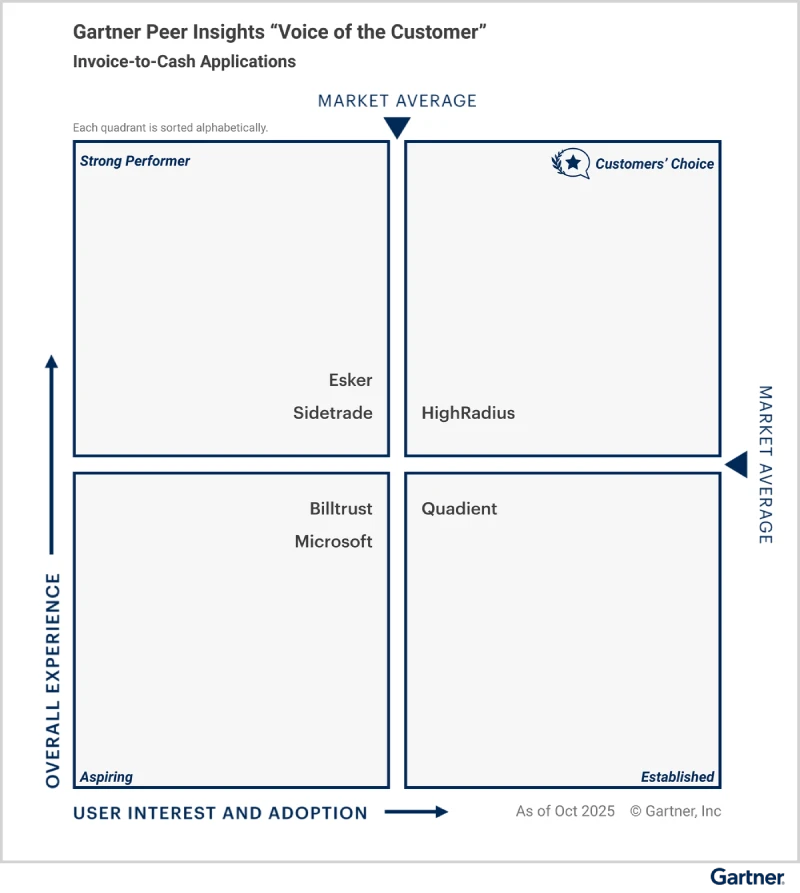
Recognized as the Only Vendor named a Customers’ Choice in the 2025 Gartner® Peer Insights™ Voice of the Customer for Invoice-to-Cash Applications
Positioned highest for delivering comprehensive automation across collections, credit, deductions, disputes, and multi-ERP integration - enabling standardized, scalable I2C transformation.
HighRadius Named an IDC MarketScape Leader for the Second Time in a Row For AR Automation Software for Large and Midsized Businesses
HighRadius stands out as an IDC MarketScape Leader for AR Automation Software, serving both large and midsized businesses. The IDC report highlights HighRadius’ integration of machine learning across its AR products, enhancing payment matching, credit management, and cash forecasting capabilities.
Forrester Recognizes HighRadius in The AR Invoice Automation Landscape Report, Q1 2023
Forrester acknowledges HighRadius’ significant contribution to the industry, particularly for large enterprises in North America and EMEA, reinforcing its position as the sole vendor that comprehensively meets the complex needs of this segment.