Key Features of Automated General Ledger Reconciliation Software
Transform your reconciliation process with HighRadius's automated general ledger reconciliation solution that delivers precise financial insights. Enhance productivity, eliminate manual tasks, and ensure a seamless closing process.
Automate Balance Sheet and GL Reconciliation
Increase reconciliation productivity by 50%
Collect and consolidate data from balance sheets and GL accounts
Implement tailored reconciliation rules
Schedule reconciliations at custom time intervals
Defined roles and responsibilities for enhanced accountability
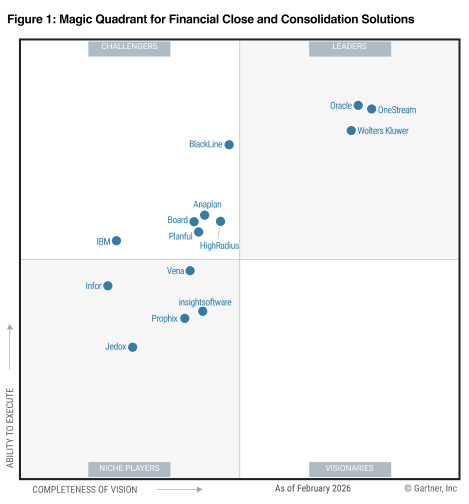
HighRadius Named a Challenger In 2026 Gartner® Magic Quadrant™ for Financial Close and Consolidation Solutions
HighRadius stands out as a challenger by delivering practical, results-driven AI for Record-to-Report (R2R) processes. With over 200+ R2R agents automating 60 %+ of close tasks and real-time anomaly detection powered by 20+ machine learning models, the platform drives continuous close with guaranteed business outcomes—moving beyond AI hype. HighRadius aims to achieve 90% automation by 2027 as it evolves toward full autonomy.
Two years in a row, A Gartner Magic Quadrant FCCS Challenger
How Does Automated General Ledger Reconciliation Software Work?
General ledger reconciliation spans multiple stages, from preparing account data to investigating variances and completing account certifications. Here's how AI-powered general ledger reconciliation software automates the entire workflow to accelerate the financial close.
General ledger reconciliation requirements differ across ERPs, industries, and business sizes. Explore how AI-powered general ledger reconciliation software supports your unique financial close processes, from complex enterprise environments to agile mid-market organizations.
Manufacturing
Deploy record-to-report automation to eliminate manual multi-ERP data reconciliations and automate high-volume journal entries for shared cost allocations across global plants.
Leverage automated financial close solutions to streamline complex subscription revenue recognition and accelerate multi-currency consolidation for recurring revenue models.
Utilize automated close solutions to dynamically match high-volume daily POS transactions against bank deposits and gain real-time visibility across storefronts.
Adopt financial close software to bridge the gap between clinical billing tech stacks and general ledgers while ensuring audit-ready compliance for facility-level allowances.
HighRadius centralizes multi-entity reconciliation giving the enterprise teams real-time visibility, anomaly detection, and built-in compliance at scale.
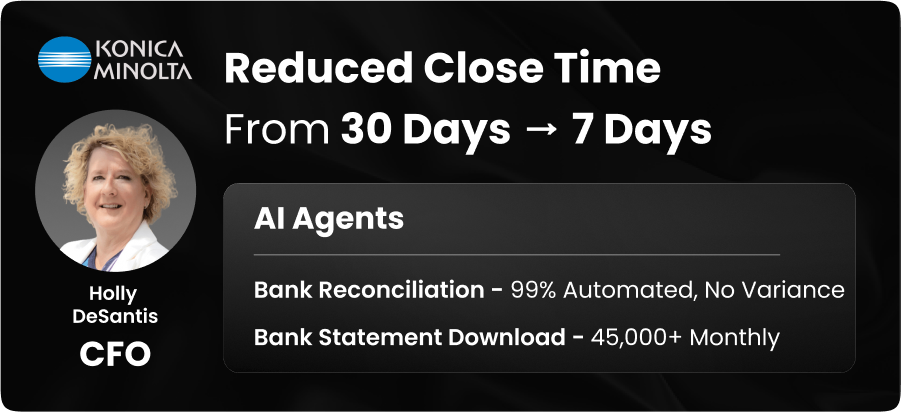
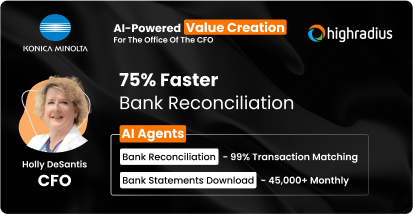
Orchestrate multi-bank reconciliation at scale: Manage 100+ bank accounts across subsidiaries and currencies as proven by Konica Minolta automating 99% of 45,000+ monthly transactions.
Detect fraud signals mid-cycle: 15+ ML models flag suspicious transactions, duplicate payments, and unauthorized withdrawals in real time before month-end.
100% SOX compliance built in: Every workflow enforces segregation of duties and immutable audit trails fully documented, timestamped, and auditor-ready.
HighRadius provides AI-powered bank reconciliation across mid-market environments, accelerating close cycles and handling high transaction volumes across multiple ERPs effortlessly.
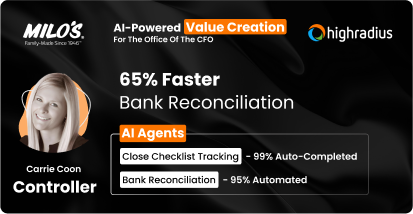
Eliminate spreadsheet-driven reconciliation: AI agents ingest bank feeds, match bank-to-GL transactions, and flag exceptions, helping lean teams close 30% faster.
Scale without adding headcount: As volumes grow through M&A or new entities, HighRadius absorbs complexity automatically, same team, same close cycle.
Go live in weeks, not months: Pre-built connectors for NetSuite, Sage Intacct, and Dynamics 365 deliver guaranteed ROI within 3–6 months
Leverage financial close software for SAP to automate high-volume Open Item Clearing and streamline complex intercompany reconciliations with native, real-time data synchronization
Deploy pre-built close automation integrations for NetSuite to replace static spreadsheets, automate inventory substantiation, and maintain continuous, audit-ready compliance.
Streamline global operations with financial close solutions for Oracle Cloud to automate recurring journal postings, manage complex accruals, and centralize multi-entity financial consolidation.
Utilize native close connectors for Sage to automatically synchronize diverse revenue streams, automate bank reconciliations, and accelerate localized financial reporting cycles.
Benefits of Automated General Ledger Reconciliation Software
By automating general ledger reconciliations with AI agents, HighRadius helps finance teams reconcile more accounts with less effort. The result: improved accuracy, time efficiency, cost savings, enhanced compliance, and real-time visibility for every reconciliation.
1
Improved Accuracy
Minimizes human errors by automating transaction matching and discrepancy detection, ensuring consistent and precise financial data for reliable reporting.
2
Time Efficiency
Accelerates reconciliation cycles, enabling faster financial closes, and freeing up resources to focus on strategic financial analysis and planning.
3
Cost Savings
Reduces the need for manual effort, saving time and operational costs, while also cutting expenses associated with errors and delayed financial closes.
4
Enhanced Compliance
Ensures alignment with regulatory standards through detailed audit trails and reports, supporting internal and external audits with transparent reconciliation records.
5
Real-Time Visibility
Provides live updates on reconciliation statuses and discrepancies, enabling proactive decision-making with instant access to financial insights.
6
Streamlined Workflows
Automates repetitive tasks and assigns reconciliation responsibilities efficiently, improving team collaboration with clear roles and responsibilities.
HighRadius Automated General Ledger Reconciliation Software helps you achieve
80%Automation in Reconciliation Tasks
30%Reduction in Reconciliation Time
100%Accuracy in Financial Reporting
ERP Integration with Automated General Ledger Reconciliation
HighRadius GL reconciliation software is ERP-agnostic, seamlessly integrating with your finance stack, enhancing accuracy, and accelerating general ledger reconciliation. Designed to work with all major ERPs, the software offers scalability to meet the needs of growing organizations, making it a flexible and adaptable solution for businesses of all sizes.
From Manual to Autonomous: Agentic AI Is the Future of General Ledger Reconciliation
Traditional automation accelerates steps. But with 200+ AI Agents, HighRadius enables autonomous general ledger reconciliation, where smart workflows think, learn, and act independently with minimal manual intervention.
Self-Correcting & Continuously Learning
AI Agents adapt based on reconciliation data to improve accuracy, catch anomalies early, and optimize processes automatically.
Autonomous Reconciliation Management
Task assignments, escalations, and approvals are handled in the background, freeing teams from routine follow-ups.
Touchless Journal Entry Automation
From data capture to posting, AI eliminates manual journal entries with intelligent validations and rule-based logic.
Trusted by Finance Leaders
Global enterprises rely on HighRadius AI to reduce costs, unify reconciliation workflows, and accelerate the financial close.
Automated general ledger reconciliation ensures accuracy and alignment between general ledger accounts and supporting financial data. By gathering information from various sources, such as bank statements, sub-ledgers, or other records, it automatically matches transactions and identifies discrepancies, eliminating manual reconciliation.
Automated reconciliation benefits businesses by providing enhanced transparency, elimination of manual errors, time savings, enhanced accuracy, compliance, and audit readiness. Further, GL reconciliation software streamlines workflows, accelerates financial closing cycles, and generates detailed audit trails and reports., By ensuring accurate financial records, automated GL reconciliation empowers finance teams to focus on strategic tasks, fostering better decision-making and financial health.
The Hassle of Manual General Ledger Reconciliation
Manual gl reconciliation is one of the most time-consuming and error-prone tasks in financial accounting. It requires accountants to sift through large volumes of transactions, verify data consistency, and identify discrepancies across multiple accounts; all while working under the pressure of tight deadlines during month-end or year-end close cycles.
Key Challenges in Manual GL Reconciliation:
Manual general ledger reconciliation is often one of the most time-consuming parts of the financial close. As transaction volumes grow and finance teams manage more accounts, relying on spreadsheets and manual reviews creates delays, increases the risk of errors, and limits visibility. Here are the key challenges organizations face with manual GL reconciliation.
Time-intensive process
Manual reconciliation demands hours or even days of effort to ensure accuracy. Accountants often need to toggle between spreadsheets, bank statements, and other source documents, which can significantly delay the financial close process.
Prone to errors
Human errors, such as data entry mistakes or overlooked discrepancies, are common in manual processes. These errors can lead to incorrect financial reporting and potential regulatory non-compliance.
Lack of visibility
With manual reconciliation, tracking the status of accounts or identifying bottlenecks becomes challenging. This lack of real-time visibility hampers decision-making and creates inefficiencies in managing financial records.
Inconsistent documentation
Manual processes often result in fragmented or inconsistent documentation. Missing backup data or insufficient audit trails can make it difficult to justify reconciliations during internal reviews or external audits.
Stressful close periods
The high workload and pressure to meet deadlines during financial close periods can overwhelm accounting teams. This stress often results in burnout, further increasing the risk of errors and inefficiencies.
How Can Automated General Ledger Reconciliation Help with Manual Reconciliation?
Automated GL reconciliation transforms the manual reconciliation process by leveraging technology to handle repetitive and error-prone tasks with precision and speed. GL reconciliation software collects data from multiple systems in real-time, using APIs or integrations, ensuring no detail is overlooked. Predefined reconciliation rules are applied to automatically match transactions, dramatically reducing the manual workload.
Further, reconciliation software flags discrepancies when they arise, providing actionable insights that help teams prioritize and resolve issues efficiently. Moreover, automated workflows streamline the task assignment process. For instance, unreconciled items can be automatically assigned to relevant team members with clear roles and responsibilities, ensuring accountability. Real-time dashboards and analytics provide comprehensive visibility into reconciliation statuses, enabling teams to track progress and address bottlenecks promptly.
What to Consider While Choosing an Automated General Ledger Reconciliation Software?
Selecting the right automated gl reconciliation software is critical for improving financial accuracy, reducing manual effort, and ensuring timely reconciliations. With various options available, it’s important to focus on features that align with your organization’s goals and workflows. Below are key considerations to guide your decision:
End-to-end automation
Ensure the software automates transaction matching, variance identification, and reconciliation workflows.
Customizable matching rules
Look for flexibility to configure rules for transaction matching and exception handling.
Seamless ERP integration
Verify compatibility with ERPs like SAP, Oracle, and Microsoft Dynamics for real-time updates.
Scalability
Choose a solution that supports growing transaction volumes, multi-entity operations, and multi-currency needs.
User-friendly interface
Prioritize intuitive dashboards and Excel-like tools for improved adoption and ease of use.
Compliance-ready features
Confirm adherence to SOX, GAAP, IFRS, and other regulatory standards.
Audit trails
Ensure the software provides transparent logs and centralized documentation for audit readiness.
Exception management
Opt for tools that automatically flag variances and streamline exception resolution.
Data security
Choose software with encryption, role-based access controls, and compliance with global security standards.
Advanced reporting
Look for customizable reports, variance analysis, and KPI dashboards for actionable insights.
FAQs - Automated General Ledger Reconciliation Software
What are the best practices of automated general ledger reconciliation?
Best practices for automated general ledger reconciliation include defining reconciliation rules, integrating ERP systems, maintaining real-time data updates, and using variance alerts for faster resolution. Automated workflows, regular audits, detailed reports, and AI-driven analytics improve accuracy, strengthen compliance with standards like SOX and GAAP, and provide greater visibility into financial processes.
Why should businesses opt for automated general ledger reconciliation software?
Businesses should adopt automated general ledger reconciliation software to reduce manual effort, improve accuracy, and accelerate the financial close. It automates transaction matching, exception handling, and account certifications while providing audit-ready documentation, ERP integration, real-time visibility, and the scalability needed to support growing transaction volumes and multi-entity operations.
How does automated general ledger reconciliation work?
Automated general ledger reconciliation collects data from ERPs, sub-ledgers, and other financial systems, matches transactions against the general ledger, flags discrepancies, and manages exceptions. AI-powered solutions improve matching accuracy, automate workflows, maintain audit-ready documentation, and accelerate the financial close with greater accuracy and control.
What are common issues found during general ledger reconciliation?
Common general ledger reconciliation issues include data entry errors, timing differences, missing or duplicate transactions, unrecorded adjustments, and mismatches between GL balances and supporting records. These problems can delay financial close, increase compliance risk, and reduce reporting accuracy. Automating reconciliation helps detect variances faster and maintain a complete audit trail.
What is the difference between a general ledger and a sub-ledger?
The general ledger summarizes all financial transactions across accounts, while sub-ledgers store detailed transactions for specific accounts such as accounts payable and receivable. Sub-ledger balances roll up into the general ledger, providing the detail needed to reconcile accounts accurately and ensure complete, reliable financial reporting.
How do you reconcile a general ledger?
General ledger reconciliation involves comparing GL account balances with supporting documents such as bank statements, subledgers, invoices, or fixed asset records. Any discrepancies are investigated, corrected, and documented to ensure financial records are accurate before the close.
Why is general ledger reconciliation important?
General ledger reconciliation ensures financial statements are accurate, complete, and compliant. It helps detect errors, fraud, and missing transactions early, strengthens internal controls, and gives finance teams confidence in the numbers reported during month-end and year-end close.
What are the common types of general ledger reconciliations?
Common types include bank account, accounts receivable, accounts payable, intercompany, fixed asset, inventory, prepaid expense, accrual, payroll, and balance sheet reconciliations. Each verifies that GL balances match supporting records and reflects the correct financial position.
How do I choose the right general ledger reconciliation software for my business?
Choose software that automates transaction matching, manages exceptions, supports account certifications, integrates with your ERP, provides audit-ready documentation, and offers AI-powered workflows. Scalability, ease of use, and real-time reporting are also essential for accelerating the financial close.