
The Hackett Group recognizes HighRadius
as a Digital World Class vendor for Accounts Payable
The Hackett Group recognizes HighRadius
as a Digital World Class vendor for Accounts Payable
Ensure every disbursement is verified, tracked and auto-posted to ERP

Automate payment initiation to accelerate disbursement cycles and ensure accurate file delivery.
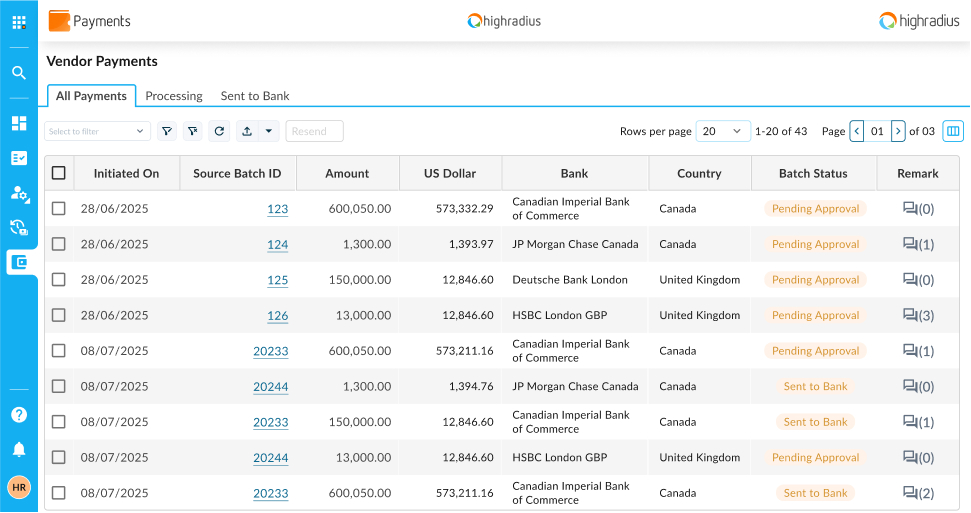
Automate the routing of payment requests to approvers and generate the required files for bank processing.
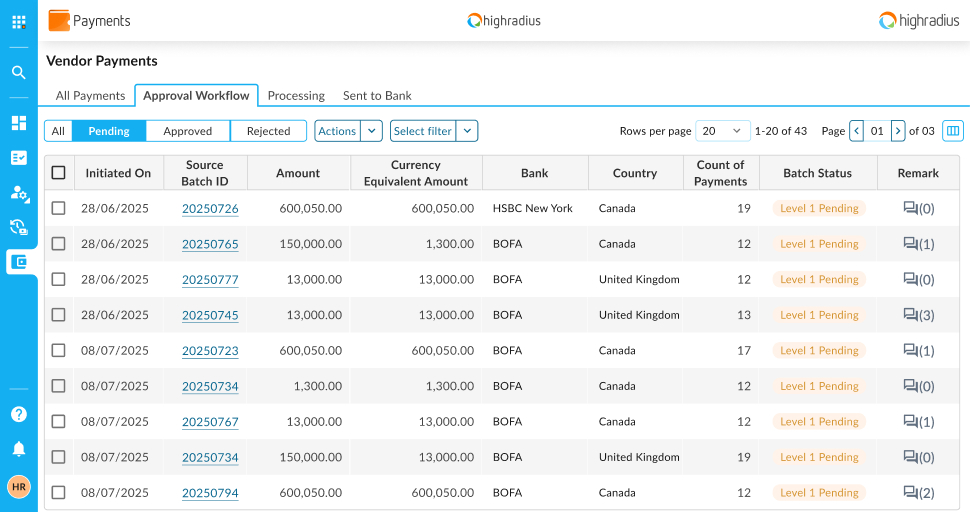
Monitor payment patterns using predefined risk rules to detect anomalies and predict fraudulent activities.
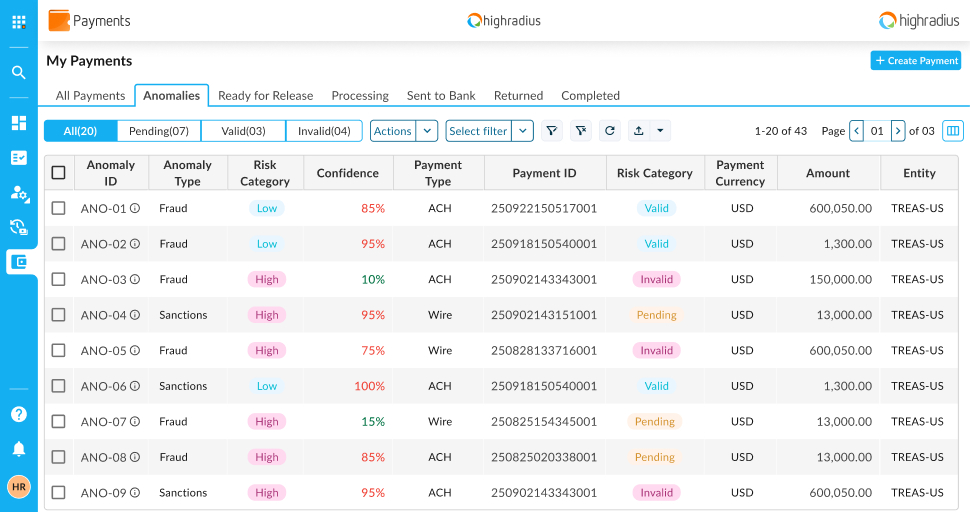
Manage global transactions with multi-currency support while optimizing exchange rates to reduce conversion costs.
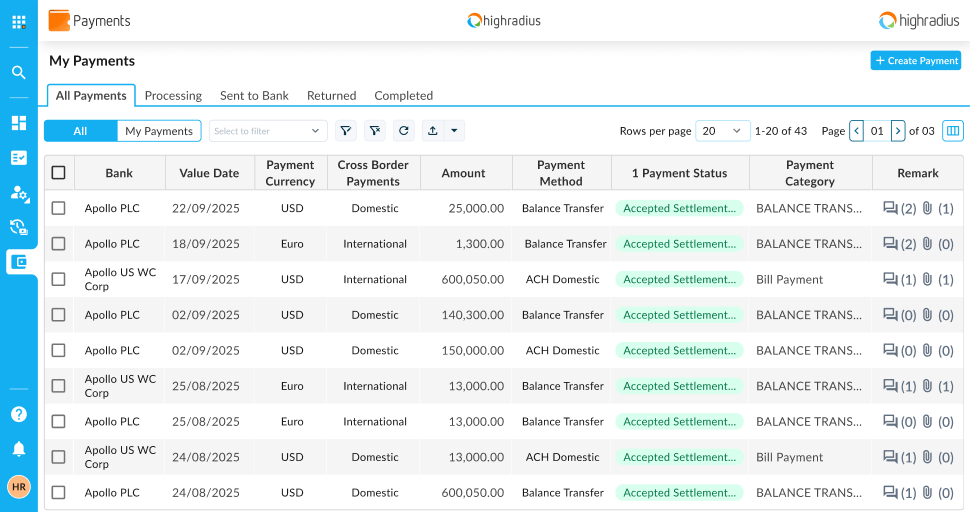
Route transaction batches through global networks to maximize settlement speed and minimize processing fees.
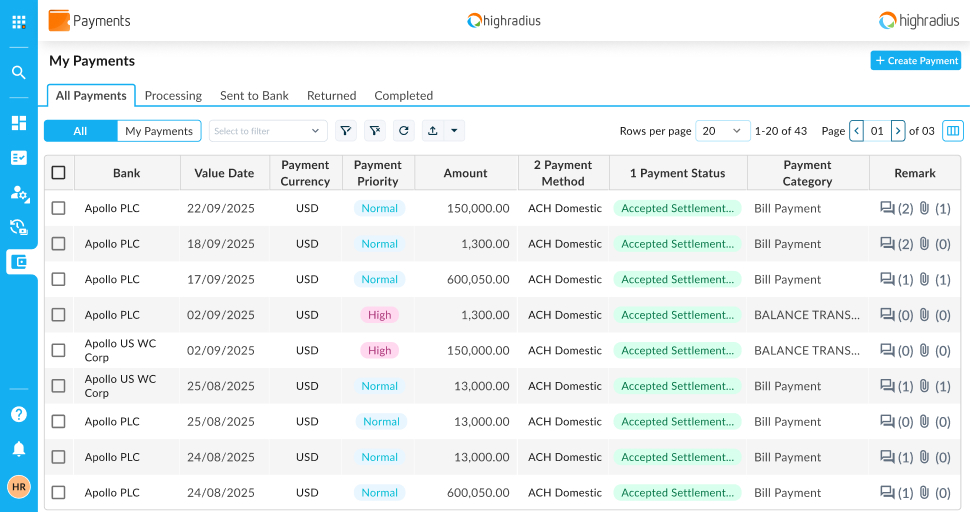
Issue unique virtual card numbers for specific vendor bills and automatically sync settlement data with your ERP.
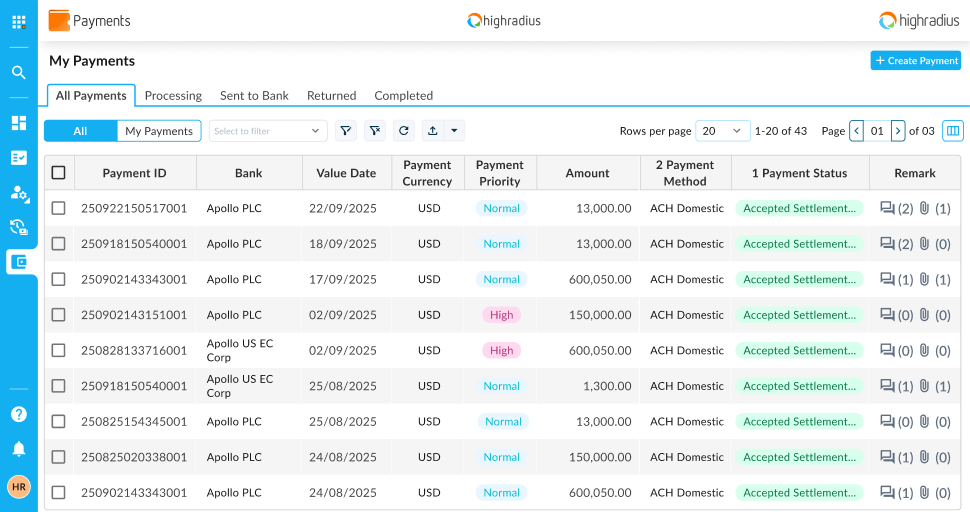
AI in vendor payments replaces manual disbursement with speedy, autonomous execution. By utilizing machine learning and predictive analytics, the system automatically parses payment terms, optimizes cash flow, and identifies inconsistent billing patterns in real-time. This ensures that every transaction is fully vetted and risk-assessed before funds are released. It also captures early payment discounts that were previously missed.
It drives "touchless" financial operations by flagging only critical anomalies for human review. The system independently validates transaction data against contracts and purchase orders, ensuring 100% visibility into the payment pipeline. .

| Features | Automated Vendor Payments | Manual Vendor Payments |
|---|---|---|
| Payment Initiation | Automatically extracts approved payment files and initiates payments without manual data entry. | Requires manual creation, uploading, and initiation of payment files within bank portals. |
| Approval Cycles | Features automated policy-based routing and bulk approval processing to handle multiple requests simultaneously | Managers must review and authorize each payment request individually, often leading to slower approval cycles. |
| Status Tracking & Visibility | Agents automatically capture bank status reports (ACK/NACK) and provide end-to-end transaction visibility. | Teams must manually check bank portals, emails or contact vendors to track the lifecycle of a payment from initiation to settlement. |
| Security & Fraud Detection | Uses Agentic AI to detect anomalies in data patterns and performs automated sanction compliance screening. | Relies on manual spot-checks or rigid rules, which are prone to human error and may miss hidden fraud trends. |
| Bank Reconciliation | Automatically reconciles payments to bank statements using 1:1, 1:Many, and Many:1 matching rules. | High manual effort required to match bank transactions to open items, especially for complex or partial payments. |
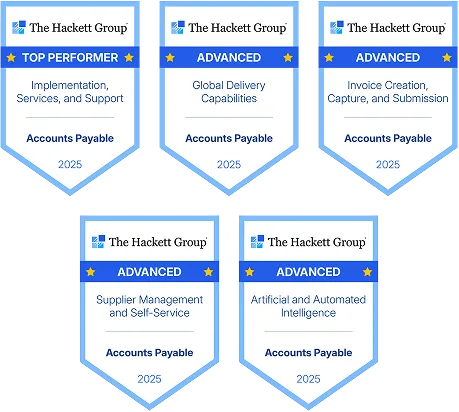
Ranked among the Top 15 Accounts Payable solutions in The Hackett Group’s 2025 report, HighRadius is recognized for transforming how enterprises execute global disbursements. Our AI-led platform optimizes the entire payment cycle, from automated invoice matching to final settlement supporting multiple payment rails like ACH, Wire, and Virtual Cards to ensure suppliers are paid accurately and on time.
Get The ReportSpeed Up Payment Execution & Efficiency
Automating vendor payments replaces manual file preparation and bank portal uploads with autonomous execution. The system uses intelligent routing to instantly select the most cost-effective payment methods such as ACH, Wire, or Virtual Cards based on vendor location and settlement needs. This transition ensures that approved invoices are paid at high speeds with minimal human intervention.
Strengthen Fraud Prevention & Security
AI-powered payment agents provide a continuous security layer by monitoring transaction patterns and flagging suspicious bank account modifications. Every payment is automatically cross-referenced against global sanctions lists and internal compliance policies to prevent unauthorized disbursements. This proactive defense identifies fraud red flags in real-time, safeguarding financial assets and maintaining a tamper proof audit trail for every transaction.
Optimize Cash Flow & Working Capital
Automation delivers a unified view of your total cash position, allowing for precise forecasting of future outflows and liquidity needs. By monitoring bank balances, the system helps schedule payments at the ideal time to capture early payment discounts without over-extending cash reserves. This balance of strategic timing and vendor trust ensures you maximize working capital while keeping your supplier relationships reliable.
Automate Bank Reconciliation & Audit Trails
A well-integrated automation platform synchronizes payment data across procurement and finance teams, eliminating data silos and manual entry errors. The system independently handles bank reconciliation by matching statement lines to open invoices, even resolving complex scenarios like partial payments or deductions. This real-time data flow ensures that your master records are accurate, audit-ready, and fully aligned with your existing ERP system.
Empower your business with autonomous AI agents that don't just assist, but execute complex workflows from start to finish.

Traditional automation still requires manual file extraction and bank portal uploads. Autonomous systems independently pull approved data from the ERP, verify real-time bank liquidity, and trigger disbursements across global rails. This removes manual "middle-man" steps, ensuring payments execute the moment they meet predefined business criteria.

Standard rule-based automation only catches basic errors based on fixed dollar thresholds. Autonomous agents use behavioral analysis to detect unusual bank detail changes or sanction hits before any funds leave the company. This shift moves security from reactive reporting to proactive prevention of high-risk or fraudulent transactions.

Basic tools match simple 1:1 invoices but might fail when faced with partial payments or currency differences. Autonomous technology independently reasons through complex ledger gaps and updates the ERP with high accuracy. It eliminates the month-end manual workload by ensuring the general ledger stays accurate and reconciled daily.

Automated systems pay bills exactly on the due date without considering broader corporate cash needs. Autonomous software analyzes real-time cash positions to time payments, maximizing early-payment discounts and choosing the most cost-effective payment rails. This turns a clerical task into a strategic tool for preserving and growing company capital.
Vendor payment automation is the use of digital tools to manage and execute the entire payment lifecycle without manual effort. It connects your internal accounting systems directly to bank portals to handle tasks like matching invoices, routing approvals, and triggering fund transfers. This streamlines the “invoice-to-pay” process, ensuring suppliers are paid accurately and on time while reducing human error.
Automation speeds up reconciliation by using intelligent matching rules to instantly pair bank statements with corresponding open invoices. Instead of staff manually comparing spreadsheets and bank records, the system automatically identifies successful matches and flags only the discrepancies for review. This transforms a labor intensive month end task into a continuous, real time process that keeps financial records current.
Essential features include a centralized hub for managing global payments and automated workflows that route approvals based on company policy. It also provides multi-channel support for various payment methods like ACH, Wires, and Virtual Cards, alongside real-time transaction monitoring. Additionally, robust systems include built-in fraud detection and automated audit trails to ensure security and compliance.
Automation lowers costs by eliminating the manual labor associated with data entry, physical check printing, and postage. By reducing errors and duplicate payments, companies avoid costly rework and late fees, while also capitalizing on rebates from virtual card usage. It allows finance teams to handle significantly higher transaction volumes without the need to increase headcount.
Look for a solution that offers seamless integration with your existing ERP and supports the specific payment rails your global vendors require. Prioritize platforms that provide high-security standards, such as automated fraud monitoring and secure sanction screening. Finally, ensure the system is scalable enough to support multi-entity operations and various international currencies as your business grows.
Automation improves working capital by providing real-time visibility into your total cash position and upcoming financial obligations. This foresight allows finance leaders to strategically time disbursements, allowing them to take advantage of early payment discounts or preserve cash by optimizing “Days Payable Outstanding.” By controlling exactly when money leaves the business, companies can maintain a more stable and predictable cash flow.



