Learn how CFOs reduce invoice processing costs by 50% with HighRadius AP Automation software.
Download Free Guide- Automate repetitive AP work: Use AI to reduce manual tasks and free teams to focus on exceptions and working capital.
- Strengthen AP control: Apply AI to detect fraud, manage exceptions, optimize payments, and improve supplier visibility.
- Prepare for autonomous AP: Start with high-volume workflows and scale toward AI agents that can execute routine tasks with oversight.
Artificial intelligence (AI) is redefining the role of accounts payable. What was once a function focused on invoice processing and payment execution is rapidly becoming a strategic driver of cash flow, supplier relationships, and financial decision-making.
Traditional AP automation streamlined repetitive tasks through predefined rules. Today’s AI-powered accounts payable solutions go much further. They analyze large volumes of financial data, detect anomalies, predict exceptions, optimize payment timing, and continuously learn from business transactions to improve performance over time.
As organizations face increasing invoice volumes, complex supplier networks, and growing compliance requirements, AI enables finance teams to process work more efficiently while improving visibility, accuracy, and control across the entire accounts payable function.
In this guide, you’ll learn what AI in accounts payable is, how it transforms every stage of the AP lifecycle, its key business benefits, practical use cases, how to evaluate AI-powered AP software, and why agentic AI is driving the next evolution of autonomous finance.
What is AI in Accounts Payable?
AI in accounts payable uses intelligent technologies to automate, optimize, and improve AP processes. Unlike traditional automation that follows predefined rules, AI can analyze data, identify patterns, predict outcomes, and recommend or execute actions with minimal human intervention.
AI supports the entire AP lifecycle from invoice validation and exception management to supplier communication, fraud detection, payment optimization, and reporting. By learning from historical transactions and business policies, it reduces manual effort, improves decision-making, and increases operational efficiency.
As AI continues to evolve, organizations are adopting agentic AI, where intelligent agents can proactively execute routine AP tasks, resolve exceptions, and continuously optimize workflows while maintaining governance and compliance.
The Evolution of Accounts Payable
| Traditional AP | AI-Powered AP | Agentic AI-Powered AP |
| Manual processing and approvals | AI assists with decision-making and automation | AI agents execute workflows autonomously with human oversight |
| Rule-based workflows | Learns from historical transactions | Continuously learns and optimizes processes |
| Reactive exception handling | Predicts risks and recommends actions | Resolves routine exceptions autonomously |
| Limited visibility | Real-time analytics and insights | Autonomous optimization across the AP lifecycle |
| Human-driven operations | Human + AI collaboration | Human governance with AI execution |
How AI Is Transforming the Entire Accounts Payable Function
AI is changing accounts payable from a transaction-processing function into a strategic business function. Instead of simply automating repetitive tasks, AI helps finance teams make faster decisions, reduce financial risk, improve supplier collaboration, and optimize working capital.
Here are the key areas where AI delivers the greatest impact across the AP lifecycle.
1. Intelligent Invoice and Document Management
AI automatically captures, validates, classifies, and routes invoices from multiple channels without relying on fixed templates. It continuously learns from historical transactions to improve extraction accuracy, reduce manual intervention, and accelerate invoice processing.
2. Faster Exception Resolution
Invoice exceptions are one of the biggest causes of payment delays. AI identifies pricing mismatches, missing purchase orders, duplicate invoices, and approval bottlenecks early, prioritizing high-risk exceptions while allowing routine invoices to flow through automatically.
3. Smarter Fraud Detection and Risk Management
AI continuously monitors supplier transactions and payment activity to detect duplicate invoices, unusual spending patterns, vendor anomalies, and potential fraud before payments are released. This strengthens internal controls while reducing financial risk.
4. Better Supplier Communication
AI helps automate supplier interactions by classifying incoming emails, generating response recommendations, answering payment status inquiries, and routing requests to the appropriate teams. This improves response times while reducing administrative workload.
5. Optimized Working Capital and Payment Decisions
Rather than paying every invoice as it becomes due, AI analyzes payment terms, supplier priorities, discount opportunities, and cash flow forecasts to recommend the optimal payment timing. This helps organizations improve liquidity while maintaining strong supplier relationships.
6. Real-Time Visibility and AP Analytics
AI-powered dashboards provide finance leaders with real-time insights into invoice status, exception rates, approval bottlenecks, supplier performance, and payment trends. These insights support better forecasting, stronger compliance, and more informed financial decisions.
7. Toward Autonomous Accounts Payable
The latest advancement is agentic AI, where intelligent agents can proactively manage routine workflows, recommend next-best actions, and execute repetitive AP tasks with minimal human intervention. Finance professionals remain in control while AI handles execution at scale, enabling organizations to move closer to autonomous accounts payable.
Manual Accounts Payable Tasks You Can Automate Using AI
AI in accounts payable extends far beyond invoice capture. Modern AI-powered AP solutions automate repetitive, judgment-based tasks across the entire accounts payable lifecycle, allowing finance teams to focus on supplier relationships, cash flow optimization, and financial controls.
1. Invoice Validation and Data Extraction
AI automatically captures invoice data from emails, PDFs, supplier portals, and e-invoices while validating invoice details against supplier records and business rules. This reduces manual entry, improves data accuracy, and accelerates invoice processing.
2. Approval Routing and Exception Resolution
AI routes invoices to the right approvers based on spending policies, invoice value, supplier, or department. It also identifies exceptions such as missing purchase orders, pricing discrepancies, or duplicate invoices and recommends the next best action to resolve them faster.
3. Supplier Communication
AI-powered assistants automatically classify supplier emails, answer payment status inquiries, request missing documents, and generate contextual responses. This reduces repetitive communication and improves supplier experience without increasing AP workload.
4. Payment Optimization and Working Capital Management
AI analyzes payment terms, supplier behavior, available discounts, and cash flow forecasts to recommend the best payment timing. This helps businesses maximize early payment discounts while maintaining healthy working capital.
5. Fraud Detection and Compliance Monitoring
AI continuously monitors invoice and payment activity to identify duplicate invoices, unusual payment patterns, policy violations, and potential fraud before payments are released, strengthening financial controls and reducing risk.
6. Reporting, Forecasting, and AP Analytics
AI converts AP data into real-time insights by forecasting cash requirements, identifying approval bottlenecks, monitoring supplier performance, and highlighting process improvement opportunities. Finance leaders gain better visibility for faster, data-driven decisions.
Real World Examples & Use-Cases of AI in Accounts Payable
Organizations across industries are using AI in accounts payable to improve productivity, strengthen financial controls, and reduce processing costs. These examples illustrate how AI-powered AP solutions deliver measurable business outcomes.
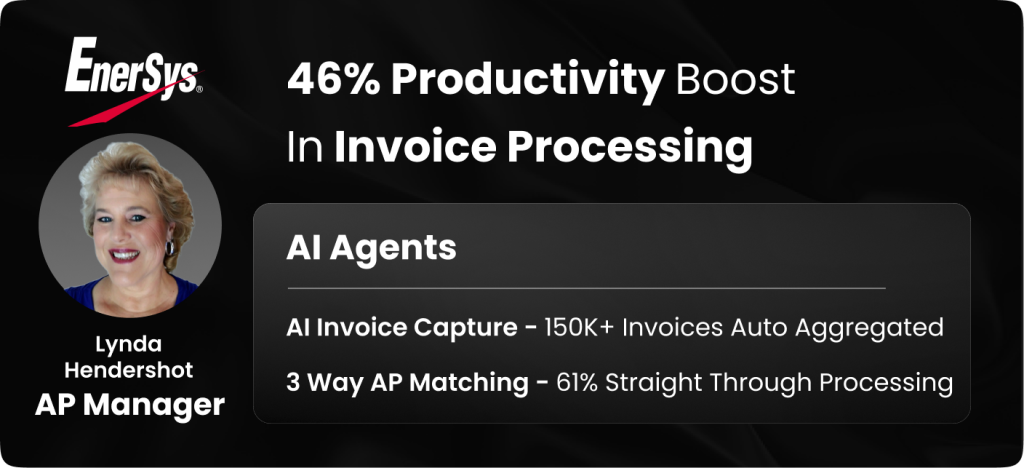
46% Higher Invoice Processing Productivity
Challenge:
EnerSys was processing over 150,000 invoices annually across multiple ERP systems, leading to manual effort and inconsistent approval workflows.
AI Solution:
AI invoice capture automatically aggregated invoices, while a 3-way AP matching agent improved straight-through processing across North America.
Result:
- 46% improvement in invoice processing productivity
- 61% straight-through processing achieved
- Standardized operations across 3 ERPs and 8 company codes
55% Faster AP Productivity
Challenge:
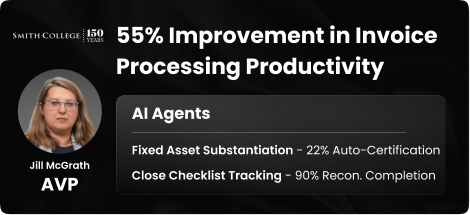
Smith College was struggling with siloed AP operations with manual invoice validation and disconnected approval workflows, which slowed invoice processing.
AI Solution:
AI automated document capture, validation, GL coding, and approval routing for over 22,000 invoices annually.
Result:
- 55% improvement in invoice processing productivity
- 99.9% posting success rate
- Average invoice lead time reduced to 4.7 days
$2 Million Saved Annually in AP
Challenge:
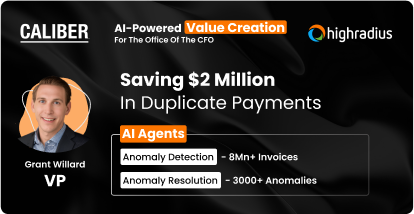
Caliber was managing AP across 1,800+ locations, which increased duplicate payment risks and processing costs.
AI Solution:
AI agents aggregated 8 million invoices while fraud detection agents flagged duplicate invoices before payment.
Result:
- Stronger payment controls across 1,800+ locations
- $2 million saved annually
- 12,360 duplicate invoices prevented
6 Things to Consider Before Choosing an AI Accounts Payable Solution
Implementing AI in accounts payable requires a strategic approach to ensure a smooth transition and maximize benefits. Below are key steps to successfully integrate AI into your AP processes:
1. Evaluate your current AP workflow
Before integrating AI, it’s crucial to evaluate your existing AP processes. Identify pain points, inefficiencies, and areas where automation can add value. This assessment provides a clear picture of your current workflow and helps in designing an AI solution tailored to your specific needs.
2. Prepare your data for AI success
The next step is gathering comprehensive and accurate data. Collect historical data, including invoices, payment records, purchase orders, and vendor information, and ensure that it is accurate and consistent by organizing it, removing duplicates, and addressing any inconsistencies that could negatively impact AI performance.
3. Select the perfect AI-powered Accounts Payable solution
Selecting the appropriate AI solution is critical for successful implementation. Evaluate various AI platforms based on features, scalability, and compatibility with your existing systems. Look for solutions that offer robust automation capabilities, real-time analytics, and seamless integration with your current setup.
4. Pilot test and train your team
Conduct pilot tests to assess the AI solution’s effectiveness in real-world scenarios. Pilot testing helps identify potential issues and provides insights for system fine-tuning. Additionally, invest in training your AP team to ensure they are comfortable with the new technology and can utilize its full potential.
5. Integrate AI seamlessly with existing systems
Ensure seamless data integration between your AI solution and existing systems. Proper data integration is vital for accurate and efficient AI operations. Collaborate with your IT team to establish secure data connections, ensuring the AI system can access and process relevant data.
If the AI solution involves machine learning, train algorithms using your prepared data to recognize vendor patterns, invoice formats, and approval workflows. Continuously monitor AI performance and adjust algorithms as needed.
6. Continuously monitor and optimize
After implementing AI, continuously monitor its performance and gather user feedback. Use this feedback to make necessary adjustments and optimize the system. Regular monitoring ensures that the AI solution remains effective and continues to deliver value over time.
The 90-Day Roadmap to AI in Accounts Payable
Most AP teams move from rule-based automation to autonomous exception handling within the first 90 days of AI adoption. The first 90 days often show the biggest operational improvements as teams shift from reactive processing to autonomous execution.
Here’s what typically changes:
First 30 Days: Reduce Manual Invoice Routing
The first phase focuses on eliminating repetitive manual tasks such as invoice capture, approval routing, and purchase order matching.
AI-powered AP validates incoming invoices, routes approvals based on business logic, and identifies missing or incorrect data before it reaches AP teams. This reduces manual handoffs and improves invoice flow from day one.
Days 31–60: Resolve Exceptions Faster
Once workflows are stabilized, the focus shifts to exception handling—one of the biggest causes of AP delays.
AI in accounts payable automation solution identifies duplicate payments, approval bottlenecks, pricing mismatches, and supplier disputes. It can trigger follow-ups, recommend corrective actions, and ensure exceptions are resolved faster without constant manual tracking.
Days 61–90: Move Toward Autonomous AP
In the final phase, AP teams gain greater control through predictive decision-making and proactive workflow management.
AI in AP automation helps optimize payment timing, improve cash flow visibility, prioritize high-risk invoices, and support touchless invoice processing. AP moves from managing tasks manually to overseeing a more autonomous and strategic finance function.
The Future of AI in Accounts Payable
AI is rapidly transforming accounts payable from a transactional function into a strategic business capability. As AI models become more intelligent and autonomous, finance teams will spend less time processing invoices and more time improving working capital, strengthening supplier relationships, and managing financial risk.
Agentic AI Will Drive Autonomous AP
The next evolution of AI in accounts payable is agentic AI—intelligent agents that can understand context, make decisions, and execute AP tasks with minimal human intervention. Instead of simply recommending actions, AI agents will validate invoices, resolve exceptions, follow up on approvals, communicate with suppliers, and optimize payment decisions while keeping finance teams in control.
Predictive and Proactive Decision-Making
AI will shift AP from reacting to problems to anticipating them. By analyzing invoice, payment, and supplier data in real time, AI can identify fraud risks, forecast cash flow, recommend payment timing, and detect process bottlenecks before they impact operations.
AP Teams Will Become Strategic Advisors
As repetitive work becomes automated, AP professionals will focus on higher-value activities such as supplier collaboration, spend analysis, compliance, and working capital optimization. AI will augment—not replace—finance teams by enabling faster, more informed decision-making.
Connected, Intelligent Finance Operations
Future AI-powered AP platforms will seamlessly integrate with procurement, treasury, ERP, and payment systems to create a unified finance ecosystem. This connected approach will provide real-time visibility across the entire procure-to-pay process, helping organizations improve efficiency, resilience, and financial performance.
How HighRadius Uses AI to Transform Accounts Payable
HighRadius uses AI to automate the most time-consuming accounts payable tasks, helping finance teams reduce manual effort, improve invoice accuracy, and accelerate invoice processing from capture to payment. Here’s how HighRadius simplifies Accounts Payable with AI:
Higher Straight-Through Processing
Reduces manual intervention across invoice capture, approvals, exception handling, and payment workflows—enabling faster, touchless invoice processing.
AI-Powered Invoice Capture
Automatically captures invoices from emails, supplier portals, EDI networks, and B2B platforms while extracting data from PDFs, images, Word files, and formats like EDI 810, cXML, and iDOC.
Automatic Invoice Coding
AI assigns non-PO invoices to the correct GL accounts, cost centers, and departments based on historical transaction patterns and business rules.
Supplier and Invoice Validation
Validates supplier details, invoice fields, tax information, and line-item calculations against master data to improve accuracy and reduce payment errors.
Intelligent PO and GRN Matching
Matches invoice details with purchase orders and goods receipt notes (GRNs), automatically flagging mismatches as exceptions for faster resolution.
Duplicate Invoice Detection
Detects duplicate invoices using invoice number, amount, supplier details, and invoice dates to prevent overpayments and reduce AP fraud risks.
AI-Powered AP Inbox
Classifies incoming supplier emails, such as invoice submissions, payment follow-ups, and status requests, into relevant categories automatically.
Smart Response Suggestions
Recommends draft email responses based on historical communication patterns, helping AP teams respond faster and improve supplier communication.
Frequently Asked Questions
1. How can AI be used in accounts payable?
1. How can AI be used in accounts payable?
AI is used in accounts payable to automate invoice capture, data extraction, GL coding, approval routing, and payment processing. It also helps detect duplicate invoices, prevent fraud, and manage exceptions faster. AI improves supplier management by analyzing payment history and vendor performance. This helps finance teams reduce manual work and improve cash flow visibility.
2. What are the benefits of AI in accounts payable?
2. What are the benefits of AI in accounts payable?
AI improves processing speed, reduces manual work, strengthens fraud detection, enhances supplier communication, optimizes payment timing, increases visibility into AP operations, and enables finance teams to focus on strategic initiatives instead of repetitive administrative tasks.
3. What are the top AI use cases in accounts payable?
3. What are the top AI use cases in accounts payable?
The top AI use cases in AP include invoice capture, GL coding, duplicate payment detection, fraud prevention, approval routing, and predictive reporting. AI also improves vendor management and payment scheduling. These use cases reduce processing time and improve straight-through processing. They help businesses move toward touchless AP operations.
4. How do I choose the right AI accounts payable software?
4. How do I choose the right AI accounts payable software?
Look for a solution that supports end-to-end AP automation, integrates with your ERP, uses AI for intelligent decision-making, provides strong security and compliance controls, delivers actionable analytics, and demonstrates measurable business outcomes such as higher straight-through processing and lower processing costs.
5. What is agentic AI in accounts payable?
5. What is agentic AI in accounts payable?
Agentic AI is the next generation of AI-powered AP automation. Unlike traditional automation, AI agents can understand context, make decisions, execute tasks such as resolving exceptions or following up on approvals, and continuously learn while operating within business controls.
6. How long does it take to see results from AI in accounts payable?
6. How long does it take to see results from AI in accounts payable?
Many organizations begin seeing improvements within the first few months after implementation, including faster approval cycles, reduced manual effort, improved straight-through processing, better payment accuracy, and enhanced visibility into AP performance.