Create SMART AP goals to stay 100% compliant & audit-ready with this free checklist
Achieve Your AP GoalsSMART Accounts Payable goals are crucial for maintaining a structured and efficient Financial Process. Without clear goals, Accounts Payable (AP) operations can lack focus, leading to inefficiencies and strained Vendor relationships.
Businesses with well-defined financial objectives consistently achieve better outcomes. By setting SMART goals: Specific, Measurable, Achievable, Relevant, and Time-bound, you can enhance Accountability, Streamline Workflows, and optimize cash flow management. Leveraging Accounts Payable Automation further accelerates goal achievement by eliminating manual bottlenecks, improving accuracy, and ensuring timely payments.
800+ Enterprises Use SMART Goals to Drive AP Performance
HighRadius turns SMART goals into measurable wins with 90% touchless Invoice processing
Want to learn how to set SMART Accounts Payable goals effectively? Read on for actionable strategies and examples.
- Set SMART Accounts Payable goals: Goals that are specific, measurable, achievable, relevant, and time-bound make it easier to track progress, improve Accountability, and drive better AP performance.
- Focus on metrics that matter: Monitor key Accounts Payable KPIs such as Invoice processing time, payment accuracy, cost per Invoice, and Days Payable Outstanding (DPO) to measure success and identify improvement opportunities.
- Align AP goals with business outcomes: Effective Accounts Payable goals help improve cash flow management, strengthen vendor relationships, reduce operational costs, and support compliance efforts.
- Use measurable targets to drive improvement: Goals such as reducing Invoice processing time, increasing on-time payment rates, or capturing more early-payment discounts provide clear benchmarks for success.
- Leverage automation to achieve goals faster: Accounts Payable automation can reduce manual work, improve accuracy, enhance visibility, and help your team consistently meet performance targets.
Table of Contents
- What Are Accounts Payable Goals?
- Why Setting AP Goals Matters
- Examples of Accounts Payable Goals
- How To Set The Right Accounts Payable Goals?
- What Are the Challenges in Meeting Accounts Payable Goals?
- Smart Ways to Achieve Your Accounts Payable Goals
- Accounts Payable Automation: A Game-Changer for Achieving AP Goals
What Are Accounts Payable Goals?
AP goals are specific objectives that an organization sets to optimize the management of its Financial obligations to Vendors and Suppliers. These goals typically focus on ensuring on-time payments to maintain strong Supplier relationships and avoid penalties, while improving transaction accuracy to reduce errors and discrepancies. They also include controlling processing costs to enhance profitability, maintaining compliance with regulatory requirements and internal policies, and optimizing Accounts Payable Processes to increase efficiency and reduce cycle times.
Together, these goals ensure organizations Manage Vendor Invoices, payments, and workflows more effectively. Setting the right goals can reduce errors, prevent delays, and minimize financial losses while fostering trust with Vendors and ensuring smoother day-to-day operations.
Here are some of the core Accounts Payable goals businesses should prioritize:
1. Reduce Invoice processing time
Processing Invoices promptly is not just a goal; it’s a relief. By setting a common goal of processing Invoices within three business days, you can eliminate the stress of late fees and maintain Vendor trust. This requires eliminating manual bottlenecks, simplifying approval chains, and leveraging technology.
2. Minimize payment errors
Errors such as duplicate or incorrect payments can lead to financial losses and damaged Vendor relationships. Setting a goal to reduce payment errors by achieving 99% accuracy improves trust and minimizes operational inefficiencies.
3. Strengthen Vendor relationships
Vendors value organizations that consistently pay on time. Prioritizing goals like maintaining a 95% on-time payment rate fosters strong partnerships, leading to better terms, priority services and a reliable Supply chain.
4. Reduce processing costs
Cost efficiency is a vital AP goal. Organizations can achieve significant savings by Streamlining AP Workflows and reducing reliance on manual labor or paper-based processes. A goal such as reducing processing costs by 10% annually can directly impact profitability.
5. Enhance cash flow management
Optimizing Cash Flow ensures that organizations can meet financial obligations without overextending resources. Setting goals like maintaining an ideal Days Payable Outstanding (DPO) ensures that payments align with cash flow cycles, Supporting financial stability.
6. Achieve compliance and security standards
Maintaining 100% adherence to industry regulations and ensuring secure data handling not only protects the organization from penalties and reputational harm but also instills a sense of security and satisfaction.
Why Setting AP Goals Matters
Setting clear AP goals helps organizations create a more efficient, controlled, and strategic payment process. Without defined objectives, AP teams may struggle to measure performance, manage cash flow effectively, and maintain strong Supplier relationships.
Well-structured goals provide direction, align AP activities with broader business priorities, and drive continuous improvement across the function, offering benefits like:
- Accountability and measurability: Clear AP goals establish performance benchmarks and make it easier to track progress through key metrics such as Invoice processing time, payment accuracy, and on-time payment rates. These metrics help teams align day-to-day activities with broader performance goals. This creates Accountability and helps teams identify areas for improvement.
- Cash flow and working capital: Effective AP goals Support better cash flow management by balancing payment timing with business needs. Monitoring metrics such as DPO helps organizations optimize working capital without disrupting Supplier relationships.
- Stronger Vendor relationships: Consistently meeting payment commitments builds trust with Suppliers and strengthens long-term partnerships. Reliable payment practices can also improve negotiating power and increase access to favorable terms.
- Lower cost and risk: Well-defined AP goals help reduce processing costs, minimize payment errors, and improve compliance with internal policies and regulatory requirements. This lowers financial risk while Supporting more efficient operations.
By setting clear and measurable Accounts Payable goals, organizations can improve financial performance, strengthen Supplier relationships, and build a more efficient and resilient AP function.
Examples of Accounts Payable Goals
The best Accounts Payable goals are specific, measurable, and aligned with your organization’s financial objectives. Whether your focus is efficiency, cost control, Supplier satisfaction, or cash flow management, setting clear targets makes it easier to track progress through Accounts Payable KPIs and performance metrics.
Below are some practical Accounts Payable goals examples your team can use as benchmarks:
1. Reduce Invoice processing time
Decrease the average Invoice processing cycle from 7 days to 3 days within the next six months to improve operational efficiency and prevent payment delays.
2. Improve payment accuracy
Achieve a payment accuracy rate of 99% or higher by reducing duplicate payments, incorrect amounts, and data-entry errors.
3. Lower cost per Invoice
Reduce the cost of processing each Invoice by 15% over the next year through workflow improvements and automation.
4. Increase touchless (straight-through) processing
Raise straight-through Invoice processing rates from 40% to 75% within 12 months to reduce manual intervention and accelerate approvals.
5. Optimize cash flow via DPO
Increase DPO by 5 days while maintaining Supplier satisfaction to improve working capital and Support more accurate Accounts Payable projections.
6. Capture more early-payment discounts
Increase the percentage of eligible Invoices paid early from 20% to 50% within six months to maximize cost savings.
7. Raise on-time payment rates
Achieve a 95% on-time payment rate to strengthen Supplier relationships and avoid late-payment penalties.
8. Improve Vendor satisfaction
Reach a Supplier satisfaction score of 90% or higher by improving communication, payment consistency, and dispute resolution processes.
These goals can serve as Accounts Payable KPI examples for measuring AP performance and establishing meaningful performance goals for AP teams.
The right combination of goals will depend on your team’s priorities, operational challenges, and current baseline performance. Once you’ve identified your objectives, the next step is learning how to set and implement them effectively.
How To Set The Right Accounts Payable Goals?
Setting Accounts Payable goals requires careful thought, planning, and strategy. Here are the steps you should follow:
Tracking the Wrong AP KPIs?
Find out which 15 metrics top AP teams use to cut costs, boost accuracy, and hit every goal on time
1. Evaluate current processes and performance
Before setting new goals, it’s essential to understand the existing state of your AP processes. This involves thoroughly evaluating your workflows, identifying bottlenecks, and pinpointing inefficiencies. Start by analyzing key metrics such as:
- Invoice processing time: How long does it take to process Invoices from receipt to payment?
- Payment accuracy rate: What percentage of accurate payments, and how often do errors occur?
- On-time payment rate: Are payments consistently made before due dates?
- Cost of processing Invoices: What are the expenses related to manual labor, technology, or other resources?
2. Define clear and measurable objectives.
Once you’ve evaluated your current processes, the next step is to define objectives that address the identified pain points. To ensure success, your goals should follow the SMART criteria:
- Specific: Clearly state what you aim to achieve. For example, instead of “improve payment processes,” say, “reduce Invoice processing time to three days.”
- Measurable: Include quantifiable metrics to track progress, such as increasing payment accuracy to 99% or achieving a 90% on-time payment rate.
- Achievable: Ensure the goals are realistic based on your resources and capabilities. Overly ambitious goals can lead to frustration and burnout.
- Relevant: Align goals with broader organizational objectives, such as enhancing cash flow management or strengthening Vendor relationships.
- Time-bound: Set a deadline for achieving the goal, such as reducing payment processing time by 20% within six months.
For example, a SMART goal could be: “Achieve a 95% on-time payment rate within the next quarter by automating Invoice approvals and improving communication with approvers.”
3. Set key performance indicators (KPIs)
Key Performance Indicators (KPIs) are critical for measuring progress and keeping the team Accountable. KPIs should be tied to each specific AP goal and provide actionable insights into performance. Some examples of relevant KPIs include:
- Days Payable Outstanding (DPO): Measures how long it takes to pay Invoices after receiving them.
- Payment accuracy rate: Tracks the percentage of error-free payments made.
- Invoice approval time: Measures the time taken to approve Invoices from receipt to final payment.
- Cost per Invoice processed: Tracks the average cost of processing an Invoice.
4. Adjust workflows and implement changes.
After setting goals and KPIs, the next step is to align your workflows with these objectives. This may involve introducing new processes, eliminating redundancies, or adopting technology to improve efficiency. Here are some strategies to consider:
- Automate repetitive tasks: Implement Automation tools for data entry, Invoice Matching, and payment approvals. Automation reduces errors and speeds up the process.
- Streamline approval processes: Review the approval hierarchy and remove unnecessary steps to avoid delays.
- Enhance communication: Improve collaboration between teams, such as procurement, finance, and Vendors, to resolve issues quickly.
- Leverage templates and guidelines: Standardize processes with clear guidelines for submitting, reviewing, and approving Invoices.
5. Measure and review progress
Setting AP goals is not a one-time activity but an ongoing process requiring regular monitoring and adjustments. After implementing changes, schedule regular performance reviews to evaluate progress. This involves:
- Tracking metrics: Use dashboards and reports to monitor KPIs such as payment accuracy, DPO, and Invoice processing time.
- Identifying inefficiencies: Analyze areas where the team falls short of goals and identify root causes.
- Adjusting strategies: Modify workflows, add resources, or provide additional training based on insights from performance reviews.
What Are the Challenges in Meeting Accounts Payable Goals?
Setting and achieving Accounts Payable goals is essential, but the path to success often comes with hurdles. From managing high Invoice volumes to maintaining compliance with evolving regulations, these challenges can disrupt workflows, delay payments, and increase operational costs.
Below are the common challenges AP teams face:
| Challenge | Description |
| High Invoice volume | Managing a large number of Invoices can overwhelm the AP team, leading to processing delays and errors. |
| Manual data entry errors | Errors during manual data entry can cause discrepancies in payments, compliance issues, and delays. |
| Late or inconsistent payments | Delayed approvals or mismanagement of cash flow often result in late or inconsistent payments. |
| Lack of visibility | Limited tracking and reporting make it hard to monitor AP performance, identify inefficiencies, or make timely improvements. |
| Compliance risks | Non-compliance with financial regulations exposes organizations to audits, penalties, and reputational harm. |
| Resource constraints | Limited resources or undertrained staff can slow down AP processes and increase errors. |
| Fraud and security concerns | AP processes can be vulnerable to fraud or breaches, risking financial and reputational losses. |
Smart Ways to Achieve Your Accounts Payable Goals
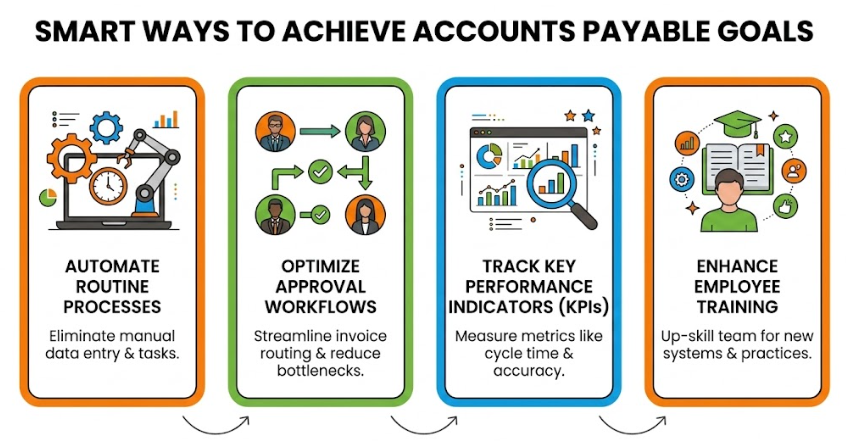
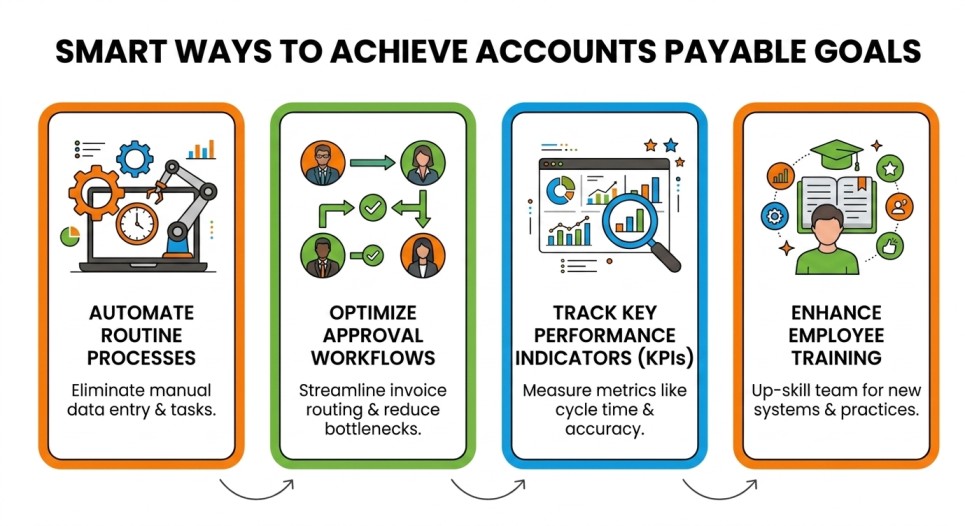
To meet Accounts Payable goals effectively, organizations must implement strategies that drive efficiency and measurable results. Below are some best practices:
1. Automate routine processes
By automating routine processes, organizations can eliminate repetitive tasks such as data entry, Invoice matching, and purchase order matching. This not only saves time but also ensures accuracy, as tools like Optical Character Recognition (OCR) and AI-powered platforms capture and process data with precision. As a result, the AP team is freed up to focus on more strategic tasks, enhancing overall efficiency.
2. Regularly review and optimize workflows
Periodic evaluations help identify bottlenecks in the AP process. For example, reviewing the approval hierarchy and consolidating steps can reduce processing time and improve efficiency.
3. Monitor KPIs and metrics
Tracking KPIs like Days Payable Outstanding (DPO), Invoice processing time, payment accuracy, and exception management provides valuable insights. These metrics help identify trends, measure progress, and guide decision-making.
4. Set clear policies and standards
Establishing standardized procedures for Invoice approval, data validation, and payment timelines empowers the team, ensuring consistency and minimizing misunderstandings. Clear policies give the team a sense of control and make it easier for them to adhere to AP goals, fostering a confident and efficient work environment.
5. Invest in employee training
Regular training is not just a necessity, but a testament to the value the organization places on its AP Team. It ensures the team stays updated on the latest tools, compliance standards, and best practices, making them an integral part of the organization’s success. A well-trained team is better equipped to meet and exceed AP goals, fostering a sense of value and belonging.
Transfrom your Accounts Payable Solution:
Accounts Payable Automation: A Game-Changer for Achieving AP Goals
Accounts Payable Automation is a game-changer for organizations striving to achieve their AP goals. By replacing manual processes with automated solutions, businesses can significantly improve efficiency, accuracy, and productivity. Here’s how Automation directly Supports AP goals:
1. Streamlined Invoice processing
Manual Invoice processing often involves time-consuming tasks like data entry, validation, and routing for approvals. Automation tools capture nvoice data using Optical Character Recognition (OCR), Support automated purchase order matching, and route Invoices directly to the relevant approvers. This reduces processing time, ensuring Invoices are paid on time and workflows are not delayed.
2. Reduced errors and improved accuracy
Manual data entry is prone to errors, such as duplicate payments or incorrect amounts, leading to financial losses and strained Vendor relationships. Automation software uses machine learning, validation checks, and automated exception management to eliminate errors, ensuring payment accuracy and preventing costly mistakes.
3. Enhanced cash flow management
Automation allows AP teams to schedule payments strategically, optimizing cash flow. By providing real-time visibility into payment schedules, due dates, and outstanding Invoices, automation helps businesses avoid late payments and maintain healthy liquidity.
4. Improved compliance and audit readiness
Automation tools are designed to ensure compliance with regulatory requirements. Features like audit trails, automatic tax calculations, and secure data handling make it easier to adhere to industry standards and prepare for audits. This reduces the risk of non-compliance penalties and safeguards the organization’s reputation.
5. Increased efficiency through analytics and insights
AP Automation platforms often include dashboards and reporting tools that provide insights into key performance indicators (KPIs) such as Days Payable Outstanding (DPO), payment accuracy, and approval times. These insights allow organizations to track progress, identify inefficiencies, and continuously improve their AP processes.
6. Facilitating Vendor collaboration
Automation enhances communication with Vendors by providing real-time updates on payment statuses and enabling faster dispute resolution. Self-service portals allow Vendors to check payment details and submit Invoices electronically, reducing back-and-forth communication and improving satisfaction.
7. Seamless ERP integration
Accounts Payable Automation not only streamlines Invoice processing and approvals but also integrates seamlessly with ERP systems like AP Automation for NetSuite, SAP, and Oracle. This integration ensures real-time data synchronization, eliminates duplicate entries, and gives finance teams complete visibility into Payables across all business units, helping them achieve accuracy, compliance, and faster financial closes.

Frequently Asked Questions (FAQs)
1. What role does Supplier communication play in achieving AP goals?
1. What role does Supplier communication play in achieving AP goals?
Supplier communication is essential for achieving Accounts Payable goals because it builds trust and reduces disputes. Clear communication ensures accurate payments and strengthens relationships, helping the AP team meet objectives like efficiency, on-time payments, and streamlined Invoice processing.
2. How can Automation help in achieving Accounts Payable goals?
2. How can Automation help in achieving Accounts Payable goals?
Automation helps achieve Accounts Payable goals by improving accuracy, reducing manual errors, and speeding up processes like data entry, Invoice matching, and approvals. It ensures compliance, optimizes cash flow management, and provides real-time insights, helping businesses achieve targets such as reducing Days Payable Outstanding (DPO). With a compelling AP Automation Business Case, companies can secure leadership buy-in, justify technology investment, and clearly demonstrate how Automation will help reduce costs.
3. What is a SMART goal in Accounts Payable?
3. What is a SMART goal in Accounts Payable?
A SMART goal in Accounts Payable is Specific, Measurable, Achievable, Relevant, and Time-bound. For example, reducing Invoice processing time by 20% within three months using Automation aligns with these criteria and improves efficiency while achieving organizational Accounts Payable objectives.
4. What is the main goal of Accounts Payable?
4. What is the main goal of Accounts Payable?
The main goal of Accounts Payable is to process payments accurately and on time while maintaining strong Supplier relationships, avoiding late fees, and optimizing cash flow. These goals ensure the organization’s financial stability and support its long-term growth strategy.
5. What are the strengths needed for Accounts Payable?
5. What are the strengths needed for Accounts Payable?
Successful Accounts Payable professionals need strong attention to detail, organization, and analytical skills to process Invoices accurately and identify discrepancies. Effective communication, problem-solving abilities, and a solid understanding of financial processes are also essential for maintaining Vendor relationships and ensuring smooth AP operations.
6. What are key performance indicators (KPIs) for Accounts Payable?
6. What are key performance indicators (KPIs) for Accounts Payable?
Accounts Payable KPIs are metrics used to evaluate the efficiency and effectiveness of AP processes. Common KPIs include Invoice processing time, cost per Invoice, DPO, payment accuracy rate, exception rate, and on-time payment percentage. Monitoring these metrics helps teams identify improvement opportunities, measure progress toward AP goals, and support broader performance goals across the AP function.
7. What are the main objectives or goals of an Accounts Payable department?
7. What are the main objectives or goals of an Accounts Payable department?
The primary objectives of an Accounts Payable department are to process Invoices accurately, make payments on time, maintain compliance with internal policies and regulations, optimize cash flow, and build strong Supplier relationships. These goals help support financial stability, operational efficiency, and long-term business growth.