Modern Accounting and the Role of Technology in Accounting
16 January, 2024
22 minute read
Sudeepta Pradhan, Finance Content Expert
S
Sudeepta Pradhan
Sudeepta specializes in Record-to-Report (R2R) and accounting automation content, focusing on the strategic narratives that drive the B2B SaaS and FinTech industries. Drawing on over eight years of experience, she translates complex autonomous finance capabilities into clear, insightful resources for modern finance teams. When she’s not analyzing the latest trends in enterprise finance, Sudeepta enjoys diving into literary fiction and sci-fi novels. Her approach to writing blends editorial rigor with a genuine passion for clarifying the evolving landscape of financial technology.
Last updated: 26 March, 2026
See How AI Agents Recover 12,000+ Close Hours and Accelerate Your Close by 45% Annually.
Accounting technology is no longer a competitive advantage; it is the baseline. The office of the CFO is undergoing a structural pivot from manual oversight to strategic leadership. According to recent Gartner research, nearly 60% of CFOs plan to increase their AI and automation investments by 10% or more in 2026, with 88% of finance leaders now prioritizing staff productivity through automation as a top-three mission-critical goal.
Accounting technology encompasses the full spectrum of digital tools, platforms, and systems that power modern financial operations, from AI-driven reconciliation and cloud-based close management to robotic process automation, blockchain, and real-time analytics. Together, these technologies are transforming what accountants do, how finance teams are structured, and what organizations can expect from their financial function.
This guide covers everything you need to understand about accounting technology: what it is, the key technologies reshaping accounting processes today, how they are impacting modern accounting practices and the profession itself, the benefits organizations realize from adopting them, and where the technology is headed next.
Table of Contents
Introduction
What is Modern Accounting?
What is Accounting Technology?
The Impact of Technology on Modern Accounting Practices
8 Key Technologies Used in Accounting
Benefits of Accounting Technology
Key Features of Modern Accounting Systems
Future of Accounting Technology
Challenges of Deploying New Technologies in Accounting
Overcoming the Challenges of Modern Accounting Adoption
How HighRadius Helps Organizations to Automate Their Accounting Process?
FAQs on Modern Accounting Technology
What is Modern Accounting?
Modern accounting transforms end-to-end processes from data acquisition to verification, emphasizing automation, digitalization, and data-driven methods. It utilizes technology to automate tasks, reducing reliance on manual execution for enhanced efficiency and accuracy in financial operations.
Furthermore, modern accounting emphasizes real-time data accessibility and integration. Cloud-based accounting platforms allow financial information to be accessed from anywhere, at any time, facilitating better collaboration among team members and enabling timely decision-making. These systems often include robust reporting and analytics tools, providing deep insights into financial performance and trends. By integrating with other business systems, such as ERP and CRM software, modern accounting solutions offer a unified view of the organization’s financial health, ensuring that decision-makers have the comprehensive information they need to drive growth and maintain compliance with regulatory standards.
The AI Agent Capability Matrix: A Roadmap for Financial Reconciliation
Get your strategic blueprint for deploying audit-ready AI agents across your global reconciliation workflow.
Accounting technology encompasses a wide array of tools, software, and systems that play a crucial role in accounting. These solutions leverage advanced technologies like artificial intelligence, cloud computing, machine learning, blockchain, natural language processing, and accounting automation.
The profound impact of accounting technology is evident in its capacity to transition traditional manual, paper-based processes into streamlined and accessible accounting workflows through cloud-based software. This evolutionary shift enables the digitization of previously labor-intensive tasks, such as bookkeeping practices, reducing time frames from weeks to mere minutes. In fact, accounting solutions such as HighRadius Financial Close software automate a majority of close tasks, resulting in a 30% reduction in days to close.
In this way, accounting technology acts as a catalyst, fostering increased efficiency, enhanced accuracy, and time-saving for accounting teams across industries.
Case Studies
A global hotel chain slashed 10+ days off their close. Your finance team can too.
Learn how they replaced their outdated processes to hit their fastest month-end ever.
The Impact of Technology on Modern Accounting Practices
The impact of technology on modern accounting practices has shifted the industry from manual record-keeping to real-time financial intelligence. This evolution has redefined the role of the accountant from a number cruncher to a strategic business advisor. Key impact areas are:
From Batch to Real-Time Processing: Technology has eliminated the waiting period for financial data, allowing for continuous closing and instant visibility.
The Advisory Shift: Automation handles the manual tasks such as data entry, allowing accountants to focus on business strategy and forecasting.
Data Accessibility: Financial insights are no longer siloed in the accounting department; they are accessible across the organization via the cloud.
8 Key Technologies Used in Accounting
Accounting technology includes a diverse range of tools and software that enhance the efficiency of accounting teams, enabling them to focus on higher business value tasks. There are eight major technologies that play a pivotal role in transforming the accounting landscape.
Let us look at some of these technologies in detail:
1. Automation & Artificial Intelligence (AI)
AI is a cornerstone of accounting technology, transforming modern accounting by automating labor-intensive tasks like tax preparation, payroll, and reconciliations. By eliminating manual data entry, AI-powered systems reduce human error and enable accountants to focus on strategic financial analysis.
Beyond simple automation, advanced modern accounting techniques leverage AI for:
Self-Learning Systems: Continuously improving accuracy and efficiency as the system processes more financial data over time.
Real-time Auditing: Analyzing massive datasets to uncover risks overlooked by manual sampling.
Fraud Detection: Utilizing pattern recognition to identify anomalies instantly.
Ebooks
Finance leaders are crushing financial close—with AI
Discover how AI is eliminating month-end chaos across global enterprises.
Machine Learning (ML) is a transformative accounting technologythat processes vast financial datasets in real-time to identify patterns and anomalies. By utilizing self-learning algorithms, this modern accounting method significantly reduces the manual labor required for data analysis and verification.
Key benefits of ML in modern accounting include:
Fraud Prevention: ML models adapt through continual learning to detect sophisticated fraud patterns within financial statements.
Anomaly Detection: Swiftly identifies deviations in invoices and transactions, ensuring more accurate financial reporting.
Audit Efficiency: Processes millions of transactions instantly, drastically reducing the time accountants spend on manual audit tasks.
3. Cloud-based Accounting
Cloud computing is the backbone of modern accounting, shifting financial data from isolated desktops to a centralized, internet-accessible environment. This accounting technology enables real-time data access and seamless integration across various business applications, ensuring a single source of truth for the entire organization.
Advantages of a cloud-based modern accounting system:
Real-Time Visibility: Replaces static spreadsheets with dynamic, automated reports for faster decision-making.
Global Collaboration: Allows accounting teams to collaborate securely from any location, eliminating device-specific constraints.
Scalable Integration: Provides a secure foundation for layering advanced modern accounting methods like AI, ML, and Blockchain.
4. Robotic Process Automation (RPA)
RPA is an essential accounting technology used to automate high-volume, rule-based tasks without human intervention. By deploying software bots for manual data entry and invoice processing, firms can significantly reduce human error and operational costs.
How RPA transforms modern accounting practices:
Workflow Consistency: Meticulously adheres to predefined rules, ensuring strict regulatory compliance and data integrity across all financial records.
Cross-System Integration: Automatically cross-references data from diverse sources to identify discrepancies and address vendor inquiries in real-time.
Resource Optimization: Expedites routine tasks, allowing financial experts to focus on modern accounting techniques like strategic analysis and complex report preparation.
5. Big Data
Big Data is a transformative accounting technology that allows firms to process and analyze massive volumes of unstructured information beyond the limits of traditional spreadsheets. By integrating Big Data into modern accounting practices, organizations can convert raw financial data into strategic, actionable knowledge.
The role of Big Data in a modern accounting system:
Enhanced Anomaly Detection: Delves into massive datasets to identify irregularities and potential fraud that traditional sampling methods might miss.
Predictive Risk Modeling: Analyzes historical trends and correlations to predict future financial implications and enable proactive planning.
360-Degree Insights: Processes data from diverse sources to foster a deeper understanding of customer behavior, vendor performance, and employee productivity.
6. Data Analytics and Business Intelligence
Advanced data analytics tools are essential accounting technology for converting raw numbers into strategic foresight. By applying modern accounting techniques to historical and real-time data, finance teams can move beyond reporting the past to predicting the future.
Strategic advantages of analytics in modern accounting:
Data-Driven Decisions: Empowers accountants to act as strategic advisors, providing leadership with actionable insights for informed business choices.
Predictive Forecasting: Utilizes statistical models to project future financial trends and recommend growth-oriented business strategies.
Risk Mitigation: Identifies operational inefficiencies and management risks by uncovering hidden patterns within complex datasets.
Proactive Resolution: Tools like HighRadius Anomaly Resolution identify error patterns and suggest fixes automatically, leading to a 30% reduction in days to reconcile.
7. Blockchain
Blockchain is a disruptive accounting technology that provides a secure, transparent, and immutable distributed ledger for financial transactions. By creating a shared single source of truth, this technology is fundamentally reshapingmodern accounting practices and record-keeping.
The impact of blockchain on modern accounting:
Transactional Automation: When combined with AI, blockchain can fully automate data-heavy workflows, allowing teams to shift toward higher-value strategic tasks.
Triple-Entry Accounting: Enables simultaneous recording of transactions in a shared ledger, significantly reducing the need for manual reconciliations.
Real-Time Auditing: Provides an unalterable audit trail that allows for instant validation, ensuring accountability and minimizing data inconsistencies.
Cost Reduction: Lowers expenses associated with transaction verification and historical asset tracking through decentralized encryption.
8. Low Code No Code
No-code development is a rapidly evolving accounting technology that empowers finance teams to automate complex workflows without traditional software development. By using no-code apps, organizations can implement modern accounting techniques to bridge data gaps and customize financial processes independently of IT departments.
How no-code impacts modern accounting practices:
Strategic Shift: Automates routine data-gathering, allowing accounting professionals to focus on high-value analysis and strategic business assignments.
Self-Service Automation: Streamlines tasks like account reconciliation, journal entry management, and financial statement generation without requiring coding expertise.
Operational Agility: Enables teams to build and deploy custom applications significantly faster than traditional development methods.
Benefits of Accounting Technology
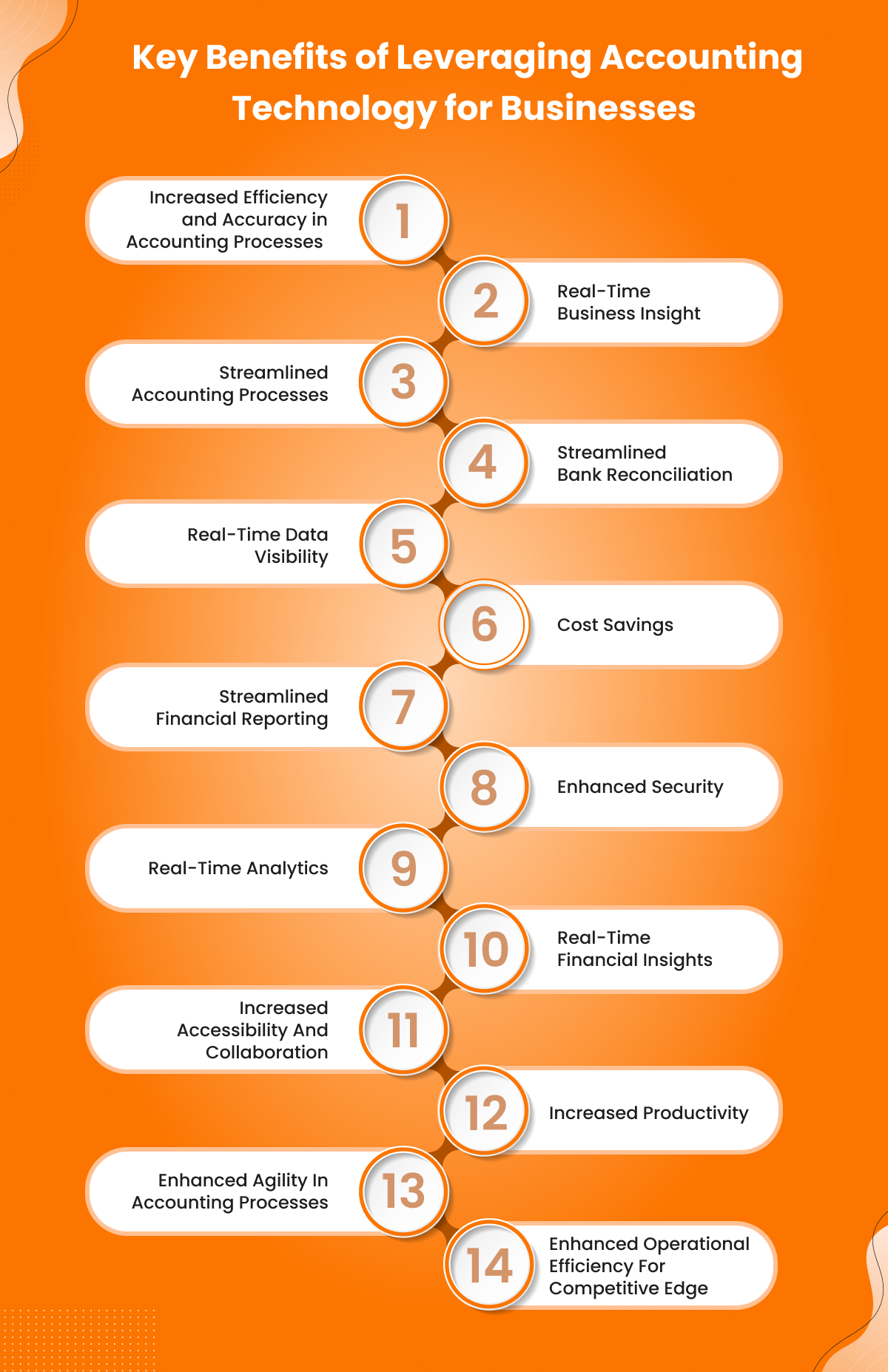
Technology has transformed accounting processes, empowering businesses to enhance their operations with increased efficiency, precision, and security. Innovations in automation, AI/ML, cloud computing, big data and analytics, and blockchain are reshaping accounting processes, offering additional benefits such as:
Increased efficiency and accuracy in accounting processes Automation of manual tasks, such as data entry and reconciliations, reduces time consumption and minimizes errors. Accounting software provides businesses with more control over financial records, improving data accuracy and security.
Streamlined accounting processes Migration to digital applications streamlines and improves accounting processes, significantly speeding up routine tasks. Automation eliminates bottlenecks, making workflows less frustrating and allowing accountants to focus on higher-value activities.
Real-time business insight Accounting software provides a comprehensive, real-time view of a business’s financial performance, from high-level summaries to detailed transactions. This insight enables swift decision-making and the ability to capitalize on new opportunities or address issues promptly.
Real-time data visibility The technology eliminates roadblocks in accessing information, providing accountants with secure and deep access to all relevant client data. This results in less guesswork, more precision, and the ability to draw valuable conclusions for the organization.
Streamlined reconciliation One of the key benefits of integrating technology into accounting is the streamlined reconciliation of bank statements. Accounting software seamlessly connects with bank accounts, providing direct access to bank statements within the software interface. Additionally, it facilitates automatic matching and reconciliation of bank transactions, simplifying the traditionally time-consuming process.
Cost savings Cloud-based accounting systems contribute to cost savings by lowering IT costs and improving productivity. Automation of repetitive tasks enables accounting professionals to focus on higher-value activities, further reducing resource costs.
Streamlined financial reporting Specialized accounting software streamlines complex and time-sensitive tasks like generating financial statements, creating balance sheets, and making income statements. Modern accounting software has simplified these processes by seamlessly compiling data from diverse sources, enabling the generation of comprehensive reports with just a few clicks.
Enhanced security Technological innovations, including advanced encryption, multi-factor authentication, and secure cloud storage, provide a higher level of security for sensitive financial information. This ensures the integrity and confidentiality of financial data.
Real-time analytics The integration of real-time analytics tools allows accountants to make informed decisions based on up-to-the-minute information. This proactive approach ensures businesses stay competitive by responding promptly to ongoing trends.
Real-time financial insights Technology enables accountants to access real-time financial data, eliminating the need to wait for weeks or months for updates. This facilitates timely insights, allowing accountants to provide valuable information to the organization promptly.
Increased accessibility and collaboration Cloud-based accounting software enhances accessibility and collaboration, enabling accountants to work remotely. This flexibility is crucial in today’s dynamic work environment, allowing professionals to serve from anywhere in the world.
Increased productivity Automation of routine tasks allows accountants to expand their role and focus on more higher-value services. This shift to becoming strategic advisors enhances overall productivity and satisfaction for the accounting teams.
Enhanced agility In a highly competitive business environment, technology equips accountants to respond quickly to market changes and challenges. The traditional quarterly examination is replaced by real-time insights, making accountants valuable advisors in major decision-making.
Enhanced operational efficiency for a competitive edge Implementing technology in business operations brings about a notable improvement, particularly in real-time execution. This improvement extends to optimizing cash flow through streamlined cash application and reconciliation processes. By automating these tasks, staff is liberated to engage in higher-level functions, including analysis and strategic evaluation. This enhanced operational efficiency enables management to make agile and informed decisions, contributing significantly to the overall competitiveness of the business.
Key Features of Modern Accounting Systems
A modern accounting system is an advanced software solution designed to manage an organization’s financial processes and data. Unlike traditional accounting methods that rely heavily on manual entry and physical records, modern accounting systems leverage technology to automate and streamline financial tasks.
As technology advances, organizations need to ensure that their accounting systems are equipped with the latest accounting technology. Some of the key features that organizations should ensure that their modern accounting systems have are as follows:
Modern accounting systems should have a cloud-based infrastructure: Modern accounting systems should operate in the cloud, as this reduces IT costs, mitigates technology risks, and enhances productivity with increased accessibility for accounting teams. Cloud-based infrastructure enhances efficiency, adaptability, and security while fostering seamless collaboration across geographical barriers. This facilitates remote work, ensures automatic updates for security, and incorporates legal changes seamlessly.
Modern accounting systems should provide end-to-end financial function streamlining: A robust accounting system should automate and streamline core financial functions, including accounts receivable, accounts payable, financial close, fund accounting, project accounting, account reconciliation, and revenue recognition.
Modern accounting systems should provide automated bookkeeping: Modern accounting systems should automate day-to-day bookkeeping tasks seamlessly, including general ledger updates, reconciliation, asset depreciation tracking, tax calculations, and error prevention.
Modern accounting systems should provide proactive anomaly identification: Advanced modern accounting software goes beyond automating routine tasks. It proactively manages anomalies by detecting accounting errors and omissions, using deviation detection and data pattern recognition to enhance accuracy.
Modern accounting systems should have enhanced security measures: Security is paramount for accounting software, given its handling of sensitive financial and personal data. Modern accounting solutions should prioritize robust security measures to safeguard information. HighRadius Record to Report suite prioritizes data security and privacy, meeting key compliance standards such as GDPR, HIPAA, SOC 1 Type 2, and SOC 2 Type 2. This ensures that data remains confidential and secure, giving organizations peace of mind while managing their finances.
Modern accounting systems should have seamless integration capabilities: Integration capabilities are crucial for efficiency. Modern accounting software, with seamless integration options, saves time, money, and effort for organizations as they integrate it with other tools the organization might be using.
Modern accounting systems should align with workflows seamlessly: Modern accounting software should offer customization to align with the specific workflow of the organization. Integration of accounting software should not only optimize the efficiency of routine accounting tasks but also empower organizations to derive actionable insights from their financial data, fostering informed decision-making and strategic planning.
Modern accounting systems should provide detailed financial reporting and projections: Modern accounting software should be able to leverage financial data to generate detailed reports and projections, providing valuable business intelligence for informed decision-making. Additionally, these reporting capabilities should extend beyond mere data presentation, offering intuitive visualization tools and analytics that empower users to interpret complex financial information effortlessly.
Modern accounting systems should utilize the latest accounting technology: Modern accounting systems should leverage the latest technologies, such as AI, ML, big data, and data analytics, to ensure that the accounting system is up-to-date and provides organizations with enhanced capabilities that improve their competitiveness in the market.
Future of Accounting Technology
The accounting profession is undergoing its most significant structural shift in decades, not just in the tools it uses, but in the fundamental nature of the work itself. If 2024 was the year AI entered the accounting workflow as an experiment, 2025 and 2026 mark the years teams are expected to own it strategically.
From Generative AI to Agentic AI
The next frontier in accounting technology is agentic AI systems that don’t just assist but act. Unlike generative AI, which responds to prompts, agentic AI can set goals, plan multi-step workflows, and execute them autonomously with little to no human intervention. This means end-to-end processes like bank reconciliation, invoice matching, journal entry preparation, and variance analysis are increasingly handled by AI systems that initiate actions rather than wait to be directed. A recent Gartner CFO survey found that while 78% of CFOs are actively investing in AI and automation, only 47% believe their teams are equipped to use these tools effectively, making this one of the defining capability gaps of 2026.
The Rise of Continuous Close
One of the most consequential shifts in modern accounting practice is the move from periodic month-end close to continuous close, a model where reconciliation, anomaly detection, and financial validation run as ongoing background processes rather than concentrated bursts of activity at month’s end.
The Evolving Role of the Accountant
Perhaps the most important dimension of technology’s impact on modern accounting is what it means for the accountant’s role. As routine tasks, data entry, reconciliation, report generation, and financial statement prep are increasingly automated, the accountant’s value proposition is shifting decisively toward judgment, interpretation, and strategic advisory.
AI Governance and the Audit-Ready Imperative
As AI becomes embedded in financial systems, regulatory scrutiny is intensifying. The EU AI Act, which entered enforcement in 2025, imposes stringent requirements around data transparency, usage, and risk assessment. Organizations today need to look for audit-ready AI accounting systems that are explainable, auditable, and governed by documented frameworks.
Addressing the Talent Shortage Through Technology
The accounting profession faces a structural talent challenge. With over 300,000 accountants having left the profession since 2020 and a large proportion of CPAs approaching retirement age, automation is increasingly viewed not just as an efficiency driver but as a capacity solution.
Challenges of Deploying New Technologies in Accounting
Implementing new technologies in accounting can transform financial operations, driving efficiency and accuracy. However, this transition is not without its challenges. Organizations must navigate various obstacles to ensure a successful deployment. Understanding these challenges can help businesses better prepare and mitigate potential issues.
Resistance to change The staff who are habituated to the old ways of working may not be willing to accept the new technology. This is brought about by fear of the unknown, unawareness of the operation of the new system, or even loss of job security. This can be overcome by comprehensive training, clear communication about the benefits, and involvement of staff in the process of transition.
Cost of implementation Setting up new accounting technologies can be quite expensive. This is so because it includes the purchase price for the software, an upgrade in hardware, and probably hiring consultants to implement them. The organization must carefully assess the return on investment and weigh potential long-term savings with efficiency gains against the up-front costs.
Integration with existing systems This ensures that new technology is seamlessly integrated with other existing systems. If they are incompatible, apart from disrupting workflow, it can also lead to inconsistencies in data. Careful planning, testing, and selection of technologies designed for easy integration reduces the risks involved.
Data security and privacy With new technology implementations comes an increase in the number of associated security risks. Stronger measures of security will be called for in order to protect sensitive financial data through encryption, access control, and the execution of security audits periodically. Compliance with the data protection regulations will also have to be at the forefront to avoid any legal risk.
Training and skill development Adopting new accounting technologies generally requires a significant amount of employee training. This process is time-consuming and costly. Ongoing learning and resources help staff to work with the new systems efficiently and stay updated with evolving technologies.
Downtime during transition Conversion to new technologies can result in temporary operational downtime for daily activities. It may have an effect on productivity and financial reporting. Appropriate planning, like installation on a phased basis and backup systems, can minimize the disruption of operations.
Rapid technological changes Technology is changing rapidly, and accounting systems become outdated quickly without relevant technology. This requires organizations to keep up with changes in technology and replace or upgrade systems much more often than in prior years.
Overcoming the Challenges of Modern Accounting Adoption
While the impact of technology on modern accounting practices is overwhelmingly positive, firms must navigate specific hurdles to ensure a successful digital transformation.
Resistance to Change: Shifting from legacy methods to modern accounting techniques requires cultural buy-in.
The Fix: Prioritize user-friendly interfaces and comprehensive training to reduce the fear of the unknown.
Data Security Concerns: Transitioning to the cloud increases the focus on cybersecurity.
The Fix: Adopt platforms with enterprise-grade encryption and SOC 1/SOC 2 compliance to safeguard sensitive financial data.
System Integration: Legacy ERPs often struggle to talk to new tools.
The Fix: Utilize accounting technology with robust API capabilities that allow for seamless data flow between existing systems.
The Skills Gap: AI and ML require a new set of analytical skills.
The Fix: Invest in No-Code platforms that empower accountants to manage automation without needing deep technical or IT expertise.
How HighRadius Helps Organizations to Automate Their Accounting Process?
HighRadius leverages the latest technology to enable organizations to fundamentally transform their accounting processes with comprehensive Record to Report software, offering end-to-end capabilities to streamline and automate various accounting processes and workflows. Powered by cutting-edge accounting technologies, the R2R solution empowers organizations to achieve a remarkable 30% reduction in days to close by seamlessly integrating Month-end Close Software, Account Reconciliation, and Anomaly Management.
At the heart of HighRadius’s R2R solution is an AI-powered platform designed to cater to all accounting roles. One of the standout features of the solution is its ability to automate almost 50% of manual repetitive tasks. This is achieved through LiveCube, a ‘No Code’ platform, that replaces Excel and automates data fetching, modeling, analysis, and journal entry proposals. It empowers the accounting teams, as any stakeholder who is familiar with tools like Excel can rapidly build applications without relying on IT, significantly enhancing the automation of accounting calculations. LiveCube combines the flexibility and familiarity of an Excel-like interface with pre-configured bi-directional data integrations with popular enterprise applications, including ERPs, CRMs, and Data Warehouses.
Leveraging real-time anomaly management,organizations can take a giant leap from reactive to proactive anomaly management by leveraging AI to identify and present anomalies as worklists for a faster closing. With the ability to detect 12 common types of errors and omissions in real-time, organizations can ensure the accuracy and integrity of their financial data.
Our Account Reconciliation Software provides an out-of-the-box formula set that can configure matching rules and match line-level transactions from multiple data sources and create templates to automate various transaction processing required for month-end close. Our solution has the ability to prepare and post journal entries, which will be automatically posted into the ERP, automating 70% of your account reconciliation process.
HighRadius Solution empowers organizations to experience enhanced efficiency by leveraging the best of the latest accounting technology and swiftly transitioning to modern accounting. The R2R solution not only provides organizations with a powerful, AI-driven platform that enhances efficiency and accuracy but also fundamentally changes the way organizations approach and execute their accounting processes.
Take a deep dive into HighRadius’ R2R solutions
Getting granular visibility and control into your accounting process is just a click away.
Achieve up to 90% transaction auto-match with out-of-the-box matching rules
Financial Close Management
Reduce days to close by 30% with a detailed checklist for month-end close
FAQs on Modern Accounting Technology
1) What is the difference between traditional and modern accounting?
Traditional & modern accounting represent different approaches & methodologies used in accounting. Traditional accounting focuses on historical data & compliance. In contrast, modern accounting integrates technology, real-time data, & strategic decision-making, offering a dynamic approach to financial management.
2) What are the emerging technologies in accounting?
Emerging technologies in accounting include AI-driven automation, blockchain for secure transactions, cloud-based accounting software, data analytics, and robotic process automation for streamlining repetitive tasks. These emerging technologies have revolutionized traditional accounting practices.
3) How has technology changed the accounting industry?
Technology has transformed accounting by automating tedious tasks with software, enhancing data accuracy, enabling real-time reporting, and providing real-time data access. Cloud-based platforms streamline collaboration, reducing manual errors and elevating efficiency and adaptability in the accounting industry.
4) What types of accounting technology do accountants use?
Accountants leverage diverse technologies, including accounting software, cloud platforms for data storage and collaboration, enterprise resource planning (ERP) systems, automated data entry tools, robotic process automation, and advanced analytics like AI and machine learning for in-depth financial analysis.
5) What is bookkeeping technology?
Bookkeeping technology involves digital tools & software facilitating the recording of financial transactions. It includes accounting software that streamlines tasks such as data entry, ledger maintenance, & financial reporting for efficient & accurate bookkeeping. Automation tools simplify reconciliations.
6) What are modern accounting practices?
Modern accounting practices incorporate advanced technologies like cloud computing, AI, data analytics, and automation. Real-time data access, digital transactions, and data analytics enhance efficiency. Sustainability reporting and a focus on advisory services are also integral to contemporary accounting.
7) What is cloud-based accounting technology?
Cloud-based accounting technology refers to financial management software hosted on remote servers accessed via the Internet. It allows users to access real-time financial data from anywhere, facilitating collaboration, enhancing flexibility, and ensuring that updates and backups are managed by the service provider.
8) Is cloud-based accounting technology secure?
Yes, cloud-based accounting technology is generally secure. Providers implement advanced security measures like encryption, multi-factor authentication, and regular security audits. These measures protect sensitive financial data from unauthorized access, ensuring compliance with industry standards and regulations.
9) How do APIs work in accounting technology?
APIs (Application Programming Interfaces) in accounting technology enable different software systems to communicate and share data seamlessly. They enable integration of accounting software with other business applications, automating data transfer, reducing manual entry, and enhancing overall efficiency and accuracy in financial processes.
10) What technology is needed for accounting?
Modern accounting requires a blend of technologies, including accounting software, cloud computing, APIs for integration, data analytics tools, and cybersecurity measures. These technologies streamline financial processes, enhance data accuracy, provide real-time insights, and ensure the security and compliance of financial information.
11) Why should you invest in accounting technologies?
Investing in accounting technologies enhances efficiency, accuracy, and decision-making. Automation reduces manual errors and saves time, while real-time data access improves financial insights. Integration with other systems streamlines operations, and advanced security measures protect sensitive information.
HighRadius Named a Challenger In 2025 Gartner® Magic Quadrant™ for Financial Close and Consolidation Solutions
HighRadius stands out as a challenger by delivering practical, results-driven AI for Record-to-Report (R2R) processes. With 200+ LiveCube agents automating over 60% of close tasks and real-time anomaly detection powered by 15+ ML models, it delivers continuous close and guaranteed outcomes—cutting through the AI hype. On track for 90% automation by 2027, HighRadius is driving toward full finance autonomy.
HighRadius Named ‘Rising Star’ in 2024 ISG Provider Lens™ Finance and Accounting Platforms Report
HighRadius leverages advanced AI to detect financial anomalies with over 95% accuracy across $10.3T in annual transactions. With 7 AI patents, 20+ use cases, FreedaGPT, and LiveCube, it simplifies complex analysis through intuitive prompts. Backed by 2,700+ successful finance transformations and a robust partner ecosystem, HighRadius delivers rapid ROI and seamless ERP and R2R integration—powering the future of intelligent finance.
HighRadius Named As A Major Player For Treasury & Risk Management Software By IDC
HighRadius is redefining treasury with AI-driven tools like LiveCube for predictive forecasting and no-code scenario building. Its Cash Management module automates bank integration, global visibility, cash positioning, target balances, and reconciliation—streamlining end-to-end treasury operations.