Can Agentic AI Solve Your Financial Consolidation Challenges? 5 Things to Consider
Last Updated: 20 August, 2026
•
Sakshi Saxena Senior Content Writer
Analyst Recognition
HighRadius Named a Challenger in 2025 Gartner® Magic Quadrant™ for Financial Close and Consolidation Solutions
Discover how HighRadius brings practical, results-driven AI to record-to-report processes with automation, anomaly detection, and continuous close capabilities.
Month-end and quarter-end close reporting remain two of the most critical and painful exercises in finance. Teams are expected to move quickly, maintain accuracy, and respond to executive questions—all while gathering data from different systems. Even with accounting systems in place, many finance teams still like real-time insights and grapple with a chaotic close cycle.
This is where agentic AI in Financial Consolidation starts to matter. It's not just about speeding things up. It’s about how work gets done autonomously, intelligently, and without constant oversight. In this blog, we break down what agentic AI means in practice and walk through five key aspects to weigh if you're thinking about implementing it.
Table of Contents
What is Agentic AI in Financial Consolidation?
What Financial Consolidation Challenges Can Agentic AI Actually Solve?
How Agentic AI Differs From Traditional Automation
Five Ways Agentic AI Supports Financial Consolidation
What Should Finance Teams Look for in an Agentic AI Consolidation Solution?
Implementation Considerations for Agentic AI in Finance
Is Agentic AI Right for Your Finance Function?
Boost Consolidation Efficiency with HighRadius Financial Consolidation Software
What is Agentic AI in Financial Consolidation?
In the simplest terms, Agentic AI moves consolidation from a human-led process supported by software to an AI-driven financial consolidation process overseen by humans. Unlike standard RPA, which just repeats a task, or Generative AI, which just summarizes text, Agentic AI is goal-oriented and enables AI for financial consolidation to execute multi-step workflows with greater autonomy. You don't just tell it to run a report, you tell it to ensure the books are audit ready. It then breaks that goal down into actionable steps, navigating your ERPs, sub ledgers, and spreadsheets just like a seasoned controller would.
Here is how these agents actually function in the trenches of a global month end close:
Cleaning Up the ERP Mess (Data Extraction & Standardization) We all know the headache of managing data soup from multiple ERPs SAP in Europe, Oracle in the US, and maybe a legacy system in APJ. Agentic AI doesn't just pull this data; it standardizes it on the fly, creating a more consistent foundation for AI consolidation across entities. It recognizes that a Marketing Expense in one system and Promotional Spend in another belong in the same bucket, ensuring your Chart of Accounts (COA) is harmonized without weeks of manual mapping.
Settling the Intercompany Score (Reconciliation & Elimination) Intercompany mismatches are one of the biggest time sinks in AI financial consolidation. An AI agent acts as a 24/7 mediator. It doesn’t wait until Day 5 to tell you there’s a $100k imbalance. It identifies the missing invoice or currency discrepancy the moment it happens, tracks down the transaction at the source entity, and proposes the elimination entry automatically.
Finding the Needle (Variance Detection) Traditional variance analysis is reactive, you find the outlier after the report is generated. Agentic AI performs continuous variance detection. It monitors trends in real time and more importantly, provides the context. It won't just say travel expenses are up 20% it will tell you travel expenses are up because of the annual sales kickoff in Q3, saving your team hours of digging.
Ending the Email Ping Pong (Workflow & Approvals) The close is often held up by a single person forgetting to hit approve on a journal entry. Agentic AI manages the workflow by predicting bottlenecks. It knows who needs to sign off on what, sends intelligent reminders with the necessary backup documentation attached, and ensures the process stays on track without a manager having to play detective.
Audit Ready by Default (Reports & Audit Trails) Audit season is usually a nightmare of how did we get this number? Agentic AI builds the audit trail as it works. Every autonomous decision from a currency translation to a manual adjustment is documented with a clear, logical rationale. By the time you hit generate on your consolidated statements, the why behind every number is already baked in.
30% Faster Close Cycles—Here’s How Leading Finance Teams Are Doing It
Explore 5 proven use cases of automated financial close. Learn how AI agents reduce manual work, improve accuracy, and deliver faster close outcomes.
What Financial Consolidation Challenges Can Agentic AI Actually Solve?
Financial consolidation is complex when teams must coordinate data, entities, currencies, and approvals across fragmented systems. Agentic AI in Consolidation simplifies this by automating the consolidation workflow rather than just flagging issues.
Key challenges it solves:
Disconnected financial data: Data scattered across ERPs, sub-ledgers, and spreadsheets causes inconsistencies and delays. AI agents automate the collection, standardization, and mapping of this data.
Manual intercompany reconciliation: Resolving entity mismatches is time-consuming. Agentic AI detects these mismatches, traces transaction sources, and automates eliminations.
Time-consuming adjustments: Recurring entries, currency conversions, and top-side adjustments are labor-intensive. Agents automate these based on set rules and historical data.
Reactive variance analysis: Finding anomalies after reporting is slow. AI agents continuously monitor data to identify unusual movements and provide context for faster investigation.
Close bottlenecks: Approval delays or unresolved exceptions stall the close. AI agents monitor workflows, trigger actions, and escalate exceptions to the right people.
The result: Finance teams spend less time on repetitive manual tasks and more time on high-value financial insights.
How Agentic AI Differs From Traditional Automation
Older systems follow fixed routines. They’re fine when everything goes as planned, but as soon as there’s a missing value or mismatch, the process stalls. It then requires human intervention to step in and sort it out manually.
However, agentic AI doesn’t pause. It’s built to proactively recognize what’s happening and act accordingly. When a figure doesn’t align with historical trends, it compares, evaluates, and decides. It doesn’t just react; it chooses a solution forward.
That’s why agentic AI in financial consolidation makes a real difference. It keeps teams moving without stopping for every small exception. It keeps watch across your systems, spots issues, and takes action based on what's worked in the past. If something’s off, like an intercompany discrepancy, it won’t just raise a flag. It knows what to check and where to step in.
Five Ways Agentic AI Supports Financial Consolidation
Full Cycle Automation Instead of following a manual checklist, agents drive the workflow from data ingestion to final sign off. They trigger tasks autonomously, moving your team from task managers to process reviewers.
Adaptive Intelligence These agents learn how you resolve specific variances. If a recurring intercompany mismatch pops up, the AI doesn’t just flag it. It remembers the previous fix and applies it, preventing the same bottleneck from happening twice.
Data Consistency Agentic AI acts as the connective tissue between your SAP, Oracle, or legacy systems, creating a consistent data foundation for Agentic AI financial consolidation. It continuously pulls, maps, and standardizes data into a single source of truth, ensuring your COA is always aligned.
Real Time Alerts Why wait until Day 5 to find an error? Agents monitor sub ledgers 24/7. When an entry doesn't match or a threshold is breached, it’s flagged instantly with the necessary context for a quick resolution.
Audit ready logs Every adjustment and approval is logged as it happens. This audit by design approach means that by the time you close the books, the documentation is already complete no last minute forensic digging required.
What Should Finance Teams Look for in an Agentic AI Consolidation Solution?
To move beyond basic AI, look for solutions that execute and manage complex, real-world workflows:
End-to-end automation: Agents should coordinate workflows across data ingestion, mapping, reconciliation, adjustments, and reporting.
ERP connectivity: The solution must integrate with existing ERPs, sub-ledgers, and data sources without requiring infrastructure changes.
Human-in-the-loop: Ensure you maintain control with configurable approval workflows and clear boundaries for human review.
Explainability/Audit trails: Every AI-driven action—including adjustments and decisions—must be traceable and documented for audit readiness.
Scalable agents: You should be able to expand automation across new entities and processes without rebuilding workflows.
The goal is to find an agentic AI solution that pairs autonomous execution with financial controls, transparency, and human oversight for scalable, compliant automation.
Implementation Considerations for Agentic AI in Finance
Rolling out agentic AI in financial consolidation takes more than switching on a platform. You’ll need a plan that fits your team and your systems.
Tech setup: Can your ERP or reporting systems integrate with agent-level tools?
Data structure: If records are incomplete or inconsistent, the output won’t hold up. Make sure inputs are clean.
Team understanding: AI agents work best when people understand the key processes where AI agents can work autonomously and the processes where human insights will be more strategic.
Control levels: Be clear on what AI agents should run independently and areas that require supervision.
Start with one process, such as account reconciliations, and let the results build the case for what comes next.
Is Agentic AI Right for Your Finance Function?
Not every finance function needs to overhaul its approach overnight. But if inefficiencies are mounting, deadlines are tight, and manual work is eating into valuable time, it may be the right moment to evaluate your options.
Here’s a quick checklist to start:
Are spreadsheets still central to your financial close process?
Is your team consistently rushing to meet reporting deadlines?
Are you spending more time correcting errors than focusing on strategic analysis?
Does the month-end close feel like a fire drill instead of a structured process?
If two or more of these challenges sound familiar, your team could benefit from a different way of working, one that introduces autonomy, speed, and reliability.
Agentic AI doesn’t replace your finance team. It supports it. These digital agents handle routine, repetitive tasks like data aggregation, reconciliations, and journal validation, without needing to be manually triggered. They adapt to changes and learn from past cycles, making every month end close smarter than the last.
Better still, agentic AI Financial Consolidation works with the platforms you already use. Whether you're running on SAP, Oracle, NetSuite, or Microsoft Dynamics, intelligent agents can be layered on top to enhance workflows, not disrupt them.
You don’t need to commit to a full transformation. Start with one process, like intercompany reconciliation, and scale your AI driven Consolidation approach as you see results. Agentic AI in financial reporting and consolidation offers a way to modernize without risking your foundation. It’s about enabling your team to do more, with less friction and more confidence.
Templates
Companies leveraging HighRadius solutions have experienced 45% faster close times & 30% drop in close times.
Use this ready-to-deploy checklist to keep your team aligned, deadlines on track, and close tasks under control.
Boost Consolidation Efficiency with HighRadius Financial Consolidation Software
HighRadius financial consolidation software, powered by agentic AI workflows, automates real-time data ingestion, currency conversion, intercompany elimination, allowing top-side adjustments and accelerates financial close and consolidation.
Automatically detects and eliminates intercompany transactions, preventing double-counting, ensuring accurate consolidation, and enhancing financial transparency and compliance. Experience up to 99% accurate intercompany eliminations.
Automates consolidation by standardizing data aggregation, ensuring consistency, reducing workload, and providing centralized financial visibility.
Applies real-time exchange rates and adjusts FX rates, eliminating currency discrepancies and ensuring compliance. Businesses are empowered to realize 97% currency conversion automation.
Agentic AI doesn't replace finance teams, it augments them. When used in consolidation, it removes roadblocks, saves time, and ensures greater accuracy in the numbers. If your current reporting and consolidation processes feel stuck, this is the step forward.
Take a deep dive into HighRadius’ Consolidation solutions
Accelerate Consolidation efficiently and achieve Audit Readiness
Calculate BS and P&L conversions with accurate CTA reporting.
Intercompany Eliminations
Eliminate loans, revenue, & expenses with adjusting JEs.
Chart of Accounts Mapping
Generate cross-entity statutory & managerial CoA hierarchies.
Entity Ownership
Automate NCI metrics, control rules, and reporting.
GL Transaction Download
Automate multi-ERP extraction and CoA-based consolidation.
Top-side Adjustments
Automate topside entries, & audit trails.
Frequently Asked Questions (FAQs)
1. What is AI in Financial Consolidation?
Agentc AI in financial consolidation uses artificial intelligence to automate and optimize processes such as financial data collection, account mapping, currency conversion, intercompany reconciliation, variance analysis and reporting. AI in financial consolidation can reduce manual work while helping finance teams improve accuracy, accelerate the close, and maintain better visibility across entities.
Agentc AI in financial consolidation uses artificial intelligence to automate and optimize processes such as financial data collection, account mapping, currency conversion, intercompany reconciliation, variance analysis and reporting. AI in financial consolidation can reduce manual work while helping finance teams improve accuracy, accelerate the close, and maintain better visibility across entities.
2. How do AI agents help in financial consolidation?
AI agents in Financial Consolidation help automate repetitive and complex consolidation activities by collecting financial data, identifying anomalies, reconciling intercompany transactions and triggering workflows. AI-driven consolidation allows finance teams to move from manually managing each task to overseeing an intelligent workflow that can execute actions and escalate exceptions when human judgment is needed.
AI agents in Financial Consolidation help automate repetitive and complex consolidation activities by collecting financial data, identifying anomalies, reconciling intercompany transactions and triggering workflows. AI-driven consolidation allows finance teams to move from manually managing each task to overseeing an intelligent workflow that can execute actions and escalate exceptions when human judgment is needed.
3. Is Agentic AI Consolidation better than RPA for financial consolidation?
AI in consolidation can be more effective than traditional RPA for complex consolidation processes because it can respond to changing data and exceptions rather than relying only on fixed rules. While RPA is useful for repetitive, predictable tasks, AI-driven financial consolidation can analyze context, adapt to exceptions, and take action across multi-step workflows.
AI in consolidation can be more effective than traditional RPA for complex consolidation processes because it can respond to changing data and exceptions rather than relying only on fixed rules. While RPA is useful for repetitive, predictable tasks, AI-driven financial consolidation can analyze context, adapt to exceptions, and take action across multi-step workflows.
4. Can small finance teams use AI for consolidation?
Yes. AI for consolidation can be deployed incrementally, allowing smaller finance teams to start with high-friction processes such as account reconciliation, data collection, or intercompany matching. An Agentic AI consolidation tool can automate repetitive activities without requiring teams to completely replace their existing ERP or financial systems.
Yes. AI for consolidation can be deployed incrementally, allowing smaller finance teams to start with high-friction processes such as account reconciliation, data collection, or intercompany matching. An Agentic AI consolidation tool can automate repetitive activities without requiring teams to completely replace their existing ERP or financial systems.
5. What should finance teams consider before adopting AI financial consolidation software?
Finance teams should evaluate ERP compatibility, data quality, workflow automation, security, auditability, scalability, and human-in-the-loop controls. The best AI financial consolidation software should integrate with existing finance systems while providing clear visibility into AI-driven decisions and allowing teams to determine which activities require human approval.
Finance teams should evaluate ERP compatibility, data quality, workflow automation, security, auditability, scalability, and human-in-the-loop controls. The best AI financial consolidation software should integrate with existing finance systems while providing clear visibility into AI-driven decisions and allowing teams to determine which activities require human approval.
6. What are the benefits of AI-driven financial consolidation?
The key benefits of AI-driven financial consolidation include faster close cycles, reduced manual effort, improved data consistency, automated intercompany reconciliation, faster variance analysis, and stronger audit readiness. AI can also continuously monitor consolidation workflows and identify exceptions that require finance team intervention.
The key benefits of AI-driven financial consolidation include faster close cycles, reduced manual effort, improved data consistency, automated intercompany reconciliation, faster variance analysis, and stronger audit readiness. AI can also continuously monitor consolidation workflows and identify exceptions that require finance team intervention.
7. What should a top AI driven Financial Consolidation provide?
The top AI solutions for financial consolidation should do more than automate individual tasks. Finance teams should look for solutions that provide end-to-end automation across data ingestion, account mapping, currency conversion, intercompany reconciliation, adjustments, reporting, and workflow management. They should also offer ERP connectivity, audit trails, configurable controls, and human oversight for exceptions.
The top AI solutions for financial consolidation should do more than automate individual tasks. Finance teams should look for solutions that provide end-to-end automation across data ingestion, account mapping, currency conversion, intercompany reconciliation, adjustments, reporting, and workflow management. They should also offer ERP connectivity, audit trails, configurable controls, and human oversight for exceptions.
Resource Library
Resource Hub
ASSETS
Cash Flow Calculator (FREE)
Track operating and net cash flow while forecasting balances to maintain liquidity and financial control.
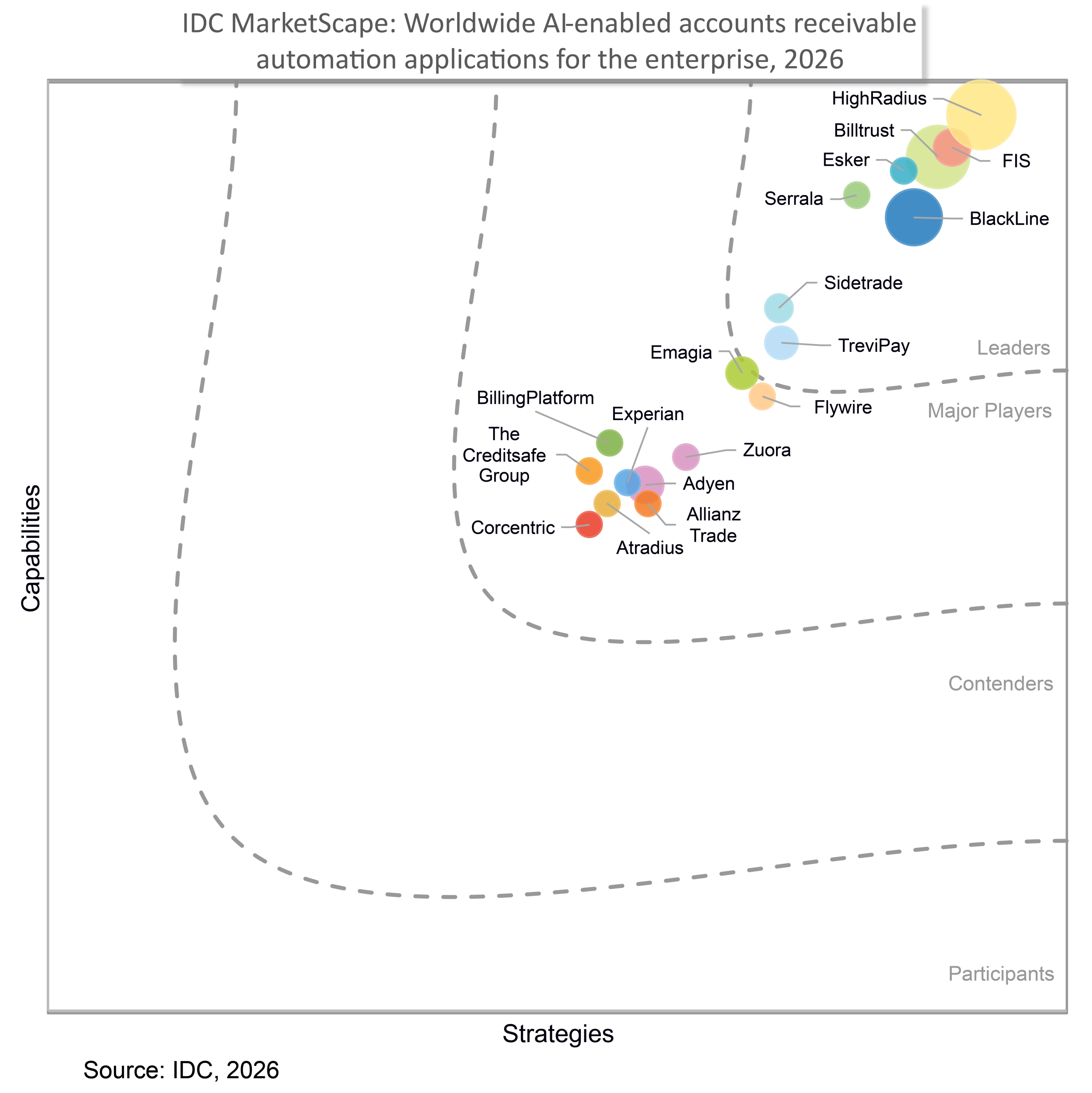
HighRadius recognized as a "Leader" in IDC Marketscape: Worldwide AI-enabled accounts receivable automation applications for the enterprise 2026 vendor assessment
Recognized as a Leader in 2026 Vendor Assessment for unifying credit, collections, cash application, deductions, e-invoicing, and payments on one AI platform to advance enterprise-wide invoice-to-cash transformation.
Forrester Recognizes HighRadius in The AR Invoice Automation Landscape Report, Q1 2023
Forrester acknowledges HighRadius’ significant contribution to the industry, particularly for large enterprises in North America and EMEA, reinforcing its position as the sole vendor that comprehensively meets the complex needs of this segment.