Arjobi specializes in finance transformation, crafting content that bridges the gap between traditional financial operations and modern, technology-driven processes. With a strong focus on automation, efficiency, and strategic value creation, Arjobi brings clarity to complex transformation journeys within the B2B SaaS and FinTech landscape. Leveraging deep domain expertise, Arjobi translates evolving financial practices into actionable insights for forward-thinking finance teams. Beyond work, Arjobi has a keen interest in exploring emerging trends in digital finance and enjoys content that challenges conventional thinking. Their writing style combines analytical depth with a practical, results-oriented perspective on the future of finance.
Analyst Recognition
HighRadius Named a Challenger in 2026 Gartner® Magic Quadrant™ for Financial Close and Consolidation Solutions
Discover how HighRadius brings practical, results-driven AI to record-to-report processes with automation, anomaly detection, and continuous close capabilities.
Balance sheet reconciliation software helps finance teams automate account matching, exception management, and journal posting while improving accuracy and audit readiness.
The right reconciliation solution depends on your ERP environment, reconciliation volume, entity complexity, automation goals, and long-term scalability needs.
This guide compares 9 leading balance sheet reconciliation tools, including HighRadius, BlackLine, FloQast, OneStream, QuickBooks, Sage Intacct, SolveXia, Trintech, and Xero.
Each platform is evaluated on automation depth, AI capability, ERP integrations, scalability, controls, and overall audit-readiness for finance teams.
When comparing tools, prioritize real automation and AI capability over feature count, and watch for vague claims, manual rules, or weak audit trails.
HighRadius stands out for AI-powered, agent-driven balance sheet reconciliation with end-to-end R2R capabilities for mid-market and enterprise finance teams.
Not every balance sheet reconciliation tool actually replaces spreadsheets. Many simply add a workflow layer while finance teams continue exporting GL data to Excel, reconciling accounts manually, and uploading results back into the system. Before evaluating any vendor, ask one question: Does it eliminate spreadsheets, or simply hide them?
What's the root cause? Traditional reconciliation processes were built around month-end cycles, manual account substantiation, and reactive exception handling. As organizations grow, finance teams struggle to keep pace with increasing reconciliation volumes, fragmented ERP environments, intercompany complexity, and growing compliance requirements, all while relying heavily on spreadsheets.
What's changed? Today, AI-powered balance sheet reconciliation platforms can continuously reconcile transactions, prioritize high-risk accounts, automate account substantiation and supporting documentation, and post journals directly to ERP systems, reducing manual effort long before the financial close begins.
This guide compares the 9 best balance sheet reconciliation tools of 2026 for mid-market and enterprise finance teams. We evaluated each platform based on automation capabilities, AI functionality, ERP integrations, scalability, and audit readiness to help you identify the solution that best fits your reconciliation process, not just your technology stack.
Best Balance Sheet Reconciliation Tools At A Glance
Organizations typically evaluate balance sheet reconciliation tools when spreadsheets become difficult to scale, month-end reconciliations take too long, or teams need greater automation and control. For Controllers, Finance Directors, Global Process Owners, and CAOs, the comparison below highlights each tool’s key strengths and ideal use cases to help shortlist the right solution.
Platform
Best For
HighRadius
AI-powered balance sheet reconciliation for mid-market and enterprise finance teams, with automated matching, GL certification, journal posting, and ERP integrations.
BlackLine
Standardized reconciliation templates, workflow automation, and dashboards for general finance teams.
FloQast
Collaboration-focused month-end close and reconciliation tracking with ERP integration.
OneStream
Platform for consolidated financial reporting with standard reconciliation capabilities.
QuickBooks
Bank reconciliation and transaction matching suited for small businesses.
Sage Intacct
Multi-entity financial consolidation with standard reconciliation functionality.
SolveXia
Automation of routine reconciliation with matching and reporting, and dashboards.
Trintech
Dashboard and alerts to manage reconciliations with standard reporting features.
Xero
Side-by-side bank reconciliation and currency support for small-sized businesses.
*List of leading balance sheet reconciliation tools, arranged in no particular order
Have You Outgrown Spreadsheet-Based Reconciliation?
Spreadsheets can work for straightforward reconciliation, but they become difficult to sustain as complexity grows. If month-end reconciliations are taking too long, account volumes are outpacing your team, or exceptions are being discovered only during the close, it may be time to rethink the process. The same applies when teams lack visibility into reconciliation status, spend significant time gathering substantiation and audit support, or struggle to standardize processes across multiple ERPs and entities.
If these challenges sound familiar, a dedicated reconciliation solution can help automate manual work, improve visibility, and strengthen control over the close.
How We Evaluated The Balance Sheet Reconciliation Tools
Balance sheet reconciliation software automates the process of matching account balances with supporting data, identifying exceptions, and maintaining the documentation needed to substantiate accounts. Modern platforms can go beyond basic workflow automation with AI-powered matching, continuous reconciliation, and automated journal entries.
For this comparison, we evaluated each tool based on the factors that matter most when modernizing reconciliation:
Automation: How much manual reconciliation work can the platform eliminate?
AI capabilities: How effectively does it use AI for matching, exception management, substantiation, or other reconciliation tasks?
ERP integrations: Can it connect with the financial systems and ERPs used across the organization?
Scalability: Can it support growing account volumes, entities, transaction complexity, and reconciliation needs?
Controls and audit readiness: Does it provide the visibility, documentation, approvals, and controls needed for an audit-ready close?
Usability: Can finance teams adopt and operationalize the platform without adding unnecessary process complexity?
These criteria help distinguish platforms that simply digitize existing workflows from those that can meaningfully automate and modernize balance sheet reconciliation.
9 Best Balance Sheet Reconciliation Tools Options
Choosing the right balance sheet reconciliation software is crucial for enhancing accuracy, streamlining month-end closings, and ensuring that your financial records are audit-ready and compliant. The following list highlights nine of the best platforms for 2026, showcasing their key strengths and how they can help finance teams streamline reconciliations efficiently.
HighRadius
HighRadius’ Balance Sheet Reconciliation Software is a Gartner-named Challenger in Financial Close & Consolidation built for both fast-scaling mid-market finance teams and complex global enterprises. Powered by 22 purpose-built AI agents and the LiveCube Agent Builder, it transforms spreadsheet-driven reconciliations into autonomous workflows that deliver 90% automated reconciliation, 95% journal posting automation, 99% reconciliation accuracy, and 30% faster close cycles.
For mid-market controllers, HighRadius eliminates spreadsheet dependency by converting existing reconciliation templates into AI agents, helping lean teams automate close activities without adding headcount and achieve ROI in 3–6 months.
For enterprise finance organizations, HighRadius orchestrates reconciliation across 50+ ERPs, multi-entity environments, and global balance sheet workflows, enabling continuous close visibility, automated intercompany substantiation, and audit-ready compliance at scale.
Key Features for Finance Teams
Bank Reconciliation Agent - Automatically syncs bank + GL data, matches transactions, flags variances, and posts journals directly to ERP systems with 95% transaction auto-match accuracy.
GL Auto-Certification Agent - Auto-certifies up to 40% of low-risk accounts, allowing accountants to focus only on material exceptions.
Prepaid Expense Substantiation Agent - Builds amortization schedules automatically and validates balances against accounting policy for 100% expense recognition accuracy.
Deferred Revenue Agent - Automates revenue schedules, calculates monthly recognition entries, and posts journals back into ERP systems.
Payroll Clearing Reconciliation Agent - Matches payroll runs to clearing accounts and auto-resolves timing differences at scale.
Bad Debt Reserve Substantiation Agent - Calculates reserve adjustments using aging + historical provisioning logic and routes entries for approval automatically.
HighRadius clients have achieved the following value:
BlackLine is a cloud-based platform for automating financial close, reconciliation, and journal entry management. It centralizes reconciliation templates, automates workflows, and provides visibility across the close process.
Key Features:
Automates reconciliations, journal entries, and close processes
Centralized dashboard for visibility and collaboration
ERP integration with SAP, Oracle, and others
Built-in controls to support compliance and audit readiness
FloQast
FloQast is a cloud-based platform that supports balance sheet reconciliation and close management. The platform includes automated reconciliations, centralized task management, and ERP integration, helping accounting teams manage workflows efficiently. It is commonly used by small-sized organizations for structured financial close management.
Key Features:
Interface designed to support accounting workflows
Centralized task and document management for collaboration and visibility
Integrates seamlessly with ERP systems and existing financial tools
Offers built-in checklists and audit trails to boost compliance.
OneStream
OneStream offers a unified platform for financial consolidation, reporting, and reconciliations. It allows finance teams to trace reported balances back to their underlying accounts, helping improve transparency and maintain auditability across financial data.
Key Features:
Unified platform for consolidation, reporting, and data integration
Drill-to-reconciliation feature for improved transparency and audit tracking
Integration with ERP systems, including Oracle, SAP, and Microsoft Dynamics
Scalable to handle large transaction volumes and datasets
QuickBooks
QuickBooks is a cloud-based accounting solution commonly used by small to small-sized businesses. It simplifies account reconciliations by providing an intuitive interface that enables users to match transactions, identify discrepancies, and maintain accurate records. The platform supports standard security features such as data encryption, multi-factor authentication, and audit trails, making it ideal for secure and compliant financial management.
Key Features:
Simplified reconciliation tool for matching transactions and identifying discrepancies
A cloud-based platform offering remote access and flexible account management
Customizable reporting tools tailored to business needs
Integration with banks and third-party apps for data sync and real-time updates
Sage Intacct
Sage Intacct is a cloud-based financial management platform that supports organizations in automating reconciliations and managing financial operations. Its automation capabilities reduce manual work, minimize errors, and accelerate month-end close processes. The platform also includes features for multi-entity consolidations and financial reporting across subsidiaries.
Key Features:
Automates workflows and reconciliations, reducing manual effort and errors
Real-time dashboards provide insights into financial health
Compliance and audit-ready features to support regulatory requirements
User-friendly interface designed to simplify accounting tasks
SolveXia
SolveXia is an automation platform that supports finance teams in streamlining reconciliations and eliminating repetitive manual tasks. The platform automates data preparation, transaction matching, and reporting, enabling teams to process large volumes of transactions accurately.
Key Features:
Automation for complex, repetitive reconciliation tasks
Integrates with ERP systems and spreadsheets for centralized data management
Provides comprehensive audit trails for compliance and transparency
Supports real-time visibility into reconciliation progress and exceptions
Trintech
Trintech is a financial software platform that automates reconciliation and streamlines the financial close process. The platform helps reduce manual errors, identify discrepancies, and provide visibility into account balances. It includes tools for compliance and audit-ready reporting and is compatible with Trintech products such as Cadency and Adra Balancer.
Visibility into account balances to support reporting and decision-making
Integrates with ERP systems to streamline data flow and close processes
Xero
Xero is a cloud-based accounting solution designed to simplify and automate reconciliation processes for small businesses. The platform includes automated bank feeds, real-time transaction matching, and tools for maintaining accurate accounts. Xero also enables multiple users, such as accountants and team members, to access financial data simultaneously for improved collaboration and visibility.
Key Features:
Automated bank feeds and reconciliation suggestions
A cloud-based platform allows real-time access and collaboration across teams
Integrates with third-party apps for payments, inventory, and reporting
Key AI Features to Look For In A Balance Sheet Reconciliation Platform
AI is changing what finance teams can expect from balance sheet reconciliation software. But not every platform using the term “AI” delivers the same level of automation. When evaluating solutions, look beyond AI as a feature and consider where it actually reduces manual work, improves decision-making, and strengthens reconciliation controls.
1. Intelligent Transaction Matching
Look for AI that can identify matches across different data sources, including one-to-one, one-to-many, and many-to-one transactions, even when amounts, dates, or reference information do not align perfectly. The goal is to increase automated matching without requiring finance teams to maintain increasingly complex rules.
Why it matters: Higher auto-match rates reduce the volume of transactions requiring manual review, allowing teams to focus their time on genuine exceptions.
2. AI-Powered Exception Management
AI should help finance teams identify, prioritize, and investigate exceptions rather than simply flagging every mismatch. More advanced platforms can surface unusual transactions, identify patterns, and prioritize exceptions based on risk or business impact.
Why it matters: Prioritizing exceptions helps finance teams focus on the accounts and discrepancies that require attention instead of working through large volumes of low-risk items.
3. Automated Account Substantiation
AI can help gather and analyze supporting documentation, explain account movements, and prepare reconciliation workpapers. This reduces the manual effort required to substantiate accounts and prepare for review or audit.
Why it matters: Automating substantiation reduces the effort required to prepare accounts for review while creating more consistent documentation for audit purposes.
4. Continuous Reconciliation
Instead of waiting until month-end, AI-enabled platforms can continuously monitor transactions and account activity, allowing teams to identify discrepancies earlier and address them before they affect the close.
Why it matters: Finding discrepancies earlier reduces the concentration of reconciliation work at month-end and gives teams more time to resolve issues before the close.
5. Intelligent Journal Automation
Look for platforms that can identify when reconciliation differences require journal entries, prepare the relevant entries, and route them through appropriate approval workflows while maintaining a clear audit trail.
Why it matters: Connecting reconciliation to journal creation can eliminate downstream manual work and reduce the time between identifying an adjustment and recording it in the ERP.
6. Agentic Automation
The next step is moving from AI that assists individual tasks to AI agents that can execute multi-step reconciliation workflows. This can include gathering data, performing matches, investigating exceptions, preparing documentation, and triggering downstream actions with human oversight where required.
Why it matters: Agentic automation can move reconciliation from task-level automation toward end-to-end process execution, reducing the amount of manual intervention required across the workflow.
Ebooks
What’s the ROI of Automating Accounting?
Go beyond AI capabilities and discover how to quantify the value of accounting automation and build a stronger business case for transforming finance operations. Learn about:
How To Choose The Right Balance Sheet Reconciliation Solution?
The right reconciliation solution should address your current process challenges while giving your finance organization room to scale. Start by assessing the volume and complexity of your reconciliations, the level of manual work involved, your ERP environment, and the controls required for an audit-ready close. Then evaluate vendors on how effectively they can automate the work, not simply how many features they offer.
Questions to Ask During Vendor Demos
Use these questions to move beyond feature checklists and understand how a solution will work in your environment:
How much of the reconciliation process can be automated? - Ask what happens without manual intervention, from data ingestion and matching through substantiation and journal posting.
How does the platform handle exceptions? - Understand how unmatched transactions are identified, investigated, prioritized, and resolved.
How does AI improve reconciliation? - Ask what AI actually does, where it is applied, and whether it reduces the need for manually maintained rules.
How does the platform integrate with our ERP and other data sources? - Confirm how data is transferred and whether multiple ERPs, entities, and currencies are supported.
How are automated decisions documented? - Look for clear audit trails showing why transactions were matched, exceptions were handled, or changes were made.
What does implementation require from our finance team? - Understand data preparation, configuration, integrations, training, and ongoing maintenance before committing.
Red Flags to Watch For
Be cautious if a vendor:
Uses broad AI claims without explaining what the technology actually automates.
Still requires significant spreadsheet work or manual data movement.
Relies heavily on manually maintained rules to achieve automation.
Cannot explain why transactions were matched or rejected.
Provides limited visibility into exceptions, approvals, or automated decisions.
Offers integrations that require extensive manual intervention or customization.
Has unclear implementation requirements or ongoing maintenance demands.
Common Implementation Mistakes
Even the right technology can fall short when implementation is poorly planned. Common mistakes include:
Automating a broken process: Standardize reconciliation workflows before automating them.
Trying to automate everything at once: Start with high-volume, repetitive, or high-impact accounts and expand from there.
Underestimating data and ERP complexity: Validate data quality, integrations, entity structures, and account mappings early.
Leaving exception ownership unclear: Define who reviews, approves, and resolves exceptions before going live.
Measuring success only by implementation: Establish metrics such as automation rates, reconciliation cycle time, exception resolution time, and productivity gains to measure whether the solution is delivering value.
Templates
Have the Right Questions. Now Score the Answers.
Evaluate reconciliation vendors consistently with a structured scorecard designed to help you compare capabilities, identify gaps, and make a confident decision.
The right balance sheet reconciliation solution should do more than digitize existing workflows. Look for a platform that can reduce manual reconciliation work, scale across your accounts and entities, strengthen controls, and use AI to address exceptions before they impact the close. The best fit ultimately depends on your organization's reconciliation complexity, ERP environment, and automation goals.
With those criteria in mind, here's how HighRadius approaches balance sheet reconciliation.
How Can HighRadius Help?
HighRadius helps finance teams modernize balance sheet reconciliation with AI-powered balance sheet reconciliation software that automates transaction matching, account certification, variance analysis, substantiation, and journal posting. Its AI-powered capabilities can identify anomalies, classify variances, generate supporting documentation, and automate routine reconciliation activities, reducing the manual work required to prepare and substantiate balance sheet accounts.
Designed for mid-market and enterprise organizations, HighRadius supports complex, multi-entity environments and integrates with 50+ leading ERPs, including SAP, Oracle, and NetSuite. This enables finance teams to work with synchronized financial data while maintaining visibility into reconciliation status, exceptions, and account-level activity across entities.
With up to 95% automation in reconciliations and journal postings, a 90% transaction auto-match rate, and up to 50% higher productivity, HighRadius helps teams move from spreadsheet-driven, month-end reconciliation toward a more automated and controlled process.
Explore What Makes These Results Possible
Take a closer look at the AI-powered capabilities, intelligent automation, and controls that help finance teams transform balance sheet reconciliation at scale.
For organizations looking to modernize balance sheet reconciliation, HighRadius combines AI-powered automation, account certification, exception management, and audit-ready documentation in a single platform, while providing the broader R2R capabilities needed to connect reconciliation with the rest of the financial close.
Take a deep dive into HighRadius’ R2R solutions
Getting granular visibility and control into your accounting process is just a click away.
Achieve up to 90% transaction auto-match with out-of-the-box matching rules
Financial Close Management
Reduce days to close by 30% with a detailed checklist for month-end close
Anomaly Management
Resolve 80% of anomalies with auto-suggested actions.
Frequently Asked Questions (FAQs)
1. What is the best balance sheet reconciliation solution for enterprises and mid-market businesses?
HighRadius is a top choice for enterprises and mid-market businesses seeking an efficient solution for balance sheet reconciliation. The AI-powered platform automates up to 95% of journal postings and 80% of bank reconciliations, resulting in a 30% reduction in close times. It also offers seamless ERP integration across 50+ ERPs and systems for scalable, compliant operations.
HighRadius is a top choice for enterprises and mid-market businesses seeking an efficient solution for balance sheet reconciliation. The AI-powered platform automates up to 95% of journal postings and 80% of bank reconciliations, resulting in a 30% reduction in close times. It also offers seamless ERP integration across 50+ ERPs and systems for scalable, compliant operations.
2. How long does it take to implement an automated reconciliation solution?
Implementation time for an automated reconciliation solution typically ranges from a few weeks to a few months, depending on the organization’s size, data complexity, and ERP integrations. With solutions like HighRadius, pre-built connectors, and AI automation enable faster deployment and quicker ROI.
Implementation time for an automated reconciliation solution typically ranges from a few weeks to a few months, depending on the organization’s size, data complexity, and ERP integrations. With solutions like HighRadius, pre-built connectors, and AI automation enable faster deployment and quicker ROI.
3. Can AI do reconciliations?
Yes. AI can automate several reconciliation tasks, including transaction matching, exception identification, account substantiation, and variance analysis. More advanced platforms can also prepare journal entries and supporting documentation. The level of automation varies by platform, so buyers should evaluate what the AI actually executes rather than relying on broad AI claims.
Yes. AI can automate several reconciliation tasks, including transaction matching, exception identification, account substantiation, and variance analysis. More advanced platforms can also prepare journal entries and supporting documentation. The level of automation varies by platform, so buyers should evaluate what the AI actually executes rather than relying on broad AI claims.
4. What does balance sheet reconciliation software automate?
Balance sheet reconciliation software can automate data collection, transaction matching, account certification, exception management, supporting documentation, and, in some platforms, journal creation and posting. The extent of automation depends on the solution and the complexity of the organization’s accounts, data sources, and reconciliation processes.
Balance sheet reconciliation software can automate data collection, transaction matching, account certification, exception management, supporting documentation, and, in some platforms, journal creation and posting. The extent of automation depends on the solution and the complexity of the organization’s accounts, data sources, and reconciliation processes.
5. Is balance sheet reconciliation software better than Excel?
For organizations with growing account volumes, multiple entities, complex ERP environments, or time-consuming month-end processes, dedicated software can provide greater automation, visibility, and control than spreadsheets. Excel may remain sufficient for smaller or straightforward reconciliation processes that do not require extensive automation or centralized oversight.
For organizations with growing account volumes, multiple entities, complex ERP environments, or time-consuming month-end processes, dedicated software can provide greater automation, visibility, and control than spreadsheets. Excel may remain sufficient for smaller or straightforward reconciliation processes that do not require extensive automation or centralized oversight.
6. What should you look for in balance sheet reconciliation software?
Look for automation across matching, exception management, account substantiation, and journal posting; AI capabilities; ERP integrations; scalability across accounts and entities; and strong audit trails and controls. The right solution should reduce manual work rather than simply add a workflow layer around existing spreadsheet-based processes.
Look for automation across matching, exception management, account substantiation, and journal posting; AI capabilities; ERP integrations; scalability across accounts and entities; and strong audit trails and controls. The right solution should reduce manual work rather than simply add a workflow layer around existing spreadsheet-based processes.
7. How does AI improve balance sheet reconciliation?
AI can improve reconciliation by increasing automated matching, identifying unusual transactions, prioritizing exceptions, supporting account substantiation, and detecting discrepancies earlier. More advanced platforms can execute multiple steps in the reconciliation workflow, reducing the amount of manual intervention required from finance teams.
AI can improve reconciliation by increasing automated matching, identifying unusual transactions, prioritizing exceptions, supporting account substantiation, and detecting discrepancies earlier. More advanced platforms can execute multiple steps in the reconciliation workflow, reducing the amount of manual intervention required from finance teams.
8. What is the difference between balance sheet reconciliation and account reconciliation?
Balance sheet reconciliation is the process of verifying that balance sheet account balances are accurate and supported by underlying records. Account reconciliation is a broader term that can refer to reconciling different types of financial accounts. Balance sheet reconciliation specifically focuses on accounts represented on the balance sheet.
Balance sheet reconciliation is the process of verifying that balance sheet account balances are accurate and supported by underlying records. Account reconciliation is a broader term that can refer to reconciling different types of financial accounts. Balance sheet reconciliation specifically focuses on accounts represented on the balance sheet.
9. Can balance sheet reconciliation be automated end to end?
Many reconciliation activities can be automated, including data collection, transaction matching, exception identification, account substantiation, and journal preparation. However, some accounts and exceptions may still require human review and judgment. The most advanced platforms aim to automate the workflow while keeping appropriate human oversight and controls.
Many reconciliation activities can be automated, including data collection, transaction matching, exception identification, account substantiation, and journal preparation. However, some accounts and exceptions may still require human review and judgment. The most advanced platforms aim to automate the workflow while keeping appropriate human oversight and controls.
10. Is balance sheet reconciliation software worth it?
It can be worthwhile when manual reconciliation consumes significant finance-team capacity, delays the close, creates control gaps, or becomes difficult to scale across accounts and entities. The business case depends on factors such as reconciliation volume, automation potential, implementation costs, and the productivity and control improvements the solution can deliver.
It can be worthwhile when manual reconciliation consumes significant finance-team capacity, delays the close, creates control gaps, or becomes difficult to scale across accounts and entities. The business case depends on factors such as reconciliation volume, automation potential, implementation costs, and the productivity and control improvements the solution can deliver.
11. Can you trust AI to perform balance sheet reconciliations?
AI can be trusted to automate reconciliation tasks when the platform provides appropriate controls, audit trails, explainable decisions, and human oversight. Finance teams should evaluate how the system handles exceptions, documents automated actions, and allows reviewers to validate AI-generated matches, adjustments, and supporting evidence before relying on it at scale.
AI can be trusted to automate reconciliation tasks when the platform provides appropriate controls, audit trails, explainable decisions, and human oversight. Finance teams should evaluate how the system handles exceptions, documents automated actions, and allows reviewers to validate AI-generated matches, adjustments, and supporting evidence before relying on it at scale.
Resource Library
Resource Hub
ASSETS
Cash Flow Calculator (FREE)
Track operating and net cash flow while forecasting balances to maintain liquidity and financial control.
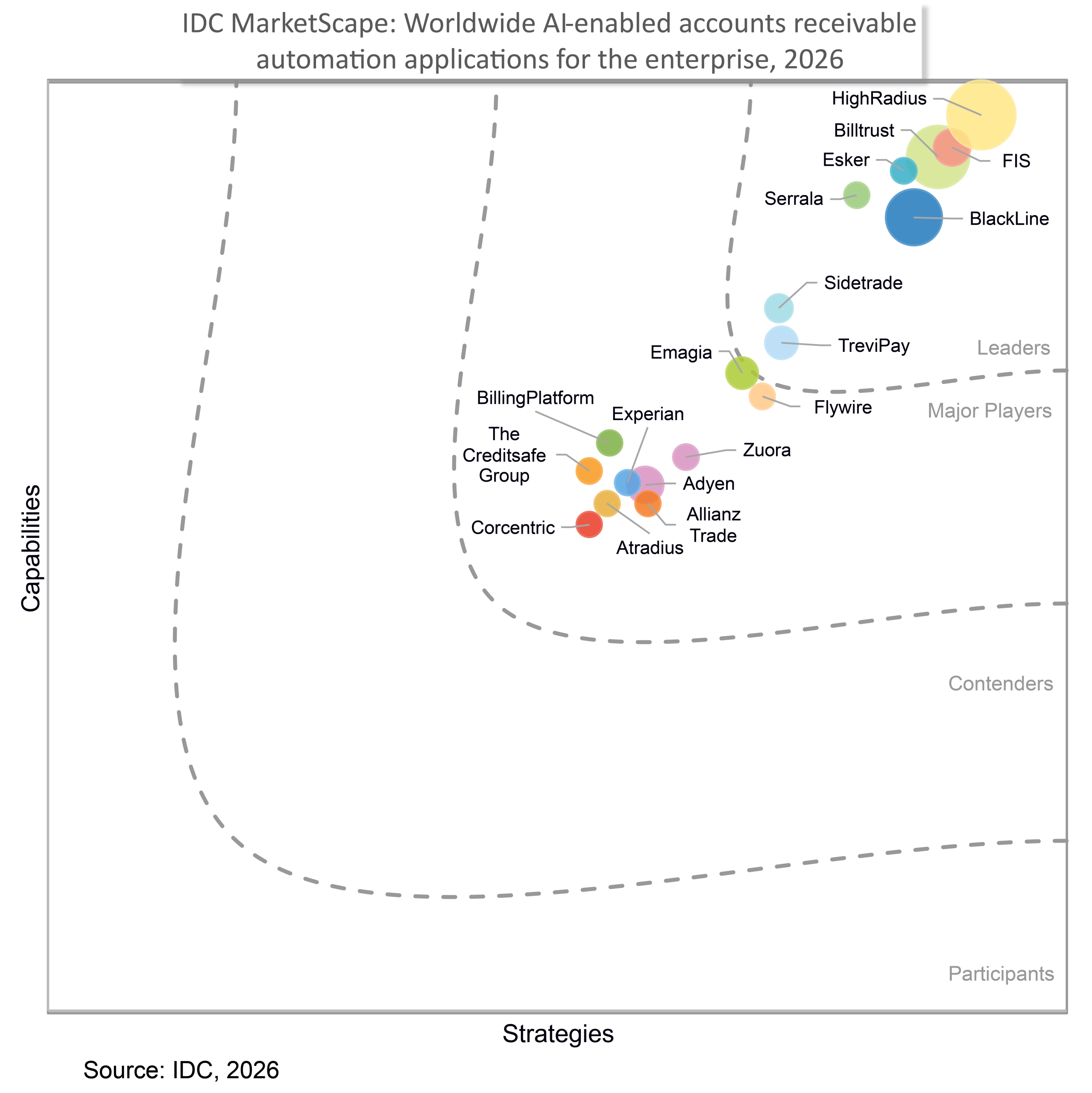
HighRadius recognized as a "Leader" in IDC Marketscape: Worldwide AI-enabled accounts receivable automation applications for the enterprise 2026 vendor assessment
Recognized as a Leader in 2026 Vendor Assessment for unifying credit, collections, cash application, deductions, e-invoicing, and payments on one AI platform to advance enterprise-wide invoice-to-cash transformation.
Forrester Recognizes HighRadius in The AR Invoice Automation Landscape Report, Q1 2023
Forrester acknowledges HighRadius’ significant contribution to the industry, particularly for large enterprises in North America and EMEA, reinforcing its position as the sole vendor that comprehensively meets the complex needs of this segment.