As transaction volumes increase and regulatory scrutiny intensifies in 2026, manual spreadsheets are no longer a viable option for growing finance teams. To achieve a faster month-end close while maintaining compliance, businesses are shifting toward AI-powered account reconciliation tools that offer real-time exception management and seamless ERP integration. This guide breaks down the best account reconciliation software on the market to help you eliminate manual errors and transform your financial operations into a strategic asset.
Table of Contents
Best Account Reconciliation Tools At A Glance
What is an Account Reconciliation Tool?
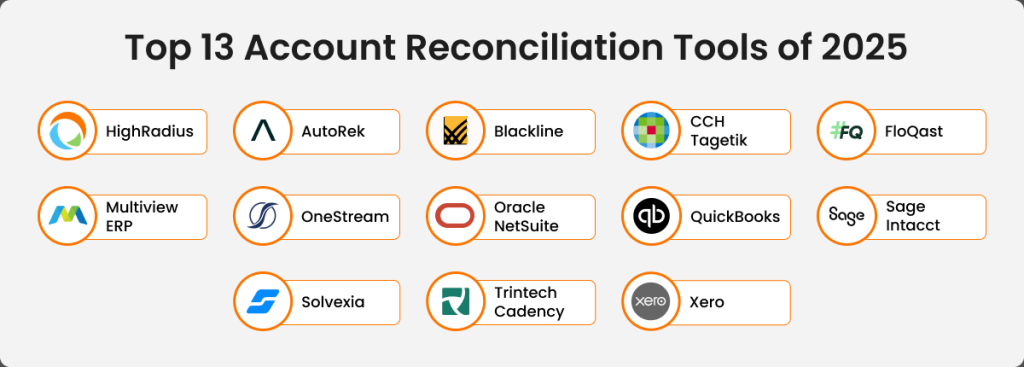
Top 13 Account Reconciliation Tools
9 Key Features to Look For in an Account Reconciliation Tool
How to Select the Most Reliable Account Reconciliation Solution for Your Business
Manual vs. Automated Reconciliation Tools
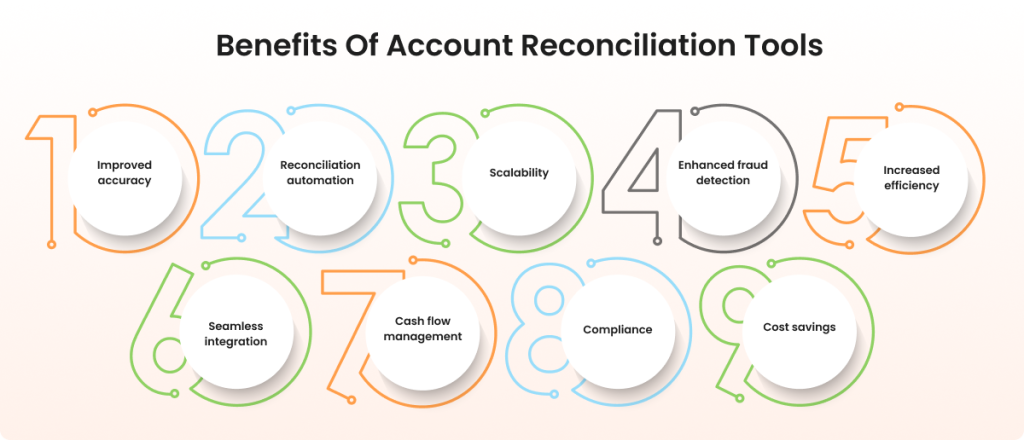
Benefits Of Account Reconciliation Tools
How HighRadius Boosts Reconciliation Productivity
FAQs On Best Account Reconciliation Tools
Best Account Reconciliation Tools At A Glance
With dozens of solutions on the market, the best tool depends entirely on your business complexity, whether you're a high-growth startup needing AI-driven transaction matching or a global enterprise requiring multi-entity consolidation.
The table below summarizes our top picks for 2026 based on primary use cases, key strengths, and target business size.
Comprehensive AI-driven automation for bank reconciliation and journal postings, providing real-time visibility and scalability for midsize and large enterprises.
*List of leading account reconciliation tools, arranged in no particular order
What is an Account Reconciliation Tool?
An account reconciliation tool is a specialized financial software designed to automate the verification of financial records. By automatically matching transactions and validating account balances between the internal general ledger (GL) and external sources, such as bank statements, credit card processors, or third-party gateways, these tools ensure that every transaction is accounted for.
While manual reconciliation relies on spreadsheets and human oversight, modern reconciliation software leverages AI and Machine Learning to ensure audit-ready data accuracy and financial integrity. For modern finance teams, these tools transition the month-end close from a reactive, manual headache into a continuous, real-time accounting process.
73% of finance leaders report slashed reconciliation costs. Discover how AI makes it possible!
Transform reconciliation from a time-consuming chore into an automated, error-free process that powers strategic finance.
HighRadius Automated Account Reconciliation Software is purpose-built for enterprises and multi-entity organizations that need speed, accuracy, and compliance at scale. Unlike traditional rule-based tools, HighRadius leverages AI agents, enabling organizations to automate 80% of reconciliations, achieving a 90% transaction auto-match rate and 95% journal posting automation.
By flagging exceptions and classifying variances, it ensures that financials are audit-ready and compliant with regulations. Combined with accelerated financial close cycles and seamless ERP integrations, the platform provides CFOs and controllers with complete end-to-end visibility.
A strong example of this impact comes from Milo’s, which achieved 65% faster reconciliation and a 99% automated task completion rate after implementing HighRadius. By leveraging AI-powered data aggregation and intelligent data extraction, the company eliminated manual bottlenecks and ensured 100% accuracy in bank statement matching. With streamlined hierarchical workflows and real-time visibility, HighRadius enables Milo’s to maintain total data integrity while supporting a significantly faster and more scalable financial close.
Best Suited For: Large-scale enterprises and multi-entity global organizations seeking Autonomous Accounting and 100% audit-readiness through AI.
Key Features
AI/ML-powered reconciliation across multiple entities and data sources, achieving 99% reconciliation accuracy while automatically flagging exceptions, classifying variances, and posting journals.
Real-time visibility into GL accounts, variances, and certification status, helping CFOs and controllers monitor financials across all entities.
Audit-ready workflows with task tracking, anomaly detection, and automated feedback loops that reduce false positives and streamline journal entry corrections.
Centralized dashboards simplify compliance, support external audits, and provide actionable insights for faster decision-making.
Proven Business Impact: 80% of reconciliations automated, 90% transaction auto-match rate, 95% journal posting automation, boosting reconciliation productivity by 50% and reducing days to reconcile by 30%.
The Only Software Recognized Across the Office of the CFO
From a 3X Leader in Invoice-to-Cash to a 2026 Gartner® Magic Quadrant™ Challenger for Financial Close. Discover why 1,100+ enterprises trust HighRadius to drive measurable ROI.
AutoRek is a cloud-based automation platform that integrates with existing systems and supports custom matching rules. It helps reduce operating costs and reconcile data across multiple formats. The platform also provides exception management capabilities.
Key Features
Provides data templates that allow users to load files from various sources.
High-volume data migration.
Automated cash allocation.
Best Suited For: Mid-to-large financial services and insurance firms dealing with high-volume data migration.
3. BlackLine
BlackLine reconciliation software is offered as a stand-alone solution or as part of a broader suite. Its unified, single-codebase platform connects seamlessly to multiple data sources, powering complex enterprise use cases with speed and scalability.
Key Features
Automated matching of transactions.
Automatic import of general ledger and sub-ledger balances.
Customizable rule-based workflows.
Best Suited For: Large companies looking for a legacy, unified codebase for broad financial close management.
4. CCH Tragetik
CCH Tagetik supports account reconciliation as part of its broader financial close platform. It offers automation and compliance features suited for enterprises, though its setup and scope may be more extensive than what smaller teams or simpler reconciliation processes typically require.
Key Features
Automates transaction matching for efficiency
Flags high-risk items for review
Provides audit-ready workflows
Best Suited For: Large enterprises already using the Wolters Kluwer ecosystem for specialized regulatory reporting.
5. FloQast
FloQast is an accounting automation tool that provides features for account reconciliation, catering to mid-sized firms. It’s ideal for mid-level enterprises seeking faster close cycles and improved collaboration without the complexity or scale required by large global organizations.
Key Features
Can easily integrate with leading ERP and accounting systems.
Reviewers and managers can see the progress of reconciliations throughout the month-end process.
Users can add documents and comments to support reconciliations
Best Suited For: Mid-market SaaS and accounting teams that prioritize an Excel-like interface and rapid implementation.
6. Multiview ERP
Multiview ERP is a financial management platform designed to simplify accounting operations and improve efficiency. It helps finance teams streamline workflows, access real-time financial data, and automate routine tasks for faster month-end closing.
Key Features
Setting up the tool is quick and easy.
It automates repetitive accounting tasks, allowing teams to focus on strategic activities.
It offers a robust general ledger module that supports processes like account reconciliation and financial reporting.
Best Suited For: Organizations looking for an all-in-one ERP solution with basic built-in reconciliation modules.
7. OneStream
OneStream provides a suite of tools for financial consolidation and reconciliation, reporting, and analysis. It helps finance teams unify data, automate manual tasks, and gain real-time insights to improve financial operations.
Key Features
Reduces manual work and errors, enhancing accuracy
Speeds up the reconciliation process, allowing businesses to manage large volumes of transactions easily.
Supports a variety of reconciliation types across industries.
Best Suited For: Organizations that need to unify reconciliation with complex Corporate Performance Management (CPM).
8. Oracle NetSuite
Oracle NetSuite is a cloud-based platform that enables the management of business operations, including financial management. It offers an account reconciliation module that automates transaction matching, standardizes processes, and reduces reliance on manual spreadsheets.
Key Features
Automated bank reconciliation matches ledger accounts with bank statements to ensure accurate financial records.
Allows custom rules and workflows for reconciliation processes.
Integrates with other software modules, such as accounts receivable and inventory management.
Best Suited For: Companies already operating within the NetSuite ERP ecosystem who want a native, module-based reconciliation experience.
9. QuickBooks
QuickBooks is accounting software designed for small businesses, helping to manage account reconciliations, invoices, and bills. It connects to bank accounts to streamline reconciliations and maintain accurate financial records.
Key Features
Helps match bank or credit card transaction statements with records.
Automatically imports transactions from banks and credit cards.
Keeps your financial data updated in real-time.
Best Suited For: Solopreneurs and small businesses with low transaction volumes and simple bank-to-ledger needs.
Templates
Streamline Your Month-End Close with Our Vendor Evaluation Scorecard
A comprehensive Excel-based tool to help you select the right financial close solution for your business
Sage Intacct is a cloud-based financial management platform designed to streamline accounting workflows. It helps finance teams simplify complex financial processes while maintaining accuracy, efficiency, and adherence to compliance standards.
Key Features
It automatically matches incoming transactions, making reconciliation easier.
Offers third-party integration, enabling data access and eliminating time-consuming exports.
It provides a real-time view of transactions, which helps to cross-check them with supporting documents during account reconciliation.
Best Suited For: Growth-stage mid-market companies that need third-party integrations and cloud-native accounting.
11. Solvexia
SolveXia automates reconciliation workflows and transforms spreadsheet-driven data into structured, actionable insights, helping finance and accounting teams reconcile accounts and unify data across systems efficiently.
Key Features
Reconciling activities can be done quickly, reducing the time and effort spent.
Improved control over the process is achieved through status dashboards and workflows.
The platform’s adaptability allows it to handle both complex and straightforward matching rules for data
Best Suited For: Finance teams looking to automate specific spreadsheet-heavy processes.
12. Trintech Cadency
Trintech Cadency is a financial close and automation platform that includes account reconciliation capabilities. It streamlines reconciliations and journal entries while providing reporting and analytics to support accurate, efficient close processes.
Key Features
Automation streamlines the financial close process, making it faster and more accurate.
Reporting and analytics give insights into financial performance and trends.
It is well-suited for organizations of different sizes.
Best Suited For: Organizations focusing on risk management and internal controls within the financial close.
13. Xero
Xero is accounting software for medium to large businesses. It imports bank transactions daily, applies rules to match them with invoices, groups similar transactions, and streamlines the reconciliation process.
Key Features
Automatically identifies and removes duplicate bank statement entries.
Easily upload multiple invoices at once.
Customizable tools for creating financial reports.
Best Suited For: Medium-sized businesses looking for a user-friendly, daily bank reconciliation
9 Key Features to Look For in an Account Reconciliation Tool
Choosing the best reconciliation software for your business depends on your needs and priorities. However, certain features are essential for any software that aims to simplify the reconciliation process. Here are the key features to look for in an account reconciliation software:
Automated data import
Seamless and real-time data flow stands at the core of ensuring accurate account reconciliation. The account reconciliation software should seamlessly integrate with your financial systems, including ERPs and non-ERP systems, to import data in real-time. It should automatically import transactions from bank and credit card statements, as well as other financial records, via an automated reconciliation software.
2. Automated detection of duplicate transactions
An effective reconciliation solution employs advanced algorithms, including fuzzy matching and machine learning, to match transactions, create a list of unmatched transactions, and identify duplicates that are not exact matches but are significantly similar. It should automatically evaluate various attributes of transactions, such as amounts, dates, and reference numbers, to detect and alert users to potential duplicates. This ensures the accuracy of financial reports.
3. Seamlessintegration with ERP and non-ERP systems
The best reconciliation software should have APIs (Application Programming Interfaces) that easily connect with various ERP platforms, such as SAP and Oracle, as well as non-ERP software. This connection enables automatic data transfer, ensuring accuracy and eliminating the need for manual data entry, which can lead to errors.
4. Custom reconciliation rules
Organizations should look for software that lets you create customizable business rules using conditional logic and scripting. This feature should allow users to set custom workflows with options to add multiple levels of approval. Being able to adjust these rules helps companies monitor high-risk tasks and unusual financial transactions smoothly while following internal controls.
5. Ability to manage large data volumes
In a company, hundreds of transactions take place every day. The software should be able to ingest and handle large amounts of data from various data sources that require reconciliation. Being able to reconcile on time will help companies close their books on time.
6. User-friendly dashboards
Reconciliation software should provide easy-to-use dashboards that provide real-time, comprehensive visibility into finances. The dashboards should provide a clear picture of your reconciliation progress, including any pending transactions, discrepancies, and other key metrics.
7. AI-based anomaly detection
AI-based account reconciliation software identifies errors and omissions in the source ERP data, thus promoting continuous close. This AI-based anomaly detection reduces false positives with an automated feedback loop.
8. Security features
The essential security features enterprises should look for in a reconciliation tool are ensuring that the tool provides comprehensive data encryption safeguarding sensitive financial information. It should enable organizations to control access based on roles, have provisions for multi-factor authentication, and ensure compliance checks to local and international regulations, such as GDPR and SOX, which are crucial for maintaining data security and privacy.
9. Scalability
The software should be designed with a flexible structure that can easily adjust resources to manage increased workloads. This way, as organizations scale and transaction volume increases, the reconciliation software can continue to run smoothly without requiring a significant investment in additional resources.
The Essential Checklist for Selecting Reconciliation Software
Reconciliations are the heartbeat of your close. Ensure your next tool doesn't just match data—it scales your entire process. Get the guide 5,400+ experts use.
How to Select the Most Reliable Account Reconciliation Solution for Your Business
Choosing the right account reconciliation software isn't just about matching transactions; it’s about future-proofing your finance department. As businesses scale, the gap between basic automation and intelligent autonomy becomes the difference between a 10-day close and a 2-day close.
When evaluating vendors, use these five pillars to determine which solution fits your long-term goals:
1. Level of AI maturity
Most legacy tools claim to offer automation, but this often just means basic, rigid rules that break when data formats change. Organizations should look for AI-native platforms that utilize machine learning for:
Fuzzy Matching: Handling slight discrepancies in descriptions or dates without manual intervention.
Anomaly Detection: Automatically identifying high-risk transactions or potential fraud.
Self-Correcting Workflows: Systems that learn from human corrections to improve auto-match rates over time.
2. Integration & data aggregation
Your tool is only as good as the data it receives. Ensure the software offers native API connectors for your specific ERP (e.g., SAP, Oracle, NetSuite) and your banking partners. A reliable solution should pull data in real-time, eliminating the need for manual CSV uploads, which introduce version-control risks.
3. Scalability & multi-entity support
If you operate across multiple subsidiaries, currencies, or jurisdictions, basic reconciliation tools will quickly become a bottleneck. Look for an account reconciliation solutions that provide:
Global Visibility: A centralized dashboard for the HQ Controller.
Intercompany Reconciliation: The ability to eliminate internal balances automatically.
Multi-Currency Handling: Automated conversion and variance tracking.
4. Audit-readiness and compliance
A reliable tool should act as your single source of truth during an audit. Advanced account reconciliation tools provide:
Read-Only Auditor Access: Allowing external auditors to view the digital trail without disrupting workflows.
Segregation of Duties (SoD): Enforcing strict approval hierarchies to prevent internal fraud.
Time-Stamped Logs: Every change, comment, and approval is permanently recorded.
5. Implementation speed vs. long-term ROI
While plug-and-play tools are tempting for small teams, enterprise-grade organizations should prioritize Return on Investment (ROI). Consider how much time your team currently spends on manual exceptions. A tool that automates 90% of your volume (like HighRadius) will pay for itself significantly faster than a tool that only automates 50%.
Manual vs. Automated Reconciliation Tools
Many finance teams still rely on manual reconciliation methods, spreadsheets, manual data exports, and physical checks. However, as transaction volumes grow and regulatory environments become more complex, the gap between manual effort and automated efficiency creates a significant cost difference.
The following table breaks down the operational differences between manual methods and modern account reconciliation tools.
Feature
Manual Reconciliation
Automated Account Reconciliation Tools
Data Matching
Line-by-line manual comparison; high risk of human oversight.
AI-powered matching: matches thousands of transactions in seconds.
Processing Speed
Linear and slow, often takes 5–10 days post-month-end.
Continuous accounting: reconciliations happen in real-time, daily.
Error Rate
High manual entry and copy-paste errors are common.
System-to-system integration eliminates manual data handling.
Audit Trail
Fragmented; relies on saved files, emails, and paper notes.
Centralized & digital: every change is time-stamped and role-attributed.
Exception Handling
Labor-intensive: every discrepancy requires manual investigation.
Scalability: handles millions of transactions without increasing staff.
Scalability
Requires more headcount as transaction volume grows.
Scalability: handles millions of transactions without increasing staff.
Visibility
CFOs only see the final result after the close.
Real-time dashboards: instant visibility into global entity status.
Benefits Of Account Reconciliation Tools
Adopting account and financial reconciliation tools can transform finance operations, delivering speed, accuracy, and strategic insights that manual processes cannot. These solutions provide organizations with automation, transparency, and enhanced control over financial data, enabling teams to focus on informed decision-making rather than repetitive tasks.
Key benefits:
Improved accuracy: AI-powered matching and automated checks reduce human errors, ensuring financial statements are precise and audit-ready.
Reconciliation automation: Manual tasks are automated, enabling teams to close books more efficiently while focusing on higher-value activities.
Scalability: Organizations can easily handle growing transaction volumes and multi-entity operations without additional headcount.
Enhanced fraud detection: By leveraging advanced analytics and anomaly detection, account teams can proactively identify irregular transactions, preventing financial fraud.
Increased efficiency: By using streamlined workflows, finance teams can reduce reconciliation time by 30% and enhance overall productivity.
Seamless integration: Advanced account reconciliation software integrates seamlessly with ERP systems, payment processors, and other financial software, providing a unified view of financial data.
Cash flow management: By having real-time visibility into reconciled accounts, finance teams can get insights into their cash positions that enable effective optimization of liquidity and planning of cash flows.
Compliance: Advanced reconciliation tools have built-in controls and audit trails that help organizations ensure adherence to regulatory standards and internal policies, preventing any material misstatements.
Cost savings: By automating 90% of the reconciliation process, automated account reconciliation tools reduce manual effort, eliminating human errors, which enhances productivity and results in 30% faster close cycles. The software scales with the transaction volumes, which results in lowering the need for additional manpower, and together with enhanced reconciliation productivity results in operational cost savings for organizations. By leveraging the best account reconciliation platforms and financial reconciliation tools, businesses can achieve operational excellence, strengthen compliance, and gain strategic financial insights, all while minimizing risks and improving productivity.
How HighRadius Boosts Reconciliation Productivity
Making confident data-driven decisions and meeting reporting deadlines hinges on accurate reporting. Without the right tools, your business risks making decisions based on outdated or inaccurate data, missing deadlines, or failing to adhere to accounting standards.
HighRadius Automated Account Reconciliation Software transforms how enterprises handle month-end closings. Take a large hotel chain, for example—they were struggling with month-end chaos until they implemented HighRadius. Using AI-powered account reconciliation, they achieved 97% automated reconciliation across 1,700+ entries and gained granular visibility into their accounting processes, from transaction data collection to reconciliation. This helped them reduce person-hours by ~60%.
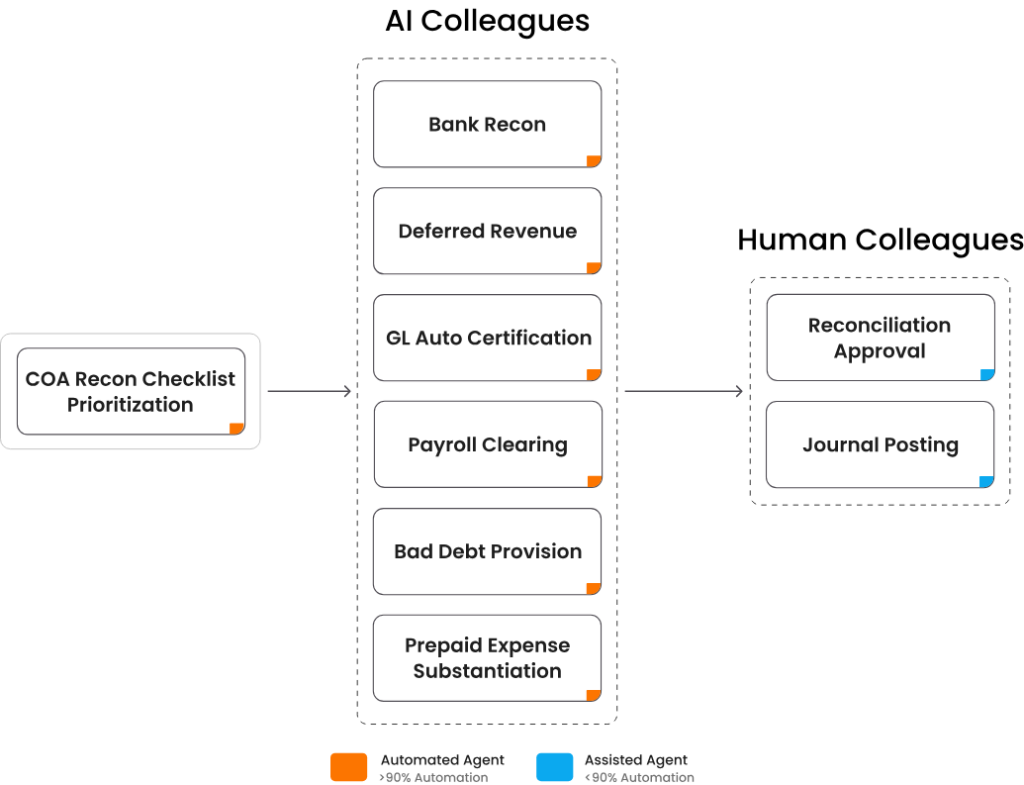
HighRadius offers an AI-powered Bank Reconciliation Software designed to eliminate manual workloads and improve accuracy across complex, high-volume financial environments. Automating everything from data ingestion to journal posting, it helps enterprises accelerate reconciliation cycles while maintaining audit-ready control
The software leverages AI to match transactions efficiently, cutting reconciliation time by 30%. With out-of-the-box formulas, configurable matching rules, and templates, month-end transactions are largely automated. HighRadius also prepares and posts 80% of journal entries directly into the ERP, while comprehensive audit trails ensure compliance and support regulatory requirements.
Take a deep dive into HighRadius’ R2R solutions
Getting granular visibility and control into your accounting process is just a click away.
Achieve up to 90% transaction auto-match with out-of-the-box matching rules
Financial Close Management
Reduce days to close by 30% with a detailed checklist for month-end close
Anomaly Management
Resolve 80% of anomalies with auto-suggested actions.
FAQs On Best Account Reconciliation Tools
What are some good alternatives to Excel for month-end account reconciliation?
Alternatives to Excel include automated account reconciliation tools such as HighRadius Reconciliation software that reduce errors, speed up the month-end close process, and ensure compliance. Leading reconciliation platforms also provide audit trails and real-time dashboards, making them more reliable than spreadsheets.
What are the best account reconciliation tools for audit-ready financials?
The best account reconciliation solution depends on your organization’s size, data complexity, and transaction volume. Key features to look for include AI-powered transaction matching, anomaly detection, automated journal posting, and built-in audit trails to ensure accuracy, compliance, and a faster financial close.
Can account reconciliation tools integrate with ERP systems?
Yes, modern automated account reconciliation software integrates seamlessly with ERPs like SAP, Oracle, and NetSuite. These integrations eliminate manual data entry, improve cash visibility, and create a centralized source of truth for financial reconciliation.
How do you perform account reconciliation?
Account reconciliation involves comparing account balances with supporting records to identify discrepancies. Using automated account reconciliation software simplifies this process through AI-driven matching, streamlined workflows, and enhanced compliance checks, resulting in faster and more accurate reconciliations.
What types of companies benefit the most from reconciliation tools?
Enterprises, multi-entity organizations, and high-transaction businesses benefit most from financial reconciliation tools. Unlike spreadsheets, these solutions provide scalability, real-time visibility, and automation, enabling faster closes and stronger compliance controls.
6. What makes the best automated accounting reconciliation platform stand out?
The best accounting reconciliation solution provides rule-based matching, automated data pulls, error detection, and ERP/bank integrations—reducing manual work and speeding up close cycles.
7. How to choose the best accounting reconciliation solution?
Focus on scalability, native integrations, matching accuracy, security standards, and how effectively the accounting reconciliation platform shortens your month-end close.
8. What are the must-have features an advanced accounting reconciliation solution should have?
The best accounting reconciliation platforms offer automated data imports, smart matching rules, exception management, audit trails, and seamless ERP or banking integrations to eliminate manual work.
9. What is the best account reconciliation software for midsize companies?
For midsize companies, the best choice for the top account reconciliation depends on your ERP stack, transaction volume, and close cycle complexity. Key factors to evaluate are automated transaction matching, ease of implementation, and total cost of ownership. HighRadius is a strong option for mid-market teams that need AI-driven matching and audit-ready compliance without enterprise-level complexity.
10. What is the best account reconciliation software for enterprises?
For enterprises the best account reconciliation software must support high transaction volumes, multi-entity structures, and strict regulatory requirements like SOX and GAAP. HighRadius stands out for its 90%+ auto-match rate, AI-powered journal automation, and end-to-end visibility across the financial close cycle, making it a strong fit for large finance teams looking to reduce manual effort and close faster.
HighRadius Named a Challenger In 2025 Gartner® Magic Quadrant™ for Financial Close and Consolidation Solutions
HighRadius stands out as a challenger by delivering practical, results-driven AI for Record-to-Report (R2R) processes. With 200+ LiveCube agents automating over 60% of close tasks and real-time anomaly detection powered by 15+ ML models, it delivers continuous close and guaranteed outcomes—cutting through the AI hype. On track for 90% automation by 2027, HighRadius is driving toward full finance autonomy.
HighRadius Named ‘Rising Star’ in 2024 ISG Provider Lens™ Finance and Accounting Platforms Report
HighRadius leverages advanced AI to detect financial anomalies with over 95% accuracy across $10.3T in annual transactions. With 7 AI patents, 20+ use cases, FreedaGPT, and LiveCube, it simplifies complex analysis through intuitive prompts. Backed by 2,700+ successful finance transformations and a robust partner ecosystem, HighRadius delivers rapid ROI and seamless ERP and R2R integration—powering the future of intelligent finance.
HighRadius Named As A Major Player For Treasury & Risk Management Software By IDC
HighRadius is redefining treasury with AI-driven tools like LiveCube for predictive forecasting and no-code scenario building. Its Cash Management module automates bank integration, global visibility, cash positioning, target balances, and reconciliation—streamlining end-to-end treasury operations.