Use our SMART AP Goals Checklist & Align Your Targets to Save Up to 30%
Download Free ChecklistAccounts Payable Productivity Benchmarks: What 21 AP Cases Reveal
Where do accounts payable (AP) analysts spend their time? In a HighRadius analysis of 21 AP business cases, invoice data entry and PO/GRN matching together represented an average of 45.9% of recorded analyst effort in the 18 cases with both measurements. The finding points to a practical opportunity: improve the work between invoice receipt and approval, not just the approval step itself.
Most accounts payable productivity benchmarks measure cost per invoice, invoices processed per full-time equivalent (FTE), or invoice cycle time. Those KPIs tell finance leaders how a process performs. Task-level workload data helps explain why it performs that way.
What did HighRadius find in 21 AP business cases?
HighRadius analyzed 165 task-level records across 21 AP business cases spanning North America and EMEA. The chart shows the mean allocation of analyst effort for each recorded activity. Since not every case measured every activity, these percentages must not be added to create a single organization-wide workload distribution.
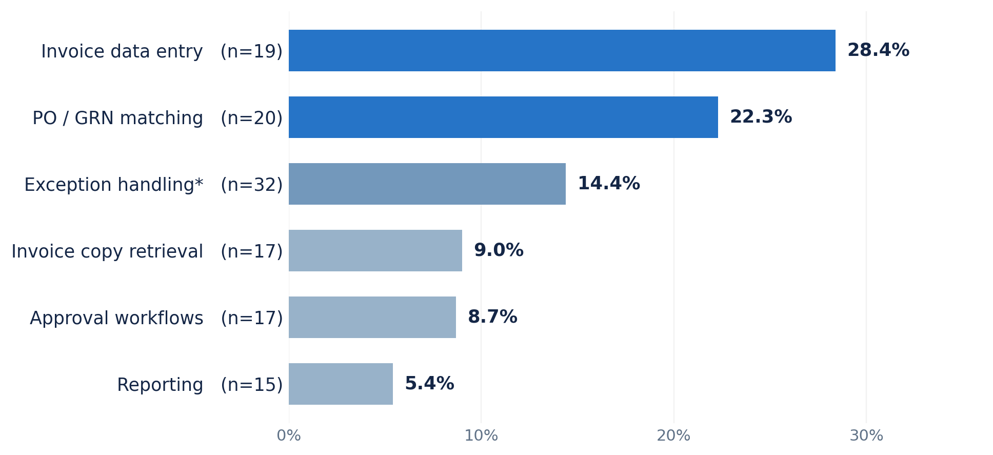
Figure 1. Mean recorded analyst effort by AP task, among cases with data for that task. Sample sizes differ by category.
Invoice data entry consumes 28.4% of recorded analyst effort
Invoice data entry averaged 28.4% of analyst effort among 19 cases with the measure available. That includes work associated with entering and checking invoice information before it can move into processing.
The bottleneck is rarely just typing an invoice number. Analysts may need to read supplier emails, identify the right invoice attachment, capture line items, verify supplier details, and correct fields that do not align with ERP records. Different invoice formats and incomplete purchase-order references make that process harder to standardize.
For AP leaders, this is a reason to examine the full invoice intake workflow. Automated invoice capture can reduce rekeying, but data validation and routing still determine whether invoices continue without manual intervention.
PO and goods receipt matching adds another 22.3%
Matching invoices to purchase orders (POs) and goods receipt notes (GRNs) accounted for an average of 22.3% of recorded analyst effort in 20 cases. Together, capture and matching averaged 45.9% in the 18 cases reporting both measures.
In two-way matching, an invoice is compared with its purchase order. Three-way matching also checks goods received. Price discrepancies, quantity differences, missing receipts, taxes, and freight charges can all interrupt processing. Analysts then spend time contacting procurement or suppliers and determining which exceptions are legitimate.
The lesson is not to automate every mismatch away. It is to automate clean matches and give reviewers the context to resolve genuine discrepancies without repeatedly switching between systems.
Exceptions, retrieval, and approvals create a second layer of work
The analysis contained 34 exception-handling task records across the 21 business cases. This is a count of recorded activities, not a percentage of analyst time or a count of companies.
Other administrative activities were material: retrieving invoice copies averaged 9.0% of recorded analyst effort across 17 observations, and approval workflows averaged 8.7% across 17 observations. These averages use different samples and should not be summed.
An invoice may be captured correctly yet remain unpaid because an approver cannot locate a supporting document or a variance lacks an owner. Productivity therefore depends on searchable documentation, defined exception ownership, timely approvals, and status visibility as much as it does on OCR accuracy.
Why invoice capture alone does not deliver touchless AP processing
Touchless invoice processing means an eligible invoice moves through required validation, matching, approval rules, and ERP posting without manual handling. Capturing invoice data is only one stage.
A practical end-to-end design connects supplier email or portal intake, field extraction, duplicate and policy checks, PO/GRN matching, non-PO coding, exception routing, approvals, and ERP updates. When those stages are disconnected, manual work simply shifts downstream.
For example, an accurately extracted PO invoice can still wait days for a missing goods receipt. Tracking capture accuracy without matching success or exception age would miss the real constraint.
Which AP productivity KPIs should finance leaders track?
Use a balanced scorecard rather than a single automation percentage:
- Cost per invoice: Total AP operating cost divided by invoices processed. Use consistent cost definitions, including labor, systems, and overhead.
- Invoices processed per AP FTE: Invoice volume divided by full-time-equivalent effort over the same period, ideally separated by invoice complexity.
- Touchless processing rate: Share of eligible invoices completed without manual intervention, with the eligibility rules disclosed.
- First-pass match or exception rate: Share of invoices matched without rework, alongside exception volume and average resolution time.
- Invoice cycle time: Elapsed time from receipt to posting or payment, with the chosen endpoint stated consistently.
APQC's accounts payable benchmark guidance covers cost, productivity, cycle time, and quality. The HighRadius task-level analysis complements those outcome metrics; it does not replace a representative peer comparison.
How to apply the findings to your AP organization
First, establish a 30-day baseline. Sample PO and non-PO invoices across major entities, business units, suppliers, and ERPs. Log analyst time for capture, matching, coding, exceptions, document retrieval, and approvals. Separate touchless transactions from manually handled ones.
Second, locate the handoff with the most rework. If capture is accurate but matching is slow, investigate PO and GRN completeness. If invoices match but stall, examine approval routing and aged exceptions. Use both time spent and business impact to prioritize.
Third, measure improvements against the same definitions. Monitor analyst minutes per invoice, touchless rate, exception resolution time, and invoice cycle time. Review the results by supplier, invoice type, and entity before scaling a workflow change.
Frequently Asked Questions (FAQs)
1. What is a good accounts payable productivity benchmark?
2. What should an AP team automate first?
About the HighRadius analysis
This directional analysis covers 165 task-level records from 21 AP business cases. The 28.4% data-entry mean is based on 19 cases; the 22.3% matching mean on 20; and the paired 45.9% figure on 18. Figures reflect reported analyst allocations, not verified time-and-motion observations or industry-wide averages. The dataset does not establish a representative sample or independently verified ROI.
Explore HighRadius invoice processing automation to see how invoice capture, matching, exception workflows, and approvals can work together across the invoice lifecycle.