See How Leading AP Teams Accelerate Invoice Processing
Download NowEvery CFO meeting touches on cash velocity, capital efficiency, and working capital optimization. Yet inside most enterprise finance operations, Accounts Payable (money going out) and Accounts Receivable (money coming in) function as isolated operational fiefdoms. They rely on different point solutions, report to separate managers, and process financial data on completely asynchronous timelines.
This organizational split ignores a fundamental truth: cash is a single continuous operational continuum.
When inbound cash applications are disconnected from outbound disbursement schedules, month-end close ceases to be a routine financial rollup. Instead, it turns into a forensic audit - a manual effort to reconcile mismatched ledger entries, trace missing remittance advice, and account for unapplied cash.
Unifying AP and AR cash workflows with continuous artificial intelligence (AI) automation removes systemic data blind spots, eliminates subledger matching friction, and compresses month-end close timelines by 40% or more.
The Hidden Taxes of Disconnected Cash Operations
Operating payables and receivables in isolation imposes silent operational taxes across the entire finance organization. These structural inefficiencies compound each day, culminating in a chaotic end-of-month scramble.
Tax 1: The Manual Reconciliation Bottleneck
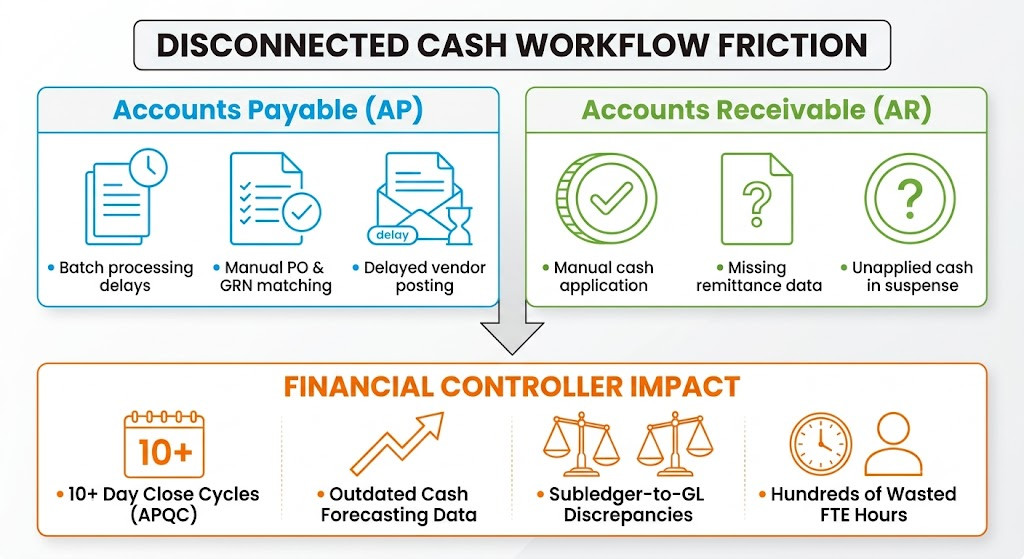
Batch processing in AP and manual cash application in AR force accounting teams into late-night spreadsheet matching at month-end.
In Accounts Payable, analysts manually pull vendor invoices, extract header and line-item details, and perform 3-way matching against Purchase Orders (POs) and Goods Receipt Notes (GRNs). When line-item prices or quantities deviate, invoices land in exception queues.
Simultaneously, AR teams review bank statements to manually match bulk customer payments against open invoices—often lacking structured remittance details.
Data from APQC highlights the operational gap this creates: bottom-performing financial organizations take 10 or more days to complete their monthly financial close, while top performers finish in just 4.8 days. That five-day gap is spent manually validating transactions across subledgers.
Tax 2: Stale Cash Visibility
Disconnected workflows force Treasury and FP&A leaders to build cash forecasts using outdated ledger snapshots.
When customer payments sit unapplied in suspense accounts for days, receivables appear artificially inflated. On the flip side, delayed AP invoice processing hides real liabilities.
As a result, executive leadership makes short-term borrowing, capital allocation, and investment decisions based on stale data rather than real-time cash positions.
Tax 3: The Human and Resource Drain
The operational cost of manual matching falls heavily on accounting staff. Finance professionals spend thousands of hours copying transaction codes between ERP systems, bank portals, and spreadsheets.
This transactional grinding causes staff burnout and high turnover. More importantly, it diverts skilled accountants away from strategic variance analysis, tax provisioning, and financial risk mitigation.
The Structural Fix: Unifying Incoming and Outgoing Cash Flows
Resolving this operational friction requires shifting from fragmented point solutions to a unified cash workflow architecture.
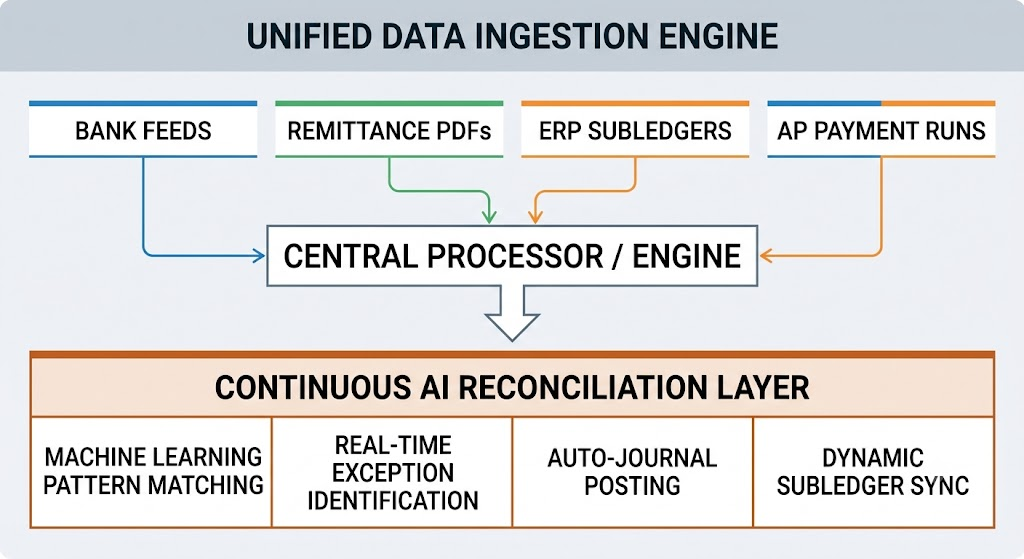
A unified platform ingests multi-source data including bank feeds, credit card settlement files, lockbox images, remittance PDFs, and outbound payment runs into a single processing engine.
Legacy Batch Reconciliation vs. Continuous AI Matching
Traditional ERP-native reconciliation relies on rigid, deterministic rules. If a customer payment doesn't match an exact invoice number and dollar amount, the rule fails, and the item drops into a manual queue.
Modern AI platforms use machine learning algorithms that evaluate historical payment behaviors, partial payments, complex multi-line purchase orders, and unformatted remittance strings.
| Operational Dimension | Legacy Batch Reconciliation | Continuous AI Reconciliation |
| Data Ingestion | End-of-month batch uploads | Real-time API bank & ERP streaming |
| Matching Logic | Rigid, exact-match rules | Machine learning pattern recognition |
| Exception Handling | Manual analyst review via spreadsheets | Agentic exception routing & resolution |
| Ledger Updates | Manual month-end adjustment journals | Automated journal creation and posting |
| Month-End Workload | High-pressure 10-day fire drill | Routine daily micro-reconciliations |
Case Study Spotlight: How Konica Minolta Transformed a 30-Day Close into 7 Days
To understand the real-world impact of unifying cash workflows, consider the operational transformation at Konica Minolta Business Solutions U.S.A. led by CFO Holly DeSantis.
The Operational Challenge
As a multi-entity enterprise, Konica Minolta faced immense transactional complexity, processing 45,000+ monthly line items.
Their legacy accounting framework relied on manual, spreadsheet-heavy reconciliation processes. Bank statements had to be manually cross-referenced against cash applications and general ledger accounts across multiple business units.
This fragmented approach resulted in an agonizing 30-day month-end close cycle. The accounting team spent the entire month closing the previous month's books, leaving zero capacity for forward-looking financial analysis.
The Solution
Konica Minolta modernized its financial operations by deploying HighRadius’s AI/ML-Powered Close & Reconciliation platform.
The system unified their cash workflows by automatically syncing bank statements via APIs, analyzing cash application data, and running automated matching algorithms against general ledger accounts. Instead of waiting until period-end, the platform performed continuous transaction matching and highlighted exceptions for immediate resolution.
Konica Minolta: Key Transformation Metrics
- Close Time Compressed: Slashed total month-end close duration from 30 days down to 7 days (a 76% reduction).
- Bank Reconciliation Speed: Accelerated bank reconciliation processing velocity by 75%.
- Match Rate: Achieved ~99% automated transaction matching across 45,000+ monthly line items.
- Capacity Reclaimed: Saved 1,600+ hours of annual manual work, redirecting accounting talent to high-risk reconciliations and strategic analysis.
By removing manual matching from the equation, Konica Minolta shifted its finance function from reactive ledger balancing to proactive risk management and strategic business partnering.
Strategic Playbook: 4 Steps to Unify AP and AR
For finance leaders looking to compress their close cycles and modernize cash operations, unifying AP and AR requires a clear execution strategy.
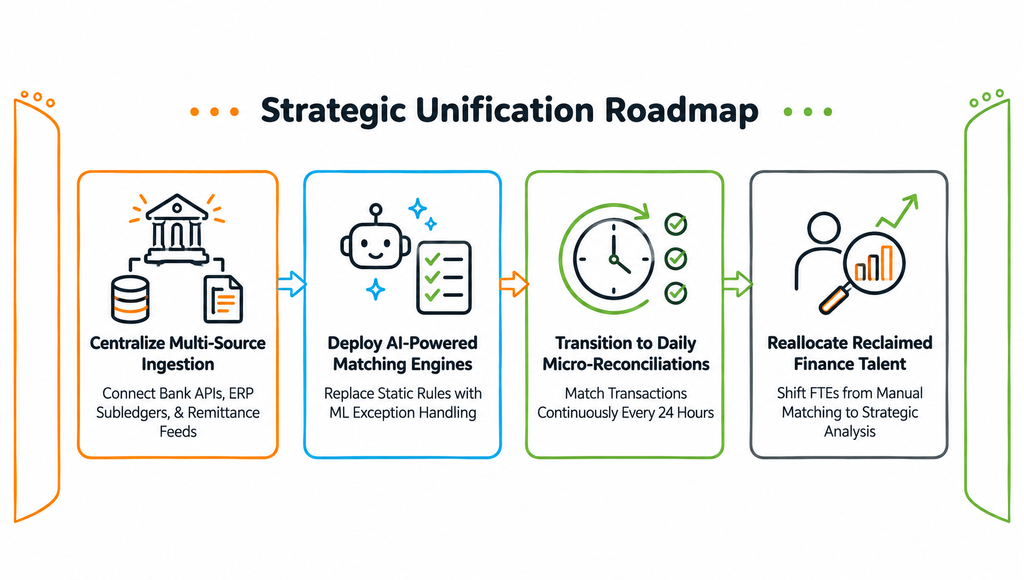
Step 1: Centralize Multi-Source Ingestion
Break down functional data silos by establishing a single ingestion pipeline.
Connect all enterprise banking portals, merchant acquiring accounts, AP invoice channels (email, EDI, web portals), and AR payment gateways into a unified platform using real-time REST APIs and secure SFTP protocols
Centralizing raw cash data ensures payables and receivables operate off the same single source of truth.
Step 2: Deploy AI-Powered Matching Engines
Replace legacy ERP matching rules with machine learning models designed to process unstructured financial data.
In AP, configure automated agents to handle data extraction, header validation, and 3-way matching against POs and GRNs, targeting an 80%+ Straight-Through Processing (STP) rate.
In AR, deploy self-learning cash application models that auto-match incoming payments against open invoices—even when remittance notices are missing or unformatted.
Step 3: Shift to Daily Micro-Reconciliations
Eliminate period-end fire drills by establishing daily reconciliation cadences.
When bank feeds, cash postings, and subledgers reconcile dynamically every 24 hours, month-end becomes just "Day 30" on the calendar.
Unapplied cash items and AP matching variances are identified and resolved daily, preventing a backlog of unresolved exceptions at close.
Step 4: Reallocate Reclaimed Capacity
Modernizing cash workflows reclaims thousands of FTE hours previously spent on low-value data entry.
Redirect this reclaimed bandwidth toward high-impact financial activities:
- Working Capital Optimization: Analyzing payment terms, early payment discount opportunities, and vendor spend patterns.
- Capital Risk Mitigation: Conducting deeper balance sheet substantiations and evaluating counterparty credit risks.
- Treasury Strategy: Optimizing cash positioning and liquidity management based on real-time cash flow visibility.
The Strategic Advantage of the Fast Close
Compressing the month-end close from 30 days to 7 days is more than an accounting achievement—it is a core operational advantage.
When CFOs and Controllers operate with real-time ledger visibility, they regain control over their working capital. They stop managing liquidity through rearview-mirror reporting and start driving agile, data-driven strategy.
Operating payables and receivables in isolated departmental silos is an outdated financial model. By unifying cash workflows through continuous AI automation, enterprise finance leaders eradicate data friction, protect their teams from burnout, and build a modern financial foundation built for scale.
Next Steps for Finance Leaders
- Audit Your Current Close Timeline: Map the exact number of days spent on manual AP/AR subledger reconciliation during month-end.
- Benchmark Your Match Rates: Evaluate your current straight-through processing rates for AP invoice matching and AR cash application against top-tier industry benchmarks.
- Explore AI Automation Platforms: Evaluate how HighRadius unifies Record-to-Report and Order-to-Cash workflows to automate complex enterprise reconciliations.