The 4 Stages of AP Automation Maturity
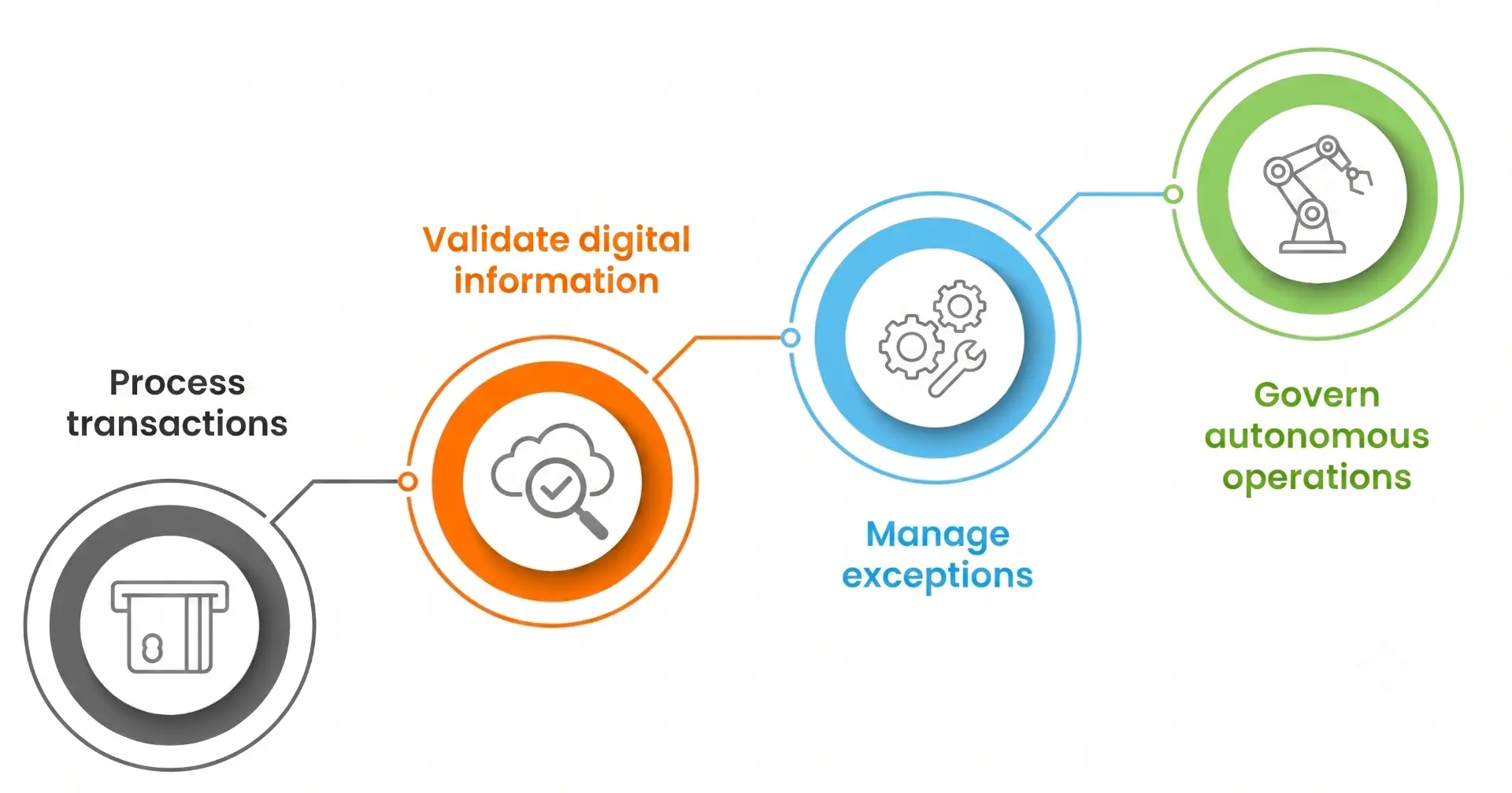
AP automation maturity can be viewed across four stages:
| Stage | Operating Model | Core Technology | Human Role | Primary Measure |
|---|---|---|---|---|
| Stage 1: Manual | People process nearly every invoice | Email, spreadsheets, ERP screens | Process every transaction | Cycle time and backlog |
| Stage 2: Digitized | Documents are digital, but work remains manual | OCR and basic workflows | Validate, route, and resolve | Data accuracy and approval time |
| Stage 3: Automated | Systems process routine transactions | AI extraction, matching, and workflow automation | Manage exceptions | Straight-through processing |
| Stage 4: Autonomous | AI agents execute and optimize workflows | AI agents, analytics, continuous learning | Govern exceptions, controls, and AI | Business value and exceptions avoided |
Swipe horizontally to view the full table
The biggest shift is not simply the technology. It is the role of the AP team:
Where Does Your AP Organization Stand?
Use the assessment below to identify your current maturity stage. Select Yes or No for each statement:
What capability is preventing your AP organization from reaching the next stage?
Manual Accounts Payable
At the manual stage, AP depends heavily on people, email, spreadsheets, ERP screens, and individual knowledge. AP employees touch most invoices from receipt through posting and spend significant time moving information between systems
If your invoice data is entered or validated manually, POs and invoices are compared manually, exceptions and supplier inquiries are tracked outside the ERP, and your AP team's productivity depends on each employee's knowledge, it means your AP team's process is still manual.
Manual AP can result in:
Digitized Accounts Payable
Digitization replaces paper and fragmented documents with electronic information and workflows. But digitization does not necessarily eliminate manual work.
AP teams may use OCR to capture invoice data and electronic workflows to route approvals, while employees still validate fields, maintain templates, investigate mismatches, and manage exceptions manually.
Why OCR Alone Is Not AP Automation?
OCR can read information from documents. It does not, by itself, make the AP process intelligent or autonomous.
Stage 2 limitations
Automated Accounts Payable
At Stage 3, the AP organization no longer processes every invoice manually. Systems process predictable transactions automatically while AP employees focus on exceptions, controls, supplier relationships, and continuous process improvement.
The objective is not simply to automate more tasks; it is to increase the percentage of transactions that move through the process without human intervention while maintaining control and accuracy.
Automation at this stage supports invoice data capture and validation, PO and non-PO processing, 2-way and 3-way matching, approval routing, duplicate and anomaly detection, ERP posting and supplier communication.
KPIs AP leaders should measure
Autonomous Accounts Payable - The current Stage
Autonomous AP represents the shift from systems that execute predefined workflows to AI agents that can interpret context, make governed decisions, take action, and continuously improve.
The defining question changes from: “How much of AP can we automate?” to: “How much of the process can safely operate without human intervention?”
What makes AP autonomous?
A mature autonomous AP operation can:
- Interpret invoice and transaction context.
- Resolve low-risk exceptions within approved thresholds.
- Prioritize approvals based on value, risk, due date, and policy.
- Communicate with suppliers using contextual information.
- Recommend or execute next-best actions.
- Learn from corrections and transaction patterns.
- Escalate material decisions to the right human owner.
- Measure AI performance against business outcomes.
How HighRadius Speed-to-Value 2.0 Accelerates AP Automation
Moving from digitized AP to automated AP is not simply a software implementation. It requires a measurable transformation program.
HighRadius Speed-to-Value 2.0 is designed to establish value quickly, validate performance against agreed metrics, and scale automation across entities, ERPs, and supplier groups.
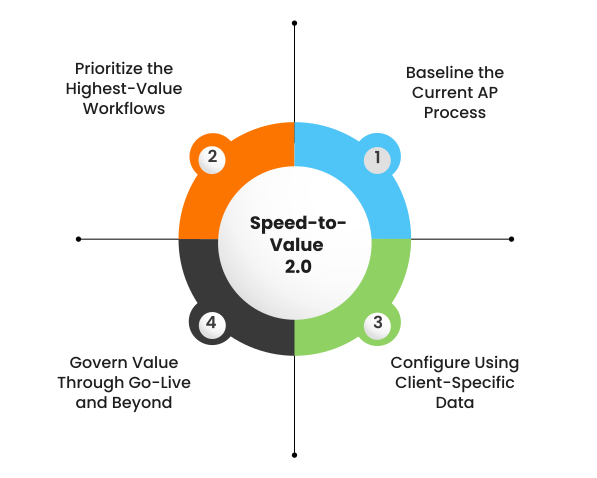
Baseline the Current AP Process: Establish the current operating baseline before configuration begins.
Prioritize the Highest-Value Workflows: Not every AP workflow should be automated first.
Configure Using Client-Specific Data: AP automation should reflect the organization's actual operating model.
Govern Value Through Go-Live and Beyond: Automation performance should be measured throughout implementation, UAT, hypercare, and post-go-live operations.
What AP Automation Looks Like in Practice
AP maturity becomes more meaningful when it is connected to measurable outcomes.



The New AP Leadership Capability: AQ
As AP organizations adopt AI agents, finance leaders need a new capability: the ability to select, deploy, govern, evaluate, and continuously improve AI agents working alongside finance teams. HighRadius calls this AQ, or Algo Quotient.
Strong AQ includes the ability to
- Set appropriate autonomy thresholds
- Monitor AI accuracy and performance
- Detect performance drift
- Maintain auditability
- Establish appropriate human oversight
- Separate automation activity from actual business value
Frequently Asked Questions
1. How do I assess my AP automation maturity?
Assess your organization based on how much work is performed manually, how much routine processing is automated, how exceptions are handled, and how much decision-making can be performed autonomously within defined controls. Use the 10-question assessment in this guide to identify your likely maturity stage.
2. What is the difference between digitized, automated, and autonomous AP?
Digitized AP makes documents and workflows electronic but may still depend heavily on people. Automated AP allows systems to process routine transactions with minimal human intervention. Autonomous AP uses governed AI agents to interpret context, make decisions, take actions, and continuously improve within defined controls.
3. What should an AP team automate first?
Start with workflows that have high transaction volume, repetitive manual effort, significant exception costs, and measurable automation potential. Invoice capture, matching, approval routing, exception management, and ERP posting are common starting points.
4. What KPIs should I track at each stage of AP automation?
Early-stage organizations should focus on cycle time, backlog, data accuracy, and approval time. As automation matures, metrics should shift toward straight-through processing, exception rates, cost per invoice, autonomous resolution, productivity, and realized business value.
5. How do I move from automated AP to autonomous AP?
Start by identifying low-risk decisions that can be safely handled by AI agents. Establish autonomy thresholds, human oversight, auditability, and performance measures before expanding autonomous execution.