Reduce Invoice Approval Time by 60% with Our 3-Way Invoice Matching Playbook
Download Free E-bookHow much should your business budget for AP automation?
There is no universal price tag for accounts payable automation. The investment depends on factors such as invoice volume, workflow complexity, ERP integrations, number of entities, automation capabilities, implementation requirements, and support.
More importantly, AP automation should not be evaluated purely on a cost-per-invoice basis. Static industry benchmarks can make the business case look simple, but they often overlook the operational costs that AP teams deal with every day, from manual invoice entry and GL coding to approval bottlenecks, exceptions, duplicate invoices, and supplier queries.This piece breaks down the key cost factors and pricing models of best accounts payable automation software to help you choose the right solution for your business.
What Determines AP Automation Cost?
AP automation software investment depends on how complex your AP environment is and how much of the invoice lifecycle you want to automate.
1. Invoice Volume
Invoice volume is an important pricing consideration. An organization processing thousands of invoices annually will have different requirements from a global enterprise processing hundreds of thousands of invoices across multiple entities.
However, volume should not be considered in isolation. Ask how much of that invoice volume the platform can actually automate—from capture and validation through matching, coding, approvals, and ERP posting.
2. Automation Capabilities
Basic invoice capture is only the starting point for AP automation. Modern AI-powered platforms can automate:
- AI-powered invoice capture and data extraction
- Invoice validation
- PO and non-PO invoice processing
- 2-way and 3-way matching
- GL coding
- Approval routing
- Exception handling
- ERP posting
- Supplier communication
The broader the automation coverage, the greater the potential impact on AP productivity and processing efficiency.
HighRadius uses AI Agents across these stages to move AP automation beyond traditional OCR-based invoice capture.
3. ERP Integration
Integration complexity can have a significant impact on implementation requirements. Organizations operating across multiple ERPs, business units, and company codes may require more complex workflows and integrations than companies operating within a single ERP environment.
For example, EnerSys integrated HighRadius across 3 ERPs and 8 company codes, enabling standardized and scalable AP operations across a complex enterprise environment.
4. Number of Entities and Locations
Global enterprises may have different approval workflows, business rules, currencies, tax requirements, and operating models across entities. Your AP automation platform therefore needs to support this complexity without forcing finance teams to maintain disconnected processes.
5. Implementation and Change Management
The total investment can also include configuration, ERP integration, workflow design, testing, training, and change management.
These costs should be evaluated alongside the operational outcomes the implementation is expected to deliver, not viewed independently from the business case.
How Much Does AP Automation Cost?
AP automation costs vary dramatically based on organizational needs. The original solutions range from just a few thousand dollars to over $50,000 based on requirements and vendor selection.
Company size determines implementation costs:
- Small businesses (1-20 employees) invest $8,000-$15,000 annually for simple invoice processing and straightforward approval workflows
- Mid-tier organizations (20-100 staff) need $15,000-$35,000 annually for strong solutions
- Large enterprises (100-500 employees) spend $35,000-$100,000+ annually for advanced workflow customization and dedicated support
Most implementations come with one-time onboarding and training fees, plus ongoing subscription costs. Companies that process over 1,000 invoices monthly often qualify for volume discounts, which reduces per-invoice costs further.
Why Traditional AP Automation Pricing Can Be Misleading?
AP automation vendors commonly use pricing models based on invoices, users, subscriptions, or transactions. While these models may appear straightforward, they do not always reflect the actual value or total cost of operating an AP function.
Common pricing models include:
- Per-invoice pricing: The per-invoice model sets a fixed fee between $1.00-$2.00 for each processed document. Your costs drop as volume goes up since vendors typically lower the per-invoice rate for higher numbers.
- Per-user pricing: Charges are tied to the number of users or seats, which can become restrictive when multiple stakeholders need to participate in approval workflows.
- Transaction-based pricing: Vendors charge based on payments or transactions processed through the platform.
- Subscription pricing: Customers pay a recurring fee based on functionality, usage, users, entities, or transaction volumes.
The bigger issue is that software pricing is only one part of AP's total cost. Extra costs are part of most packages:
- One-time onboarding and training fees
- Support and maintenance services
- Customization expenses that match your business needs
Watch out for those promotional deals with big first-year discounts. Many clients see their prices jump up to 40% in year two. Make sure you get written price commitments for years 2-5 to avoid budget surpr
So, comparing vendors purely on their quoted license price or cost per invoice can give finance leaders an incomplete picture.
What Is Outcome-Based Pricing?
Outcome-based pricing ties the software investment to defined business outcomes rather than simply charging for software consumption.
For AP automation, these outcomes can include improvements in:
- AP function cost
- Straight-through processing
- Invoice processing productivity
- Invoice cycle time
- Automated coding
- Early payment discount capture
This approach can also help shift more implementation risk toward the vendor by establishing measurable performance expectations.
For finance leaders, this provides a more meaningful way to evaluate AP automation because the business case is connected to operational performance rather than an arbitrary industry-wide cost-per-invoice assumption.
This shifts the conversation from "What does the software cost?" to "What value can the software create?"
HighRadius Outcome-Based Pricing: Pay for Results, Not Access
HighRadius takes an Outcome-Based Pricing (OBP) approach that shifts the focus from paying for software access to paying for measurable business results.
| Pricing Component | HighRadius OBP |
| Implementation Fee | $0 |
| Subscription Until Go-Live | $0 |
| Post-Go-Live Fee | Gain share — a percentage of outcomes realized |
How it works:
- $0 to implement: HighRadius funds the deployment of AI Agents across your AP workflows upfront. Its investment is tied to the value the solution is expected to create, rather than implementation milestones.
- $0 until go-live: Payments begin only after the solution is live and delivering measurable value, shifting implementation risk away from your finance team.
- Pay based on realized outcomes: After go-live, fees are tied to Mutually Agreed Success Criteria (MASC), with baselines, targets, and measurement criteria defined and agreed upon before deployment. The commercial model is therefore linked to the financial outcomes your business actually realizes.
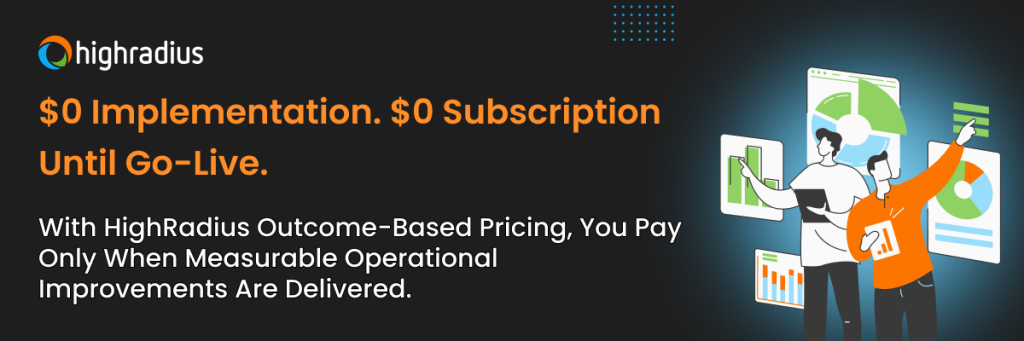
This makes HighRadius' AP automation pricing fundamentally different from traditional models that charge primarily for licenses, users, or invoice volume. The focus is on aligning the vendor's commercial success with your business outcomes.
The Real Cost of AP: Where Manual Processes Create Friction
The biggest AP costs are not always found in processing a standard invoice.
They often accumulate when invoices require human intervention.
Non-PO GL Coding
Non-PO invoices may require AP teams to identify the right GL codes and cost centers, coordinate with business teams, and wait for approvals.
Automating coding and routing can reduce these manual handoffs and help accelerate the approval process.
PO and Invoice Variances
When invoice quantities or prices do not match purchase orders, AP teams may need to investigate the discrepancy, contact procurement, check receiving information, and communicate with suppliers.
AI-powered 3-way matching can automatically compare invoices against purchase orders and receipts, resolve invoices that fall within configured tolerances, and route genuine exceptions to the appropriate owner.
Duplicate Invoices and Anomalies
Invoices can enter AP through multiple channels, creating the risk of duplicate submissions and payments.
AI-powered anomaly detection can help identify duplicate invoice numbers, unusual billing patterns, or changes in payment information before a payment is processed.
Supplier Queries
AP teams can also spend significant time responding to questions about invoice and payment status.
Supplier portals and centralized visibility can provide vendors with self-service access to relevant information, reducing the amount of manual communication required from AP teams.
This is why AP automation ROI cannot be reduced to a single per-invoice number. The real value comes from reducing the manual work and operational friction surrounding each invoice.
What Does HighRadius AP Automation ROI Look Like?
A more complete AP automation business case should consider:
| Productivity gains + automation rate + processing speed + exception reduction + control improvements + scalability |
HighRadius customer outcomes demonstrate how that value can differ depending on an organization's processes, invoice volumes, and operating complexity.
EnerSys: 46% Improvement in Invoice Processing Productivity
EnerSys used HighRadius AI Agents to transform invoice processing across a complex enterprise environment.
The organization achieved:
- 46% improvement in invoice processing productivity
- 150,000+ invoices auto-aggregated with AI Invoice Capture
- 61% straight-through invoice processing through 3-way AP Matching
- Integration across 3 ERPs and 8 company codes
- Standardized and scalable AP operations across North America
The EnerSys example shows why AP automation value extends beyond the software's ability to capture an invoice. The broader impact comes from connecting capture, matching, and ERP processes across a complex enterprise environment.
Smith College: 55% Boost in Invoice Processing Productivity
Smith College implemented AI-powered capabilities spanning document and invoice capture, validation, non-PO GL coding, and workflow and approval routing.
The results included:
- 55% boost in invoice processing productivity
- 22,000+ invoices auto-aggregated
- 99.9% posting success rate
- Average invoice lead time of 4.7 days
- Nearly all eligible invoices entered automatically
This demonstrates how automation can create value by improving both processing capacity and the reliability of downstream invoice operations.
Fancy Foods: 95.6% Straight-Through Invoice Processing
Fancy Foods used HighRadius AI Agents for invoice capture and 3-way AP matching.
The organization achieved:
- 95.6% straight-through invoice processing
- 11,700+ invoices auto-processed
- 68% faster invoice processing
- Average invoice lead time of 1.9 days
- Automated processing and posting to its Retalix ERP
For high-volume AP environments, increasing straight-through processing can reduce the number of invoices requiring manual intervention and help AP teams focus on exceptions and higher-value activities.
Geisinger: $1.01 Million Saved in Invoice Processing
Geisinger's HighRadius AP deployment demonstrates the financial impact that can result from AP automation.
The organization achieved:
- $1.01 million saved in invoice processing costs
- 229,000+ invoices automated
- 60.4% straight-through processing
This is also a useful illustration of why customer outcomes should be presented as customer-specific results, rather than converted into generalized savings claims for every prospective buyer.
HighRadius AP Automation Value Creation at a Glance
Across HighRadius deployments, AP automation can be evaluated against several business outcomes.
| Business Outcome | HighRadius Impact |
| AP Function Cost Reduction | Up to 40% |
| Team Productivity Boost | Up to 40% |
| Straight-Through Processing | Up to 90% |
| Automated GL Coding | Up to 80% |
| Early Payment Discount Capture | Up to 98% |
| Invoice Processing Cycle Time | 2X faster |
These figures should be viewed as HighRadius outcome benchmarks and targets, rather than assumptions that every customer will achieve the same results. Actual outcomes depend on the customer's existing processes, invoice mix, ERP environment, automation scope, and implementation.
How to Build Your AP Automation Business Case?
Instead of starting with an industry-wide cost-per-invoice benchmark, finance teams can build a business case from their own AP data.
Start by measuring:
- Annual invoice volume
- Invoices processed per AP employee
- Average invoice processing time
- Percentage of invoices requiring manual intervention
- Current straight-through processing rate
- Exception rate
- Number of ERP systems and entities
- Current AP operating costs
- Implementation and technology costs
- Expected productivity and automation improvements
Then compare your current baseline with the outcomes you expect from automation.
For example, if a large percentage of invoices currently require manual capture, matching, coding, or posting, increasing straight-through processing can help your AP team handle more invoices without a proportional increase in manual effort.
This approach creates a more credible ROI model because it uses your organization's actual cost structure and operational challenges rather than applying a generic industry benchmark.
Why HighRadius Takes an Outcome-Based Pricing Approach to AP Automation?
For enterprise finance teams, the objective of AP automation isn't simply to process invoices at a lower unit cost. The larger opportunity is to build a more productive, scalable, and intelligent AP function.
HighRadius combines AI Agents across invoice capture, validation, matching, coding, workflow, and ERP posting to automate more of the invoice lifecycle.
Customer results demonstrate the potential:
- 46% productivity improvement at EnerSys
- 55% productivity improvement at Smith College
- 95.6% straight-through processing at Fancy Foods
- $1.01 million saved at Geisinger
- 229,000+ invoices automated at Geisinger
- 150,000+ invoices auto-aggregated at EnerSys
These results also reinforce an important point: there is no universal AP automation ROI number.
The value an organization realizes depends on its invoice volume, existing AP processes, automation maturity, ERP environment, exception rates, and business requirements.
Conclusion
AP automation pricing should be evaluated as a business value decision, not simply a software purchasing decision. While invoice volume, users, integrations, entities, implementation, and functionality all influence the investment, the more important question is what the solution can deliver after implementation.
A strong AP automation business case should measure outcomes such as productivity, straight-through processing, invoice cycle time, AP function cost, coding automation, and scalability.
HighRadius' outcome-based approach connects AP automation investment to measurable business value, giving finance leaders a way to evaluate the technology based on the outcomes it can deliver—not generic cost-per-invoice assumptions derived from unrelated businesses. The goal isn't simply to automate invoices. It's to create measurable value for the entire AP function.
FAQs
How much does AP automation cost?
AP automation costs vary based on invoice volume, ERP integrations, deployment model, and workflow complexity. Rather than relying on industry averages, many organizations evaluate ROI based on measurable business outcomes such as lower processing costs, faster approvals, higher straight-through processing, and reduced manual effort.
Does AP automation cut costs?
Yes. Modern AP automation platforms like HighRadius reduce processing costs by automating the entire invoice lifecycle, from AI-powered invoice capture and intelligent matching to approval workflows and ERP posting. Customers have achieved up to 90% invoice automation and 40% lower AP function costs.
Is AP automation worth it?
AP automation delivers value beyond reducing processing costs. HighRadius automates invoice capture, data extraction, matching, coding, approvals, and ERP posting, enabling finance teams to process invoices faster with less manual effort. Customers have achieved up to 90% invoice automation, 80% automated invoice coding, 40% lower AP function costs, and up to 98% early payment discount capture, helping teams improve productivity, strengthen compliance, and maximize working capital.