Debt Collection Call Script Samples to Get Paid Faster in 2026
Last Updated: 12 July, 2026
•
Editorial Team HighRadius
2026 Automation Benchmark Report
HighRadius 2026 Automation Benchmark Report For The Office Of The CFO
Understand if your performance is on par with top 10% of the organizations. Identify gaps, best practices and know how you can drive value through Agentic AI-Driven Automation.
– Scripts alone don’t drive payments—most collection calls fail due to lack of prioritization and context.
– The right call matters more than more calls—focus on high-risk accounts with full customer visibility.
– Follow-through is critical—capturing promises-to-pay and next actions is what converts conversations into cash.
You’re about to call a customer about an overdue invoice. Before dialing, you pause. There’s no clear view of whether they raised a dispute, promised to pay last week, or simply missed the invoice altogether. The account notes are scattered, and the last interaction isn’t fully documented. You go into the call knowing the conversation could easily go off track.
This has become an everyday situation for most of the collection teams today. Collection calls don’t fail because they don’t have the right script or documents. They fail because teams often call the wrong customer, at the wrong time, with incomplete context. The entire process becomes reactive rather than proactive.
Additionally, finance teams still rely on static scripts while managing portfolios where 80% of effort is driven by exceptions, not routine follow-ups. At the same time, collectors spend 30–40% of their day just sorting emails, tracking disputes, or preparing for calls, instead of actually engaging customers. The result is predictable: delayed conversations, broken promises-to-pay, and rising Days Sales Outstanding (DSO).
Teams don’t need just another collection call script. They need a way to make every call informed, prioritized, and outcome-driven. The question should be, “Why am I calling this customer and what outcome am I driving?”
This blog talks about everything you need to know about debt collection call scripts—what they are, how to craft them, debt collection call script samples and solutions that can help you streamline inbound and outbound collection calls.
Table of Contents
What Is a Collection Call Script?
Why Traditional Collection Call Scripts Fall Short
What High-Performing Collections Teams Do Differently
Step-by-Step Guide to Making an Accounts Receivable Collection Call
Most Effective Debt Collection Call Scripts Examples
Pro-Tips For Effective Debt Collection Calls
How Automation Helps Businesses Unlock 2X Collection Calls
Accelerate Your Collections With HighRadius Accounts Receivable
What Is a Collection Call Script?
A collection call script is a pre-written dialogue designed to help collect owed money in a professional, effective manner. It guides the conversation, ensuring all important points are covered.
A well-prepared script can make the difference between a resolved debt and a call that ends with no clear outcome. It provides a framework for the conversation, allowing the collector to navigate through excuses, negotiate payment terms, and maintain a professional demeanor throughout the call. A good debt collection platform helps businesses prioritize high-risk accounts, use customer-specific context, and track promises-to-pay systematically instead of relying on generic scripts.
Most AR Forecasting Is Only ~70% Accurate
Spreadsheets can’t capture real customer behavior. AI-driven optimization fixes visibility and improves cash predictability.
What High-Performing Collections Teams Do Differently
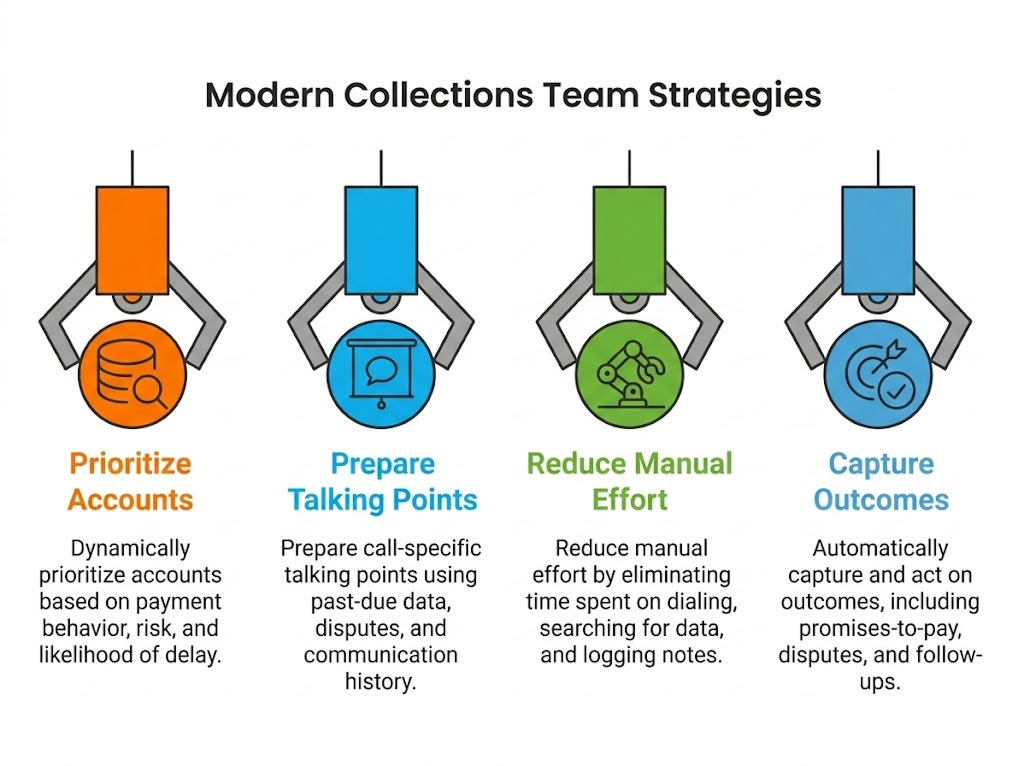
Traditional collections rely on static call lists, generic collection call scripts and manual follow ups. Modern collections teams take a different approach. They:
Prioritize accounts dynamically based on payment behavior, risk, and likelihood of delay
Prepare call-specific talking points using past-due data, disputes, and communication history
Reduce manual effort by eliminating time spent on dialing, searching for data, and logging notes
Capture and act on outcomes automatically, including promises-to-pay, disputes, and follow-ups
In high-volume environments, this shift is critical.
Collectors are often expected to make 30–40 calls per day, but only connect with a fraction of customers. Without prioritization and context, most of that effort is lost to:
voicemail loops
disconnected conversations
incomplete follow-ups
Leading teams address this by focusing on:
Calling the right customers
With the right context
At the right time
What to Say During the Call (And What Most Teams Miss)
The most effective collectors don’t follow scripts. They adapt in real time. But that requires:
visibility into disputes and past interactions
clarity on customer payment patterns
structured talking points aligned to the situation
Without this, collectors:
sound unprepared
repeat questions customers already answered
lose control of the conversation
Leading teams solve this by preparing call-specific talking points, not static scripts, so the conversation reflects the customer’s reality, not a template.
Step-by-Step Guide to Making an Accounts Receivable Collection Call
A successful accounts receivable collection call isn’t just about what you say. It’s about preparation, timing, and follow-through. The most effective collections teams combine structured call steps with customer context and prioritization to improve outcomes and reduce Days Sales Outstanding (DSO).
Follow this step-by-step process to make effective collection calls that drive payments while maintaining strong customer relationships.
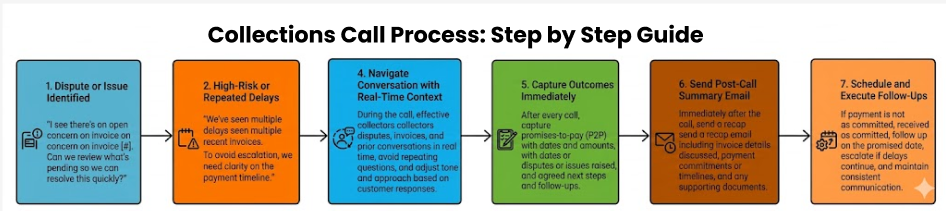
Step 1: Gather Customer and Invoice Context Before the Call
Before making a collection call, ensure you have complete visibility into:
overdue invoice details (invoice number, amount, due date)
customer payment history and average days late
open disputes, deductions, or claims
prior promises-to-pay (P2P) and communication history
Why this matters:
Collectors often lose credibility when they ask questions customers have already answered. Lack of context leads to longer calls, repeated follow-ups, and delayed payments.
Best practice: High-performing teams consolidate this data upfront so every call starts informed, not reactive.
Step 2: Start the Collection Call with Clarity and Purpose
Open the accounts receivable collection call with a clear and professional introduction:
“Hello, this is [Name] from [Company], calling regarding invoice [#], which is currently overdue.”
Then confirm:
whether the invoice was received
whether there are any issues preventing payment
Why this matters:
A clear opening sets expectations and keeps the conversation focused on resolution, not confusion.
Step 3: Use Context-Driven Collection Call Scripts (Not Generic Templates)
At this stage, the collection call script matters, but only when it reflects the customer’s situation.
1. First Reminder Call (Low Risk, Early Stage)
“Hi [Name], I wanted to check in regarding invoice [#]. It may have been missed—can I confirm if everything is in place for processing?” Goal: remove friction and enable payment
2. Broken Promise-to-Pay (P2P Follow-Up)
“Last time we spoke, we aligned on a payment by [date]. Has anything changed on your end?” Goal: reinforce commitment and accountability
3. Dispute or Issue Identified
“I see there’s an open concern on invoice [#]. Can we review what’s pending so we can resolve this quickly?” Goal: shift from collection to resolution
4. High-Risk or Repeated Delays
“We’ve seen multiple delays on recent invoices. To avoid escalation, we need clarity on the payment timeline.” Goal: drive urgency and control
Step 4: Navigate the Conversation with Real-Time Context
During the call, effective collectors:
reference disputes, invoices, and prior conversations in real time
avoid repeating questions already answered
adjust tone and approach based on customer responses
Why this matters:
Without real-time context, collectors rely on guesswork—leading to longer calls and lower success rates. Modern teams reduce this friction by ensuring relevant information is accessible during the call, so collectors focus on negotiation, not navigation.
Most Effective Debt Collection Call Scripts Examples
When speaking from a script, it is essential to stay flexible and be ready to deal with unexpected scenarios. Below are some accounts receivable collection call scripts that you could tailor to meet specific needs. These collection call scripts would help you figure out what to say when making a collection call.
Script 1: “Forgot to pay”
You: Good morning. Am I speaking with Mr. Dwight?
Dwight: Yes, Dwight speaking.
You: I am Jim, a collection analyst with Dunder Mifflin. I am calling you regarding your payment of [amount] for invoice [invoice number], which seems to be [number of days] past due. Can you help me understand why the invoice has not been paid?
Dwight: I am currently on vacation, so I forgot to pay.
You: Oh, I understand. In that case, I am sure you must have seen a link to our payment portal on your invoice.
Dwight: Yes, I have.
You: Great, you can easily pay through a credit card or ACH as you please. So, will you be making the payment today?
[If the customer says that he will pay today]
You: That’s great, taking note of this in our system. Thank you for your time. Happy holidays!
[Or if the customer says that he will pay later due to any reason]
You: Well, in that case, what we can do now is to get into a payment agreement. Is it possible for you to at least make a partial payment today? You are already past your due date. So, I suggest you make a partial payment today, and for the rest of the amount, we can schedule a time according to your convenience.
Dwight: Sounds good.
You: Okay then, please make the payment by evening, and for the next installment, I will call you Tuesday afternoon to follow up. Glad we talked.
Script 2: “Did not receive the invoice”
You: Good afternoon. This is Jim from Dunder Mifflin’s Finance Department. May I please speak with Mr. Dwight?
Dwight: Speaking, what can I do for you?
You: Hello, Dwight. I’m reaching out about your account with us. It seems there’s an invoice [invoice number] for [amount] that’s overdue. We wanted to ensure that you’ve received it and see if there’s any way we can assist with the process.
Dwight: I haven’t seen any invoice for that order.
You: I apologize for the inconvenience. Let’s verify that we have the correct contact information for you. Is abc@email.in still the best email for you?
Dwight: Yes, that’s my email.
You: Thank you for confirming. I’m resending the invoice to you right now. You should receive it within the next few minutes. May I stay on the line while you check your inbox to ensure it’s arrived?
Dwight: Sure, I’ve just received it.
You: Excellent. Now that you have the invoice in front of you, do you think you could process the payment today, or is there a specific date by the end of this week that would work better for you?
Dwight: I need to review the invoice first, so I can’t pay at this moment, but I should be able to by the end of the week.
You: I understand, Dwight. Let’s tentatively set a reminder for the end of the week then. I’ll make a note of this in our system and follow up if necessary. In the meantime, please don’t hesitate to contact me if you have any questions or concerns. Thank you for your cooperation, and have a great day ahead!
Ebooks
Handle the 5 Most Common Defaulter Excuses with Confidence
Learn expert strategies to overcome common excuses and boost collection success:
You: Hello, this is Jim with Dunder Mifflin’s finance team. May I have your name, please?
Dwight: Dwight here.
You: Hi, Dwight. I’m following up on invoice [invoice number] for [amount] that’s outstanding. We noticed it’s past due and wanted to check in with you about any payment updates or concerns you might have.
Dwight: Unfortunately, we’re tight on funds at the moment and can’t cover the invoice just yet.
You: I understand, Dwight, and I appreciate your candor. The current economic climate has been challenging for many. Would you like to share what’s been going on with your business lately?
Dwight: [Shares details of his situation]
You: It sounds like you’ve been navigating some tough waters. We value our relationship with your business and want to work with you through this. Let’s explore a payment plan that could ease the pressure. We can arrange for a partial payment now with the balance to follow at a time that’s more feasible for you.
Dwight: That could work, tell me more.
You: Excellent. If you can initiate a partial payment today, we can document a formal agreement for the remainder and schedule a follow-up for the balance. How does that fit with your current cash flow?
Dwight: Yes, I can make a partial payment today.
You: That’s great to hear. We’re here to support you, so if you have any questions moving forward, please reach out. Your proactive approach is much appreciated, Dwight. Have a wonderful day!
Script 4: “Invoice is incorrect”
You: Good morning, this is Jim from Dunder Mifflin’s finance team. May I speak with Mr. Dwight, please?
Dwight: This is Dwight.
You: Thank you for taking my call, Dwight. I’m reaching out about your account with us. We have an invoice, numbered [invoice number], totaling [amount], which seems to have gone past due by [number of days]. I’m here to help sort this out. Could you let me know what’s been holding up the payment?
Dwight: I’ve been meaning to pay, but there are some discrepancies on the invoice that need to be corrected first.
You: I’m sorry to learn that there’s been an issue. Let’s address it right away. What corrections are needed on our end?
Dwight: [Describes the needed corrections]
You: Thank you for pointing that out, Dwight. We always strive to be accurate and your feedback is crucial. I’ve made the necessary corrections and a revised invoice should be in your inbox now. Could you please take a moment to check it and verify that everything looks good?
Dwight: I’ve got it, and it looks correct now.
You: Fantastic. Now that we’ve settled the issue, are you in a position to process the payment? It would be great if we could wrap this up today.
Dwight: Yes, I’ll take care of it today.
You: That’s wonderful to hear. Your prompt response is greatly appreciated. If there’s anything else you need, don’t hesitate to get in touch. Enjoy your day!
[Or if Dwight has a misunderstanding]
You: I understand there’s been some confusion, and I’m here to clarify things. [Address the misunderstanding]. Hopefully, that clears up any concerns?
Dwight: Yes, it’s clear now.
You: Excellent. With that sorted, could we proceed with the payment?
Dwight: Sure, I’ll handle it today.
You: Great! If any questions arise or further assistance is needed, please feel free to contact me. Thanks for your time, Dwight.
Pro-Tips For Effective Debt Collection Calls
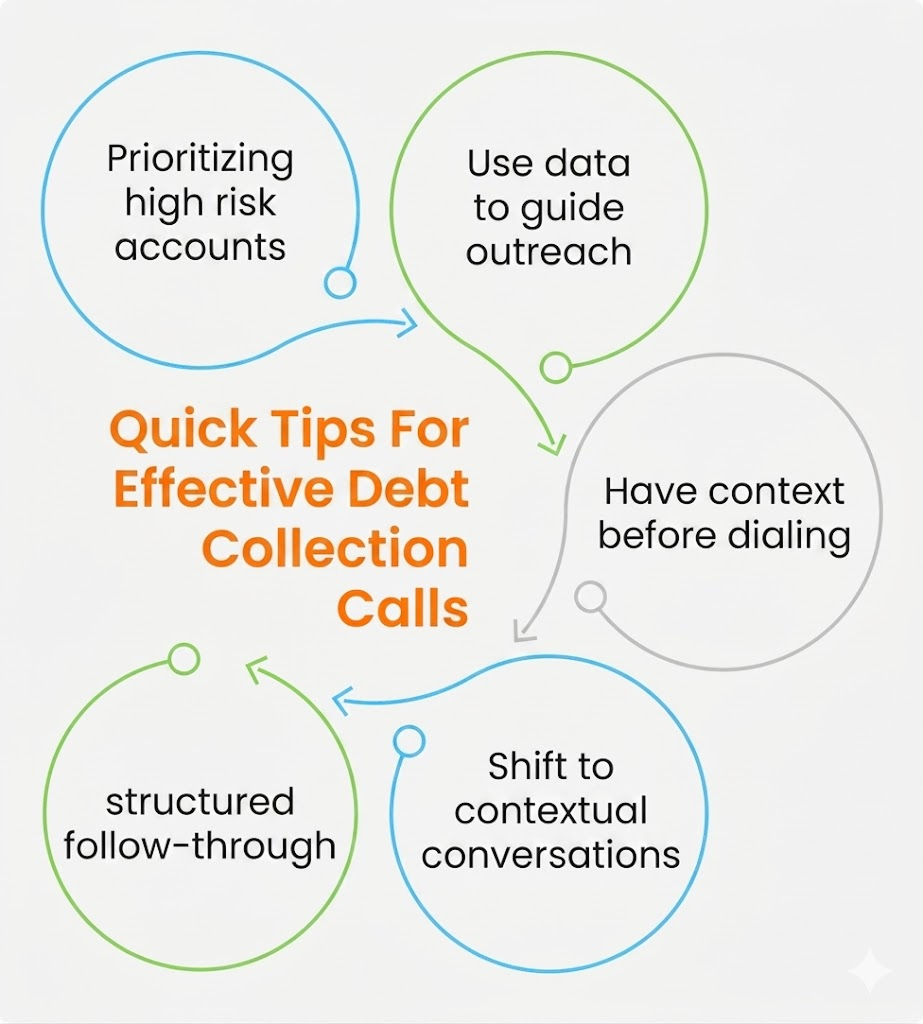
Effective collection calls are won before the conversation begins. Teams that prioritize the right accounts, prepare with context, and execute with structure consistently see better payment outcomes. Shifting from reactive calling to data-driven execution ensures every call is timely, relevant, and more likely to convert into cash.
Direct efforts toward accounts that matter most
Allocate collector time to customers with higher risk or overdue exposure, rather than treating all accounts equally.
Use data to guide outreach
Leverage payment history, dispute exposure, and past responsiveness to decide who to call and when.
Prepare context before dialing
Review open invoices, prior interactions, and commitments so the conversation starts informed, not reactive.
Shift from scripts to contextual conversations
Adapt your collection call approach based on customer behavior rather than relying on one-size-fits-all scripts.
Ensure structured follow-through
Capture promises-to-pay, schedule follow-ups, and track outcomes to turn conversations into actual payments.
Quick tip: The most effective collections teams don’t make more calls—they make the right calls, backed by data, context, and consistent execution.
How Automation Helps Businesses Unlock 2X Collection Calls
In high-volume collections environments, the gap isn’t scripting, it’s execution. An advanced, AI-powered debt collections software comes with an In-app inbound and outbound calling that removes manual friction by embedding context, automation, and follow-through directly into the call workflow, so collectors spend less time navigating systems and more time driving payments.
Key capabilities that make the difference:
One-click and parallel dialing
Connect with the right customers faster and reduce time lost on manual dialing and voicemails
AI-driven call talking points
Generate context-specific scripts based on past-due status, disputes, and payment behavior
In-context screens during calls
Automatically surface invoices, disputes, and customer history in real time
Real-time call transcription
Capture conversations and notes without manual effort
Automated post-call actions
Instantly create promises-to-pay, disputes, follow-ups, and tasks
Post-call summary emails
Reinforce commitments and next steps with customers immediately.
Whitepaper
25% Faster Payments Start With Better Systems
Find out how automation reduces delays, improves visibility, and accelerates collections outcomes across AR.
Accelerate Your Collections With HighRadius Accounts Receivable
HighRadius accounts receivable software provides a unified, AI-powered platform to manage the entire receivables lifecycle, from credit to cash. Powered by agentic AI, it helps finance teams prioritize the right actions, reduce manual effort, and accelerate cash flow by connecting data across ERP systems, banks, and customer interactions.
Key capabilities of HighRadius order-to-cash software are:
Accelerate payment recovery from delinquent customers and boost cash flow through automated collection workflows.
Cash App
Achieve same day cash application with automated remittance aggregation
Credit
Mitigate credit risk, reduce bad debt, and streamline customer onboarding with AI-powered insights.
Deductions
Reduce Revenue Leakage with AI Prediction models that identify valid and invalid deductions.
Frequently Asked Questions (FAQs)
1. What is an example of a collection call script?
Example – Hi [Customer Name], this is [Your Name] from [Your Company]. I’m calling about your overdue invoice [invoice number] for [amount due] which was due on [due date]. I wanted to check in with you to see if there was a reason the payment has been delayed and if there’s any way we can assist.
Example – Hi [Customer Name], this is [Your Name] from [Your Company]. I’m calling about your overdue invoice [invoice number] for [amount due] which was due on [due date]. I wanted to check in with you to see if there was a reason the payment has been delayed and if there’s any way we can assist.
2. What does a debt collector say?
A debt collector will confirm the debtor’s identity, inform them of the outstanding debt, and request payment or discuss potential payment arrangements. They aim to work with the debtor to find a solution, such as setting up a payment plan.
A debt collector will confirm the debtor’s identity, inform them of the outstanding debt, and request payment or discuss potential payment arrangements. They aim to work with the debtor to find a solution, such as setting up a payment plan.
3. How do I prepare for a collection call?
Before a collection call, gather all relevant information including the invoice details, customer’s account status, and history of communication. Approach the call with a clear objective and be ready to discuss and negotiate payment terms.
Before a collection call, gather all relevant information including the invoice details, customer’s account status, and history of communication. Approach the call with a clear objective and be ready to discuss and negotiate payment terms.
4. How can collection calls be improved?
Collection calls improve significantly when teams prioritize high-risk accounts, use customer-specific context, and track promises-to-pay systematically instead of relying on generic scripts.
Collection calls improve significantly when teams prioritize high-risk accounts, use customer-specific context, and track promises-to-pay systematically instead of relying on generic scripts.
5. Why do collection calls fail?
Most collection calls fail due to poor preparation, lack of customer context, and weak follow-up processes, not because of what is said during the call.
Most collection calls fail due to poor preparation, lack of customer context, and weak follow-up processes, not because of what is said during the call.
Resource Library
Resource Hub
Order to Cash
Order to Cash software data sheet
Disconnected workflows can leave teams chasing data, while automated O2C has delivered 20% lower past dues.
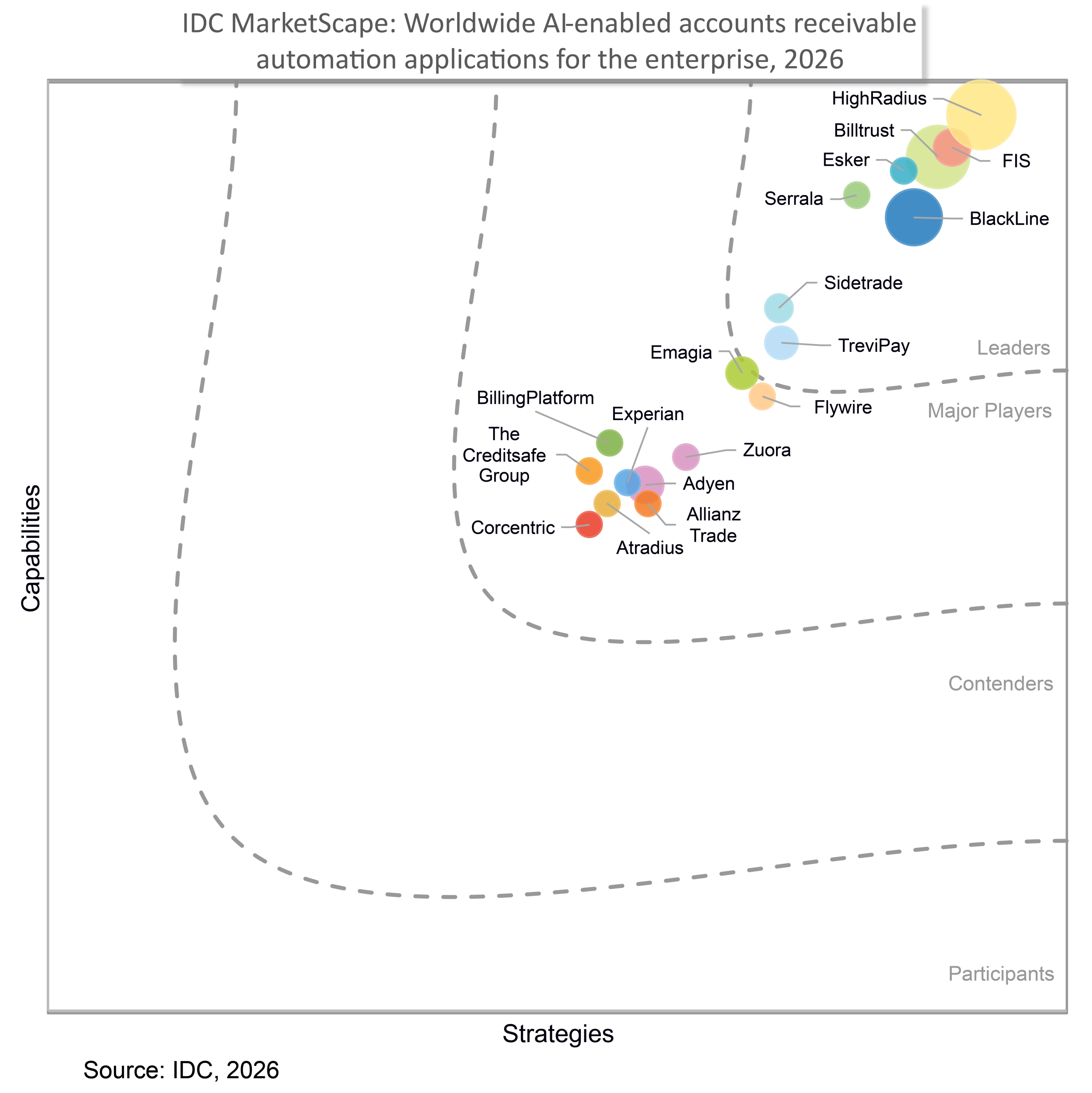
HighRadius recognized as a "Leader" in IDC Marketscape: Worldwide AI-enabled accounts receivable automation applications for the enterprise 2026 vendor assessment
Recognized as a Leader in 2026 Vendor Assessment for unifying credit, collections, cash application, deductions, e-invoicing, and payments on one AI platform to advance enterprise-wide invoice-to-cash transformation.
Forrester Recognizes HighRadius in The AR Invoice Automation Landscape Report, Q1 2023
Forrester acknowledges HighRadius’ significant contribution to the industry, particularly for large enterprises in North America and EMEA, reinforcing its position as the sole vendor that comprehensively meets the complex needs of this segment.