Seat-based pricing worked brilliantly for 20+ years. Then AI changed the equation fundamentally.
Consider what's happening in enterprise operations right now:
According to a recent research, seat-based pricing dropped from 21% of companies to just 15% in a single year.
Here's why: companies that stick with traditional per-seat pricing for AI products see:
HighRadius’ pivot provides the clearest evidence. When the company launched its outcome-based pricing model last February at Radiance 2026 in Houston, it moved away from per-seat pricing entirely. The company eliminated implementation and pre–go-live subscription fees, introducing a model tied to mutually agreed success criteria—where customers pay only when the AI agents deliver measurable outcomes.
Outcome-based pricing (OBP) inverts the entire value equation. Instead of charging for access or transactions, you pay for measurable business outcomes.
For AI agents specifically, this means:
You don’t pay based on how many invoices your team could theoretically process or how much system capacity you’ve purchased. With modern invoice automation software, you pay for outcomes like invoices accurately processed end-to-end, exceptions resolved without manual intervention, cycle times reduced, and cash flow improved through faster approvals and payments.
The vendor funds the full cost of deploying AI agents across your workflows. Why? Because vendor success depends entirely on yours. If the implementation fails or doesn't deliver outcomes, neither does the vendor's revenue. Implementation risk transfers from you to them—where it belongs.
Payments begin only when your solution is live and delivering measurable value. Zero cost until outcomes are clearly within reach. This eliminates the 6-month implementation nightmare where you're paying full pricing for zero results.
Fees are a percentage of the outcomes your business realizes. Your AI agent cuts invoice processing time by 30 hours per week? You keep most of that savings. The vendor gets a fraction. Every contract is anchored to Mutually Agreed Success Criteria (MASC): defined baselines, transparent targets, and clear sign-off metrics. No hidden billing surprises. No ambiguity.
Outcome-based pricing has existed in other industries for decades. Siemens uses it for building automation: they guarantee 20% energy cost reductions, and customers pay based on realized savings. It works.
But it's particularly suited to AI agents because AI creates a clear, measurable cause-and-effect link between the technology and business outcomes:
For traditional per-seat SaaS (Salesforce, HubSpot, ServiceNow), outcome-based pricing is much harder to implement. Success depends on user behavior, sales skills, marketing effectiveness, and dozens of other variables outside the vendor's control. But for AI agents? The vendor actually controls the outcome.
This is why 47% of SaaS companies are actively exploring or piloting outcome-based models, and why AI-native vendors have shifted entirely away from per-seat licensing.
Here's what keeps CFOs awake at night: traditional SaaS vendors are paid for promises, not results. A vendor sells you an AI invoice processor and collects day one of implementation. Whether it actually processes invoices? Doesn't impact their revenue.
This creates a perverse incentive structure:
The result? Less than 40% of software buyers report satisfaction with the value they receive. That's a damning statistic. One vendor is paid for outcomes the customer never realizes. The relationship is extractive, not collaborative.
When the vendor's revenue depends directly on your P&L impact, everything changes:
Vendor optimization priorities: They obsess over outcome quality, not speed. A rushed implementation that delivers 60% value isn't profitable for them. A well-tuned solution that delivers 95% value is.
Vendor support structure: They assign top resources to ensure continuous optimization and value expansion. Your success literally makes their year. Churn becomes catastrophic for their business model.
Vendor innovation cadence: They invest heavily in AI model improvements, workflow refinement, and integration excellence because every 5% improvement in outcomes becomes 5% incremental revenue.
Vendor customer expansion: They focus on expanding outcomes with existing customers (higher ROI than new logos) because they're already invested in your success.
This isn't theoretical. Gartner forecasts that by 2025, over 30% of enterprise SaaS solutions would incorporate outcome-based components—a near-doubling from 15% in 2022. The market is voting with its feet.
Why? Because procurement teams and CFOs have done the math. Outcome-based models deliver measurably better implementation success rates, faster time-to-value, and higher adoption than traditional licensing. The data is overwhelming.
But there's one more piece to this puzzle. Aligning incentives isn't enough. You need a way to evaluate whether your vendor is actually qualified to deliver those outcomes. That's where the concept of AI Quotient (AQ) comes in.
HighRadius was built for this moment. Our AI agents were designed to deliver specific, measurable financial outcomes—not vague productivity improvements. They were built to play well with outcome-based pricing from day one.
But before we discuss the pricing model, we need to address something deeper: the AI Quotient (AQ).
For decades, leadership was defined by Emotional Quotient (EQ)—your ability to lead, inspire, and manage human colleagues. It was the skill set that defined great managers.
We're now entering the era of hybrid teams: humans and AI working in parallel. This requires a new skill set. We call it AQ—Algo Quotient. Your ability to evaluate, deploy, and manage AI colleagues.
Just as a high-EQ manager knows how to extract maximum value from human talent, a high-AQ leader knows how to:
HighRadius helps you build that AQ. Our outcome-based pricing model ensures we're invested in your success, but more importantly, it means our AI has been tested and optimized for specific financial outcomes: cash acceleration, days payable outstanding reduction, invoice exception handling, and payment timing optimization.
1. Pay for Outcomes
We take $0 until you realize a measurable financial outcome. No hidden fees. No per-user licenses. No per-seat pricing. Just shared success.
2. Go-Live 2x Faster
Go live in weeks with $0 upfront fees until you're live and generating value. We fund the implementation entirely. Your cash flow is protected.
3. Perfect AQ Fit
We help you find the right AI agent (the right algorithm) to match your specific business outcome. No copy-paste solutions. Precision-engineered AI tailored to your financial close priorities.
That's the promise of outcome-based pricing for AI. That's the business model we've adopted because it's the only one that makes sense in an AI-driven future.
And more importantly, that's how we prove that outcome-based pricing isn't just fairer for customers. It's also the path to superior vendor performance, faster value realization, and actual partnership instead of licensing relationships.
The era of per-seat software pricing is over. It was designed for a world where software was a tool humans used. In the era of AI agents, software is an autonomous worker. The economics, the incentives, and the pricing must evolve.
Outcome-based pricing is no longer novel. It's the standard emerging vendors and forward-thinking enterprises are adopting right now. Your vendor should have skin in the game. Your outcomes should determine their revenue. Your success should be their success.
If they're not willing to tie their revenue to your results, they're betting against you. And no software partnership should ever be structured that way.
If your current vendor is charging per user regardless of outcomes, you're likely leaving millions on the table. The future of software isn't about access. It's about results.
Learn how HighRadius' outcome-based pricing model works and whether it's right for your financial close operations.
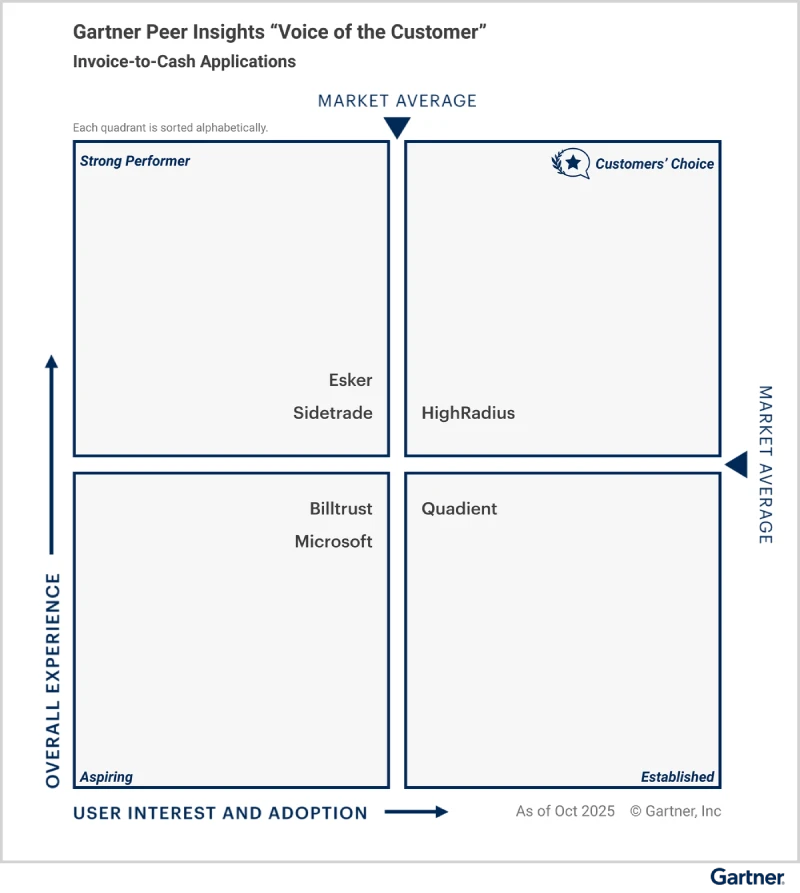
Positioned highest for delivering comprehensive automation across collections, credit, deductions, disputes, and multi-ERP integration - enabling standardized, scalable I2C transformation.
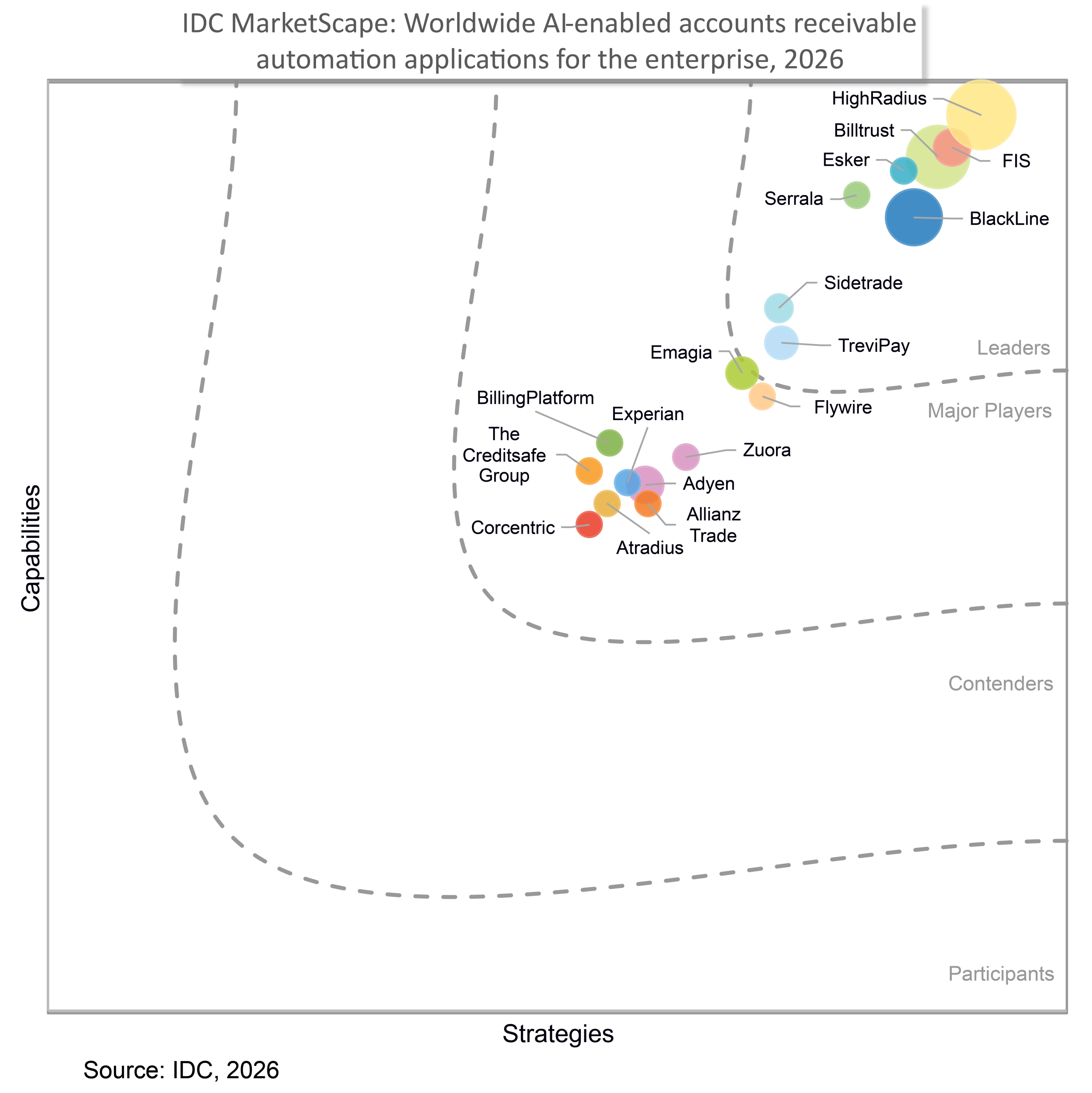
Explore why HighRadius has been a Digital World Class Vendor for order-to-cash automation software – two years in a row.

Recognized as a Leader in 2026 Vendor Assessment for unifying credit, collections, cash application, deductions, e-invoicing, and payments on one AI platform to advance enterprise-wide invoice-to-cash transformation.
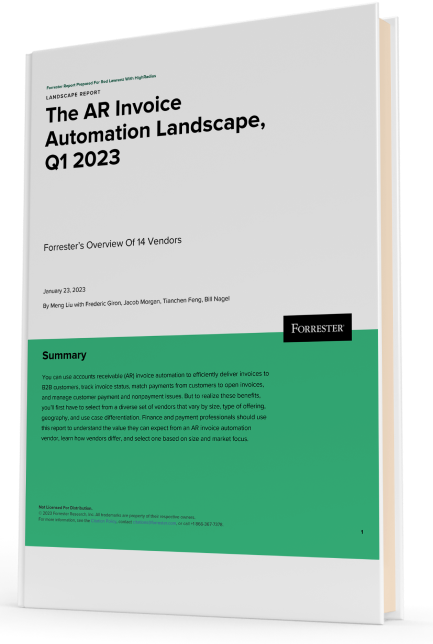
Forrester acknowledges HighRadius’ significant contribution to the industry, particularly for large enterprises in North America and EMEA, reinforcing its position as the sole vendor that comprehensively meets the complex needs of this segment.
Customers globally
Implementations
Transactions annually
Patents/ Pending
Continents
Explore our products through self-guided interactive demos
Visit the Demo CenterPlease fill in the details below
Please fill in the details below

We have seen financial services costs decline by $2.5M while the volume, quality, and productivity increase.

Colleen Zdrojewski
Trusted By 1300+ Global Businesses


