Choosing the Right AR Solution for Mid-Market ERPs
Last Updated: 16 November, 2026
•
Sharmistha Sahoo
2026 Automation Benchmark Report
HighRadius 2026 Automation Benchmark Report For The Office Of The CFO
Understand if your performance is on par with top 10% of the organizations. Identify gaps, best practices and know how you can drive value through Agentic AI-Driven Automation.
Your ERP can tell you exactly how much your customers owe. But can it tell your AR team who to contact first, why a payment is delayed, or what action will move that payment forward?
For many mid-market firms, the problem isn’t the ERP. It's everything your AR team still has to do outside it.
As businesses grow, accounts receivable becomes harder to manage with the tools that worked at a smaller scale. More customers bring more invoices, more payment behaviors, more disputes, and more collection activity. Yet AR teams often remain lean, with limited time tracking overdue invoices and chasing customers than actually improving cash flow. And having visibility into these activities doesn't necessarily mean you can act on them. An overdue invoice report tells you what's outstanding, but not always which customer needs attention first or what action will get the payment moving.
But choosing one isn't just aboutadding automation or another dashboard. It's about finding a platform that works with your existing ERP, takes manual work off your team's plate, and helps turn receivables data into action without adding another layer of complexity.
Why Mid-Market AR Teams Outgrow Their ERP
Your ERP may hold all the financial information your AR team needs. But as transaction volumes grow, managing receivables often requires more than what your current ERP setup can support right now.
Your team might still relying on:
Spreadsheets to track collection activity and payment commitments.
Emails to follow up with customers and resolve payment queries.
Manual cash application to match incoming payments with open invoices.
ERP reports to identify overdue accounts and prioritize collections.
Customer portals to retrieve invoices and payment information.
Separate workflows to escalate disputes and deductions.
Multiple screens to piece together a customer's payment history.
Individually, these tasks may seem manageable. But together, they create a fragmented AR process where information is scattered and teams spend more time coordinating work than completing it.
Collectors spend time researching accounts instead of engaging customers. Cash application teams spend hours identifying and matching payments. Managers struggle to get a consolidated view of collection performance, while overdue receivables continue to age.
For a mid-market business, adding more people isn't always the answer.
The better question is: How much of your existing AR workload can technology take off your team's plate?
What Should You Look for in an AR Solution?
Not every AR platform is designed for the operational needs of a mid-market business. The right platform should work alongside your existing ERP, address the manual work slowing down your AR team, and help improve cash flow without introducing unnecessary complexity.
Here are four capabilities worth prioritizing when evaluating your options.
1. Native or Low-Complexity ERP Integration
Integration should be one of the first things you evaluate, not something to figure out after selecting a platform.
Your AR platform needs access to the customer, invoice, payment, and credit information stored in your ERP. But data synchronization alone isn't enough. It should also write completed transactions and updates back to the ERP.Look for prebuilt integrations for your ERP, minimal custom development, automated data synchronization, and reliable writeback. Also verify compatibility with your specific ERP edition and deployment model.
The goal is simple: your ERP remains the source of truth while the AR platform handles the work around it.
2. Automated Collections
Collections automation should do more than send reminder emails when invoices become overdue.
Your team needs to know which accounts deserve attention first, what is delaying payment, and what action is most likely to move the invoice forward.
For example, an account with a history of late payments and a high outstanding balance may need more immediate attention than a customer who regularly pays a few days late. The platform should help collectors distinguish between these situations instead of treating every overdue invoice equally.
AI-driven prioritization can use payment behavior, collection history, outstanding balances, and promises to pay to recommend which accounts need attention. It should also support personalized customer communication and escalation when required.
3. Cash Application Automation
Cash application is another area where manual work quickly accumulates as transaction volumes grow.
Payments arrive through different channels, often with incomplete or inconsistent remittance information. Your team then has to identify the customer, find the corresponding invoices, resolve mismatches, and post the payment.
A modern AR platform should automate this workflow:
The important distinction is how much of this process can happen without human intervention. Look for multi-channel remittance capture, automated customer identification, AI-assisted invoice matching, exception handling, and ERP posting.The objective is to increase straight-through processing, so your team spends less time researching routine payments and more time resolving exceptions that genuinely need attention.
4. Dispute and Deduction Management
An overdue invoice isn't always a collection problem. Sometimes, the customer is withholding payment because of a pricing discrepancy, short shipment, missing proof of delivery, damaged goods, or another claim. Your AR platform should help manage these issues within the broader receivables workflow, rather than leaving teams to investigate them across disconnected emails and spreadsheets.
This means being able to capture claims from emails and customer portals, identify deduction reasons, assign disputes to the right teams, and track resolution progress. It should also connect deductions to the relevant invoices and customers, giving teams visibility into recurring causes.
The Mid-Market AR Technology Checklist
Before shortlisting an AR platform, take this quick assessment. Answer these questions based on your current AR processes to identify where your operations stand and what you should prioritize next.
0 of 10 questions answered
Your next priorities:
Calculate the Business Case Before You Choose
The best AR solution isn't necessarily the one with the most features. It's the one that delivers measurable improvements in your receivables operation.
Before comparing platforms, understand where your team is spending time and where cash is getting held up.
Start by establishing your current baseline across four areas:
Receivables performance: Total AR, DSO, and past-due receivables.
Team productivity: Number of collectors and cash application specialists, time spent on manual activities, and accounts managed per employee.
Process efficiency: Percentage of payments processed manually, number of deductions and disputes, and average resolution time.
Technology costs: Current ERP, integration, and other AR-related technology expenses.
Once you have this baseline, estimate what improvements would mean for your business.
For example, if collectors spend a significant part of their day researching accounts and sending routine follow-ups, automated prioritization and communication could free up time for more complex accounts. Similarly, higher cash application automation could reduce manual matching and help make cash available in the ERP sooner.
Don't measure the business case by the number of tasks a platform claims to automate. Connect those improvements to outcomes your finance team can track: faster collections, lower processing effort, improved productivity, and reduced operating costs.
Implementation Matters as Much as Features
A solution may look impressive in a product demo, but the real test begins when it has to work with your ERP, data, and existing finance processes.
For mid-market companies, an implementation that requires extensive customization or constant IT involvement can delay the very benefits the platform is supposed to deliver.
Before selecting a provider, understand what implementation will involve:
ERP integration: Does the provider support your specific ERP edition and deployment model?
Data migration: What customer, invoice, payment, and historical data needs to be transferred?
Customization: Can your workflows be configured using existing capabilities, or will they require custom development?
Ownership: Who will manage integration, testing, and issue resolution?
Deployment: Can high-impact workflows go live first, with other capabilities introduced in phases?
Time to value: When can your team realistically start using the first automated workflows?
A phased rollout can help your team start with high-impact areas, such as collections or cash application, before expanding to other AR processes.
The objective isn't simply to go live quickly. It's to make sure the solution works reliably without placing an unreasonable burden on your finance and IT teams.
The AR transformation should reduce their workload not create another transformation project for them to manage.
Up to 30% of AR teams' time is spent on manual cash application and collections activities.
See how leading finance teams automate repetitive work to improve cash flow performance.
One of the easiest mistakes in AR technology selection is confusing visibility with automation.
A dashboard showing overdue invoices may help a manager understand the problem. But it doesn't collect the cash.
Similarly, an AI-generated recommendation adds limited value if the collector still has to research the account, draft the email, update the ERP, and track the response manually.
For mid-market finance teams, the real value of AI lies in the work it can take off the team's plate.
When evaluating a platform, ask vendors:
What happens automatically after the system identifies an issue?
Can it prioritize the account, gather relevant information, and draft or send the right communication? Can it process the customer's response, update the workflow, and escalate exceptions to a human when needed?
The distinction matters: AI that recommends the next action is useful. AI that can execute it is what moves AR work forward.
7 Questions to Ask Before Selecting an AR Solution
A product demo can show you what a platform is capable of. But before making a decision, you need to understand how those capabilities will work in your actual AR environment.
Use these questions to evaluate every provider:
Does the solution integrate with our exact ERP environment? Ask for details about data synchronization, writeback, and supported ERP versions.
Which AR activities can it automate end to end? Distinguish between tasks the platform completes and tasks that still require manual intervention.
How does it prioritize collection activity? Understand what factors influence prioritization and how the system helps collectors decide what to work on next.
What level of cash application automation can we realistically achieve? Ask how it handles incomplete remittances, partial payments, and complex invoice matching.
How are disputes and exceptions handled? Find out how issues are identified, assigned, tracked, and resolved.
What will implementation require from our team? Get clarity on timelines, customization, IT involvement, and phased deployment.
How will we measure ROI after implementation? Agree on baseline metrics and the KPIs the provider will use to demonstrate improvement.
Don't settle for a yes-or-no answer. Ask providers to demonstrate these capabilities using workflows that reflect your own processes.
How HighRadius Helps Mid-Market AR Teams
For mid-market businesses looking to modernize receivables without replacing their ERP, HighRadius brings collections, cash application, credit, and deductions workflows together in an integrated AR platform.
Rather than making finance teams manage these activities across disconnected tools, the platform connects receivables workflows with existing ERP environments.
Here's how that translates into day-to-day AR operations:
Collections: AI-driven worklist prioritization helps collectors focus on accounts that need attention, while automated dunning and personalized outreach reduce repetitive follow-ups.
Cash application: Remittance capture, customer identification, payment matching, and ERP posting help reduce manual payment processing.
Credit management: Credit risk assessment and automated approval workflows help teams evaluate customer risk and manage credit decisions.
Deductions: Automated claim capture, deduction coding, and guided workflows help teams investigate and resolve payment discrepancies.
Learn More about HighRadius Accounts Receivable Software
Lower DSO, boost working capital, and increase productivity with our AI-driven accounts receivable platform, integrated with modern ERPs.
Accelerate payment recovery from delinquent customers and boost cash flow through automated collection workflows.
Cash App
Achieve same day cash application with automated remittance aggregation
Credit
Mitigate credit risk, reduce bad debt, and streamline customer onboarding with AI-powered insights.
Deductions
Reduce Revenue Leakage with AI Prediction models that identify valid and invalid deductions.
HighRadius also offers prebuilt ERP integrations and an implementation approach designed to help mid-market teams get started without building every workflow from scratch.
For example, DXP Enterprises used HighRadius across its receivables operations, achieving 90%+ straight-through cash application, a 20-day reduction in DSO, and a 40% increase in collector efficiency. These are customer-specific results, but they illustrate the potential impact of connecting collections and cash application rather than improving each process in isolation.
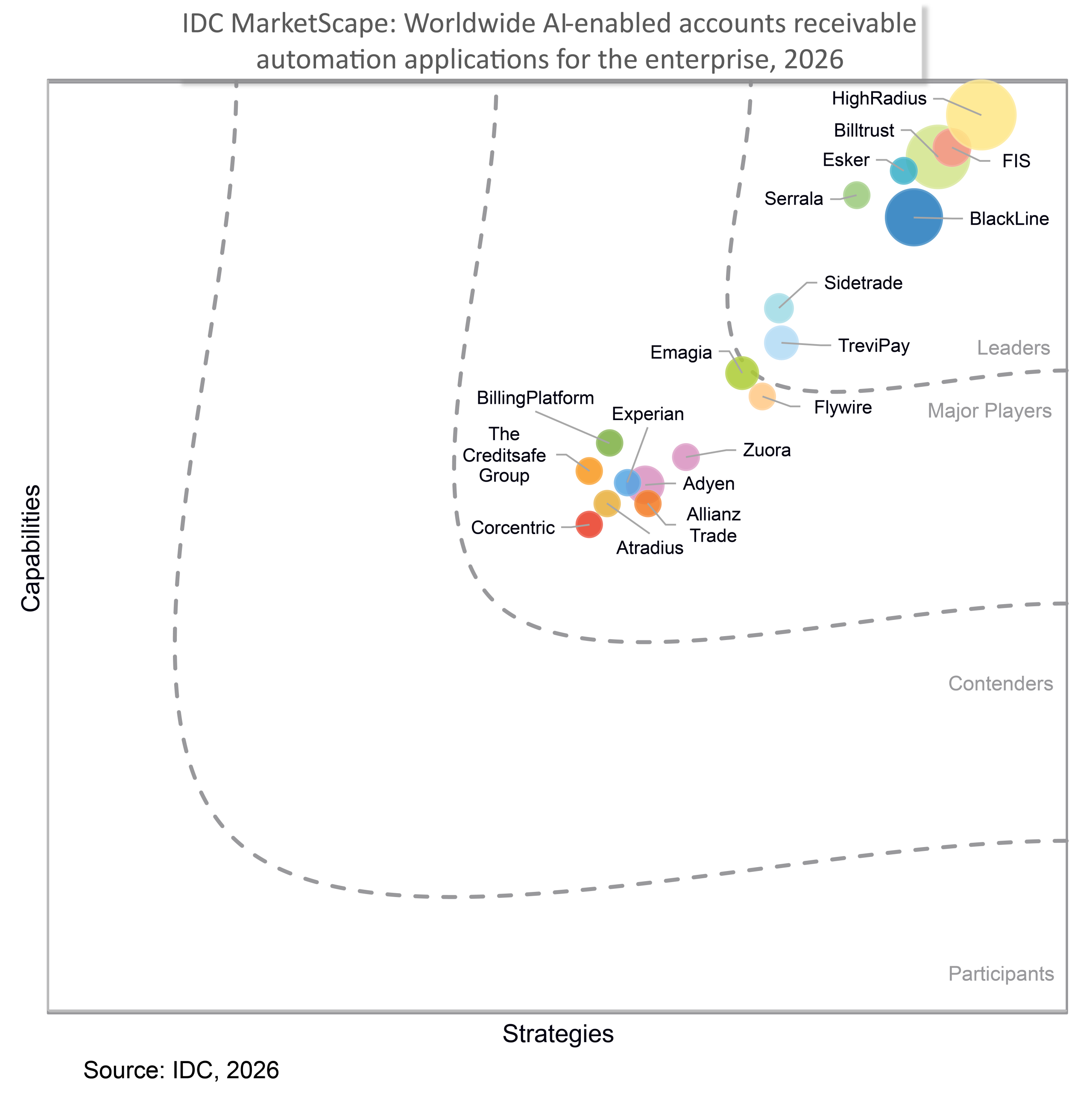
HighRadius recognized as a "Leader" in IDC Marketscape: Worldwide AI-enabled accounts receivable automation applications for the enterprise 2026 vendor assessment
Recognized as a Leader in 2026 Vendor Assessment for unifying credit, collections, cash application, deductions, e-invoicing, and payments on one AI platform to advance enterprise-wide invoice-to-cash transformation.
Forrester Recognizes HighRadius in The AR Invoice Automation Landscape Report, Q1 2023
Forrester acknowledges HighRadius’ significant contribution to the industry, particularly for large enterprises in North America and EMEA, reinforcing its position as the sole vendor that comprehensively meets the complex needs of this segment.