The Advanced Guide to Scaling Remittance Processing: Overcoming AP Portals, Lockboxes, and Legacy OCR
Last Updated: 17 November, 2026
•
Soumyadeep Paul Financial SaaS Content Expert
S
Soumyadeep Paul
Soumyadeep Paul is an Order-to-Cash (O2C) Content Expert at HighRadius, with hands-on experience in product marketing and finance-focused content creation. He enjoys breaking down complex O2C and SaaS concepts into simple, engaging narratives for modern finance teams. His goal is not just to inform, but to 'empower with content,' ensuring every piece of analysis helps finance teams move from theory to actionable strategy.
Outside of work, he’s passionate about exploring trends in finance and marketing, bike riding and gaming.
2026 Automation Benchmark Report
HighRadius 2026 Automation Benchmark Report For The Office Of The CFO
Understand if your performance is on par with top 10% of the organizations. Identify gaps, best practices and know how you can drive value through Agentic AI-Driven Automation.
In B2B finance, a frustrating paradox exists. Electronic payments move across the globe in seconds, but matching that cash to open invoices still takes accounts receivable teams days to complete.
If your mid market or enterprise organization is evaluating remittance processing software, you likely already understand the fundamental mechanics of cash application. However, executing those steps across tens of thousands of disjointed transactions is an entirely different operational reality.
The pressure to modernize accounts receivable is mounting rapidly. The global remittance market is projected to reach US$ 814.58 Billion by 2035. As transaction volumes surge toward that mark, buyers are fundamentally changing how they pay. Format proliferation is at an all time high. Throwing more human analysts at shared inboxes to decode unstructured data is no longer a viable operational strategy. Here is an advanced look at why manual processing breaks at scale and exactly how to fix it.
Why Do Legacy Remittance Payment Processing Workflows Fail?
Legacy workflows fail because they rely on manual keying and physical lockboxes, which cannot handle the volume, speed, or format proliferation of modern digital B2B remittance payment processing.
To understand why modern financial operations struggle, you have to look at how B2B payments have evolved. Twenty years ago, the workflow was linear. A customer mailed a physical check with a paper stub attached to it. Today, we live in the era of decoupled data. The payment and the remittance data are completely separated.
While cash remains a legacy payment instrument, digital channels are rapidly taking over because of their economic advantages. Across all regions, digital remittance services are by far the cheapest channel for completing transactions. According to a research, it costs 5.64 percentage points less to send money via digital versus cash.
Because buyers prefer these cheaper digital channels, they dictate the operational terms. They utilize technologically advanced rails that translate to real time benefits. For instance, an individual in the US can send money to Brazil in less than 10 seconds. But for B2B suppliers, this speed creates a data nightmare. The buyer sends the money instantly but emails a 15 page PDF to a shared inbox. Relying on an outsourced lockbox creates a visibility black box and delays cash application by processing data in end of day batches.
Every Remittance Doesn't Look the Same
Discover 13 common remittance scenarios and learn why traditional cash application processes struggle to keep up.
What Are the 4 Bottlenecks of Automated Cash Application?
The four hidden bottlenecks of automated cash application are data intake format proliferation, trapped data extraction, complex one to many invoice reconciliation, and delayed batch ERP posting.
Scaling your accounts receivable operations requires identifying exactly where your current process breaks down. Relying on manual intervention puts a hard ceiling on your growth. These are the specific areas where manual processes fail:
The Intake Bottleneck: Before any matching can happen, data must be collected. Customers send data via PDF, Excel, plain text, standardized EDI 820 formats, or physical lockbox scans.
The Extraction Bottleneck: Once the document is secured, the data must be extracted. Relying on humans to read emails and copy paste data into a spreadsheet introduces severe human error.
The Reconciliation Bottleneck: Matching a clean payment is simple, but B2B payments are rarely a perfect match. Resolving short pays requires forensic accounting that drains team productivity.
The Posting Bottleneck: The financial transaction is not complete until the data is successfully posted back into your system of record. Batch processing delays this step, leaving open invoices lingering on the ledger.
What is the AP Portal Trap in Remittance Processing?
The AP portal trap occurs when B2B buyers force suppliers to manually log into third party procurement systems to download payment data, creating massive data entry bottlenecks in remittance processing.
Because buyers hold the leverage to dictate payment terms, they have created the single biggest threat to scalable operations today. Large enterprise buyers want to standardize their accounts payable processes. To do this, they mandate that all their suppliers use specific digital networks like Ariba, Coupa, Taulia, or Tungsten. Instead of emailing you a breakdown of their payment, they require your accounts receivable team to log into their specific portal.
If your mid market business acquires 50 new enterprise clients, your team might inherit 50 new portal URLs and logins. Every morning, your financial professionals have to waste hours acting as basic data miners by performing these manual steps:
Logging into individual customer web portals.
Navigating to the payment history tabs.
Exporting raw Excel or CSV files.
Formatting that data to match your internal ERP upload requirements.
Modern AI automation solves the AP portal trap by deploying specialized Robotic Process Automation (RPA) bots. These bots are programmed with API integrations and web scraping capabilities to automatically log into every customer portal overnight, pulling the raw remittance data into a centralized queue before your human analysts even start their workday.
AI vs. Template Based OCR: The Technology Shift
Template based OCR is obsolete for payment remittance processing because it relies on rigid coordinate mapping, meaning the entire system fails the exact moment a customer alters their invoice layout or email format.
For over a decade, finance teams attempted to solve data extraction using Optical Character Recognition software. Traditional OCR is strictly zonal. It requires an IT developer to build a strict template for every single customer, mapping exact coordinates for invoice numbers and payment amounts.
The problem is that customer formats are never static. A customer might upgrade their own ERP, slightly shifting the columns on their payment advice. The moment a format deviates, traditional OCR fails. Modern systems abandon zonal templates entirely in favor of Artificial Intelligence and Machine Learning.
Extraction Technology
How the Software Reads Data
Primary Operational Limitations
Manual Keying
Analysts visually read documents and manually type data.
High error rates, incredibly slow, and unscalable.
Legacy Zonal OCR
Extracts data based on rigid, IT coded coordinate templates.
Breaks instantly when a customer changes their invoice layout.
Modern AI & Machine Learning
Contextually identifies variables like invoice numbers and amounts.
Requires upfront volume assessment to train the models on your specific customers.
Five Practical Ways to Reduce Manual Cash Application
Explore proven automation approaches that help finance teams process remittances faster, improve matching accuracy, and lower operating costs.
How Do You Automate Complex Deductions and Short Pays?
You automate short pays by using AI agents to read customer reason codes contextually, automatically mapping them to internal dispute codes and routing them for immediate resolution.
B2B customers frequently short pay their invoices due to damaged goods, negotiated trade promotions, early payment discounts, or freight discrepancies. In a manual environment, an analyst sees a payment is short, places the payment in an unapplied cash account, and spends weeks figuring out why the payment was short. Modern AI systems eliminate this bottleneck by extracting the contextual notes directly from the remittance advice.
Case Study: How Coty Scaled Across Borders
Consider the documented case of Coty, a major North American beauty products manufacturer generating over $9.4 billion in revenue. Before modernizing, their accounts receivable shared services team suffered from severe operational scaling challenges. Their analysts manually aggregated remittance information from disparate sources. The team had to identify deductions manually and assigned reason codes using physical cheat sheets. Because of this highly manual process, delayed claims investigations and inaccurate cash postings were actively slowing down dependent business processes across the entire organization. It took a dedicated team of five people just to serve the USA business unit alone.
By implementing cloud based automation, Coty completely transformed their operational efficiency. The results were striking:
87% of all payments are now processed automatically without any manual intervention.
95% of deductions are pre coded automatically, allowing for much faster claims processing.
Coty reduced the required team size for this specific task from five people down to just two.
That two person team now easily handles the transaction volumes for the USA, Canada, and Puerto Rico, proving that automation allows businesses to scale across borders without linearly scaling headcount.
How Does Real Time ERP Integration Accelerate Cash Flow?
Real time ERP integration allows matched payments to instantly update accounting ledgers, whereas manual batch processing leaves open invoices lingering and artificially restricts customer credit limits.
Extracting data and matching it in a standalone software interface is only half the battle. The financial transaction is not complete until the data is successfully posted back into SAP, Oracle, NetSuite, or Microsoft Dynamics.
Many manual workarounds rely on batch processing. Analysts spend all day matching payments, and IT runs a batch upload to the ERP at midnight. This delay creates severe downstream consequences:
Blocked Sales: If a customer pays their bill on Tuesday morning, but the cash is not applied until Thursday night, that customer's account will show as maxed out on credit.
Customer Friction: If they try to place a new order on Wednesday, the ERP will automatically place them on a credit hold, frustrating the buyer.
Manual Overrides: Sales representatives are forced to waste time calling the finance department to manually override the system block.
Modern AI driven solutions utilize bi directional API integrations with your ERP. The exact second the AI matches the data to the bank file, the system pushes the journal entry directly into the ERP. The customer's available credit line is refreshed instantly.access these portals to retrieve payment details, making this format common among large retailers and enterprises that manage supplier payments online.
See How Different Remittance Formats Impact Cash Application
Explore the most common remittance scenarios and the challenges finance teams face when processing them manually.
How Does Remittance Processing Strategy Differ for Mid Market vs. Enterprise?
Mid market teams focus on surviving initial format proliferation and portal mandates, while enterprise teams focus on standardizing shared services across multiple global ERP systems. While the fundamental problem of decoupled data applies to all B2B suppliers, the strategic approach depends heavily on the size and maturity of your organization.
The Mid Market Strategy: For companies scaling between $50 million and $500 million in revenue, the pain of manual processing usually hits a sudden breaking point. As these companies land their first tier one enterprise buyers, they are suddenly subjected to AP portal mandates they have never faced before. The goal of automation is cost avoidance. They need software that works out of the box, integrates seamlessly with a single ERP system, and prevents them from having to hire new data entry clerks.
The Enterprise Strategy: For large organizations generating over $1 billion in revenue, the pain points are infinitely more complex. These companies often operate global shared service centers. Through years of mergers and acquisitions, they likely run multiple instances of SAP or Oracle simultaneously. The goal of automation is global visibility. They require an AI platform capable of ingesting data globally, applying complex region specific business rules, and routing the reconciled cash to five different ERP systems simultaneously.
Case Studies
See How Finance Teams Process Remittances at Scale
Learn how Zimmer Biomet automatec remittance capture, payment matching, and cash application to reduce manual effort and accelerate collections.
You measure automation ROI by calculating the reduction in unapplied cash, the increase in straight through processing rates, the speed of month end close, and accelerated credit replenishment.
When pitching a financial transformation project to a Chief Financial Officer, the ROI your software delivers must extend far beyond simply saving manual labor hours. It requires looking at the downstream impact on your general ledger. Consider that 75.7% of global remittances terminate in low and middle income countries, where businesses are actively working to bridge legacy infrastructure gaps. For your own business, bridging the infrastructure gap between disconnected digital payments and your ERP system is where the true strategic value lies.
To build a compelling business case, you must identify your core friction points. Track these specific metrics to prove ROI:
Straight Through Processing (STP) Rates: Measure the percentage of payments that can be matched and posted to the ERP without human intervention.
Unapplied Cash Reduction: Calculate the exact dollar amount of cash sitting in suspense accounts at month end, and track its reduction post automation.
Labor Hours Reallocated: Measure the weekly hours your staff spends logging into AP portals or manually keying data, and assign a dollar value to that recovered time.
Credit Release Velocity: Track how fast customer credit lines are replenished after a payment hits the bank, directly correlating to faster sales order processing.
How HighRadius Automates Remittance Processing
HighRadius automates remittance processing by replacing rigid OCR templates with AI agents that contextually reads data, automatically scrapes AP portals using RPA, and pushes reconciled cash directly into your ERP.
The transition from a manual accounts receivable department to a strategic finance function requires the right technological partner. HighRadius is purpose built to tackle the exact high friction areas that break legacy lockboxes and outdated workflows.
The software sits intelligently on top of your existing ERP environment. It empowers your accounts receivable team by delivering these core capabilities:
Contextual AI Extraction: Uses proprietary AI to read complex emails like a human would, bypassing the need for IT to constantly build new OCR templates.
Automated Portal Scraping: Deploys pre-built RPA bots to navigate the most difficult AP portals for you, completely eliminating the data intake bottleneck.
Intelligent Deduction Coding: Automatically maps cryptic customer dispute codes to your internal ledger rules.
Real Time Posting: Pushes the final journal entry into your ERP instantly, unblocking sales orders without requiring batch uploads.
If your team is ready to stop keying data, eliminate unapplied cash, and start actively managing your cash flow at scale, it is time to upgrade your operational infrastructure with a cash application software, improve payment matching accuracy, and give finance teams greater visibility into incoming payments.
Ready to Automate Remittance Processing?
See how HighRadius helps finance teams capture remittances, match payments, and automate cash application with AI.
1. What makes modern remittance payment processing so difficult?
The primary challenge is decoupled data. Today, enterprise buyers send funds instantly via digital channels, but they send the actual remittance details separately through 15-page PDFs, complex emails, or third-party web portals. This forces accounts receivable teams to perform highly manual data aggregation before they can even begin matching payments to invoices.
2. What is the AP Portal Trap?
The AP portal trap occurs when large B2B buyers mandate that suppliers use specific procurement networks like Ariba, Coupa, or Taulia to retrieve payment data. Instead of receiving an email, your financial professionals are forced to manually log into dozens of different websites every morning to download and format CSV files. Modern AI solves this by deploying RPA bots to scrape these portals automatically overnight.
3. Why should finance teams replace template-based OCR with AI?
Traditional OCR relies on rigid, IT-coded coordinate templates. The exact moment a customer alters their invoice layout or shifts a column, the OCR system breaks and requires manual fixing. Modern AI and Machine Learning systems abandon templates entirely. They read documents contextually just like a human analyst would, making them highly adaptable to constant format changes.
4. How does automated cash application handle short pays and deductions?
Instead of dumping partial payments into an unapplied cash account for manual review, AI agents contextually read the customer reason codes directly from the remittance advice. The software automatically maps those external notes to your internal dispute codes and routes the claim directly to the appropriate manager for immediate resolution.
5. How do you measure the true ROI of remittance processing automation?
While saving manual labor hours is a great benefit, the true financial ROI comes from cash velocity. You should measure success by tracking the increase in Straight-Through Processing (STP) rates, the total dollar reduction in month-end unapplied cash, and how quickly customer credit lines are replenished to unblock new sales orders.
Resource Library
Resource Hub
Order to Cash
Order to Cash software data sheet
Disconnected workflows can leave teams chasing data, while automated O2C has delivered 20% lower past dues.
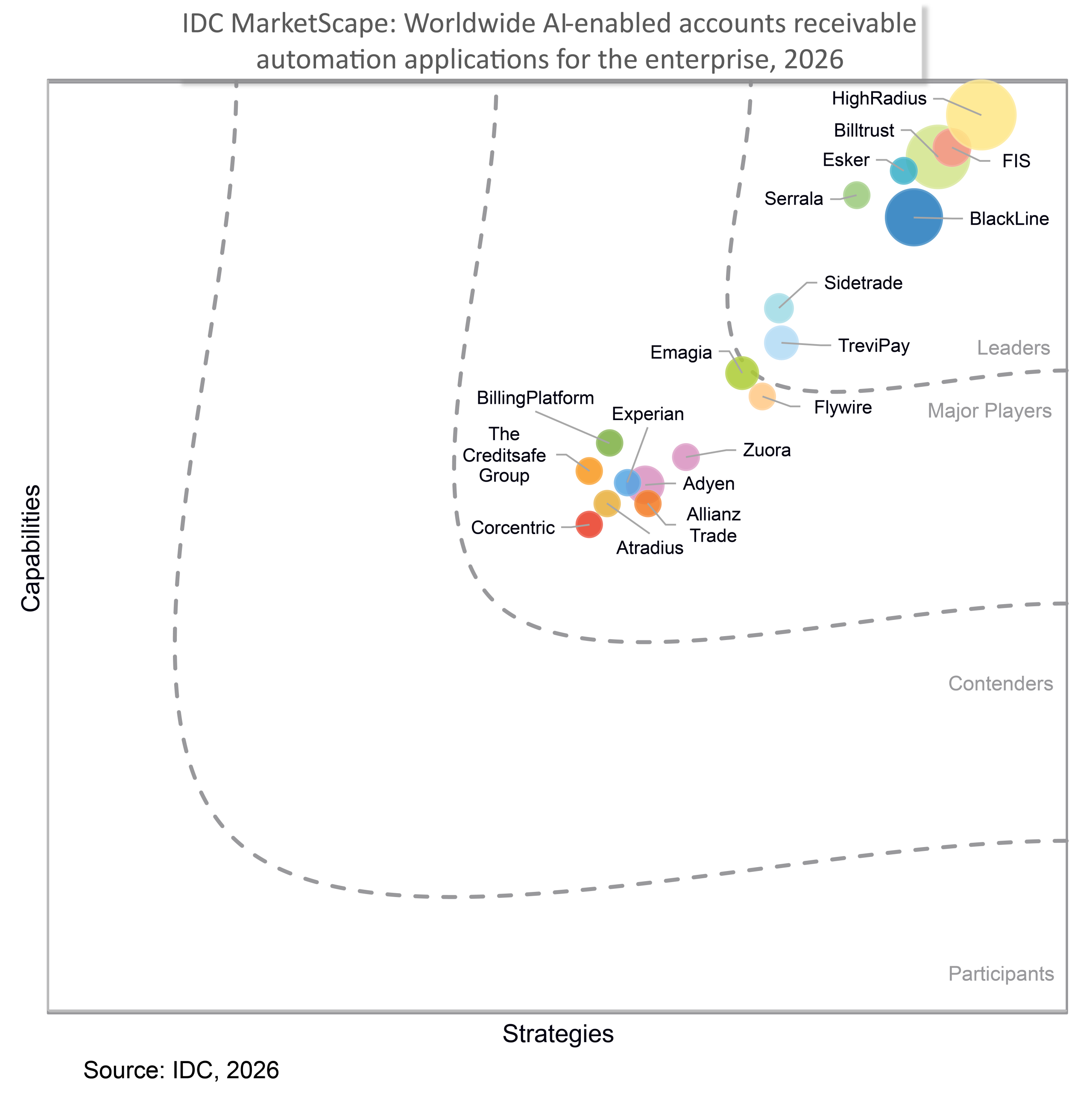
HighRadius recognized as a "Leader" in IDC Marketscape: Worldwide AI-enabled accounts receivable automation applications for the enterprise 2026 vendor assessment
Recognized as a Leader in 2026 Vendor Assessment for unifying credit, collections, cash application, deductions, e-invoicing, and payments on one AI platform to advance enterprise-wide invoice-to-cash transformation.
Forrester Recognizes HighRadius in The AR Invoice Automation Landscape Report, Q1 2023
Forrester acknowledges HighRadius’ significant contribution to the industry, particularly for large enterprises in North America and EMEA, reinforcing its position as the sole vendor that comprehensively meets the complex needs of this segment.