Calculate Your DSO in Minutes With a Free Excel Template
Download Now– Accounts receivable days measure how long it takes to collect customer payments and indicate the efficiency of your collections process.
– The accounts receivable days formula helps businesses calculate receivable days, monitor cash flow, and identify collection issues early.
– Lower AR days improve working capital, accelerate cash conversion, and strengthen overall financial performance.
Accounts Receivable Days (A/R days) refer to the average time a customer takes to pay back a business for products or services purchased. This metric helps companies estimate their cash flow and plan for short-term future expenses. By measuring the A/R days, a company can identify whether its credit and collection processes are efficient or not.
For example, if a considerable number of customers default on their payments but eventually pay, then it’s time to make the collections process more proactive. On the other hand, if the business’s bad debt is piling up, the credit management process needs improvement.
To effectively manage A/R days, every A/R leader should have a comprehensive dashboard that offers visibility into all accounts receivable processes. This allows them to keep track of key metrics and improve existing processes, ultimately reducing A/R days.
700+ Top AR Teams Use These Collection Email Templates
Grab the 11 proven templates that help AR teams recover past-due invoices—fast.
What are Accounts Receivable Days?
Accounts Receivable Days (A/R days) is a metric that allows you to determine the average time it takes for your business to collect outstanding payments from customers. It signifies the duration an invoice remains unpaid before it is eventually settled.
This accounts receivable days ratio serves as an important tool in assessing your business’s efficiency in handling short-term collections, providing crucial insights for financial analysis. By keeping track of A/R days, you gain a better understanding of your cash flow and can plan for upcoming expenses more effectively.
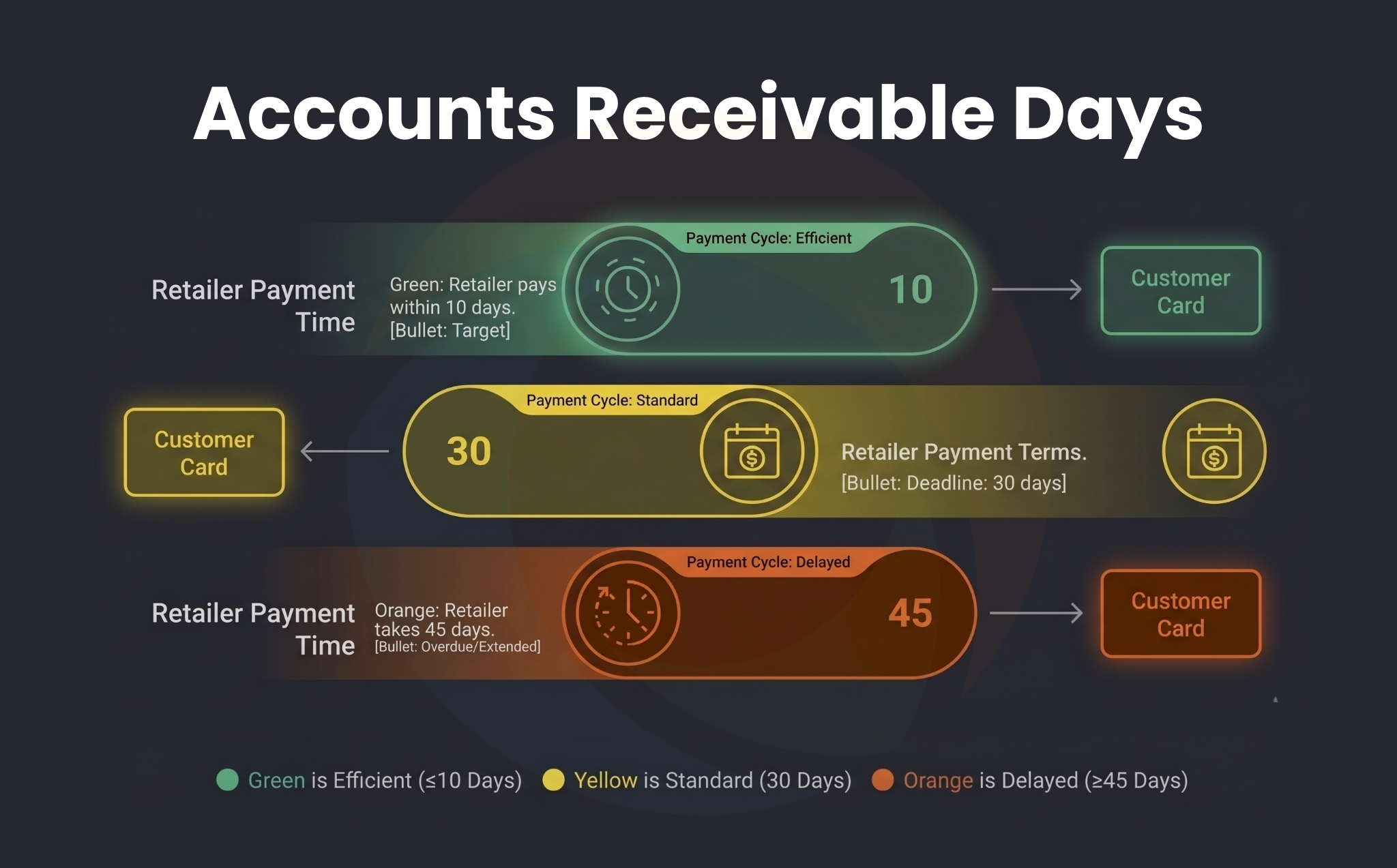
Imagine your business delivers products to a retailer and gives them 30 days to pay. If they consistently pay within 10 days, your AR Days are low, meaning your cash flow is strong and you have more flexibility to reinvest in your operations. But if they take 45 days to pay, your AR Days are high, indicating slower cash collection and potential cash flow issues.
AR Days reflect how efficient your business is at converting credit sales into cash. A lower AR Days figure is like getting paid promptly after every deal, keeping your business running smoothly without waiting long periods to collect from clients.
Why Do Accounts Receivable Days Matter?
Accounts receivable days is one of the most important accounts receivable KPIs because it measures how efficiently a business converts credit sales into cash. Along with other accounts receivable performance metrics, it helps finance teams evaluate collection effectiveness, liquidity, and overall financial health.
- Improved Cash Flow Predictability
Lower AR days lead to faster collections, making cash flow management more predictable. When customer payments arrive on time, finance teams can better manage day-to-day operations, supplier payments, and short-term cash requirements with greater confidence.
- Better Working Capital Management
Reducing accounts receivable days frees up working capital that would otherwise remain tied up in outstanding invoices. This allows organizations to reinvest cash into growth initiatives, inventory, technology, or other strategic priorities instead of waiting for customer payments.
- Reduced Borrowing and Financing Costs
Faster collections improve liquidity, reducing the need for short-term borrowing to bridge cash flow gaps. Strong collections efficiency helps businesses rely less on external financing while lowering interest expenses and improving financial flexibility.
- Enhanced Financial Planning and Forecasting
Consistent accounts receivable days reporting enables finance leaders to identify collection trends, detect payment delays early, and build more accurate cash flow forecasts. Combined with other accounts receivable KPIs, it provides a comprehensive view of receivables performance and supports better financial decision-making.
Regularly tracking and optimizing AR days strengthens the order-to-cash process, accelerates collections, improves working capital, and helps organizations maintain a healthier cash position to support both day-to-day operations and long-term growth available when the business needs it, while minimizing capital tied up in unpaid invoices.
AR Days Calculation – How to calculate Accounts Receivable Days?
To calculate day sales in accounts receivable, multiply the number of days in a year (365 or 360 days) by the ratio of a company’s accounts receivable and total annual revenue.
Calculating accounts receivable days with AR days formula – Example
Accounts Receivable Days = (Accounts Receivable/Total Revenue)*365
Company A has made a revenue of $5 million at the end of a year and has pending accounts receivable of $500,000.
Total Revenue = $5,000,000
Accounts Receivable = $500,000
Accounts Receivable Days = (Accounts Receivable/Total Revenue)*365
= (500,000/5,000,000)*365
= 0.1 * 365 = 36.5 days
So, the AR days for company A is 36.5 days. To interpret this metric, we will need details on the company’s industry and past data.
What is Days Sales in Receivables?
Days Sales in Receivables (also called Average Collection Period) measures how many days, on average, it takes a company to collect payment after a sale. It’s closely related to DSO and AR Days but focuses purely on the collection period.
Formula:
Days Sales in Receivables = (Accounts Receivable / Average Daily Sales)
- Accounts Receivable: The total receivables at a specific point in time.
- Average Daily Sales: Total sales for the period divided by the number of days in that period.
This metric helps assess how efficiently a company manages its receivables and cash flow. A lower value means faster collections.
What Is a Good Accounts Receivable Days Number?
Accounts receivable days is a dynamic metric. There are several factors involved in calculating A/R days. A good or bad AR days number will depend on the industry, the company’s payment terms, and its past trends.
For example, nearly 50% of construction and oil companies get late payments, which leads to significantly higher A/R days when compared to retail or service companies. Thus, you cannot compare the A/R days of businesses operating in different industry segments.
A business’s payment terms also affect how long customers take to pay. If a company offers a 30-day credit period as per its credit policy, then an A/R day number of 37-38 days (25% above the limit) signifies some room for improvement. On the other hand, if the A/R days are much lower than the credit period, the credit terms might be too strict. Businesses can lose out on potential customers in such scenarios.
How to Analyze Your Accounts Receivable Days Metric?
Analyzing a company’s A/R days gives a detailed insight into its credit and collection process efficiency. If the metric is tracked and mapped to a chart, you can learn about the company’s ability to collect receivables and if it is affected by any particular pattern.
If there is a steady increase in the average time to receive payments, it might be necessary for a business to tighten its credit policy. However, if there is a continuous decline, lenient payment terms can be introduced to attract more customers. So, to make the most of the A/R days metric, it’s essential to pair it with other data.
In fact, understanding working capital metrics becomes even more intriguing when comparing companies within an industry. For instance, while comparing the key working capital metrics of automotive giants General Motors (GM) and Tesla, it was found that Tesla outperformed GM in DSO, highlighting its efficiency in collecting receivables. However, GM showcased a better cash conversion cycle driven by a higher DPO and lower DIO.
| AR Days Trend | What It Signals | Suggested Action |
|---|---|---|
| Decreasing AR days | Customers are paying faster, indicating strong collections efficiency and healthy cash flow. | Continue monitoring payment trends, maintain effective collection practices, and evaluate whether credit policies can support additional growth. |
| Stable AR days | Collection performance is consistent and aligned with established payment terms and historical benchmarks. | Compare performance against industry averages and review customer payment behavior regularly to identify improvement opportunities. |
| Increasing AR days | Payments are taking longer to collect, which may indicate weak credit controls, delayed invoicing, collection bottlenecks, or deteriorating customer payment behavior. | Review credit policies, automate invoice reminders and follow-ups, prioritize overdue accounts, and strengthen collections to reduce outstanding receivables. |
For a detailed exploration of how these metrics shape the financial landscape of two industry leaders, check out the story of GM vs Tesla AR War.
How Can a Business Reduce Its Accounts Receivable Days?
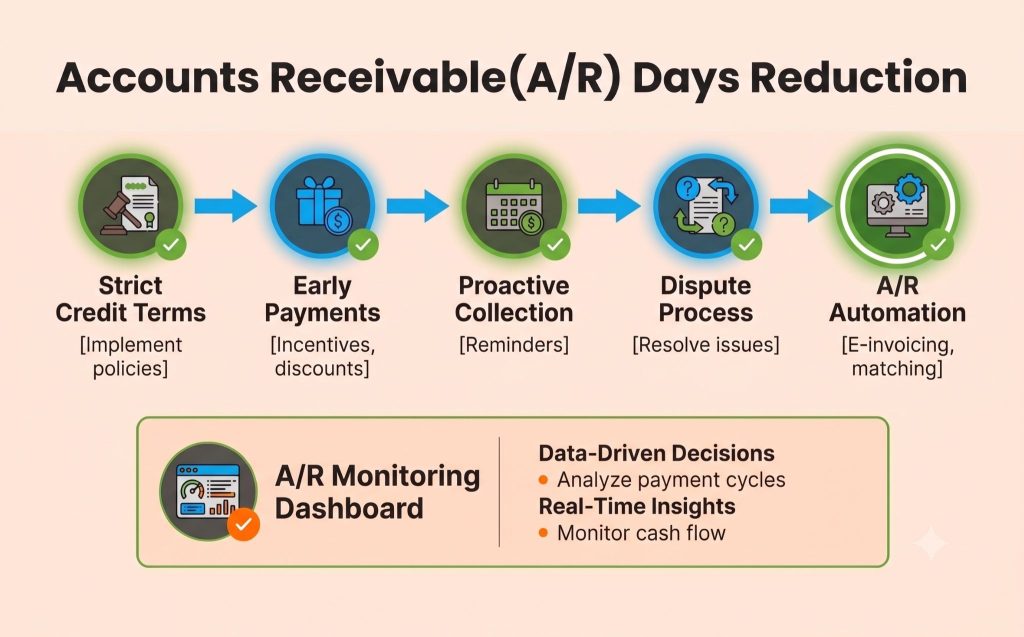
Maintaining a good A/R days number is vital for the growth of any business. This number should not be too high or too low, as striking the perfect balance is crucial to maintaining a healthy cash flow. Let’s explore five effective ways to reduce accounts receivable days and boost cash flow.
1. Implement stricter payment terms
A stringent credit policy is a great way to reduce A/R days. You can impose late payment charges to payment terms to make the process effective and prevent customers from defaulting on their due date.
To get started, businesses should have a credit policy document in place. It can be considered a guide for the credit management and sales teams on issues relating to credit lines, risk exposure, payment waive-offs, etc.
Business leaders looking to create or update the credit policy document can use a customizable template that outlines the broad sections that go into an effective credit policy document.
AI-powered Credit risk management software helps automate credit scoring, approval workflows, real-time credit risk monitoring, and blocked order management. It helps you seamlessly implement your credit policy while reducing bad debt probability.
2. Incentivize early payments
Offer a small discount to customers that pay with cash or within their credit period to bring down A/R days. It may not work for every customer, but you can motivate businesses with healthy cash flow that still delay payments till the last day without any reason to pay earlier.
By leveraging the EIPP Software to automate the billing and payment processes, businesses can provide support for discount strategies and resolve disputes on a real-time basis.
3. Collect proactively
Businesses must identify accounts that are at risk and reach out to them before the due date. It will help cut down bad debt and reduce A/R days simultaneously. If a business wants to be proactive in collections, it should have an effective collections management strategy to identify accounts that show any signs of delaying payments.
AI-based Collections Software helps businesses achieve 75% faster recovery through worklist prioritization enabled by advanced technologies. It also enables companies to improve collections efficiency with real-time visibility into health metrics like bad debt, DSO, and CEI.
4. Make it easy to pay
Sometimes, a lack of convenient payment methods is all that stops a customer from paying on time. By adding multiple payment options like credit cards, debit cards, electronic fund transfers, and checks, businesses through electronic invoicing can reduce the friction of payments. It can therefore reduce accounts receivable days of a business.
5. Automate the accounts receivable process
Automate credit and collections processes to make them more efficient and help reduce the AR days. A report from PYMNTS suggests that 88% of businesses that have automated their accounts receivable processes have seen a significant reduction in days sales outstanding (DSO or AR days). In fact, the benefits of accounts receivable automation go beyond faster collections — it also improves cash flow visibility, reduces manual errors and enhances customer experience
How HighRadius Can Streamline Your Accounts Receivable
Automating the A/R processes is a simple and effective way for businesses to improve the critical metric of Accounts Receivable Days. Doing it manually can be difficult and time-consuming, which is why leveraging accounts receivable software can make a significant difference by streamlining workflows and accelerating collections.
HighRadius AI-based credit scoring software and AI-based Collections Software allow businesses to track credit risk in real-time and enable up to 75% faster collections recovery.
With features like AI-driven worklist prioritization, automated dunning abilities, integrated call management option for collection calls, and tracking of customer payment commitments, the software enhances receivables recovery and ensures DSO reduction.
Moreover, the best credit risk management software facilitates faster customer onboarding, auto-calculation of credit score and risk class, and much more, streamlining business processes and ensuring a smoother financial journey.
By embracing automation and advanced technology, businesses can strengthen their growth plans, conduct more accurate financial assessments, and manage debts more efficiently.
Frequently Asked Questions (FAQs)
1. Why is my Days Sales in Accounts Receivable increasing?
1. Why is my Days Sales in Accounts Receivable increasing?
An increase in Days Sales in Accounts Receivable (AR days) usually indicates customers are taking longer to pay invoices. Common causes include weak credit policies, delayed invoicing, collection inefficiencies, billing disputes, or changing customer payment behavior. Monitoring AR days helps identify these issues early and improve cash flow.
2. How often should you track Days Sales in Accounts Receivable?
2. How often should you track Days Sales in Accounts Receivable?
Most organizations should track Days Sales in Accounts Receivable monthly as part of their financial reporting. Businesses with high transaction volumes or tight cash flow may monitor AR days weekly or even daily to identify overdue accounts, improve collections, and maintain healthy working capital.
3. What other metrics are similar to Accounts Receivable Days?
3. What other metrics are similar to Accounts Receivable Days?
Metrics related to Accounts Receivable Days include Days Sales Outstanding (DSO), Accounts Receivable Turnover Ratio, Collection Effectiveness Index (CEI), Average Days Delinquent (ADD), and Bad Debt Ratio. Together, these metrics measure collection efficiency, receivables performance, and overall cash flow health.
4. What are Days Sales in Receivables?
4. What are Days Sales in Receivables?
Days Sales in Receivables, also known as Accounts Receivable Days or Days Sales Outstanding (DSO), measures the average number of days it takes a business to collect payment after making a credit sale. It helps assess collections efficiency, cash flow, and the effectiveness of credit and receivables management.
5. How do you calculate Accounts Receivable Days on Hand?
5. How do you calculate Accounts Receivable Days on Hand?
Accounts Receivable Days on Hand is calculated using the formula: (Average Accounts Receivable ÷ Net Credit Sales) × Number of Days. The result shows the average time it takes to collect outstanding invoices during a specific period and helps evaluate collection performance.
6. What do high receivable days mean?
6. What do high receivable days mean?
High receivable days indicate that customers are taking longer to pay invoices. This can signal collection inefficiencies, lenient credit policies, billing disputes, or customer payment delays. Persistently high AR days can slow cash flow, tie up working capital, and increase financing needs.
7. What causes an increase in Accounts Receivable Days?
7. What causes an increase in Accounts Receivable Days?
Accounts Receivable Days can increase due to delayed customer payments, inefficient collections, weak credit policies, invoicing errors, billing disputes, or an increase in overdue accounts. Regular monitoring helps identify these issues early and supports faster collections and improved cash flow.
8. Can receivable days be negative? No. Receivable days cannot be negative because t
8. Can receivable days be negative? No. Receivable days cannot be negative because t
No. Receivable days cannot be negative because they represent the average number of days required to collect outstanding invoices after a credit sale. A very low value indicates fast collections, while a higher value suggests slower customer payments.
9. Is debtor days the same as receivable days?
9. Is debtor days the same as receivable days?
Yes. Debtor days and receivable days refer to the same financial metric. Both measure the average number of days it takes a business to collect payments from customers after a credit sale and are commonly used to evaluate collections efficiency and cash flow.
10. How is AR automation different from Accounts Payable (AP) automation?
10. How is AR automation different from Accounts Payable (AP) automation?
AR automation streamlines customer invoicing, cash application, collections, and dispute resolution to accelerate incoming payments. AP automation focuses on processing supplier invoices, approvals, and payments to improve outgoing payment efficiency. Together, they optimize different sides of the cash conversion cycle.