Peppol in France: Understanding Its Role in Electronic Invoicing Reform
Last Updated: 22 September, 2026
•
Sharmistha Sahoo
2026 Automation Benchmark Report
HighRadius 2026 Automation Benchmark Report For The Office Of The CFO
Understand if your performance is on par with top 10% of the organizations. Identify gaps, best practices and know how you can drive value through Agentic AI-Driven Automation.
How can finance leaders ensure their invoicing infrastructure remains compliant and scalable when different ERP systems, invoice formats, and regulatory frameworks must work together?
With France's mandatory e-invoicing rollout beginning on 1 September 2026 for large enterprise and mid-sized companies, the challenge for European businesses will not simply be issuing compliant invoices, it will be ensuring that invoice data moves reliably across different ERP systems, platforms, and regulatory frameworks. For finance leaders managing multi-country operations, fragmented invoicing processes can create additional integration, visibility, and compliance challenges.
Peppol and the EN 16931 standard play an important role in addressing interoperability across electronic invoicing ecosystems. This article explores how Peppol in France is establishing itself as a building block of interoperability at the intersection of tax compliance issues and European integration, while providing an overview of its role, impact, and application inB2B electronic invoicing.
Table of Contents
What is the Peppol network?
Peppol interoperability in France and Europe: automating document flows
Practical Scenario: The Invoice That Never Reached the Customer
Peppol in France: its role in electronic invoicing
Peppol and approved platforms: interoperability regulated by the French State
What invoice formats are accepted via Peppol in France?
Why rely on a Peppol-certified provider like HighRadius?
FAQ
What is the Peppol network?
Peppol is the acronym for Pan-European Public Procurement Online. Originally, it was a project launched by the European Commission in 2008 to standardize electronic exchanges in public procurement. The project was completed in 2012, after which the Peppol interoperability framework and related services were continued under OpenPeppol.
Since then, Peppol has extended beyond B2G exchanges to support B2B and cross-border electronic document exchanges in multiple countries. It is now one of the interoperability frameworks used for electronic invoicing in Europe and beyond. However, the extent of its adoption and regulatory role varies by country.
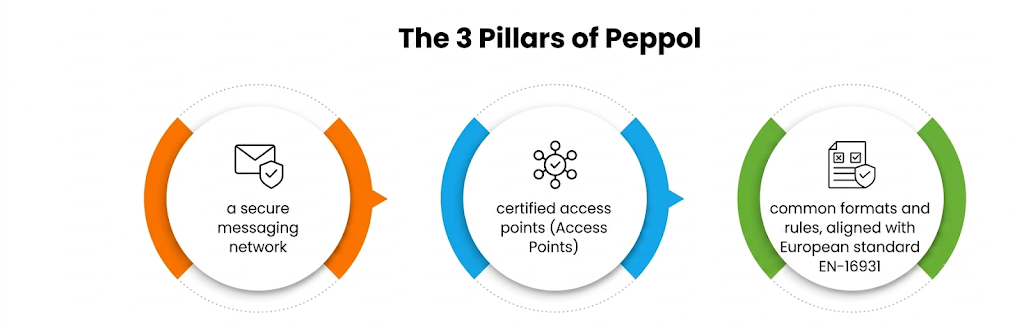
Operationally, Peppol is based on several key elements:
a secure messaging network;
certified access points;
a service metadata mechanism for identifying participants and their capabilities;
common business processes, specifications and rules, including formats aligned with the European standard EN 16931.
The objective is to allow two organizations, regardless of their country or information system, to exchange electronic invoices through interoperable service providers, without requiring a separate bilateral integration for every trading partner.
Peppol interoperability in France and Europe: automating document flows
One of the main obstacles to the transition to electronic invoicing is the fragmentation between different private stakeholders, involving:
multiplicity of formats;
heterogeneous national platforms;
local tax requirements.
Peppol addresses this problem through a principle of interoperability.
A company connected to Peppol via a certified access point can exchange documents with other participants in the network, provided that the relevant service providers support the required document types, processes and technical specifications. Format conversion and country-specific compliance requirements may still be handled by the participating platforms.
For businesses, this aspect can support:
the automation of end-to-end billing flows;
a reduction in the need for separate integrations with individual trading partners;
preparation for European obligations related to ViDA and continuous transaction control (CTC) models, where applicable.
Peppol can therefore contribute to the industrialization of electronic invoicing by providing a standardized framework for exchanging business documents across organizations and jurisdictions.
Practical Scenario: The Invoice That Never Reached the Customer
It is month-end. A finance team at a European manufacturing group is ready to close its books when several invoices sent to French customers are rejected. The invoices were generated through different ERP systems, but the receiving platforms require specific formats and data.
The AR team now has to trace each rejection, identify missing information, and coordinate corrections while payment timelines continue to move. With more European e-invoicing requirements approaching, the finance leader faces a bigger question: Can the existing invoicing infrastructure handle different formats and platforms without turning every exception into a manual task?
Peppol's standardized exchange framework and the EN 16931-based invoice formats can help address interoperability challenges, but the ability to prevent and resolve invoice exceptions depends on the connected platforms, ERP integrations, and provider capabilities.
This is where an e-invoicing platform like HighRadius can play a role helping businesses connect their invoicing workflows, manage regulatory requirements, and maintain visibility across invoice exchanges.
Peppol in France: its role in electronic invoicing
The evolution of the Y model with the PPF
France initially considered a model based around a central public platform, the Portail Public de Facturation (PPF). In October 2024, the French authorities decided not to proceed with the construction of the public invoicing portal as the primary platform for companies. However, the PPF continues to have public infrastructure and service roles, including directory, data-concentration and administrative functions. The reform therefore relies on private approved platforms (PA, formerly PDP), while retaining public infrastructure managed by the French administration.
Since this decision, the French reform of electronic invoicing has adopted a framework in which companies subject to the reform must use an approved platform (PA) to issue and receive electronic invoices and transmit the required invoice, transaction and payment data to the tax authorities.
In this framework, Peppol plays the role of an interoperability network, recognized by the French State and aligned with European standards.
France integrates Peppol as an exchange infrastructure that can connect approved platforms and other authorized participants, rather than making it the sole national channel for electronic invoicing. This enables:
standardized interconnection between private actors;
alignment with European requirements promoted by Peppol;
preparation for cross-border exchanges without creating an isolated system.
The French administration requires approved platforms to support interoperability with other platforms and the relevant public infrastructure.
Peppol and approved platforms: interoperability regulated by the French State
In the French regulatory framework, companies generally access Peppol through service providers or approved platforms rather than establishing their own direct connection to the network. The relevant platform or service provider acts as a certified Peppol access point, in accordance with the rules defined by the France Peppol Authority.
Since 8 July 2025, the DGFiP (French Public Finances Directorate) has officially acted as the France Peppol Authority. In this capacity, it has defined Peppol Authority Specific Requirements (PASRs), which govern Peppol-certified service providers operating in France, including requirements relating to:
permitted formats;
exchange profiles;
security rules;
traceability and governance requirements applicable to Peppol service providers operating in France.
The DGFiP also specifies that, in France, a provider must be registered as an approved platform to issue and receive electronic invoices within the scope of the French reform.
Automating Electronic Invoicing
Check EBook on Automate Invoice Creation & Delivery ensuring compliance with government e-invoicing mandates.
What invoice formats are accepted via Peppol in France?
Peppol does not impose a single invoice syntax. It relies on common business processes and specifications, including the EN 16931 semantic standard, while allowing technical syntaxes that comply with the relevant national and Peppol profiles.
Within the French framework, and according to the deployment information published by OpenPeppol, the formats and message types supported through Peppol include, in particular:
Factur-X (PDF/A-3 with XML);
UBL EN 16931 – France CIUS;
UBL EN 16931 – France EXTENDED-CTC-FR;
UN/CEFACT CII EN 16931 – France CIUS;
UN/CEFACT CII EN 16931 – France EXTENDED-CTC-FR;
CDAR – eInvoice message status;
Peppol BIS Billing 3.0, already used in B2G exchanges;
Peppol Invoice Message Response.
The precise formats and message types available depend on the applicable French Peppol specifications and deployment phase.
This approach makes it possible to organize the coexistence of several formats around a common base, without imposing a complete overhaul of existing systems.
For companies, this translates concretely into the possibility of unifying invoice production, even in multi-ERP or multi-country environments, subject to the applicable national requirements and the capabilities of their service providers.
Why rely on a Peppol-certified provider like HighRadius?
HighRadius has Peppol certification, which allows it to:
manage formats and their regulatory compliance;
orchestrate the flows between ERP and approved platform;
ensure real-time monitoring of invoice statuses;
absorb regulatory changes without permanent reconfiguration.
For businesses, the challenge is not just to be compliant by 2026, but to have a sustainable foundation capable of keeping pace with the increasing complexity of European models. This issue deserves to be addressed now, not as an IT project, but as a lever for reliability and financial scalability.
Learn more about HighRadius' EIPP Solution
Reduce DSO and connect buyers and suppliers globally with seamless invoicing & payments.
Cut support calls by 50% as buyers self-serve invoices and payments online.
Email Invoice Delivery
Get paid faster with automated invoices and real-time delivery tracking.
e-Adoption Campaign Management
Drive portal adoption effortlessly with targeted campaigns and real-time insights.
FAQ
1. What Is Peppol and How Does It Work in France?
Peppol is a network that enables businesses to exchange structured electronic documents through interoperable service providers. In France, it supports electronic invoicing alongside the country’s approved-platform framework.
2. Is Peppol Mandatory for E-Invoicing in France?
Peppol itself is not a universal standalone mandate. Businesses must use a French-approved platform to meet applicable e-invoicing and e-reporting obligations.
3. What Is the Role of EN 16931 in Peppol E-Invoicing?
EN 16931 defines the European semantic data model for electronic invoices. It helps standardize invoice information so different systems can interpret and process it consistently.
4. Which Invoice Formats Does Peppol Support in France?
The French Peppol framework supports formats including Factur-X, UBL, and UN/CEFACT CII, alongside Peppol BIS Billing and invoice response messages. Applicable national profiles and technical requirements must also be considered.
5. Can Businesses Connect Directly to the Peppol Network in France?
Businesses generally connect through a Peppol-certified service provider or an approved platform that supports Peppol interoperability. The appropriate setup depends on the company’s systems, transaction flows, and compliance requirements.
6. Does Peppol Replace Approved E-Invoicing Platforms in France?
No. Peppol supports document exchange and interoperability, while French-approved platforms perform the functions required under the national e-invoicing framework, including invoice transmission and data reporting.
7. How Does Peppol Support ERP Integration?
Peppol helps connect different ERP systems and invoicing platforms through standardized document formats and exchange protocols. This can reduce the need for separate integrations across every trading partner.
8. What Should Businesses Consider When Selecting a Peppol E-Invoicing Provider?
Finance leaders should assess:
Compatibility with existing ERP systems
Support for required French and European invoice formats
Approved-platform status and Peppol capabilities
Invoice status visibility and exception handling
Ability to manage regulatory and cross-border requirements
9. Is Peppol Suitable for Businesses Using Multiple ERP Systems?
Yes. Peppol’s interoperability model can support businesses exchanging invoices across multiple ERP systems, platforms, and trading partners. However, the provider must support the formats, integrations, and regulatory requirements relevant to the business.
Resource Library
Resource Hub
Order to Cash
Order to Cash software data sheet
Disconnected workflows can leave teams chasing data, while automated O2C has delivered 20% lower past dues.
HighRadius Named an IDC MarketScape Leader for the Second Time in a Row For AR Automation Software for Large and Midsized Businesses
HighRadius stands out as an IDC MarketScape Leader for AR Automation Software, serving both large and midsized businesses. The IDC report highlights HighRadius’ integration of machine learning across its AR products, enhancing payment matching, credit management, and cash forecasting capabilities.
Forrester Recognizes HighRadius in The AR Invoice Automation Landscape Report, Q1 2023
Forrester acknowledges HighRadius’ significant contribution to the industry, particularly for large enterprises in North America and EMEA, reinforcing its position as the sole vendor that comprehensively meets the complex needs of this segment.