20 Best Accounts Receivable Solutions In 2026 ( + How To Choose Your AR Automation System)
Last Updated: 20 October, 2026
•
Soumyadeep Paul Financial SaaS Content Expert
S
Soumyadeep Paul
Soumyadeep Paul is an Order-to-Cash (O2C) Content Expert at HighRadius, with hands-on experience in product marketing and finance-focused content creation. He enjoys breaking down complex O2C and SaaS concepts into simple, engaging narratives for modern finance teams. His goal is not just to inform, but to 'empower with content,' ensuring every piece of analysis helps finance teams move from theory to actionable strategy.
Outside of work, he’s passionate about exploring trends in finance and marketing, bike riding and gaming.
2026 Automation Benchmark Report
HighRadius 2026 Automation Benchmark Report For The Office Of The CFO
Understand if your performance is on par with top 10% of the organizations. Identify gaps, best practices and know how you can drive value through Agentic AI-Driven Automation.
Best for End-To-End AR Tool in Mid-Market & Enterprise: HighRadius AR Automation Software helps with end-to-end transformation of credit , e-invoicing, cash application, deductions , collections, payments & AR forecasting on a unified Agentic AI tool. A 3-time Gartner-recognized leader and a pioneer in AR transformation, HighRadius can handle enterprise-level complexity while going live as early as 3 weeks so that companies across all sizes realize ROI faster. With industry-first Outcome Based Pricing model, HighRadius partners with firms to help identify and transform processes in AR that could unlock measurable business outcomes.
Best for SMB: BILL, Zoho Books, or FreshBooks – Streamlined invoicing and automate reminders to get paid faster without adding headcount.
Best For Billing Workflow Transformation: Billtrust or Corcentric – Workflow transformation focused on invoicing and payment acceptance.
Best for AR Collaboration: Versapay or Quadient A/R (YayPay) – Portals to enhance buyer-seller collaboration thereby helping companies get paid faster.
Best Collections Add-Ons: Upflow or Gaviti – Collections-focused tools to enhance follow-ups and provide aging visibility.
Best Credit Program: TreviPay – Extend net terms across channels with an optional funded model for predictable settlement.
Best Checkout Financing Options: Balance, Slope, or Hokodo – Ensures net terms get embedded at the digital point of sale.
By 2026, the mandate for finance leaders has shifted from "managing accounts receivable" to "unlocking working capital." With DSO climbing 9.5% this year and interest rates going up, it’s no surprise that 60% of US CFOs have moved the Accounts receivable tool to the very top of their priority list. The results of this shift are becoming clear. According to the HighRadius 2026 Benchmark Report, which analyzed data from over 1,500 customers, companies using agentic AI-driven technology are seeing a decrease in DSO by up to 68% and a 40% boost in productivity.
This guide is designed to help you navigate these changes with the right Accounts Receivable automation platforms. We’ve analyzed the top 20 accounts receivable tools for 2026, evaluating them based on criteria such as company size, specific pain points they solve, integration capabilities with the tech stack, scalability & pricing. Whether you are looking for AI-powered technology for credit, collections, or cash application, or for the entire accounts-outstanding cycle, this list breaks down the right fit for your use cases.
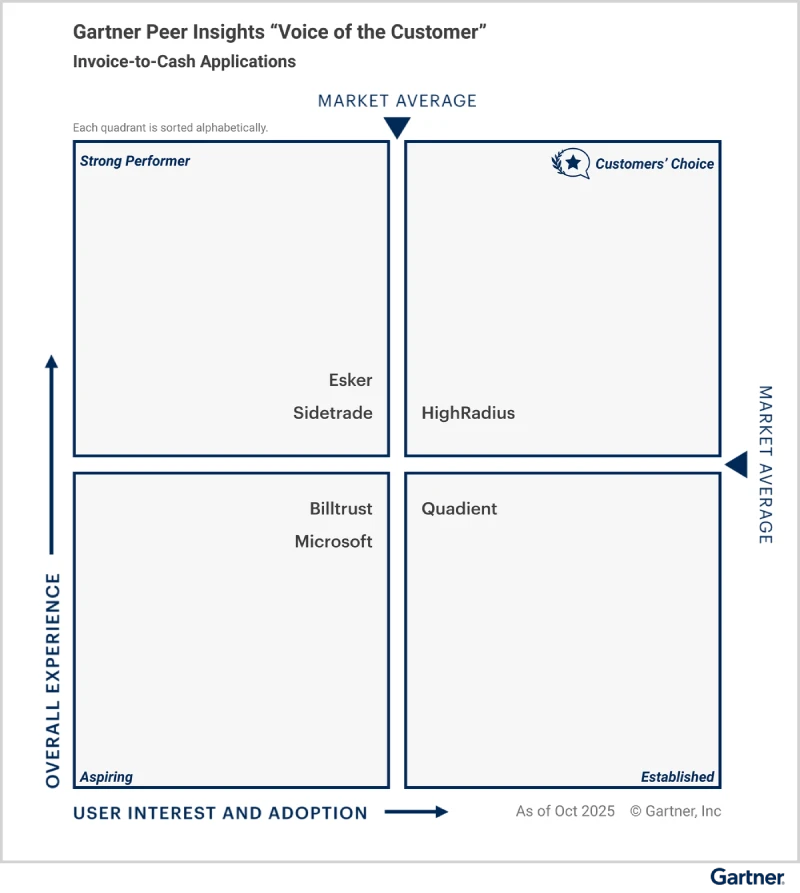
HighRadius has spent decades establishing itself as an industry standard, maintaining a "Leader" position in the Gartner® Magic Quadrant™ for three consecutive years. A strong fit for everything from growing mid-market organizations to large, complex enterprises, HighRadius brings the entire accounts receivable cycle - from credit to cash application - onto a single, unified AR automation tool. With pre-built integrations for over 50 different ERPs and 100+ banks and industry-first Auto Consulting Agents, teams can go live in as little as three weeks, providing institutional stability and scalability without the typical enterprise implementation headaches. Book your personalized demo here.
Table of Contents
What Are Accounts Receivable Solutions?
How To Evaluate Accounts Receivable Solutions?
What Is The Best Accounts Receivable System By Company Size?
How To Choose The Right Accounts Receivable Platform by Strategic Use Case
What Are The Top Features to Look for in an Accounts Receivable System
20 Best Accounts Receivable AR Automation Systems in 2026
Key Benefits of Accounts Receivable Solution
What Are Accounts Receivable Solutions?
Accounts receivable solutions are software platforms that help businesses manage and automate the process of collecting payments from customers. They support key accounts receivable (AR) activities, including credit management, invoicing, collections, dispute resolution, cash application, and payment reconciliation. The goal is to reduce overdue receivables, improve cash flow, and shorten Days Sales Outstanding (DSO).
Unlike traditional accounting software that primarily records transactions and tracks outstanding balances, modern accounts receivable tools help finance teams take action on unpaid invoices. They can identify at-risk accounts, prioritize collection activities, automate payment reminders, and match incoming payments to open invoices.
How To Evaluate Accounts Receivable Solutions?
Choosing the right accounts receivable solution in 2026 goes beyond automating invoices and collection follow-ups. The right AR platform should help finance teams streamline AR workflows, improve credit decisions, reduce manual effort, and deliver measurable improvements in cash flow and collections performance.
For mid-market and enterprise teams, evaluating accounts receivable software means looking at how well the solution supports core AR functions, integrates with existing ERP systems, and simplifies daily work for AR teams. Ease of use, scalability, and implementation time are equally important when comparing the best accounts receivable software tools.
Here are the key criteria to consider when evaluating accounts receivable solutions:
Agentic AI vs. Basic Workflow Automation
Unified Ecosystem vs. Point Solutions
Strong Integrations (ERPs, Payment Processors, AP Portals, Banks, etc.)
Speed-to-Value
Scalability of Your AR Automation
Total Cost of Ownership (TCO)
Pricing Models
Compliance & Security Standards
Ease of Use and User Adoption
1. Agentic AI vs. Basic Workflow
Standard rule-based processes follow "if-then" rules - for example, if an invoice is 30 days late, then send email A. In 2026, that is the bare minimum.
The Agentic Edge: You should look for Agentic AI in accounts receivable that can autonomously handle routine buyer inquiries ("Where do I send the check?"), Identify dispute reasons and route them for resolution without human help.
The Result: This shift is what drives the 40% productivity boost seen in top-performing finance teams, allowing your current staff to manage higher volumes without the burnout.
2. Unified Ecosystem vs. Point Tools
Buying "point solutions" - one for credit management, another for collections, and a third for cash application - is a recipe for disconnected data.
The Connected Loop: In a unified ecosystem, data flows across AR functions. Changes in customer payment behavior should inform credit decisions, helping teams reassess credit limits and manage risk proactively.
Why it matters: Fragmented tools require manual data syncing, which can delay credit decisions, introduce errors, and affect liquidity planning. They can also increase your overall TCO (Total Cost of Ownership).
3. Strong Integrations (ERPs, Banks, Payment Processors, and AP Portals)
Your accounts receivable solution is only as good as its connection to your financial core.
ERPs: Look for 50+ native integrations (SAP, Oracle, NetSuite, Sage, etc.). If a vendor tells you they need to build a custom connector, expect high costs and long delays.
The Network: Beyond ERPs, ensure the system connects directly with global banks for real-time reconciliation and AP Portals (like Ariba or Coupa) to transform invoice delivery where your customers actually work.
4. Speed-To-Value
This connects to the previous point - if the vendor does not have pre-built integrations, then the implementation for an accounts receivable system will take months or even years. In the current economy, you can't afford to wait for months for a return on your investment.
Weeks Not Months: Modern "high-speed" implementation frameworks should get you live in as early as 3 weeks. This ensures you start reducing DSO and unlocking working capital in the same quarter you sign the contract.
5. Scalability
Your Accounts Receivable Platform needs to meet you where you are today and where you’ll be in five years. It should not break when the volume of invoices increases.
Growing with You: Whether you are expanding into new regions or growing through acquisitions, the accounts receivables solutions must handle multi-entity, multi-currency, and multi-language complexity without requiring a "re-implementation."
Analyst Backing: Check for consistent recognition - like being a Gartner Magic Quadrant Leader - which signals the R&D stability needed for long-term scale.
6. Total Cost of Ownership (TCO)
The subscription fee is just the tip of the iceberg. True TCO includes:
Implementation & Integration: Hidden costs often lie in custom coding and IT resources.
Maintenance: If you need a consultant every time you want to change a dunning sequence, your TCO is too high.
Labor Savings: High-performing tools reduce TCO by eliminating the need to hire additional staff as your transaction volume grows.
7. Pricing Models
Pricing in 2026 has moved away from simple "per seat" licenses toward models that reflect the actual business impact.
Outcome-Based Pricing: This model ties the cost of the software to specific results, such as a percentage of DSO reduction or improvements in straight-through processing (STP). It ensures the vendor has "skin in the game" regarding your success.
The Value Anchor: To truly understand the price, you have to anchor it against the cost of doing nothing. If manual processes are costing you $1.5M in labor and $2M in trapped working capital annually, the accounts receivable platform isn't an "expense" - it’s a recovery mechanism. Anchoring the price against your current "cost of manual work" makes the ROI calculation clear.
8. Compliance & Security Standards
When you’re managing millions in receivables, security is non-negotiable.
The Standards: Ensure the provider holds SOC 2 Type II, ISO 27001, and PCI DSS certifications.
Global Mandates: With e-invoicing becoming a legal requirement in many countries, your accounts receivable system must be able to handle regional tax compliance and reporting without manual intervention.
9. Ease of Use & User Adoption
An AR platform should reduce manual work, not add more steps to daily workflows.
The Usability Test: Check whether collectors can access prioritized worklists, track disputes, and manage follow-ups without switching between systems. Cash application teams should be able to review and resolve payment exceptions easily.
The Productivity Check: Look for measurable efficiency gains. HighRadius reports a 40% productivity improvement and 90%+ cash application automation. Ask vendors to demonstrate similar results for your AR team's workflows.
Summary: The Right Approach to Choosing the Best Accounts Receivable Solution
When you sit down for a demo, don't just look at the dashboard. Evaluate your AR automation tool based on your specific "pain area":
If your DSO is drifting: Look past simple reminders. Prioritize AI technology Depth - specifically, predictive risk scoring that tells you who won't pay before they actually miss a deadline.
If your TCO is a runaway train: Look for a unified end-to-end accounts receivable tool that replaces three different vendors and eliminates the need for expensive, custom-coded bridges between your credit and collections tools.
If your team is drowning in data entry: Don't settle for "okay" matching. Prioritize Cash Application accuracy (aim for 90%+ straight-through processing) and a vendor that can actually prove a 3-week go-live timeline to help them focus on high-value tasks.
What Is The Best Accounts Receivable System By Company Size?
Selecting the right accounts receivable system is rarely about finding the "best" AR automation tool in a vacuum - it’s about finding the best fit for your specific scale and the operational hurdles you’re currently facing. Here's how the needs differ:
SMBs: At this stage, the goal is simple: get the money in the door without spending all day on it. You need a tool that handles basic invoicing and payment links so you don't have to hire a dedicated accounts receivable person.
Mid-Market: This is where things get complicated. You’re likely growing faster than your headcount, and your "small business" tools are starting to break. You need an accounts receivable system that can handle higher volumes and sync perfectly with a more robust ERP (like NetSuite or Sage) without a six-month IT project and can scale as you grow.
Enterprise: For global organizations, it’s all about managing complexity. You’re dealing with multiple entities, varied currencies, and massive amounts of "messy" data. You need a unified accounts receivable system that acts as a single source of truth across all your business units and global regions.
Use this table to identify where your organization sits and which tools are built for your specific stage of growth.
Company Size
Common Challenges
Primary Picks
Enterprise (Global, Multi-entity)
High DSO, global tax compliance, complex deductions, and "messy" data across multiple ERPs.
HighRadius
Mid-Market ($100M – $1B)
Fragmented workflows, scaling without adding headcount, and high dispute volumes.
HighRadius
SMB & Startup (<$100M)
Manual invoicing, limited aging visibility, and a need for fast, "out-of-the-box" setup.
BILL, Zoho Books, FreshBooks
To help you finalize your 2026 strategy, we’ve broken down the market into two distinct categories. Use the Full-Suite table if you want to overhaul your internal operations, and the Specialized table if you have a specific, high-stakes bottleneck like credit risk or B2B e-commerce friction.
Full-Suite Accounts Receivable AR Automation Solutions
These accounts receivable solutions provide an end-to-end accounts receivable ecosystem. They are designed to be your primary financial operating tool for everything from the first credit check to the final bank reconciliation.
Tools
Core Strength
2026 "Agentic" Edge
HighRadius
Unified End-To-End Accounts Receivable Solution: Credit, Cash App, Deductions, and Collections in one place. Seamlessly connects with Close, Recon, AP & Treasury suites.
AI Agents trained on $10.3 Trillion+ transactions across decades which help predict payment behavior & ensure accuracy in AI.
BlackLine
Financial Close Integration: Deep focus on complex global cash application and reconciliation.
High-volume transaction processing that syncs directly with the month-end close.
Billtrust
Billing & Payments Network: Excellent at getting invoices into tough-to-reach customer AP portals.
A vast Business Payments Network (BPN) that standardizes how buyers and sellers transact.
Versapay
Customer Collaboration: A portal-first approach where buyers and sellers resolve disputes in real-time.
Reduces friction by allowing buyers to manage their own accounts and pay via a branded portal.
Quadient AR
Collections Playbooks: Highly visual dunning workflows that act as a "GPS" for collections teams.
Predictive analytics that rank customer risk, helping lean teams prioritize their daily outreach.
Specialized & Niche Accounts Receivable Solutions
These are "specialists" solutions. They aren't meant to run your entire receivable department, but they solve specific problems - like transferring credit risk or collating a massive email inbox - better than anyone else.
Tools
Specialty
Best Use Case
Ideal Business Model
TreviPay
Credit-as-a-Service
Offloading credit risk and managing complex dealer/distributor networks.
Manufacturers & Wholesalers wanting a funded model for predictable settlement.
Balance
B2B Checkout
Providing instant net terms and financing at the digital point of sale.
E-commerce & Marketplaces looking to increase checkout conversion.
Auditoria.ai
AI Finance Clerks
Using NLP to autonomously read and respond to customer accounts receivable emails.
High-Growth Tech with massive volumes of routine email-based inquiries.
Younium
Subscription AR
Managing the mess of recurring billing, usage-based fees, and SaaS revenue.
Tool & XaaS companies with complex subscription lifecycles.
Upflow
Dunning Specialist
A "lightweight" layer for collections follow-ups and aging visibility.
SMEs that like their current billing tool but need better follow-up logic.
A Quick Strategic Check
If you are currently evaluating your 2026 roadmap, the choice usually comes down to ownership:
Go Full-Suite if you want to keep your data and operations in-house while maximizing your team's productivity.
Go Specialized if you want to outsource a specific burden - like credit underwriting or financing - to a partner who carries the risk for you.
How To Choose The Right Accounts Receivable Platform by Strategic Use Case
In 2026, the "best" Accounts Receivable Platform is the one that solves your most expensive bottleneck. Use this table to map your primary business challenge to the tool designed to handle it.
Here are the best accounts receivable systems mapped to specific use cases they solve for.
Use Case / Strategic Goal
Primary Pick
The 2026 Competitive Edge
DSO Reduction & Predictive Collections
HighRadius
HighRadius deploys Agentic AI that predicts payment dates before the invoice is due, allowing you to prioritize the high-risk 20% of your portfolio.
Manual Cash App (High-Volume Matching)
HighRadius
HighRadius targets 90%+ Straight-Through Processing (STP) for cash application, autonomously resolving messy or missing remittance data.
Global Scale & Multi-ERP Complexity
HighRadius
HighRadius offers an Unified accounts receivable Suite that acts as a single source of truth across 50+ ERPs and handles regional e-invoicing compliance.
B2B Billing & Portal Delivery
HighRadius
HighRadius excels at standardizing invoice delivery into buyer portals and reducing interchange fee via L2/L3 processing.
Buyer Collaboration
Versapay
Versapay uses a collaborative portal to resolve disputes in real-time; Lunos uses AI agents to autonomously negotiate and track payment promises via email.
Transferring Credit Risk (CaaS)
TreviPay
TreviPay offers a funded model that pays you upfront; Resolve is the preferred alternative for high-growth firms looking for a "Stripe-like" credit experience.
B2B E-commerce & Checkout
Balance
Balance provides instant net terms at the point of sale; Hokodo is the leader for European-based e-commerce operations.
Ask This To Your Vendor
When you move into the demo phase, ask the vendor to show you "The Exception." Anyone can show you a workflow where everything goes right. In 2026, the value is in how the tool handles a missing remittance, a partial payment, or a disputed line item without requiring a human to step in.
What Are The Top Features to Look for in an Accounts Receivable System
1. End-to-End Functional Coverage
Capability: Unified orchestration of the entire accounts receivable lifecycle, including Invoicing, Collections, Credit, Cash Application, and Dispute Resolution.
Why? Disparate financial tools increase processing bottlenecks by up to 35% compared to a unified, end-to-end tool that centralizes the lifecycle (Source: Gartner).
2. Predictive AI Engines
Capability: AI-driven calculation of exact payment dates, frictionless customer risk tiering, and algorithmic prioritization of collection tasks.
Why? AI-powered predictive scoring and prioritized workflows increase collection team efficiency and outreach accuracy by up to 35% (Source: IDC).
3. Plug-and-Play ERP Integration
Capability: Native, bi-directional data synchronization with tier-1 ERP ecosystems such as SAP, Oracle, Microsoft Dynamics, and NetSuite.
Why? Companies lacking deep, native ERP integration suffer a 40% increase in data synchronization errors and delayed month-end closings.
4. Customer Self-Service Portals
Capability: Decentralized online customer workspaces supporting independent account management and digital payment settlement.
Why? Digital self-service portals lower inbound customer support volumes by 25% while simultaneously accelerating payment turnaround times (Source: Forrester).
5. Automated Cash Application
Capability: Multi-format remittance ingestion (checks, ACH, emails, PDFs) featuring a target 95% to 100% straight-through auto-match rate.
Why? Automated cash application cuts payment reconciliation time by up to 80%, eliminating manual exceptions (Source: IOFM).
6. Real-Time Dashboards and Reporting
Capability: Instant, single-click computation of DSO, aging buckets, deduction trends, and cash liquidity forecasts.
Why? World-class finance organizations leverage real-time dashboard visibility to mitigate credit risk exposure 20% more effectively than lagging peers (Source: The Hackett Group).
7. Global Scalability
Capability: Multi-currency, multi-entity support architecture built to manage exponential transaction scaling under global compliance frameworks.
Why? Highly scalable, cloud-native tools allow companies to scale transaction volumes by 4x over three years without needing to add manual headcount (Source: Accenture).
20 Best Accounts Receivable AR Automation Systems in 2026
To help you navigate the 2026 landscape, we have vetted the top 20 accounts receivable systems currently driving the shift toward autonomous finance. From enterprise powerhouses to agile SMB tools, here is the definitive list for this year.
1. HighRadius: The Best Overall for Mid-Market & Enterprise AR Automation
HighRadius remains the gold standard in the accounts receivable space, having maintained a Leader position in the Gartner® Magic Quadrant™ for three consecutive years. What sets HighRadius apart in 2026 is its pivot from simple "AI-powered technology" to Agentic AI. While older tools follow rigid "if-then" rules, HighRadius utilizes AI agents - powered by their proprietary engine, FreedaGPT - that can autonomously handle complex tasks like reading customer emails, identifying dispute reasons, and predicting exactly when a customer will pay with over 90% accuracy.
The accounts receivable system is designed as a Unified Accounts Receivable (AR) Suite, meaning credit, electronic invoicing, cash application, and collections all live in one ecosystem. This prevents the "data silos" that typically lead to DSO spikes. Perhaps its most significant advantage in 2026 is the "High-Speed" implementation model, which allows mid-market and enterprise firms to go live in as little as 3 weeks. This rapid deployment, paired with outcome-based pricing (where you pay based on realized business results), makes it the most aggressive ROI-driven choice for finance leaders today.
Best For: Mid-market companies ready to scale and global enterprises managing multi-ERP, multi-currency complexity.
Key Advantage: A unified accounts receivable platform that eliminates manual data entry and offers a 68% reduction in DSO via predictive AI.
Get Your Personalized HighRadius Accounts Receivable Platform Demo Now
Explore the #1 Accounts Receivable Platform that detects anomalies, runs collections autonomously, and cuts DSO by 10%
Accelerate payment recovery from delinquent customers and boost cash flow through AI-Powered collection workflows.
Cash App
Achieve same day cash application with AI-Powered remittance aggregation
Credit
Mitigate credit risk, reduce bad debt, and streamline customer onboarding with AI-powered insights.
Deductions
Reduce Revenue Leakage with AI Prediction models that identify valid and invalid deductions.
Online Credit Application
Onboard customers seamlessly with a configurable online credit application. Cut down on back-and-forth and collect all customer details in one go.
2. TreviPay
TreviPay is the premier choice for enterprise credit programs, offering a funded model that pays you upfront and offloads credit risk entirely, making it ideal for managing complex dealer and partner networks.
3. Upflow
A pioneer in "Financial Relationship," Upflow helps mid-sized B2B companies modernize collections through a framework that balances aggressive cash collection with strong customer relationship health.
4. BILL (formerly Bill.com)
The essential standard for US small businesses, BILL provides a "plug-and-play" experience for basic invoicing, reminders, and simple ACH payments.
5. Tesorio
A leader in "Connected Finance," Tesorio is highly popular with high-growth tech companies for its exceptional cash flow forecasting and real-time visibility into liquidity.
6. Versapay
Focused on "Collaborative AR," Versapay uses branded buyer portals to allow customers to view, dispute, and pay invoices in a social-style interface, drastically reducing resolution times.
7. Quadient accounts receivable (formerly YayPay)
A favorite for the mid-market, it provides highly visual dashboards and predictive analytics that act as a "GPS" for collections teams to prioritize their daily outreach.
8. Billtrust
A veteran in B2B billing, Billtrust excels at standardizing how invoices are delivered into complex buyer AP portals through its vast Business Payments Network (BPN).
9. BlackLine
Best known for financial close, BlackLine’s AR suite is a powerhouse for large enterprises that need high-volume cash application integrated directly into their reconciliation process.
10. Sidetrade (Augmented Cash)
A global contender featuring "Aimie," an AI agent that uses trillions of payment signals to recommend the best collections strategy for every individual buyer.
11. Esker
A robust choice for organizations requiring deep global compliance and multi-national e-invoicing support, particularly those operating in a "SAP-first" environment.
12. Serrala
Serrala offers an end-to-end AI-powered O2C process with specialized, native integration for complex SAP landscapes, making it a staple for large-scale industrial enterprises.
13. Emagia
Provides an enterprise-class AI tool that focuses heavily on the "Order-to-Cash" cycle, featuring some of the industry's strongest predictive credit risk modules.
14. Dun & Bradstreet (Finance Analytics)
A logical choice for firms that already rely on D&B data, this tool pulls the world’s largest commercial database directly into your credit and collections workflows.
15. Auditoria.ai
A specialized tool that uses Natural Language Processing (NLP) to act as a "digital clerk," autonomously managing your accounts receivable email inbox and responding to routine customer inquiries.
16. Gaviti
A purpose-built collections specialist that focuses on transforming dunning sequences for mid-sized teams that find their ERP’s native tools too rigid.
17. Balance
A top-tier B2B checkout specialist that embeds instant credit approvals and net terms directly into your e-commerce tool to reduce abandoned carts.
18. Slope
A modern AI-native payments tool designed for B2B businesses that want a "Stripe-like" experience for managing net terms and financing at scale.
19. Hokodo
The leading choice for European-based B2B e-commerce, offering localized credit underwriting and instant "Buy Now, Pay Later" options for international trade.
20. Younium
Specifically built for the SaaS and subscription economy, Younium handles the complex billing and revenue recognition hurdles unique to recurring revenue models.
** This blog reviews 20 accounts receivable tools; the sequence is for reference only and does not indicate ranking or quality.
Key Benefits of Accounts Receivable Solution
As businesses grow, manual accounts receivable becomes slow, error-prone, and unsustainable. Accounts Receivable solutions solve this by helping finance teams handle higher invoice volumes, improve collection efficiency, and tighten control over cash flow.
1. Accelerated Cash Conversion Cycles
Faster Inflow: Shortens the time required to convert invoices into cash.
Streamlined Workflows: Utilizes pre-configured reminders and prioritized collection queues to minimize manual follow-ups.
Predictable Forecasting: Lowers DSO and stabilizes monthly cash flow, enabling better budgeting and reducing the need for strategic borrowing.
According to PYMNTS research, businesses utilizing AI-powered accounts receivable reduce their Days Sales Outstanding (DSO) by an average of 14 days, drastically speeding up capital rotation.
2. Real-Time Visibility and Analytics
Centralized Dashboards: Tracks outstanding invoices, predicted payment dates, at-risk customers, and dispute trends in real time.
Proactive Decision-Making: Eliminates days or weeks spent waiting for manual reports, allowing leaders to manage credit exposure instantly.
A report by Ardent Partners reveals that manual accounts receivable teams spend over 10 hours per week just compiling reports, whereas teams gain instant visibility, cutting data lag to zero.
3. Reduced Operational Costs and Manual Labor
AI Technology Used in Tasks: Eliminates high-volume, low-value manual tasks like data entry, repetitive emailing, and chasing remittances.
Strategic Resource Allocation: Frees up accounts receivable specialists to focus on dispute resolution, complex exceptions, and relationship building.
Scalable Efficiency: Creates a leaner operation capable of processing higher volumes without a proportional increase in headcount.
Benchmark data from the American Productivity & Quality Center (APQC) shows that organizations with AI-Powered solutions spend less than $2 per invoice processed, compared to manual operations, which spend upwards of $9 per invoice - a cost savings of over 75%.
Fewer Disputes: Minimizes billing errors, which directly reduces write-offs and billing friction.
Brand Credibility: Delivers timely, accurate invoices that build long-term trust and customer confidence.
IOFM reports that pre-configured ingestion and cash-matching workflows eliminate manual typos, reducing invoice disputes and subsequent write-offs by up to 50%.
Frequently Asked Questions (FAQs)
1. What are Accounts Receivable (AR) Solutions?
Accounts receivable solutions are designed to transform and streamline the entire “Order-to-Cash” cycle. Reducing the manual effort involved in generating invoices, tracking payments, and following up on late receivables, it allows finance teams to shift from administrative data entry to strategic capital optimization. In 2026, these tools are the primary lever for improving cash flow visibility and reducing human error.
Accounts receivable solutions are designed to transform and streamline the entire “Order-to-Cash” cycle. Reducing the manual effort involved in generating invoices, tracking payments, and following up on late receivables, it allows finance teams to shift from administrative data entry to strategic capital optimization. In 2026, these tools are the primary lever for improving cash flow visibility and reducing human error.
2. What are the key benefits of using an accounts receivable system?
The impact is measured in two ways: speed and accuracy. Key benefits include significantly reduced Days Sales Outstanding (DSO), accelerated cash flow, and a 40% boost in team productivity. By transforming the “grunt work,” through an accounts receivable system, businesses realize faster invoice processing and much higher accuracy in cash application, ensuring that the books are always a real-time reflection of liquidity.
The impact is measured in two ways: speed and accuracy. Key benefits include significantly reduced Days Sales Outstanding (DSO), accelerated cash flow, and a 40% boost in team productivity. By transforming the “grunt work,” through an accounts receivable system, businesses realize faster invoice processing and much higher accuracy in cash application, ensuring that the books are always a real-time reflection of liquidity.
3. How does Agentic AI enhance accounts receivable compared to basic workflows?
Standard process is “reactive” – it follows basic “if-then” rules. An agentic AI-based accounts receivable platform is “proactive.” It uses Natural Language Processing (NLP) to autonomously read customer emails, identify dispute reasons, and prioritize collections efforts based on predicted payment behavior. Instead of just sending a reminder, Agentic AI investigates why a payment is late and takes the next logical step to resolve it.
Standard process is “reactive” – it follows basic “if-then” rules. An agentic AI-based accounts receivable platform is “proactive.” It uses Natural Language Processing (NLP) to autonomously read customer emails, identify dispute reasons, and prioritize collections efforts based on predicted payment behavior. Instead of just sending a reminder, Agentic AI investigates why a payment is late and takes the next logical step to resolve it.
4. What factors should I consider when choosing an accounts receivable solution?
The “best” accounts receivable solution must align with your tech stack and growth goals. Prioritize Integration Capabilities (does it speak your ERP’s language?), Scalability, Ease of Use, and Total Cost of Ownership (TCO). Most importantly, look for Speed-to-Value – in 2026, the benchmark is a 3-week “High-Speed” implementation to ensure immediate ROI.
The “best” accounts receivable solution must align with your tech stack and growth goals. Prioritize Integration Capabilities (does it speak your ERP’s language?), Scalability, Ease of Use, and Total Cost of Ownership (TCO). Most importantly, look for Speed-to-Value – in 2026, the benchmark is a 3-week “High-Speed” implementation to ensure immediate ROI.
5. What is the best accounts receivable platform for Enterprise and Mid-Market organizations?
HighRadius Accounts Receivable Platform is the definitive choice for both segments. It is the only unified tool that handles the complexity of global enterprises while offering a scalable tool for the rapid growth of mid-sized businesses. As a Gartner® Magic Quadrant™ Leader for three consecutive years, it provides a unified AI ecosystem that replaces fragmented point tools, allowing teams to manage credit, billing, and collections on a single pane of glass.
HighRadius Accounts Receivable Platform is the definitive choice for both segments. It is the only unified tool that handles the complexity of global enterprises while offering a scalable tool for the rapid growth of mid-sized businesses. As a Gartner® Magic Quadrant™ Leader for three consecutive years, it provides a unified AI ecosystem that replaces fragmented point tools, allowing teams to manage credit, billing, and collections on a single pane of glass.
6. What makes HighRadius the leading tool in the 2026 market?
HighRadius accounts receivable solution leverages Agentic AI and machine learning to turn A/R from a back-office function into a “working capital engine.” By transforming 90% of cash application and using predictive analytics to rank customer risk, it allows finance teams to make smarter, data-driven decisions. Its ability to handle the “Exceptions” (like messy remittances or complex deductions) without human help is what sets it apart from legacy competitors.
HighRadius accounts receivable solution leverages Agentic AI and machine learning to turn A/R from a back-office function into a “working capital engine.” By transforming 90% of cash application and using predictive analytics to rank customer risk, it allows finance teams to make smarter, data-driven decisions. Its ability to handle the “Exceptions” (like messy remittances or complex deductions) without human help is what sets it apart from legacy competitors.
7. Can HighRadius integrate with my existing ERP system?
Yes. HighRadius accounts receivable platform features 50+ native, pre-built integrations for major ERPs like SAP, Oracle, and NetSuite, as well as mid-market leaders like Sage and Microsoft Dynamics. This ensures real-time data synchronization and eliminates the need for expensive, custom-coded bridges, keeping your accounts receivable processes perfectly aligned with your core financial workflows.
Yes. HighRadius accounts receivable platform features 50+ native, pre-built integrations for major ERPs like SAP, Oracle, and NetSuite, as well as mid-market leaders like Sage and Microsoft Dynamics. This ensures real-time data synchronization and eliminates the need for expensive, custom-coded bridges, keeping your accounts receivable processes perfectly aligned with your core financial workflows.
8. How does an accounts receivable solution improve overall team efficiency?
Efficiency is driven by Straight-Through Processing (STP). The best accounts receivables solutions uses AI to match payments to invoices with 90%+ accuracy, even when remittance data is missing. By handling the high-volume, repetitive tasks, the tool allows your existing team to manage a much larger portfolio without the need for additional headcount.
Efficiency is driven by Straight-Through Processing (STP). The best accounts receivables solutions uses AI to match payments to invoices with 90%+ accuracy, even when remittance data is missing. By handling the high-volume, repetitive tasks, the tool allows your existing team to manage a much larger portfolio without the need for additional headcount.
9. How does the accounts receivable platform help with financial reporting and compliance?
Modern accounts receivable platform provide real-time dashboards that offer a “live” view of outstanding invoices and cash forecasts. For the 2026 regulatory environment, they maintain rigorous audit trails and comply with global security standards (SOC 2 Type II, ISO 27001). This makes month-end closing faster and ensures that financial reporting is both accurate and “audit-ready” at all times.
Modern accounts receivable platform provide real-time dashboards that offer a “live” view of outstanding invoices and cash forecasts. For the 2026 regulatory environment, they maintain rigorous audit trails and comply with global security standards (SOC 2 Type II, ISO 27001). This makes month-end closing faster and ensures that financial reporting is both accurate and “audit-ready” at all times.
10. What trends are shaping the future of accounts receivable systems and applications?
According to analyst firms like Gartner, Forrester, and IDC, the future is Autonomous Finance. We are seeing a shift toward:
Real-time Reporting at Scale: Making liquidity data available to the CFO instantly.
Increased use of Agentic AI: Moving from “reminders” to “autonomous resolution.”
Deeper API-based integrations: Connecting the entire financial tech stack in real-time.
Outcome-Based Pricing: Tying accounts receivable tool costs to actual results like DSO reduction.
According to analyst firms like Gartner, Forrester, and IDC, the future is Autonomous Finance. We are seeing a shift toward:
Real-time Reporting at Scale: Making liquidity data available to the CFO instantly.
Increased use of Agentic AI: Moving from “reminders” to “autonomous resolution.”
Deeper API-based integrations: Connecting the entire financial tech stack in real-time.
Outcome-Based Pricing: Tying accounts receivable tool costs to actual results like DSO reduction.
Resource Library
Resource Hub
Order to Cash
Order to Cash software data sheet
Disconnected workflows can leave teams chasing data, while automated O2C has delivered 20% lower past dues.
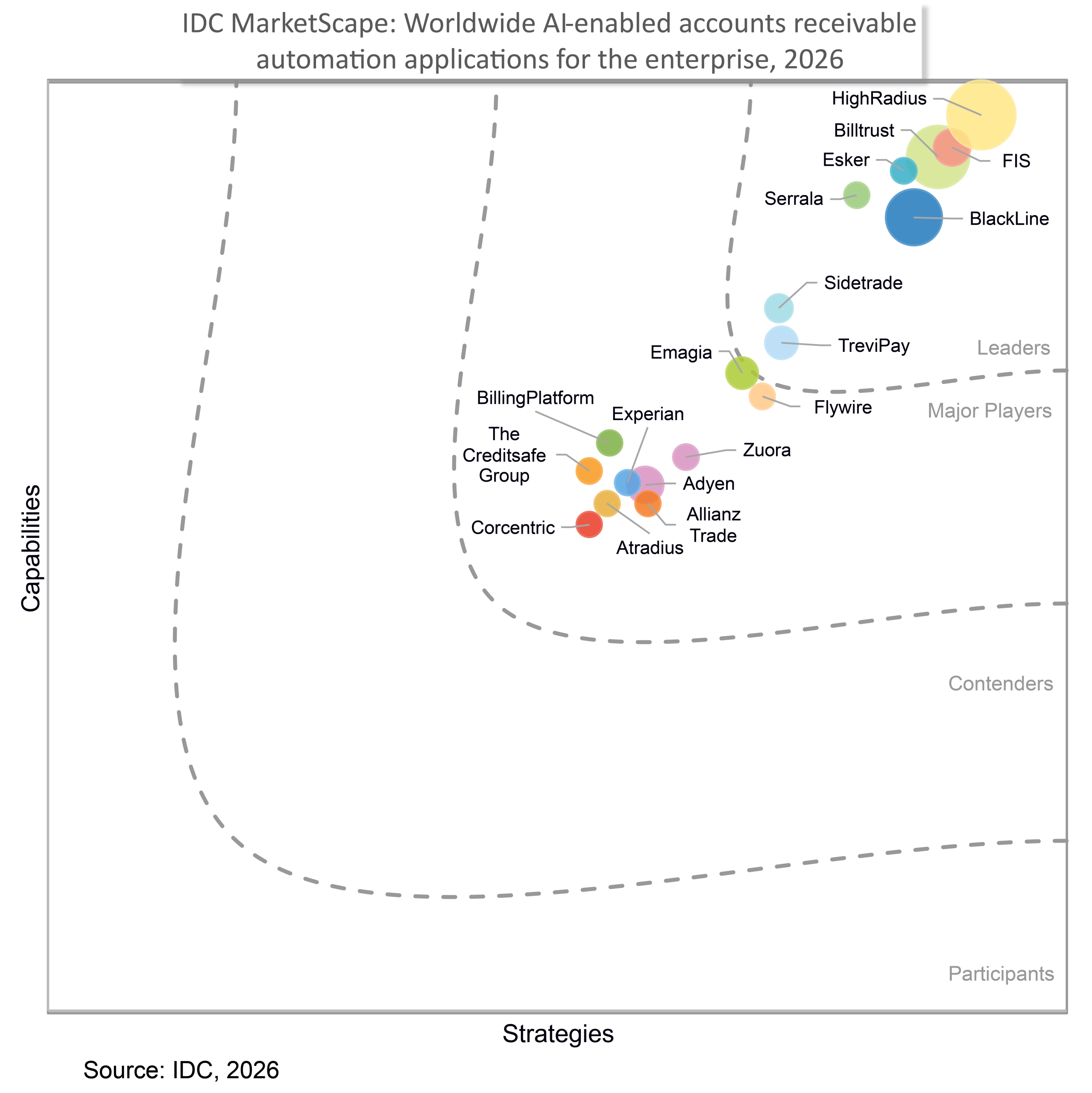
HighRadius recognized as a "Leader" in IDC Marketscape: Worldwide AI-enabled accounts receivable automation applications for the enterprise 2026 vendor assessment
Recognized as a Leader in 2026 Vendor Assessment for unifying credit, collections, cash application, deductions, e-invoicing, and payments on one AI platform to advance enterprise-wide invoice-to-cash transformation.
Forrester Recognizes HighRadius in The AR Invoice Automation Landscape Report, Q1 2023
Forrester acknowledges HighRadius’ significant contribution to the industry, particularly for large enterprises in North America and EMEA, reinforcing its position as the sole vendor that comprehensively meets the complex needs of this segment.