Smart invoicing to predictive insights—see how AI is transforming AR with real-world impact
Get the eBook Now-
From Task Bots to Thinking Agents: Accounts Receivable has evolved past rigid workflow rules and brittle RPA bots. We are now in the era of Agentic AI, pioneered by platforms like HighRadius, where autonomous digital agents don’t just move data—they actually reason through complex financial context and resolve exceptions independently.
-
Orchestration is the Secret Sauce: True AR autonomy requires a perfectly blended tech stack. HighRadius natively unifies RPA to fetch raw data, Machine Learning to predict behaviors, Proprietary Algorithms to enforce accounting guardrails, and Gen AI to handle human-like customer communication under one single roof.
-
Hard, Measurable Bottom-Line ROI: This isn’t a futuristic concept; it’s delivering massive enterprise liquidity today. Real-world HighRadius case studies prove this immediate impact, from slashing bad debt (like BlueLinx’s $2.1M reduction) to driving cash application auto-apply rates up to 98% (like Keurig Dr Pepper).
-
Elevating Finance to a Strategic Weapon: By eliminating manual data entry, routing disputes instantly, and automating blocked order releases, HighRadius completely liberates your finance team. It reduces DSO by over 10% and shifts AR from an administrative cost center into a strategic engine for unlocking working capital.
For a long time, the back office treated Accounts Receivable (AR) as an unavoidable cost center - a tactical team tasked with dialing late payers, squinting at messy remittance sheets, and matching payments by hand. But things have changed. In a corporate landscape defined by volatile interest rates, shifting credit environments, and hyper-accelerating digital transactions, cash is no longer just a passive metric on a balance sheet; it is a tactical weapon.
Relying on legacy processes to manage your accounts receivable lifecycle isn't just an operational bottleneck - it’s a direct threat to liquidity. That is why Artificial Intelligence (AI) AI in Accounts Receivable has evolved from basic automation to becoming a strategic driver of liquidity. By leveraging Artificial Intelligence in Accounts Receivable, organizations can now automate cash application, prioritize collections with higher precision, accelerate dispute resolution, and reconcile payments across fragmented global channels.
When implemented with clear governance via an account receivable software, AI for Accounts Receivable doesn't just save time, it actively cuts DSO by at least 10% and improves team's productivity by 40% thereby driving efficiency and unlocking working capital. If you are evaluating vendor capabilities and want to see how the market stacks up, read our comprehensive breakdown of the best accounts receivable software solutions in 2026. Ready to see how enterprise-grade automation can scale your specific order-to-cash workflow? Explore the HighRadius accounts receivable automation software.
What is AI in Accounts Receivable?
AI in accounts receivable is the application of advanced data models, machine learning, natural language processing, and generative intelligence to the order-to-cash lifecycle. True AI doesn't just read data; it interprets intent. It acts as an intelligent overlay that integrates natively with your existing ERPs (like SAP, Oracle, or NetSuite) to identify patterns in customer behavior, deciphers unstructured data from messy email chains, and predicts delinquency risks weeks before they impact your Days Sales Outstanding.
The Evolution of AR Technology: The Leap to Agentic AI
To understand where AR is going, we have to look at the technology maturity curve. Finance departments have transitioned through four distinct historical phases, moving away from human labor and brittle scripts toward true operational autonomy.
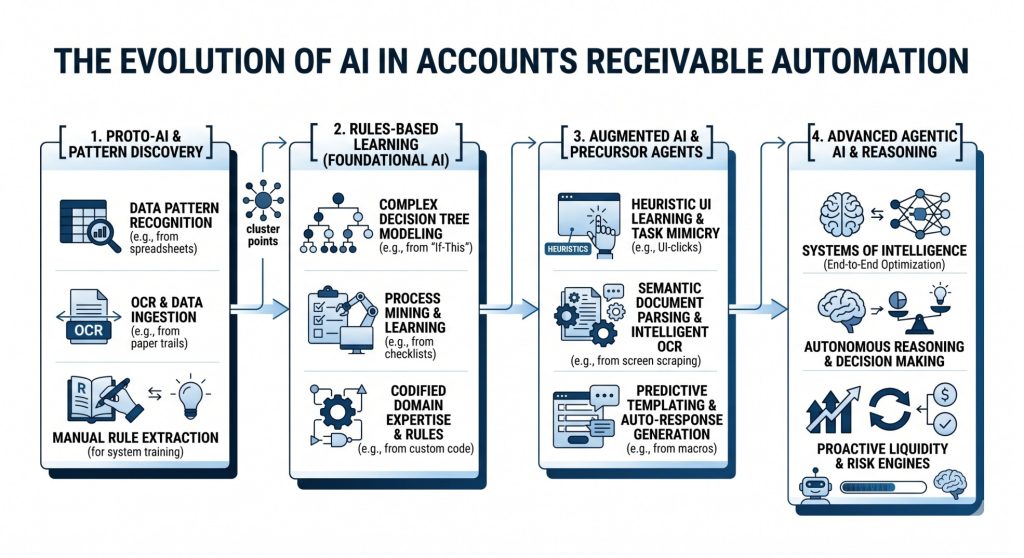
1. The Manual Era (Spreadsheets & Sledgehammers)
This was the era of pure operational friction. AR teams worked out of massive, static Excel aging reports downloaded once a week. Collectors spent their days making cold calls and sending manual dunning letters, while cash application analysts spent hours typing line-item check data into the ERP. It was highly error-prone, unscalable, and inherently reactive.
2. The Workflow Automation Era (Systems of Record)
Workflow automation brought basic structure to the chaos by introducing automated email triggers, standardized dunning templates, and centralized UI dashboards. It connected teams via linear checklists. However, these systems were built on rigid rules. The moment a customer altered a payment format, sent an unstructured PDF via a secondary email account, or deducted an unannounced shortage, the automated workflow broke, requiring human intervention to fix.
3. The RPA Era (The Brittle Task Bots)
Robotic Process Automation (RPA) introduced software "bots" designed to eliminate repetitive administrative actions by mimicking human clicks—like logging into a specific banking portal, pulling a lockbox report, and downloading a CSV.
While RPA was a massive leap forward for data-hauling between legacy systems without APIs, it is fundamentally brainless. RPA relies entirely on static user interfaces and screen scraping. If a bank shifts a web button three pixels to the left, or a retail client updates their portal UI, the RPA script crashes. It can copy and paste data, but it cannot read, interpret, or handle unexpected deviations.
4. The Agentic AI Era (Systems of Intelligence)
We have entered the era of Agentic AI. An AI agent does not simply copy data or flag a broken exception for an analyst to fix. It reasons, determines context, and executes the resolution itself. Agentic systems understand deep financial hierarchies, orchestrate tasks across disparate software systems, self-correct when data formats shift, and securely act on behalf of the credit manager. Workflow automation built the track, RPA tried to drive a blind train on it, but Agentic AI actually puts an intelligent pilot in the cabin.
Deconstructing the AI Spectrum For Accounts Receivable Orchestration
To build a truly autonomous accounts receivable automation engine, a platform cannot rely on just one type of technology. It requires a synchronized stack of these capabilities working in harmony:
- Robotic Process Automation (RPA): The low-level utility muscle. It handles the raw, mechanical data-fetching across bank gateways and customer portals.
- Machine Learning (ML): The predictive brain. It digests massive historical data mountains to find underlying trends, recognize hidden customer behaviors, and predict the exact day a customer will pay an invoice, completely ignoring static contract terms.
- Proprietary Algorithms: The domain-specific accounting guardrails. These specialized mathematical models provide the logic required to navigate complex multi-currency conversions, parent-child corporate hierarchies, and retail deduction structures.
- Generative AI (LLMs): The cognitive communication layer. It excels at synthesizing, interpreting, and writing highly context-aware, unstructured text. When a customer emails about a short-payment due to a damaged shipment, Gen AI reads the email, extracts the real intent, notes the invoice number, and writes a professional response while automatically spinning up an internal deduction claim.
7 Use Cases of AI in Accounts Receivable - Backed By Real-World HighRadius Customer Insights
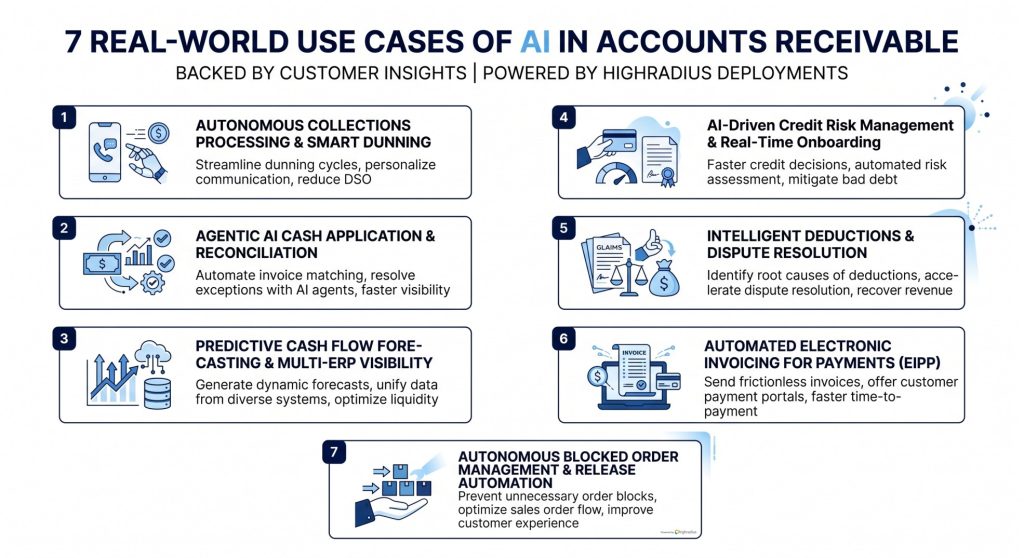
Below are the seven impactful use cases for AI in Accounts Receivable, inspired by the high-value outcomes generated through real-world deployments with HighRadius:
- Autonomous Collections Processing & Smart Dunning: Streamline cycles and personalize customer communication.
- Agentic AI Cash Application & Reconciliation: Automate invoice matching and resolve exceptions for better visibility.
- Predictive Cash Flow Forecasting: Leverage AI for dynamic forecasting and multi-ERP visibility to optimize liquidity.
- AI-Driven Credit Risk Management: Accelerate onboarding and automate risk assessment to mitigate bad debt.
- Intelligent Deductions & Dispute Resolution: Identify root causes and accelerate resolution to recover revenue.
- Automated Electronic Invoicing (EIPP): Offer frictionless payments and customer portals for faster payment cycles.
- Autonomous Blocked Order Management: Prevent unnecessary blocks to improve customer experience and sales flow.
1. Autonomous Collections Processing & Smart Dunning
What It Is
Collections are often where human intervention is highest, and efficiency is lowest. AI in accounts receivable replaces the traditional, one-size-fits-all email blast with Behavior-Based Collections.
How It Works
- Payment Intent Prediction: The AI categorizes your aging report not just by days past due, but by Willingness to Pay. This ensures your specialists spend their time on high-value "At-Risk" accounts rather than calling a Reliable Payer who is simply experiencing a temporary technical glitch.
- Dynamic Dunning & Strategy: Autonomous AI agents (like Freeda) determine the optimal time, communication channel (Email, SMS, or Call), and appropriate tone for every customer interaction. This calibrated approach ensures you get paid quickly without damaging long-term customer relationships.
HighRadius Enterprise Case Study
- The Organization: Ferrero Group (Global Chocolate Confectionery)
- The Challenge: Difficulty keeping track of critical, past-due customer accounts and a slow collections cycle driven by a manual, tedious dunning process.
- The Impact: By implementing AI-enabled worklist prioritization and touchless dunning via automated correspondence, Ferrero achieved a 28% decrease in DSO and a 67% reduction in Average Days Delinquent (ADD), while saving over 1,000 hours every year.
- Case Study Link:Ferrero Group Success Story
2. Agentic AI Cash Application & Reconciliation
What It Is
Cash application is historically the most manual, error-prone part of Accounts Receivable. Agentic AI payments reconciliation completely solves the missing remittance problem that plagues global enterprise operations.
How It Works
- Multi-Source Remittance Capture: Whether a remittance is buried directly in an email body, attached as a messy, unformatted PDF, or hidden behind an external customer portal login, AI agents autonomously log in, extract, and normalize the data.
- Straight-Through Processing: By automatically matching payments to open invoices in your core ERP, HighRadius achieves 90%+ auto-match rates. This ensures cash hits the balance sheet the same day it hits the bank, providing the CFO with a real-time, accurate view of organizational liquidity.
HighRadius Customer Case Study
- The Organization: Keurig Dr Pepper (KDP)
- The Challenge: Lack of real-time visibility into outsourced accounts, manual cash application for e-payments, and delayed cash posting caused by manual remittance aggregation.
- The Impact: KDP brought its payments processing completely in-house using AI-driven automation. They achieved a 98% auto-apply rate for payments, auto-identified 92% of short payments, and reallocated 56% of their resources to critical tasks, saving $2.5M in financial services costs in just one year.
3. AI-Driven Credit Risk Management & Real-Time Onboarding
What It Is
Traditional credit management is slow and reactive, often relying on stale credit agency reports that are 30 to 90 days old. AI for accounts receivable shifts the focus to real-time, 360-degree risk monitoring.
How It Works
- Automated Onboarding: AI-powered agents can approve 80% of new credit applications instantly by extracting data directly from financial statements, commercial credit applications, and tax documents—slashing onboarding time from weeks to minutes.
- Predictive Credit Scoring: AI continuously analyzes real-time internal payment behaviors alongside external data from thousands of sources. It instantly identifies customers whose external credit scores look healthy but whose internal payment speed is decelerating, allowing you to adjust limits before a default occurs.
HighRadius Customer Case Study
- The Organization: J.J. Keller & Associates, Inc.
- The Challenge: Managing credit risk for 60,000 annual orders required the credit team to manually aggregate bureau data, keep track of bankruptcy alerts, and navigate a slow approval process.
- The Impact: Automating the end-to-end credit-to-cash lifecycle allowed J.J. Keller to achieve 80% automated cash posting, a 20% reduction in past-dues, and a 50% increase in credit review speeds.
4. Intelligent Deductions & Dispute Resolution
What It Is
Deductions can account for 5% to 10% of total revenue in some distribution-heavy industries, and manual resolution is a massive drain on resources. Artificial intelligence in accounts receivable turns this cost center into a recovery engine.
How It Works
- Root-Cause Analysis: The AI performs an instant analysis to identify exactly why a deduction happened (e.g., pricing error vs. damaged goods) by comparing and cross-referencing the invoice, purchase order (PO), and proof of delivery (POD).
- Cross-Functional Orchestration: Once identified, the AI agent autonomously routes the claim to the relevant department (Sales, Logistics, or Pricing) for instant credit memo approval or rejection, reducing the total resolution cycle time by up to 50%.
HighRadius Customer Case Study
- The Organization: Blackhawk Network
- The Challenge: Over 2,000 open customer deductions left unresolved for more than two years due to a highly manual aggregation process and zero real-time visibility.
- The Impact: Deploying automated deduction workflows enabled 95% faster dispute resolution, a 96% reduction in open deductions, and boosted overall AR team productivity by 60%.
5. Automated Electronic Invoicing for Payments (EIPP)
What It Is
The final pillar of optimization is entirely about removing the friction of how a customer pays. AI in receivables management ensures the invoice gets to the right person, in the exact required format, at the right time.
How It Works
- Automated Delivery & Tracking: AI ensures invoices are formatted correctly and delivered via the customer's preferred channel (AP Portals, EDI, or Email). It also tracks Open and Read rates, immediately alerting a collections agent if an invoice hasn't been viewed or has been rejected by an enterprise portal.
- Self-Service Payment Portals: Integrated portals allow customers to pay via their preferred digital method (ACH, Credit Card, or Virtual Card) and even raise disputes directly within the portal, which the AI then pre-categorizes for the AR team.
HighRadius Customer Case Study
- The Organization: Yaskawa America Inc.
- The Challenge: Escalating past-due AR caused by manual collections, an expensive PCI compliance setup to process credit card payments over the phone, and a tedious deductions process.
- The Impact: By launching a secure, compliant EIPP portal paired with AI prioritization, Yaskawa achieved zero bad debt, a 5.5-day reduction in DSO, and successfully eliminated weekly transactional exceptions by over 70%.
6. Autonomous Blocked Order Management & Release Automation
What It Is
When a customer exceeds their credit limit or has heavily overdue invoices, incoming sales orders are automatically placed on credit hold. Manually reviewing and unblocking these orders stalls sales cycles and disrupts supply chains. AI automates this verification to keep operations fluid without escalating financial risk.
How It Works
The AI engine continuously monitors active accounts and uses predictive risk algorithms (like Random Forest) to analyze over 30 variables—including payment velocity shifts, historical order values, outstanding liabilities, and active credit utilization. If a reliable customer triggers a blocked order due to a minor transactional overlap, the system computes the risk score and securely auto-releases the order or instantly routes a pre-populated approval request to the appropriate executive hierarchy.
HighRadius Customer Case Study
- The Organization: BlueLinx (Leading Wholesale Building Products Distributor)
- The Challenge: Inefficient credit application reviews and manual order-release bottlenecks that slowed down onboarding and restricted working capital visibility.
- The Impact: BlueLinx transformed its risk lifecycle by deploying specialized AI agents. This automation yielded a massive $2.1 Million reduction in bad debt and accelerated customer onboarding by 70%. By integrating a unified Credit Approval Agent, they automated 99% of their credit workflow, scaled analyst capacity to 3X more credit reviews per day (with each review taking under 5 minutes), and successfully processed over 1 million blocked orders—autonomously auto-releasing 75% of them through a Blocked Order Prediction Agent.
7. Predictive Accounts Receivable & Cash Flow Forecasting
What It Is
Traditional cash forecasting relies on historic ledger averages and nominal invoice due dates. AI-powered AR forecasting models look past those static numbers to predict the exact day cash will clear the bank, giving the CFO absolute visibility into working capital.
How It Works
The AI engine simultaneously captures and maps high-velocity data across complex, multi-currency organizational entities. By analyzing historical payment performance, macroeconomic variables, and active collections interactions (like promises-to-pay), the system generates a rolling forecast with up to 95%+ accuracy, automatically mapping entries down to the specific chart of accounts (CoA).
HighRadius Customer Case Study
- The Organization: DXP Enterprises (Industrial Distribution Leader)
- The Challenge: Over 1,000 weekly transaction exceptions, 2-to-3-day posting delays, and a complex web of 15 distinct ERPs inherited from more than 10 rapid corporate acquisitions.
- The Impact: Implementing autonomous data unification and predictive cash visibility allowed DXP to close $20M cash flow gaps. This completely eliminated their reliance on a $300M+ Asset-Based Lending (ABL) facility to fund their ongoing M&A strategy.
How To Unlock Value By Leveraging AI In Your Accounts Receivable Process?
Transitioning your credit and collections department into an autonomous liquidity engine isn’t about running a massive IT overhaul or replacing your ERP overnight. It requires a deliberate roadmap focused on orchestration rather than standalone tech fixes. If you want to move away from legacy friction and successfully leverage AI in accounts receivable, here is the blueprint:
- Locate Your Position on the AR Maturity Curve: Before writing a single line of code or signing a vendor contract, audit your current operational bottlenecks. Are your analysts trapped in manual spreadsheet manipulation? Is your automated workflow breaking because of messy customer remittance formats? Pinpointing exactly where your process breaks down allows you to target your AI deployment where it will unlock the most cash flow immediately.
- Prioritize Unified Orchestration Over Point Solutions: Avoid the trap of buying a disconnected point solution for collections, another for credit risk, and an RPA bot for portal scraping. True agentic autonomy requires a cohesive platform (like HighRadius) where RPA fetches data, Gen AI interprets unstructured customer communications, Proprietary Algorithms enforce accounting rules, and Machine Learning calculates cash forecasting. If your tools don't talk to each other, you are just building new digital silos.
- Shift from Rigid Rules to Behavior-Based Operations: Move past generic "if-this-then-that" rules. To leverage true AI, stop treating every past-due customer identically based on static Net-30 contract terms. Configure your system to actively analyze behavioral trends - such as Willingness to Pay and Payment Intent Prediction - so your workflows can dynamically adjust dunning tones and automatically prioritize high-risk, high-value accounts.
- Reposition Human Talent for Strategic Exception Management: The goal of agentic AI is not to eliminate your finance team; it is to liberate them from data-entry prison. Program your autonomous AI agents to manage 85% to 95% of routine, repetitive tasks - like auto-applying clean payments, routing valid deductions, and releasing low-risk blocked orders. This shifts your human staff to focus purely on high-value exceptions, critical data anomalies, and cultivating strong customer relationships.
AI Governance: The Guardrails That Keep AI Compliant and Accurate
True agentic autonomy requires enterprise-grade governance. Here are the non-negotiable guardrails required to keep your AR AI accurate, secure, and compliant:
- The Separation of Math and Language (Preventing Hallucinations): Large Language Models (LLMs) are exceptional at reading emails, but they are not calculators. To prevent financial errors, your AI architecture must strictly isolate tasks. Generative AI should only be used as a communication layer to read messages or draft responses. The heavy mathematical lifting - like balancing a sub-ledger or calculating credit limits - must be completely offloaded to Proprietary Algorithms and deterministic Machine Learning models that operate within rigid accounting guardrails.
- Defined "Human-in-the-Loop" Thresholds: Autonomous AI agents should operate with absolute freedom on low-risk, high-velocity tasks (e.g., auto-matching a clean ACH payment or emailing a standard invoice reminder). However, clear dollar-value and risk-based thresholds must be enforced. For instance, the AI can flag an invalid retail deduction and draft a dispute letter, but writing off a $15,000 variance or approving a multi-million dollar credit line extension must always require a human click for final authorization.
- Immutable, Audit-Ready Activity Logs: Every single action, prediction, and adjustment executed by an AI agent must generate a transparent, immutable audit trail. If an AI agent autonomously applies cash, releases a blocked order, or shifts a customer's credit score, the system must log the exact data points, confidence scores, and historical data patterns that led to that specific decision. This ensures your operations remain fully verifiable for internal compliance and external auditors.
- Enterprise-Grade Data Security and Compliance: Accounts receivable workflows handle sensitive corporate data - including bank routing details, tax identification numbers, and confidential corporate financial statements. The underlying platform must maintain strict compliance with global security frameworks, including SOC 1 Type II, SOC 2 Type II, PCI-DSS, and GDPR. Furthermore, customer financial data must never be leaked into open-source public models to train public AI; all intelligence must remain strictly ring-fenced within your secure, encrypted enterprise environment.
How HighRadius Delivers True Agentic AI in Accounts Receivable
When it comes to executing this transition, HighRadius stands as the definitive industry pioneer, intentionally architected to move enterprise finance teams away from brittle point solutions and into the era of true "Agentic Accounts Receivable".
Recognized as an industry leader, HighRadius doesn't just sell standalone automation tools; it provides a unified, autonomous platform that orchestrates the entire AI spectrum - perfectly blending RPA, Machine Learning, Proprietary Algorithms, and Generative AI into a single, cohesive liquidity engine.
Here is exactly how HighRadius transforms accounts receivable into a strategic powerhouse:
- Orchestration of Specialized AI Agents: HighRadius replaces legacy, static checklists with domain-specific AI Agents (including their cognitive digital assistant, Freeda). These agents act as digital coworkers across your entire O2C cycle. From the New Credit Application Agent to the Blocked Order Prediction Agent, these modules autonomously observe, analyze, and safely execute daily financial transactions exactly like a human analyst - but at infinite enterprise scale.
- Native Multi-ERP Data Unification: Enterprise organizations frequently struggle with fragmented data locked behind regional silos and acquisitions. HighRadius sits seamlessly on top of your existing infrastructure - whether you run a single instance of SAP or a complex web of 25+ disparate ERPs and banking portals. It continuously aggregates, sanitizes, and normalizes financial data in real time, giving leadership absolute visibility into aggregate cash positions.
- Elimination of the "Exception Bottleneck": Legacy automation tools can process clean data, but they immediately choke on exceptions like unannounced short-pays or decoupled check remittances. HighRadius pairs advanced, template-free Optical Character Recognition (OCR) with deep financial reasoning logic. The platform autonomously resolves missing remittance details, auto-codes deductions directly back to your sub-ledger, and achieves 90%+ straight-through processing rates on complex item-level matching.
- Guaranteed, Metric-Driven Business Outcomes: HighRadius shifts the conversation away from software features and focuses entirely on bottom-line financial health. By converting reactive billing into proactive, behavioral-driven processes, the platform typically empowers global enterprises to unlock a 10% to 30% reduction in DSO, boost total AR team productivity by 40%, scale analyst credit review speeds by 3X, and slash past-due balances by up to 20% within the first six months of deployment.
Conclusion: The Future of AR with the Agentic AI
Agentic AI represents more than just an incremental upgrade to finance automation; it is the transition from rules-based tasks to goal-oriented reasoning. By moving beyond the rigid boundaries of legacy RPA, AI in Accounts Receivable now empowers teams to build systems that learn from every payment, adapt to customer behavior, and resolve complex exceptions without manual intervention.
For modern finance leaders, the evolution toward Agentic AI means moving past the friction of paper trails and chasing payments. It is about transforming the AR department into a high-velocity liquidity engine. Organizations that embrace artificial intelligence in receivables management today aren't just saving hours; they are gaining the agility and precision needed to drive strategic business growth in an increasingly volatile global market.
Frequently Asked Questions (FAQs) On AI In Accounts Receivable
Q1: What is the difference between RPA and AI in accounts receivable?
Answer: Robotic Process Automation (RPA) is a rigid, rules-based macro that mimics basic human mechanics, like copying a file from a portal and dropping it into an ERP. It cannot think or handle unexpected data shifts; if a portal's layout changes by a few pixels, RPA breaks. AI in accounts receivable uses Machine Learning (ML) and Natural Language Processing (NLP) to read unstructured text, understand financial context, adapt to unexpected process deviations, and make complex operational decisions autonomously.
Q2: What is Agentic AI in accounts receivable?
Answer: Agentic AI represents the shift from passive task automation to full operational autonomy. While traditional workflow tools simply route task reminders to a human checklist, Agentic AI deploys autonomous digital agents that can perceive financial exceptions, reason through accounting rules, and execute cross-system solutions independently. For instance, an AI agent can analyze a blocked order, calculate the risk score, evaluate historical payment intent, and securely auto-release the order to fulfillment without human intervention.
Q3: How do HighRadius guardrails prevent AI hallucinations in financial operations?
Answer: HighRadius enforces a strict governance framework that separates mathematical logic from linguistic processing. Large Language Models (LLMs) are used strictly as a cognitive communication layer to interpret text or draft professional customer emails. All high-stakes calculations - such as adjusting credit scores, balancing ledgers, or computing cash forecasts - are offloaded to deterministic proprietary algorithms and machine learning models running within immutable accounting guardrails to eliminate financial inaccuracies.
Q4: How does AI improve accounts receivable and cash flow forecasting accuracy?
Answer: Traditional cash forecasting relies on static invoice due dates and historic payment averages. AI-powered AR forecasting engines analyze hundreds of live variables simultaneously, including real-time customer payment velocity shifts, active collections notes (like promises-to-pay), historical seasonal procurement cycles, and macroeconomic indicators. This allows the system to build rolling predictive models that map upcoming cash cycles down to the specific chart of accounts with up to 95%+ accuracy.
Q5: What is a realistic reduction in Days Sales Outstanding (DSO) when implementing AR AI?
Answer: Organizations deploying comprehensive AR artificial intelligence typically achieve a 10% to 30% reduction in Days Sales Outstanding (DSO) within the first six months. This is achieved by transitioning from generic calendar-based dunning blasts to behavior-based collections, where machine learning algorithms dynamically optimize the timing, tone, and communication channel for each unique buyer based on their calculated Willingness to Pay.
Q6: How does AI automate blocked order management without escalating credit risk?
Answer: When a buyer exceeds their credit limit, traditional systems automatically place a blanket hold on new orders, disrupting sales velocity. AI-driven blocked order automation uses predictive models (like Random Forest) to analyze real-time credit utilization, historical settlement speed, and total outstanding liabilities. If a low-risk customer triggers a block due to a minor timing overlap, the AI calculates the safety score and autonomously auto-releases the order to the warehouse, keeping supply chains fluid.
Q7: What are the security and compliance requirements for accounts receivable AI?
Answer: Because enterprise accounts receivable platforms handle highly sensitive corporate data (such as financial statements, credit applications, and tax IDs), strict compliance boundaries are non-negotiable. Enterprise-grade AR systems must be certified in SOC 1 Type II, SOC 2 Type II, PCI-DSS, and GDPR frameworks. Furthermore, all data must remain strictly encrypted within a private enterprise cloud and never be leaked into public models to train open-source AI.
Q8: How does AI-driven credit risk management prevent bad debt write-offs?
Answer: Traditional credit reviews are slow and reactive, relying on stale agency credit reports that are 30 to 90 days out of date. AI-driven credit monitoring replaces this with a continuous, 360-degree risk assessment loop. The system flags hidden risk profiles by automatically identifying customers whose external credit agency scores appear stable, but whose internal payment speed is actively decelerating, allowing credit managers to reduce exposure before an enterprise default or bankruptcy occurs.
Q9: Does deploying AI in accounts receivable mean replacing human credit and collection analysts?
Answer: No. The objective of agentic AR AI is to eliminate repetitive administrative friction—such as drafting routine emails, parsing scanned tax documents, and manually tracking down low-risk past-due accounts. By automating 85% to 95% of routine workflows, the AI functions as an autonomous assistant. This liberates human analysts to function as strategic managers focused on high-value exception handling, deep portfolio data anomalies, and cultivating customer relationships.
Q10: How does HighRadius integrate with complex multi-ERP environments?
Answer: HighRadius operates as an intelligent data and automation overlay that unifies complex, highly fragmented multi-ERP systems. Whether an enterprise uses a single instance of a major ERP or navigates a web of dozens of disparate, legacy accounting systems inherited through rapid mergers and acquisitions, HighRadius seamlessly aggregates, cleanses, and synchronizes the financial transaction data in real time without requiring a massive, multi-year IT infrastructure overhaul.