Manage Cross-Border E-Invoicing & Automate AR for ViDA
Last Updated: 21 September, 2026
•
Amisha Agarwal FinTech Content Expert
A
Amisha Agarwal
Amisha specializes in Accounts Payable strategy and content, focusing on the deeper logic and domain knowledge that drives the industry. As a finance expert, she translates complex financial concepts into clear, insightful narratives that help businesses understand the "big picture." Her authority in the field is backed by an MBA from NMIMS, where she graduated as a Gold Medalist.
When she's not analyzing the latest trends in finance, she stays grounded through a fitness routine of yoga and meditation. Her approach in both professional and personal life with a single, driving principle: "Sky is the Limit."
2026 Automation Benchmark Report
HighRadius 2026 Automation Benchmark Report For The Office Of The CFO
Understand if your performance is on par with top 10% of the organizations. Identify gaps, best practices and know how you can drive value through Agentic AI-Driven Automation.
Tax authorities across the European Union lose an estimated €93 billion annually to VAT compliance gaps and fraud, according to European Commission data? This revenue leakage is the primary driver behind the EU's landmark regulatory framework, VAT in the Digital Age (ViDA).
For mid-market and enterprise finance leaders, this mandatory shift represents far more than a standard policy update. It requires a structural redesign of cross-border billing and cash collection operations. Under the EU VAT reform, periodic retrospective reporting is being replaced by continuous transaction controls (CTC).
While the Digital Reporting Requirements (DRR) pillar mandates EU-wide cross-border electronic invoicing and 10-day invoice reporting windows by 2030, domestic mandates across France, Germany, Poland, and Italy are already active or phasing in fast. Finance teams that rely on manual Accounts Receivable (AR) workflows risk invoice rejections, delayed cash collection, and non-compliance penalties.
ViDA (VAT in the Digital Age) is a major European Union legislative package designed to modernize the value-added tax system, curb cross-border tax fraud, and adapt tax rules to the modern digital economy.
It was adopted in early 2025, the initiative rolls out progressively through 2035. It focuses on three core pillars:
The Three Pillars of ViDA
Pillar 1: Digital Reporting Requirements (DRR) and E-Invoicing
Replaces traditional invoicing with mandatory electronic invoicing (e-invoicing) for cross-border business-to-business (B2B) transactions.
Introduces real-time or near-real-time digital reporting for intra-EU trade to help tax authorities catch fraud faster.
Pillar 2: The Platform Economy
Makes online short-term accommodation and passenger transport platforms act as a "deemed supplier".
Platforms must collect and remit VAT when the underlying individual service provider or small business does not charge VAT.
Pillar 3: Single VAT Registration
Expands the existing One-Stop Shop (OSS) and Import One-Stop Shop (IOSS) systems.
Allows cross-border sellers to manage their EU-wide VAT obligations through a single online portal in one language, avoiding multiple local registrations.
Prevent Real-Time Invoice Rejections
In a continuous VAT digital reporting model, tax authorities validate invoices in real time before buyers process them for payment. Under traditional AR setups, master data errors often remain undetected until quarterly reconciliations. Under real-time digital VAT rules, an inaccurate field triggers immediate validation failure.
When a government clearance portal or buyer network rejects a structured invoice, the 10-day issuance window continues to run while payment processing stops completely. Common master data failure points include:
Stale VAT Identification Numbers: Dispatching invoices without verifying buyer VAT IDs against the EU VIES database.
Incorrect Tax Rate Mapping: Misapplying zero-rate VAT or reverse-charge rules across multi-entity product lines.
Unstructured Customer Records: Maintaining legacy ERP fields that lack mandatory tax parameters required by national XML schemas.
Finance organizations prevent validation failures by deploying Accounts Receivable software that automatically validates customer tax data upstream before invoice generation.
Automating Electronic Invoicing
Check EBook on Automate Invoice Creation & Delivery ensuring compliance with government e-invoicing mandates.
Managing Multi-Country Format Differences- Peppol, Factur-X, and KSeF
A critical technical challenge under what is VAT in the Digital Age is managing syntax diversity across regions. While ViDA defines the overarching EU standard (EN 16931) for cross-border transactions, member states enforce distinct local technical architectures:
Region / Country
Mandatory Format Standard
Delivery Architecture
Cross-Border EU
Peppol BIS Billing 3.0 (UBL)
Peppol 4-Corner Network
France
Factur-X (Hybrid PDF/XML)
PDP (Partner Dematerialization Platforms) & PPF
Germany
ZUGFeRD / XRechnung
E-Invoicing Mandate (B2B Phased Implementation)
Poland
KSeF XML
National e-Invoicing System (Centralized Clearance)
Italy
FatturaPA
SDI (Sistema di Interscambio)
Customizing native ERP environments to build and maintain code for every country-specific format creates heavy IT overhead. Enterprise finance teams implement unified EIPP and electronic invoicing solutions that serve as a central translation engine, converting billing data into compliant regional syntaxes automatically.
Financial Benefits of Single VAT Registration (SVR) and OSS Expansion
While ViDA introduces strict digital controls, it also provides operational savings through the expansion of Single VAT Registration (SVR). Historically, businesses selling across EU borders had to maintain separate local EU VAT registrations in every member state where they held inventory or supplied goods.
By expanding the One-Stop Shop (OSS) and Import One-Stop Shop (IOSS) schemes alongside mandatory reverse charge mechanisms under Article 194, ViDA offers structural advantages:
Reduction in Foreign VAT Registrations: Companies manage EU-wide B2C and specific B2B transactions through a single home-country VAT portal.
Lower Administrative Overhead: Decreases localized tax filing and third-party advisory costs across multiple jurisdictions.
Capital Protection: Prevents corporate funds from being locked up in delayed foreign VAT refund claims.
Real-World Value
Automating accounts receivable and e-invoicing workflows directly protects operating cash flow while supporting cross-border operations.
Air France-KLM: Managing complex global travel and freight transactions across multiple jurisdictions required automated billing controls. By deploying AI-driven receivables automation, Air France-KLM transformed O2C operations, accelerating processing speed across European finance workflows.
Red Bull: Automated invoice delivery and processed $93 million in payments annually with 100% global compliance. Check the value craeted, here.
Learn more about HighRadius' EIPP Solution
Reduce DSO and connect buyers and suppliers globally with seamless invoicing & payments.
Cut support calls by 50% as buyers self-serve invoices and payments online.
Email Invoice Delivery
Get paid faster with automated invoices and real-time delivery tracking.
e-Adoption Campaign Management
Drive portal adoption effortlessly with targeted campaigns and real-time insights.
How HighRadius Accelerates ViDA Compliance and Receivables Automation
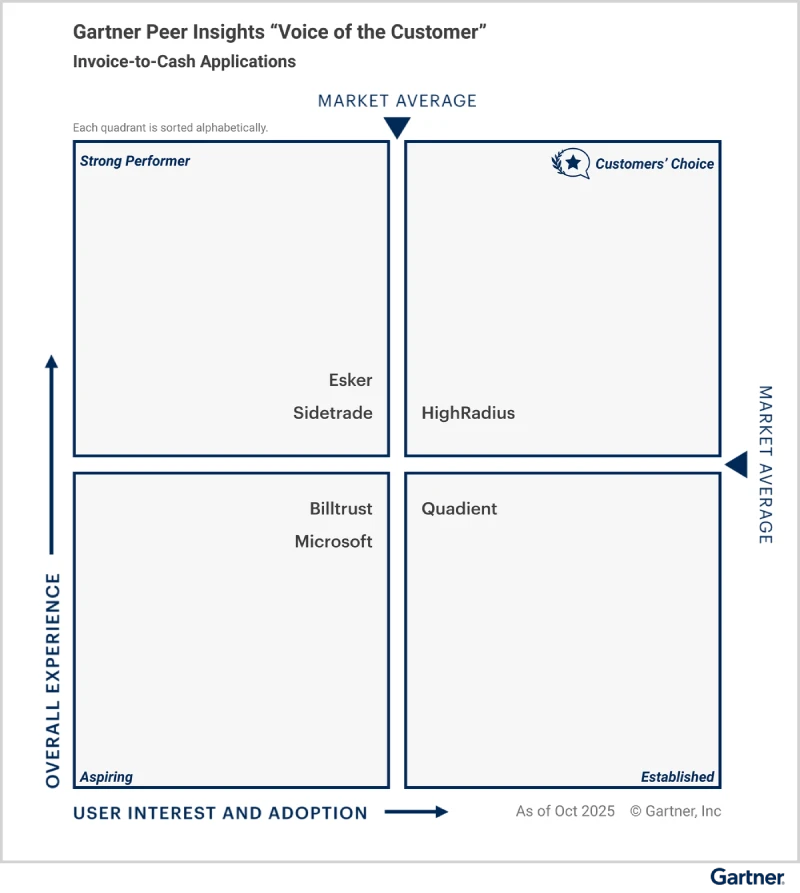
Selecting a platform partner with proven scale is essential as digital compliance timelines approach. HighRadius has been recognized as a Leader in the Gartner Magic Quadrant for Invoice-to-Cash Applications, reflecting established capability in automated credit, e-invoicing, and receivables management.
The HighRadius Autonomous Finance Platform integrates order-to-cash operations, payment processing, and cross-border digital compliance into a single operational layer. By using domain-specific AI agents, HighRadius enables finance teams to:
Automate E-Invoice Generation: Extract ERP data automatically and map invoices to Peppol, Factur-X, XRechnung, and national XML standards.
Eliminate Tax Data Discrepancies: Validate customer VAT identification numbers and tax codes upstream to maximize first-pass acceptance rates.
Reduce DSO: Eliminate delivery delays and automate dispute resolution for rejected digital invoices to speed up cash application.
Maintain Multi-ERP Compatibility: Connect disparate legacy billing systems to government tax portals without building custom ERP code.
Frequently Asked Questions (FAQs)
1. What is the core difference between domestic B2B e-invoicing and ViDA Digital Reporting Requirements (DRR)?
Domestic B2B e-invoicing mandates regulate transactions within a single member state under local frameworks (such as France PDP or Poland KSeF). ViDA DRR standardizes electronic invoicing and real-time digital reporting for cross-border transactions between EU member states using the EN 16931 format.
Domestic B2B e-invoicing mandates regulate transactions within a single member state under local frameworks (such as France PDP or Poland KSeF). ViDA DRR standardizes electronic invoicing and real-time digital reporting for cross-border transactions between EU member states using the EN 16931 format.
2. Does ViDA implementation require replacing existing ERP systems?
No. ViDA compliance does not require replacing core ERP systems. Organizations connect an electronic invoicing platform alongside their ERP. The solution extracts raw invoice data, validates master tax details, maps files to required XML schemas, and routes them to national clearance portals or Peppol networks.
No. ViDA compliance does not require replacing core ERP systems. Organizations connect an electronic invoicing platform alongside their ERP. The solution extracts raw invoice data, validates master tax details, maps files to required XML schemas, and routes them to national clearance portals or Peppol networks.
3. How does ViDA impact non-EU companies operating in European markets?
Non-EU businesses with local EU subsidiaries or local VAT registrations must comply with the same electronic invoicing and digital reporting mandates as EU-headquartered entities. Additionally, the expanded Single VAT Registration (SVR) framework allows non-EU entities to simplify their EU VAT footprint into a single registration point.
Non-EU businesses with local EU subsidiaries or local VAT registrations must comply with the same electronic invoicing and digital reporting mandates as EU-headquartered entities. Additionally, the expanded Single VAT Registration (SVR) framework allows non-EU entities to simplify their EU VAT footprint into a single registration point.
4. What happens when a government portal rejects an electronic invoice?
If a clearance portal rejects an electronic invoice due to validation errors, the invoice is legally invalid and cannot be processed by the buyer for payment. Under ViDA, the 10-day reporting window requires finance teams to correct master data errors immediately and resubmit the formatted invoice via automated workflows.
If a clearance portal rejects an electronic invoice due to validation errors, the invoice is legally invalid and cannot be processed by the buyer for payment. Under ViDA, the 10-day reporting window requires finance teams to correct master data errors immediately and resubmit the formatted invoice via automated workflows.
Resource Library
Resource Hub
Order to Cash
Order to Cash software data sheet
Disconnected workflows can leave teams chasing data, while automated O2C has delivered 20% lower past dues.
HighRadius Named an IDC MarketScape Leader for the Second Time in a Row For AR Automation Software for Large and Midsized Businesses
HighRadius stands out as an IDC MarketScape Leader for AR Automation Software, serving both large and midsized businesses. The IDC report highlights HighRadius’ integration of machine learning across its AR products, enhancing payment matching, credit management, and cash forecasting capabilities.
Forrester Recognizes HighRadius in The AR Invoice Automation Landscape Report, Q1 2023
Forrester acknowledges HighRadius’ significant contribution to the industry, particularly for large enterprises in North America and EMEA, reinforcing its position as the sole vendor that comprehensively meets the complex needs of this segment.