Reduce DSO by 10% and Unlock Hidden Cash Flow with AI-Powered AR Automation Solution
Download Feature Guide-
Uncollected accounts receivable directly traps working capital, creating a structural drag on operational liquidity within the cash flow statement.
- Fragmented manual processes blind 57% of finance leaders, skewing critical cash forecasting and risk management decisions.
- AI-driven AR orchestration eliminates collection friction, driving faster cash velocity and elevating forecasting accuracy up to 95%+.
Every outstanding invoice is, fundamentally, an interest-free loan granted to your customers. While corporate growth strategies often focus on driving top-line revenue, many organizations are inadvertently sabotaging their own liquidity to do it. According to a global working capital study by PwC, the world’s leading companies have over $1.2 trillion in trapped cash tied up on their balance sheets due to inefficiencies in optimization.
At the heart of this liquidity bottleneck lies Accounts Receivable (AR). On an income statement, AR represents a promise of revenue; however, on the cash flow statement, uncollected invoices function as zero-interest loans to customers. When fragmented, manual collection processes delay incoming payments, businesses face a structural drag on their operational cash flow. Transforming these static receivables into dynamic, active capital requires an evolution from reactive accounting to proactive, AI-led cash orchestration.
Understanding exactly how accounts receivable impacts your cash flow statement is the first step toward reclaiming trapped liquidity. In this blog, we will explore the mechanics of AR within the cash flow ecosystem, the hidden costs of inefficient collections, and how modern finance leaders are managing it effectively with accounts receivable automation software.
What Are Cash Flow and Cash Flow Statements?
Cash flow refers to the amount of money that moves into and out of a business over a specific period. It’s essential for maintaining a company’s day-to-day operations, as it shows how well the business generates cash to cover expenses, pay debts, and fund investments.
A cash flow statement is a financial document used to track and record a business’s cash movements (in and out). The statement determines how well a company generates cash, where the money comes from, and how it is spent.
57% of finance leaders say poor AR visibility skews cash decisions.
AI-led AR automation solution fixes this without raising risks.
Download GuideUnderstanding Accounts Receivables
Accounts receivable (AR) represents the money owed to an organization by its customers for goods or services that have been delivered but not yet paid for. It is recorded as a current asset on the company’s balance sheet, reflecting amounts the company expects to collect in the near term, typically within one year.
It is essential for businesses to keep track of their accounts receivables to ensure that their customers are making timely payments, which, in turn, aids smooth cash flow for the company.
How Are Cash Flow and Accounts Receivable Related?
Cash flow and accounts receivable are two of the closely related financial metrics. Accounts receivable (AR) represent money owed to a company by its customers, while cash flow tracks the actual movement of cash in and out of the business. This means if a company is capable of collecting payments from customers on time, it will eventually have sufficient cash inflow, which can be invested further.
Here are some aspects that signify the relationship between AR and cash flow:
- Liquidity Management: Efficient management of AR ensures the company has sufficient cash for daily operations and streamline liquidity management for continuous working capital availability.
- Forecasting Cash Flow: Tracking AR helps predict future cash needs and identify potential cash flow issues.
- Financial Stability: Monitoring how AR affects cash flow provides insights into the company’s ability to meet its obligations and fund growth.
How Does Accounts Receivable Affect Cash Flow Statements?
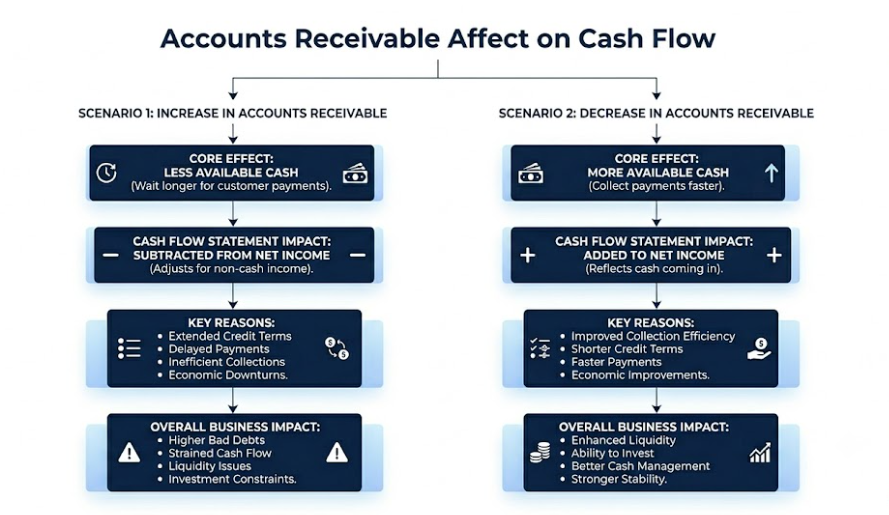
To understand the impact of a change in accounts receivable on the cash flow statement of a company, let’s consider two case scenarios:
Case 1: When accounts receivable increases
When accounts receivable rise, the company is waiting longer to collect payments from customers, reducing available cash and potentially impacting future investment opportunities.
Reasons:
- Extended credit terms
- Delayed customer payment
- Inefficient collection practices
- Economic downturns
How does a decrease in accounts receivable affect cash flow?
When accounts receivable increase it means the company has more money it is expecting to receive from customers but hasn’t collected yet. This increase means less cash is available right now, so on the cash flow statement, this amount is subtracted from net income. This subtraction adjusts the cash flow to show that not all reported income has turned into cash.
The overall impact on business:
- Higher bad debts as delayed payments raise the risk of defaults.
- It can strain cash flow, reducing the cash available for daily operations and leading to negative working capital.
- Higher liquidity issues may arise, making it challenging to cover short-term expenses.
- Investment constraints can occur, limiting the company’s ability to pursue growth opportunities or new projects.
Case 2: When accounts receivable decreases
When accounts receivable decrease, it indicates that the business has collected cash from customers more quickly. This increase in available cash can enhance the company’s liquidity, enabling it to better meet its financial obligations and potentially invest in future opportunities.
Reasons:
- Improved collection efficiency
- Shorter credit terms
- Faster customer payments
- Economic improvements
How does an increase in accounts receivable affect cash flow?
A decrease in accounts receivable indicates that the company has received cash from customers. This collection means more cash is available, so on the cash flow statement, this decrease is added to net income. This addition reflects that cash has come in and improved the cash flow from operations.
The overall impact on business:
- Enhanced liquidity allows the company to meet financial obligations.
- Ability to invest in growth and strategic opportunities.
- Better cash management can reduce the need for external financing.
- Stronger financial stability and efficiency in business operations.
Needless to say, the better an organization handles and manages its receivables, the more efficiently it can improve cash flow and liquidity. To achieve this, businesses can utilize AR automation tools, which streamline collections processes, ultimately enhancing their overall financial management.
How Accounts Receivables Automation Can Help Improve Cash Flow?
Managing accounts receivable is challenging, involving numerous customer follow-ups and various details that can make manual processes cumbersome, time-consuming, and error-prone. Thankfully, with automation, businesses can simplify the process of managing their accounts receivables and ensure consistent cash flow in the organization.
Transitioning to an AI-driven AR ecosystem allows organizations to master their cash flow statement across four distinct pillars:
- Accelerating Cash Conversion (Faster Collections): Relying on static aging reports guarantees delayed payments. Modern AR automation shifts collections process from reactive to proactive by deploying intelligent AI agents that analyze customer payment behaviors, prioritize daily worklists based on risk, and automate personalized dunning across thousands of accounts. By executing this at scale, enterprise organizations routinely see up to a 20% reduction in past-dues and a 10% drop in DSO, directly accelerating cash inflows.
- Achieving Touchless Processing (Error Reduction & Efficiency): Manual cash application is heavily prone to human error and delays actual cash visibility by days. Intelligent AR systems bypass this by capturing line-item remittance data from any channel—emails, lockboxes, or over 600 AP portals—and posting over 90% of payments touchless to the ERP on the same day. This eliminates processing friction, delivering up to a 40% efficiency gain and allowing analysts to pivot from manual data entry to strategic capital optimization.
- Predictive Risk Management (Safeguarding Revenue): Consistent cash flow requires anticipating disruptions before they hit the balance sheet. Advanced AR automation continuously monitors credit profiles, utilizing AI credit risk scoring to predict potential payment defaults up to 30 days in advance. Furthermore, by auto-coding and instantly verifying deductions, businesses stop leaking revenue through invalid claims and unnecessary write-offs.
- Enterprise-Grade Liquidity Visibility: You cannot optimize what you cannot see. Automated systems replace retrospective spreadsheet reporting with live DSO, aging, and cash-forecast dashboards. This real-time synchronization between AR and the core ERP provides the Office of the CFO with the precise, high-fidelity data required to accurately forecast operational cash flow.
With all this, businesses cannot only effectively manage AR collections to prevent cash flow issues but also stay ahead of their finances and make strategic investment decisions.
Case study: How Konica Minolta Unlocked $30 Million in Cash Flow
To understand the real-world impact of converting accounts receivable from a passive accounting ledger to an active liquidity engine, consider the financial transformation of Konica Minolta.

The Challenge: The Hidden Costs of Fragmented AR
Despite generating billions in global revenue, Konica Minolta’s treasury and finance teams were battling severe friction across their order-to-cash cycle. Their liquidity was bottlenecked by highly manual, legacy processes:
- Cash Application Blind Spots: Only 3% of their daily electronic payments were posted straight-through to the ERP. Five full-time specialists were required to manually reconcile the remaining 97% line by line, significantly delaying real-time cash visibility.
- Reactive Collections: A team of 50+ collectors was attempting to manage 75,000 customer accounts without any risk-based prioritization—treating high-risk delinquent accounts the same as low-risk self-payers.
- Costly Settlement Methods: Heavy reliance on paper checks and credit cards was draining operational capital, resulting in over $5.5 million in annual payment processing fees.
The Intervention: AI-Driven AR Orchestration
To reclaim trapped working capital, Konica Minolta deployed HighRadius’s Autonomous Finance platform, fundamentally restructuring their AR operations. The intervention focused on deploying Agentic AI to automate transaction matching, introducing risk-based dunning strategies, and creating a frictionless B2B digital payment gateway to drive self-service settlements.
The Strategic Outcomes
The transition from reactive administration to autonomous finance delivered immediate, board-room-level results, directly hitting the cash flow statement:
| Metric | Net Strategic Impact |
| Working Capital Velocity | $30 Million added in cash flows, driven by a 9-day reduction in Days Sales Outstanding (DSO). |
| Touchless Cash Application | Achieved ~99% automated bank reconciliation, auto-matching over 45,000 line items monthly, eliminating manual data entry. |
| Operational Savings | Saved $5.5 Million annually in credit card fees via an 83% increase in e-payment adoption. |
| Cost of Capital Reduction | Generated over $1.6 Million in annual interest savings by reducing the need for short-term borrowing. |
| Predictive Confidence | Boosted cash flow forecasting accuracy to 98.6%, providing the Office of the CFO with high-fidelity data for capital allocation. |
Why choose HighRadius?
While standard software plug-ins and basic tools merely track your outstanding debts, HighRadius transforms the entire invoice-to-cash lifecycle into an active liquidity engine. Recognized as the definitive market leader across the Gartner Magic Quadrant, IDC MarketScape, and Forrester reports, HighRadius delivers a unified, Agentic AI accounts receivable platform built specifically for the enterprise Office of the CFO.
By deploying intelligent AI agents that autonomously handle manual bottlenecks across credit, collections, cash application, and deductions, the platform eliminates the chaotic “manual login loop” of customer portals.
The true differentiator lies in HighRadius’s outcome-driven architecture and zero-friction deployment. The platform features native, out-of-the-box connectors that seamlessly synchronize with major ERPs—including SAP, Oracle, Microsoft Dynamics, and NetSuite, enabling businesses to achieve a 10% reduction in DSO and a 20% drop in past-due accounts within months of going live.
Backed by a transparent value-creation framework, HighRadius provides over 1,300 global companies with the real-time visibility, 98%+ forecasting accuracy, and data-driven confidence required to protect operational cash flow and aggressively fund corporate growth.
FAQs
1) How to increase cash flow from accounts receivable?
To boost cash flow, businesses must streamline their receivables process by speeding up invoice processing, enforcing clear credit terms, automating follow-ups, offering discounts for early payments, and improving collection efforts. Efficient management and timely collection enhance cash flow.
2) What is the direct method of cash flow in accounts receivable?
The direct method shows actual cash flows from operations. For accounts receivable, it adjusts net income by subtracting increases in receivables or adding decreases to reflect the actual cash collected from customers. This method provides a clear picture of cash received from customers and is used for cash flow statements.