Top 7 Quadient Alternatives for AI-Driven AR Automation in 2026
Last Updated: 15 October, 2026
•
Soumi Sarkar Fintech content strategist
S
Soumi Sarkar
Soumi specializes in O2C, finance, and accounting transformation with a focus on bringing a domain-led perspective to accounting, finance and order-to-cash transformation. She crafts insight-driven, CFO-aligned content that helps finance teams optimize operational workflows and drive measurable outcomes. Beyond her professional work, Soumi is a published author of two books, a poetess, an avid reader, and a storyteller who enjoys exploring narratives across both B2B and creative formats.
2026 Automation Benchmark Report
HighRadius 2026 Automation Benchmark Report For The Office Of The CFO
Understand if your performance is on par with top 10% of the organizations. Identify gaps, best practices and know how you can drive value through Agentic AI-Driven Automation.
– Modern AR automation platforms now combine AI-driven collections, touchless cash application, predictive credit monitoring, deductions automation, and AP portal connectivity instead of relying only on basic dunning workflows and manual reconciliation.
– HighRadius helps mid-market and enterprise finance teams automate collections, cash application, credit management, deductions, and payments through 190+ Agentic AI agents, AP portal integrations, and predictive working capital intelligence.
– Businesses adopting AI-driven Order-to-Cash automation platforms now achieve 90%+ touchless cash application, 30–40% reduction in blocked orders, 2× improvement in collections coverage, and stronger real-time visibility into cash flow and customer risk exposure.
Many finance teams initially adopt Quadient AR (YayPay) to move away from spreadsheets and automate basic accounts receivable workflows. For mid-market businesses managing moderate invoice volumes, automated dunning emails, customer payment portals, and lightweight collections workflows often provide a strong first step into AR automation. But as businesses scale, operational complexity changes quickly. Deduction volumes increase, AP portals multiply, blocked orders begin impacting revenue, and finance teams struggle to manage collections, cash application, credit risk, and forecasting across fragmented ERP environments.
This is where companies begin evaluating broader AR automation and Order-to-Cash platforms that can support AI-driven collections, touchless cash application, predictive credit monitoring, deductions automation, and enterprise-scale workflow orchestration. In this guide, we compare leading Quadient alternatives including HighRadius, Billtrust, Versapay, Tesorio, Gaviti, Upflow, and Serrala based on their capabilities across collections automation, cash application, credit risk management, deductions automation, scalability, and AI-driven working capital optimization.
Top Quadient Alternatives At A Glance for 2026
Platform software
Target market segment
Primary best-for use case
Pros
Cons / considerations
HighRadius
Mid-market and enterprise
AI-driven autonomous Order-to-Cash automation
Unified O2C platform spanning collections, cash application, deductions and credit management; remittance capture from 500+ AP portals; predictive working-capital intelligence.
May offer more functionality than smaller businesses with straightforward AR workflows require.
Billtrust
Mid-market and enterprise
B2B payments, electronic invoicing and invoice-to-cash automation
Established B2B payments network; connectivity with buyer AP portals; electronic invoice delivery and digital payment capabilities.
Buyers should assess implementation requirements, integration dependencies and whether the platform meets their needs across the full O2C cycle.
Versapay
Mid-market and growing businesses
Collaborative AR, customer payment portals and collections
Customer-facing invoice and payment collaboration; digital payment capabilities; tools for customer communication and collections workflows.
Buyers with complex O2C requirements should validate cash application, credit management, deductions automation, reporting and ERP integration needs.
Tesorio
Mid-market and enterprise teams prioritizing cash visibility
Collections prioritization, cash forecasting and working-capital visibility
Collections workflow automation; cash visibility and forecasting capabilities; tools to help teams prioritize receivables.
Buyers should validate the depth of deductions and credit management capabilities, alongside integration requirements and end-to-end workflow coverage.
Gaviti
SMB and mid-market
Collections automation and receivables follow-up
Automated reminders and collections workflows; collector visibility; customer communication and self-service capabilities.
Buyers should assess reporting flexibility, customization, performance at their transaction volumes and coverage of wider O2C workflows.
Upflow
Growing mid-market and B2B businesses
Collaborative collections and customer payment follow-up
Collections workflow management; customer communication tools; integrations designed to connect receivables activity with finance workflows.
Buyers with complex enterprise environments should validate multi-ERP support, deductions handling, reporting and scalability for their specific requirements.
Serrala
Mid-market and enterprise
Finance process automation, including SAP-oriented AR workflows
SAP-oriented deployment options; automation across finance processes; capabilities spanning AR and other finance operations.
Buyers should validate configuration and rule-maintenance requirements, deployment fit and coverage of their specific O2C workflows.
The comparison across these Quadient alternatives highlights a broader shift happening in AR automation. While many platforms focus on lightweight collections workflows or customer payment experiences, finance teams increasingly prioritize AI-driven cash application, predictive credit risk management, automated deductions resolution, AP portal automation, and enterprise-scale working capital visibility as AR complexity grows.
Most AR Forecasting Is Only ~70% Accurate
Spreadsheets can’t capture real customer behavior. AI-driven optimization fixes visibility and improves cash predictability.
Quadient AR helps businesses replace spreadsheet-based collections and automate foundational accounts receivable workflows. But as transaction volumes increase and finance operations become more complex, many organizations begin encountering limitations around scalability, automation depth, and cross-functional visibility.
Growing transaction complexity
As invoice volumes, customer disputes, deductions, and payment channels increase, finance teams often find manual workflows reappearing across collections, cash application, and reconciliation processes. What works for lightweight AR automation can become difficult to manage across larger customer portfolios and higher transaction complexity.
Limited AI automation depth
Many AR platforms automate notifications and workflows but still rely heavily on collector intervention for exception handling, deductions resolution, credit scoring and cash forecasting. Finance teams increasingly seek AI-driven automation that can reduce manual research, prioritize actions intelligently, and automate operational decisioning at scale.
Reactive credit and collections management
Traditional collections workflows often identify risk only after invoices become delinquent or blocked orders begin impacting revenue. Modern finance organizations are prioritizing predictive collections, real-time credit monitoring, and proactive risk management to reduce bad debt exposure and improve working capital visibility.
Scaling challenges across ERPs and business units
As businesses expand across multiple ERPs, entities, geographies, and customer segments, maintaining consistent workflows and centralized visibility becomes increasingly difficult. Many organizations evaluating Quadient alternatives are looking for platforms that can support enterprise-scale automation, policy governance, AP portal connectivity, and unified Order-to-Cash orchestration across global operations.
What Did We Evaluate in Quadient Alternatives
As AR operations grow more complex, finance teams evaluating Quadient alternatives increasingly prioritize platforms that can automate workflows, improve working capital visibility, and scale across broader Order-to-Cash operations.
AI automation depth
Look for AI-driven AR automation platforms that go beyond basic dunning workflows and support automated cash application, predictive collections, credit decisioning, and deductions resolution.
Cash application accuracy
Evaluate whether the platform can automate remittance matching, reduce unapplied cash, and handle complex payment scenarios across multiple payment channels and customer formats.
Collections workflow automation
Modern collections software should support automated prioritization, risk-based outreach, dispute visibility, payment forecasting, and collector productivity optimization.
ERP scalability and integration
Ensure the platform integrates seamlessly across ERP systems, banks, AP portals, and payment providers while supporting multi-entity and multi-region finance operations.
Deductions and dispute management
Assess whether the solution can automate claim capture, backup document aggregation, dispute workflows, and invalid deduction identification to reduce revenue leakage.
Predictive credit risk monitoring
The best AR automation platforms combine collections with AI-driven credit monitoring, blocked-order prediction, and real-time customer risk visibility.
AP portal connectivity and payment optimization
Evaluate AP portal automation capabilities, digital payment adoption support, and tools that improve payment processing efficiency and customer payment experience.
Auditability and governance
Finance teams should prioritize platforms with configurable approval workflows, centralized audit trails, policy enforcement controls, and explainable AI decision tracking.
Ebooks
39% of Invoices Are Paid Late! All Due To Weak AR Workflows.
See how leading finance teams use 5 structured AR workflows to reduce operational delays.
As AR complexity increases, many finance teams begin evaluating alternatives to Quadient that can support broader Order-to-Cash automation, stronger AI-driven workflows, and scalable working capital management. The platforms below are commonly evaluated based on their strengths across collections automation, cash application, deductions management, credit risk monitoring, AP portal connectivity, payment optimization, and enterprise scalability.
1. HighRadius: The best Quadient alternative for mid-market and enterprises
HighRadius is an AI-native Order-to-Cash platform built for finance teams that have outgrown spreadsheet-driven collections and lightweight AR automation tools. The platform combines collections automation software, automated cash application, credit risk management, deductions automation, e-invoicing, and cash forecasting into a unified AI-driRecognized as 3X Leader in Gartner Magic Quadrant, HighRadius is the accounts receivable platform trusted by 1300+ finance teams worldwide built to scale from mid-market growth to enterprise-grade complexity.
For mid-market organizations, HighRadius delivers out-of-the-box automation to unify cash application, collections, invoicing, credit and deductions. This achieves up to 90%+ touchless cash application, reduces past dues by 20% and delivers ROI in 3–6 months without adding headcount.
For global enterprises, the software unifies fragmented operations and multi-ERP landscapes. By intelligently prioritizing billions in receivables and automating data retrieval across AP portals, HighRadius improves net recovery of invalid deductions by 30% and clears millions in unapplied cash.
Whether your business is handling massive volumes or scaling with lean agility, HighRadius provides the speed and scale to unlock trapped working capital, accelerate cash flow and drive bottom-line impact.ven working capital platform powered by 190+ autonomous AI agents and embedded LLMs.
HighRadius Breakdown
Pros: 190+ autonomous AI agents; automated cash application and deductions workflows; pre-built integrations with 50+ ERPs and 100+ banks; strong AI-driven credit management and collections automation.
Cons: May be more functionality than needed for smaller businesses with low invoice complexity or limited AR transaction volumes.
Best For: Mid-market and enterprise organizations seeking AI-driven AR automation, automated cash application software, credit management software, deductions automation, and enterprise-scale Order-to-Cash orchestration.
Pricing: Custom SaaS pricing based on transaction volume, modules, and organizational scale.
Review Summary: Users consistently highlight HighRadius for automating complex cash application, collections, and dispute workflows across large multi-ERP environments. Reviewers frequently mention strong scalability, operational automation depth, and improvements in working capital visibility.
Analyst Reports
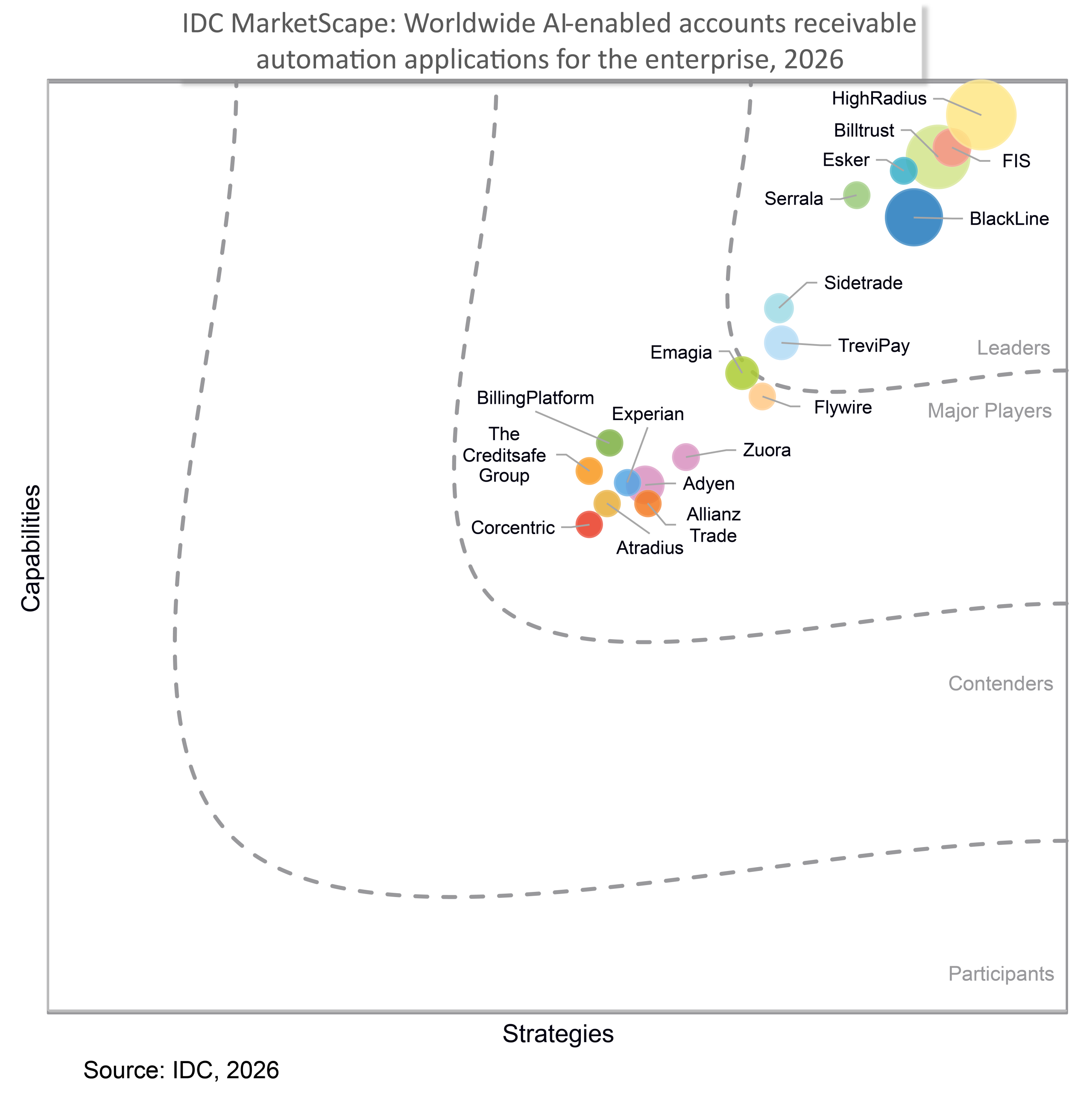
Recognized as an IDC MarketScape Leader in AR Automation
IDC recognized HighRadius for AI-driven AR automation across both enterprise and mid-market organizations.
2. Billtrust: Best for B2B payments and invoice delivery
Billtrust is a B2B accounts receivable and payments platform that helps businesses manage electronic invoicing, payment processing, and invoice-to-cash workflows. Its Business Payments Network (BPN) connects businesses with buyer payment processes and AP portals, helping finance teams streamline invoice delivery and payment collection.
Organizations evaluating Billtrust often prioritize electronic invoice presentment, digital payments, and connectivity with customer payment portals. Buyers should assess how its capabilities align with their broader Order-to-Cash requirements, including credit management, collections, cash application, and deductions.
Billtrust Breakdown
Pros
B2B payments and electronic invoicing capabilities.
Connectivity with buyer AP portals through its payments network.
Support for invoice delivery and payment collection workflows.
Cons / considerations
Implementation and integration requirements should be assessed against the existing ERP environment.
Buyers should validate the level of workflow customization required.
Organizations with broader O2C requirements should evaluate coverage across credit, collections, cash application, and deductions.
Best For: Mid-market and enterprise organizations prioritizing B2B payments, electronic invoicing, and buyer AP portal connectivity.
Pricing: Confirm current pricing and the applicable commercial model directly with Billtrust.
Review Summary: Customers value Billtrust for simplifying invoice distribution and digital payment workflows across multiple business entities. Feedback commonly highlights strong portal connectivity and payment processing capabilities.
3. Versapay: Best for collaborative AR and customer payment experience
Versapay is an accounts receivable automation platform centered on customer collaboration, digital payments, and invoice-to-cash workflows. Its collaborative approach helps finance teams share invoice information, communicate with customers, and manage payment-related queries through a connected AR experience.
Businesses evaluating Versapay often prioritize customer self-service, invoice transparency, and collaboration between buyers and sellers. Organizations with more complex O2C requirements should also assess its fit for credit management, cash application, deductions, reporting, and ERP integration.
Versapay Breakdown
Pros
Customer-facing invoice and payment collaboration capabilities.
Digital payment and collections workflows.
Tools that support invoice communication and dispute-related interactions.
Cons / considerations
Validate ERP integration requirements and implementation effort.
Assess reporting and analytics against finance-team requirements.
Confirm that cash application, credit management, and deductions capabilities meet the complexity of the business's O2C processes.
Best For: Mid-market businesses seeking to improve customer payment experiences and collaborative AR workflows.
Pricing: Confirm current pricing, package availability, and usage-based charges directly with Versapay.
Review Summary: The supplied review summaries highlight ease of use, payment management, and customer collaboration as positive themes. Some reviews also mention payment issues, integration challenges, reporting limitations, or support concerns. Individual experiences may vary by implementation and configuration.
4. Tesorio: Best for cash forecasting and collections visibility
Tesorio is a finance platform focused on accounts receivable, collections management, and cash forecasting. It helps finance teams improve visibility into receivables, prioritize collection activities, and understand expected cash inflows.
Organizations evaluating Tesorio often prioritize collections intelligence, cash flow visibility, and forecasting alongside their existing finance systems. Buyers should assess its capabilities against their end-to-end O2C requirements rather than assuming that forecasting and collections are its only areas of functionality.
Tesorio Breakdown
Pros
Collections and receivables visibility capabilities.
Cash forecasting and working-capital insights.
Tools to help finance teams prioritize collection activities.
Cons / considerations
Validate forecasting capabilities against the organization's data and accuracy requirements.
Assess the depth of automation required for cash application, deductions, and credit management.
Confirm integration coverage and workflow fit across the existing ERP and finance environment.
Best For: Finance teams prioritizing cash forecasting, receivables visibility, and collections prioritization.
Pricing: Confirm current pricing and the applicable licensing or subscription model directly with Tesorio.
Review Summary: Customers commonly highlight strong reporting visibility, forecasting accuracy, and easy adoption across collections teams.
5. Gaviti: Best for lightweight collections automation
Gaviti is an accounts receivable automation platform focused on collections management, automated follow-ups, and customer communication. It helps finance teams organize collection activities, monitor overdue invoices, and coordinate receivables follow-up.
Businesses evaluating Gaviti often prioritize collections workflow automation and improved visibility into outstanding receivables. Buyers should assess its fit for their transaction volumes, reporting requirements, ERP environment, and wider O2C processes.
Gaviti Breakdown
Pros
Collections workflow management and automated follow-ups.
Visibility into receivables and collection activities.
Customer communication and self-service capabilities.
Cons / considerations
Validate reporting flexibility and customization requirements.
Test system performance against expected transaction volumes and workflows.
Assess coverage across cash application, deductions, credit management, and other required O2C processes.
Best For: Businesses seeking to automate collections activities and improve overdue invoice follow-up.
Pricing: Confirm current pricing and the applicable subscription structure directly with Gaviti.
Review Summary: Users frequently mention ease of setup, collections visibility, and improvements in overdue invoice follow-ups and customer communication consistency.
6. Serrala: Best for finance process automation and SAP-oriented environments
Serrala provides finance process automation solutions spanning accounts receivable, payments, and other finance operations. Its portfolio includes SAP-oriented deployment options as well as solutions designed for different ERP environments.
Organizations evaluating Serrala often consider its fit with their ERP landscape, finance transformation plans, and automation requirements. For O2C teams, the evaluation should focus on the specific capabilities required across credit management, collections, cash application, deductions, and receivables reporting.
Serrala Breakdown
Pros
Finance process automation across multiple workflows.
SAP-oriented deployment options.
Capabilities that can support broader finance transformation initiatives.
Cons / considerations
Assess configuration and implementation requirements for the selected solution.
Validate the technical expertise needed to create and maintain automation rules.
Confirm that the selected deployment and product modules cover the organization's required O2C workflows.
Best For: Mid-market and enterprise finance teams evaluating finance automation, particularly in SAP-oriented environments.
Pricing: Confirm current pricing and deployment-specific commercial terms directly with Serrala.
Review Summary: Customers frequently highlight billing flexibility, ease of use, and strong recurring invoicing capabilities for subscription-based business models.
7. Upflow: Best for modern collaborative collections workflows
Upflow is a receivables and collections management platform focused on helping B2B finance teams organize collection activities, communicate with customers, and improve visibility into outstanding invoices. Its workflow approach can help finance teams coordinate follow-ups and monitor customer payment behavior.
Businesses evaluating Upflow often prioritize collections organization, customer communication, and integration with their existing finance technology stack. Buyers with more complex requirements should assess its fit for ERP integration, cash application, deductions, reporting, and broader O2C automation.
Upflow Breakdown
Pros
Collections workflow and customer communication capabilities.
Visibility into outstanding invoices and follow-up activities.
Integration options for connecting receivables workflows with finance systems.
Cons / considerations
Validate integration compatibility with the existing finance stack.
Assess reporting and customization against business requirements.
Confirm coverage of cash application, deductions, credit management, and other advanced O2C workflows.
Best For: B2B finance teams seeking collections workflow management and improved visibility into customer receivables.
Pricing: Confirm current pricing and the applicable subscription structure directly with Upflow
Review Summary: Users commonly highlight Upflow’s clean user experience, communication workflows, and strong visibility into customer payment behavior across finance and customer-facing teams.
Ebooks
Is Your O2C Process Scaling or Slowing Growth?
Explore key features businesses prioritize across collections, cash application, deductions, credit risk, and AI automation.
Why Choose HighRadius’ AI Agents For Accounts Receivable?
Many businesses begin their AR automation journey looking to eliminate spreadsheets, automate collections emails, and improve payment visibility. That works initially. But as invoice volumes increase, deductions grow, AP portals multiply, and working capital pressure intensifies, finance teams often realize they need more than lightweight workflow automation. They need a platform that can automate decision-making, execute workflows autonomously, and scale across increasingly complex Order-to-Cash operations.
This is where HighRadius differentiates itself. HighRadius is an AI-native Order-to-Cash platform built to automate collections, cash application, credit risk management, deductions, payments, and treasury workflows through 190+ Agentic AI agents and embedded predictive intelligence. Instead of simply digitizing AR activities, the platform continuously monitors risk, predicts blocked orders before disruption occurs, automates remittance processing across 500+ AP portals, and resolves deductions using AI-driven claim validation and document retrieval.
For growing mid-market organizations, HighRadius helps lean finance teams scale collections, cash application, and credit operations without increasing headcount. Businesses automate up to 80–90% of low-risk approvals, accelerate onboarding by up to 70%, improve collections coverage, and reduce manual reconciliation work through ERP-integrated AI workflows.
For enterprises managing global receivables operations across multiple ERPs and business units, HighRadius delivers enterprise-grade orchestration with predictive blocked-order prevention, real-time portfolio monitoring, policy standardization, automated deductions resolution, and AI-powered working capital visibility across large customer portfolios.
HighRadius vs. traditional AR automation platforms
Capability
HighRadius
Other AR / O2C automation platforms
Collections automation
AI-prioritized worklists, inbox intelligence, in-app calling and autonomous workflows.
Automation varies by vendor; compare prioritization, customer communication, collector productivity and autonomous workflow capabilities.
Cash application
Automated cash application, including remittance processing across 500+ AP portals. Retain the 90%+ touchless figure only if confirmed by the approved fact sheet.
Integration and orchestration capabilities across supported ERP environments, including SAP, Oracle, NetSuite and Microsoft Dynamics, where confirmed.
Assess each vendor's supported ERP integrations, multi-ERP requirements, implementation effort and cross-system data visibility.
AI automation depth
200+ AI agents designed to automate tasks across Order-to-Cash workflows, from credit and collections to cash application and deductions.
Compare AI-assisted recommendations, autonomous task execution, rules-based automation, human review and exception handling.
O2C workflow coverage
Integrated capabilities spanning credit, collections, cash application, deductions and related O2C workflows.
Workflow coverage varies by platform; compare the specific modules required and the extent to which workflows operate together.
Case study: BSN Sports
BSN Sports, a fast-growing sporting goods distributor managing large invoice volumes with a lean AR organization, used HighRadius to modernize collections automation, payment workflows, and working capital operations without increasing headcount.
Using AI-driven collections workflows, payment optimization, and automated customer engagement, the company achieved:
50% reduction in past-due balances
2× increase in collections coverage
6× more personalized outbound emails
$500K+ annual savings in card processing fees
31-day acceleration in cash conversion cycle
The outcome reflects the core reason many finance teams adopt HighRadius: the platform continues scaling as operational complexity increases, without forcing businesses to rebuild finance processes later.
Case Studies
Learn How BSN Sports Reimagined Collections With HighRadius
Learn how lean AR teams improved collections coverage, personalized outreach, and payment efficiency without increasing manual workload.
Streamline Your Receivables With HighRadius Order-To-Cash Software
HighRadius Order-to-Cash Software helps finance teams automate receivables operations, reduce manual workloads, and improve working capital visibility across collections, cash application, credit, deductions, and customer payments. Built for organizations scaling beyond spreadsheet-driven AR processes, the platform combines Agentic AI, predictive analytics, ERP-integrated workflows, and real-time monitoring to help businesses accelerate cash flow, reduce operational bottlenecks, and scale finance operations without increasing headcount.
Centralize receivables operations with AI-driven workflows, real-time AR visibility, automated customer communications, and predictive working capital insights.
Improve customer payment experiences through digital invoicing, self-service payment portals, AP portal delivery, and intelligent payment orchestration across global channels.
Learn More about HighRadius Accounts Receivable Software
Lower DSO, boost working capital, and increase productivity with our AI-driven accounts receivable platform, integrated with modern ERPs.
Accelerate payment recovery from delinquent customers and boost cash flow through automated collection workflows.
Cash App
Achieve same day cash application with automated remittance aggregation
Credit
Mitigate credit risk, reduce bad debt, and streamline customer onboarding with AI-powered insights.
Deductions
Reduce Revenue Leakage with AI Prediction models that identify valid and invalid deductions.
Frequently Asked Questions (FAQs)
1. What should businesses consider when switching from Quadient?
When switching from Quadient, businesses should evaluate their current accounts receivable workflows, ERP integrations, automation requirements, reporting needs, and implementation timelines. Compare how alternative platforms handle collections, cash application, credit management, deductions, and customer payments. The right choice should address existing process gaps while supporting future business growth.
When switching from Quadient, businesses should evaluate their current accounts receivable workflows, ERP integrations, automation requirements, reporting needs, and implementation timelines. Compare how alternative platforms handle collections, cash application, credit management, deductions, and customer payments. The right choice should address existing process gaps while supporting future business growth.
2. Is HighRadius a good alternative to Quadient?
HighRadius is an alternative to consider for businesses looking to automate accounts receivable and broader Order-to-Cash (O2C) processes. Its platform supports collections, cash application, credit management, deductions, and related finance workflows. Businesses evaluating a move from Quadient should compare workflow coverage, integration requirements, automation capabilities, implementation needs, and expected business outcomes before making a decision.
HighRadius is an alternative to consider for businesses looking to automate accounts receivable and broader Order-to-Cash (O2C) processes. Its platform supports collections, cash application, credit management, deductions, and related finance workflows. Businesses evaluating a move from Quadient should compare workflow coverage, integration requirements, automation capabilities, implementation needs, and expected business outcomes before making a decision.
3. How do you migrate from Quadient to another AR automation platform?
Migrating from Quadient typically involves mapping existing workflows, reviewing ERP and banking integrations, validating customer and invoice data, configuring automation rules, and testing reporting and exception handling. Before going live, finance teams should test collections, cash application, deductions, and payment workflows using representative business data. A phased rollout and clear success metrics can help reduce disruption during the transition.
Migrating from Quadient typically involves mapping existing workflows, reviewing ERP and banking integrations, validating customer and invoice data, configuring automation rules, and testing reporting and exception handling. Before going live, finance teams should test collections, cash application, deductions, and payment workflows using representative business data. A phased rollout and clear success metrics can help reduce disruption during the transition.
4. What features should you look for in a Quadient alternative?
When evaluating Quadient alternatives, prioritize the capabilities that address your current AR challenges. These may include automated collections, intelligent cash application, credit risk assessment, deductions management, customer payment portals, ERP integrations, and actionable reporting. Businesses with complex O2C requirements should also evaluate cross-workflow automation, scalability, exception handling, and the platform’s ability to support changing business needs.
When evaluating Quadient alternatives, prioritize the capabilities that address your current AR challenges. These may include automated collections, intelligent cash application, credit risk assessment, deductions management, customer payment portals, ERP integrations, and actionable reporting. Businesses with complex O2C requirements should also evaluate cross-workflow automation, scalability, exception handling, and the platform’s ability to support changing business needs.
Resource Library
Resource Hub
Order to Cash
Order to Cash software data sheet
Disconnected workflows can leave teams chasing data, while automated O2C has delivered 20% lower past dues.
HighRadius recognized as a "Leader" in IDC Marketscape: Worldwide AI-enabled accounts receivable automation applications for the enterprise 2026 vendor assessment
Recognized as a Leader in 2026 Vendor Assessment for unifying credit, collections, cash application, deductions, e-invoicing, and payments on one AI platform to advance enterprise-wide invoice-to-cash transformation.
Forrester Recognizes HighRadius in The AR Invoice Automation Landscape Report, Q1 2023
Forrester acknowledges HighRadius’ significant contribution to the industry, particularly for large enterprises in North America and EMEA, reinforcing its position as the sole vendor that comprehensively meets the complex needs of this segment.