How Agentic AI Is Transforming the Credit Approval Process?
Last Updated: 26 August, 2026
•
Nishma Gankidi Global Finance Process Expert
N
Nishma Gankidi
"Nishma specializes in Order-to-Cash (O2C), finance, and content-led transformation, bringing a domain-first perspective to enterprise finance. She creates insight-driven, CFO-aligned content that simplifies complex workflows and helps teams drive efficiency and measurable outcomes.
Beyond the numbers, she’s driven by a curiosity for human behavior, shaping narratives that don’t just inform, but truly resonate."
2026 Automation Benchmark Report
HighRadius 2026 Automation Benchmark Report For The Office Of The CFO
Understand if your performance is on par with top 10% of the organizations. Identify gaps, best practices and know how you can drive value through Agentic AI-Driven Automation.
Credit approval has gradually evolved into something far more complex than originally intended: a full-scale operational effort. What used to be a straightforward decision point now triggers a chain of actions—gathering data, validating policies, routing requests for review, and circling back when things inevitably slow down. It’s no longer a single task. It’s a multi-step workflow with dependencies and handoffs that cut across teams.
Yet despite this growing complexity, the tools behind the process haven’t meaningfully changed. Most systems still rely on manual decisions, waiting for human input to determine what happens next. Agentic AI changes that. Rather than following fixed rules, it evaluates the situation and takes action based on context. It doesn’t just support the process—it actively moves it forward, step by step, with decisions grounded in data.
In this blog, let’s explore what that means and how the Agentic AI framework simplifies credit management.
80–90% of Credit Evaluations Don't Need Manual Review.
Automate routine approvals, focus analysts on high-risk accounts, and improve portfolio visibility with continuous AI-driven risk monitoring.
The Credit Approval Process Is More Complicated Than It Should Be
Whether you’re issuing credit for trade finance, equipment leasing, or just vetting new customers, the approval path tends to follow a familiar pattern.
It starts with application submission, followed by data retrieval from internal systems and third-party sources. Once the information is compiled, credit scoring models are applied to assess initial risk. From there, the process moves to manual review, where exceptions are flagged, additional documentation is requested, and clarifications are sought. Only after these steps is a decision made—often taking several days to finalize.
But what drags things down isn’t the decision itself. It’s everything wrapped around it:
Incomplete customer data
Manual document validation
Systems that don’t talk to each other
Approval logic buried in spreadsheets or tribal knowledge
Endless email threads to keep things moving
Even with robotic process automation (RPA) in place, many organizations end up with rigid workflows that break as soon as inputs deviate from the norm. It's brittle, it's slow, and it doesn’t scale well.
Guessing your next credit management partner?
Use this Excel-based scorecard to confidently evaluate credit management partners—because top finance teams don’t guess, they measure.
Agentic AI simplifies business credit decision-making by moving beyond static workflows to adaptive, reasoning-driven processes. In traditional business credit operations, every step—from financial analysis to document verification—relies heavily on manual input or rigid automation. Agentic AI, however, can interpret complex financial documents, assess business health using real-time and historical data, and autonomously handle conditions like missing financials or unclear revenue streams. For example, when reviewing a credit application from a small enterprise, the AI doesn’t just check boxes—it evaluates tax filings, compares financial ratios to industry benchmarks, and initiates follow-ups or escalations as needed, without waiting on human prompts.
This intelligent approach transforms the way credit teams operate. Agentic AI acts as an autonomous partner that not only gathers and processes information across systems—like ERP, CRM, and credit bureaus, but also makes contextual decisions based on company size, industry risk, or prior relationship history. It ensures faster turnaround times on credit decisions, minimizes back-and-forth with applicants, and enhances consistency across portfolio evaluations. Ultimately, it allows credit analysts and risk managers to focus on strategic reviews and high-value accounts, while the AI handles the volume and variability of day-to-day credit processing with precision.
Five Ways Agentic AI Reshapes Credit Approval and Credit Decisioning
Agentic AI is transforming the landscape of credit management by enhancing efficiency, accuracy, and responsiveness across the credit lifecycle. Below are five key areas where its impact is particularly profound:
Intelligent Document Processing Agentic AI can automatically extract relevant fields from submitted documents such as PDFs, identify discrepancies or missing information, and initiate follow-up communication with applicants. This reduces manual oversight and ensures a faster, more reliable review process.
Real-Time Risk Scoring By integrating external credit bureau data with internal risk models, agentic systems can assess applications dynamically. Rather than halting progress on borderline cases, the AI adapts risk thresholds or escalates applications based on predefined business logic—ensuring continuity and adherence to risk policies.
Automated and Personalized Communication Whether requesting a missing bank statement or delivering conditional approvals, agentic AI autonomously manages communications. It sends tailored messages, records applicant responses, and updates customer relationship management (CRM) systems to maintain full traceability throughout the credit process.
Seamless Cross-System Orchestration One of the most significant advantages lies in the AI’s ability to operate across multiple platforms—CRM, ERP, and other enterprise systems. It intelligently determines which system to engage and executes tasks accordingly, streamlining workflows and reducing friction between departments.
Proactive Handling of Complex Cases Rather than routing atypical or edge cases directly to analyts, agentic AI first attempts resolution by referencing historical precedents, gathering supplemental information, or proposing actionable next steps. Human oversight remains essential, but the process begins with a well-informed foundation, accelerating resolution times.
Case Studies
How this manufacturing giant unlocked 17,000+ annual credit reviews
Learn how FBM modernize credit operations with AI-driven scoring, automated workflows, and centralized visibility across entities.
From Manual Credit Reviews to Automatic Credit Decisions
For organizations exploring the integration of agentic AI into credit operations, it is critical to undertake a structured and strategic approach. The following steps will help lay a strong foundation for successful adoption:
Conduct Comprehensive Process Mapping Begin with a detailed evaluation of existing credit workflows—from application intake to decision issuance and system updates. Map out each stage, highlighting points of manual intervention, inefficiencies, and delays. This baseline assessment is essential to identify areas where agentic AI can deliver meaningful impact.
Define a Clear North Star Metric Establish a well-defined primary objective to guide implementation. Whether the focus is on accelerating decision cycles, improving accuracy, or reducing manual workload, having a central metric ensures alignment and clarity when selecting automation opportunities.
Initiate with a Targeted Use Case Select a focused and manageable use case, such as document verification for credit lines below a specific threshold (e.g., $10,000). This controlled environment allows for effective testing, iteration, and refinement of the AI deployment before scaling across broader processes.
Select the Appropriate Technology Stack Choose a technology framework that supports autonomous reasoning, memory management, system interoperability, and governance. While open-source tools like LangChain offer flexibility, enterprise-grade platforms such as HighRadius provide pre-integrated, secure solutions optimized for quicker implementation.
Design with Built-in Human Oversight Ensure human oversight is embedded into the solution through strategic checkpoints. Agentic AI should be empowered to analyze and recommend actions, but final decisions—particularly in complex or high-risk cases—should remain with human stakeholders. This hybrid approach fosters trust and confidence in the system over time.
How HighRadius Automates Credit Decisions at Scale?
How HighRadius Credit Risk Software Helps Improve Credit Risk Assessment
HighRadius credit management software helps finance teams move from periodic, spreadsheet-driven credit reviews to connected, AI-powered credit decisioning. The platform combines customer payment behavior, external credit intelligence, financial data, configurable scoring, automated approvals, and continuous risk monitoring to give teams a clearer view of changing customer risk. For mid-market companies scaling with lean credit teams, this means automating routine decisions and reducing manual reviews without adding headcount. For global enterprises, it brings credit risk visibility, policy governance, and decisioning across complex customer portfolios, entities, and ERP environments.
With real-time credit risk analysis software and credit decisioning software, you can receive alerts for any changes in your customers’ credit profile and make data-driven credit decisions from unlimited credit reports. Our software integrates with your ERP system and can start monitoring your customers in just 30 days.
We offer configurable credit scoring software and approval workflows that can be customized based on geography, customer segments, business units, and other factors. You can fast-track credit approvals through complex corporate hierarchies, making the credit application process more efficient and streamlined.
Our highly configurable online credit application allows you to onboard customers across the globe with multi-language, customized credit applications embedded on your website. You can automatically capture financials, personal guarantees, and check bank references, reducing the need for manual data entry.
Our software also automatically extracts credit data from over 40+ global and local agencies, including credit ratings, financials, and credit insurance information. You can configure the auto-extracted data in your preferred currency, making it easier to analyze and interpret.
With AI-based blocked order management, you can auto-predict blocked orders based on the customers’ credit limit utilization and payment history. You can leverage AI-based release or partial payment recommendations for faster credit decisions, reducing the need for manual intervention.
Struggling With Slow Credit Approvals and Credit Reviews?
Explore the #1 software that makes onboarding customer faster and easier
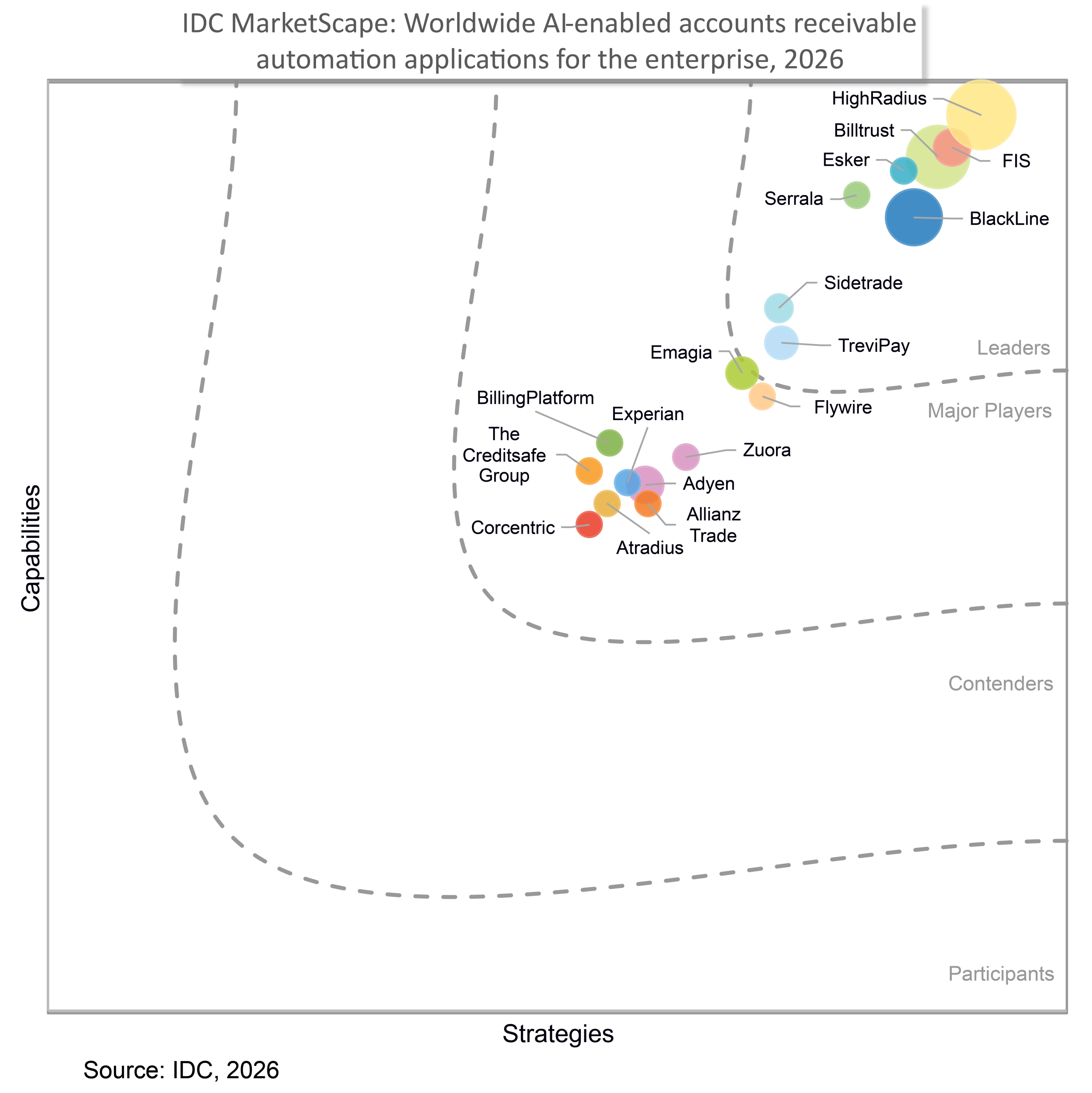
HighRadius recognized as a "Leader" in IDC Marketscape: Worldwide AI-enabled accounts receivable automation applications for the enterprise 2026 vendor assessment
Recognized as a Leader in 2026 Vendor Assessment for unifying credit, collections, cash application, deductions, e-invoicing, and payments on one AI platform to advance enterprise-wide invoice-to-cash transformation.
Forrester Recognizes HighRadius in The AR Invoice Automation Landscape Report, Q1 2023
Forrester acknowledges HighRadius’ significant contribution to the industry, particularly for large enterprises in North America and EMEA, reinforcing its position as the sole vendor that comprehensively meets the complex needs of this segment.