Fun Fact: Under legacy EU reporting rules, some businesses only had to submit cross-border transaction statements four times a year, giving fraudulent operators months to disappear with collected VAT before tax authorities could detect them? This critical blind spot contributed to an estimated €93 billion EU VAT gap in 2020, prompting the shift toward real-time continuous transaction controls under the VAT in the Digital Age (ViDA) mandate. For finance leaders managing European operations, achieving this level of reporting speed requires moving beyond legacy batch processing and fully automating the Accounts Receivable (AR) pipeline.
Key Takeaways
-
Continuous Transaction Control Shift: ViDA moves EU VAT compliance from periodic retrospective filings to real-time transaction reporting, making pre-billing validation mandatory
-
Syntax and Format Fragmentation: Managing country-specific e-invoicing formats like Peppol, Factur-X, and KSeF requires a centralized translation layer rather than expensive ERP customizations.
-
Actionable 4-Step Audit: Preparing Order-to-Cash operations requires systematic execution across master data cleaning, network connectivity, workflow timing, and automated ERP status synchronization.
Questions to Ask Before Auditing Your AR Environment
Evaluating your current operational maturity is critical before enforcing system-wide changes. Challenge your IT and finance teams with these baseline diagnostic questions:
- Are customer VAT identification numbers validated in real time against the EU VIES (VAT Information Exchange System) database prior to invoice generation?
- Does our current billing architecture rely on batch processing that could jeopardize the incoming 10-day digital reporting window?
- Can our core ERP natively convert standard billing data into localized syntax formats like Peppol BIS, Factur-X, or KSeF (Krajowy System e-Faktur) XML?
- How quickly can the AR team resolve a rejected digital invoice and resubmit it to a government clearance portal?
Interpreting Your AR Diagnostic Results
The required operational state for cross-border AR under ViDA is continuous, automated processing. Here is how your diagnostic results align with compliance mandates and what operational shifts are necessary.
- VAT Validation: Peak operational efficiency requires real-time API integration. Organizations relying on manual VIES verification or skipping validation entirely must prioritize automated master data checks within their invoice generation workflows.
- Batch Processing: Maximum efficiency demands event-triggered invoicing. Legacy batch workflows executing at week-end or month-end risk violating the mandatory 10-day reporting window. Transitioning to continuous, real-time invoice generation is strictly required.
- Format Conversion: Ideal efficiency requires automated syntax mapping. Standard ERPs lack native multi-country syntax conversion. Rather than building custom ERP configurations, finance teams should deploy centralized electronic invoicing platforms to manage regional compliance mapping.
- Rejection Resolution: Ideal efficiency requires rapid, automated dispute resolution. Rejection handling must occur within hours. Prolonged manual dispute cycles will result in compliance failures, necessitating automated workflows that capture return status codes directly from tax portals.
Customer Success: Red Bull
See how they autmated email invoice delivery by 100% with full complaince
Check Case Study
The 4-Step ViDA Readiness Execution Plan
The following checklist will help you overhaul your Order-to-Cash operations. The coming steps will guide you through auditing master data, testing network connectivity, eliminating batch processes, and executing end-to-end ERP integration tests to guarantee compliance before the mandates take effect.
Step 1: Master Data & VIES Audit Invalid master data instantly triggers invoice rejections under ViDA clearance models. Finance teams must establish a continuous validation loop.
- Connect ERP master data to real-time VIES validation services via direct API.
- Audit and remap tax code mappings across all operating entities in the EU to ensure accurate application of zero-rate and reverse-charge rules.
- Identify and populate missing buyer parameters mandated by EN 16931 cross-border syntax guidelines.
Step 2: Network & Format Capability Review Cross-border and domestic e-invoicing require a flexible mapping engine to handle diverse regional compliance requirements.
- Verify your active Peppol Access Point connectivity for B2B cross-border billing delivery.
- Establish automated conversion workflows for highly regulated local formats, including Factur-X, XRechnung, and KSeF.
- Confirm that your integration layer supports both 4-corner Peppol delivery and direct connections to centralized national tax authority portals.
Step 3: AR Workflow & Timing Assessment ViDA strictly enforces a 10-day invoice issuance and reporting window for cross-border transactions. Legacy batch workflows fail under these constraints.
- Measure the average billing cycle time from order fulfillment and goods receipt to final invoice issuance.
- Eliminate manual invoice batching procedures to align directly with strict continuous reporting windows.
- Restructure internal approval hierarchies to prevent human delays from compromising legal delivery deadlines.
Step 4: Interoperability & Integration Test A compliant format holds no value if the ERP cannot interpret return messages from government clearance platforms.
- Ensure e-invoicing tools automatically sync invoice status codes (accepted, rejected, pending) directly back to the native ERP environment.
- Automate dispute management workflows specifically for rejected digital invoices to accelerate the correction and resubmission cycle.
- Run end-to-end sandbox testing using live production data against regional tax portal testing environments.
HighRadius Named as #1 Leader in Order-to-Cash (O2C) Products PEAK Matrix® Assessment 2025
Check Analyst Report
How HighRadius Automates ViDA Compliance and Accelerates Order-to-Cash
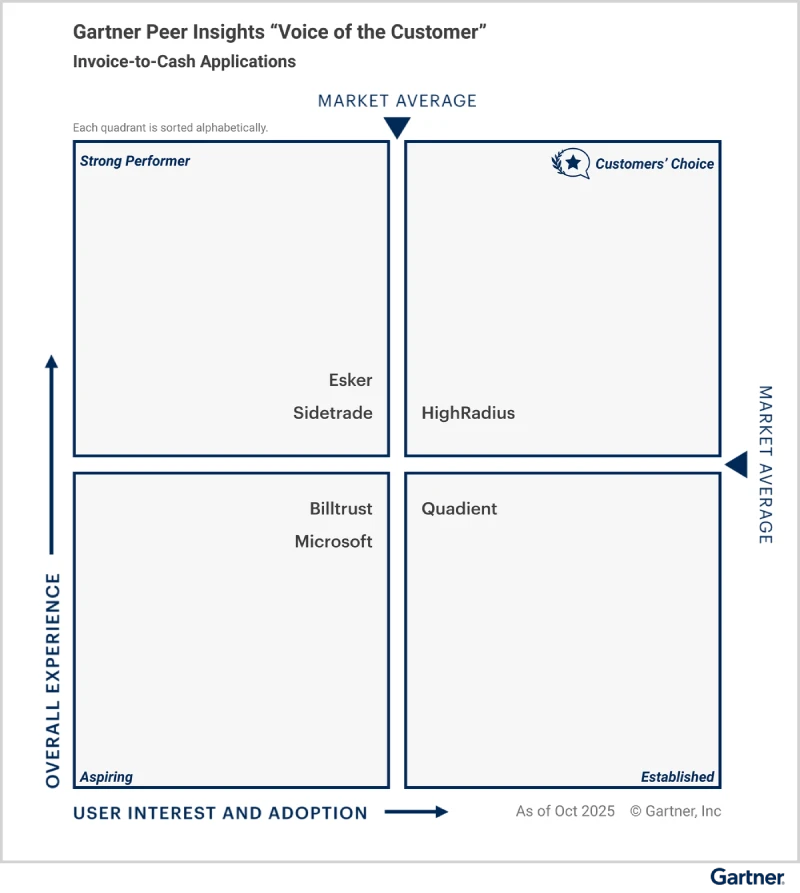
Achieving real-time compliance while protecting working capital requires enterprise grade automation. HighRadius is recognized as a Leader in the 2024 Gartner® Magic Quadrant™ for Invoice-to-Cash Applications. The HighRadius AI-Powered Electronic Invoice Presentment & Payment Software provides an intelligent compliance architecture for complex cross-border billing.
Using targeted AI agents, the platform automates the entire invoice-to-cash journey. It extracts native ERP data, automatically identifies invoices requiring submission to government e-invoicing portals, and applies country-specific formatting workflows before routing them to processors. By tracking invoice submission status through centralized visibility and synchronizing dispute updates back to the ERP, HighRadius ensures finance teams eliminate compliance risk while significantly reducing Days Sales Outstanding (DSO).
Learn more about HighRadius' EIPP Solution
Reduce DSO and connect buyers and suppliers globally with seamless invoicing & payments.
Request a Demo

Self-Serve Buyer Portal
Cut support calls by 50% as buyers self-serve invoices and payments online.
Email Invoice Delivery
Get paid faster with automated invoices and real-time delivery tracking.
e-Adoption Campaign Management
Drive portal adoption effortlessly with targeted campaigns and real-time insights.
Frequently Asked Questions on ViDA, E-Invoicing, and AR Automation
Conduct a master data extract and run a bulk verification against the EU VIES database. Identifying the failure rate of current VAT IDs provides an immediate baseline of master data cleanliness.
Conduct a master data extract and run a bulk verification against the EU VIES database. Identifying the failure rate of current VAT IDs provides an immediate baseline of master data cleanliness.
No. A certified Peppol Access Point facilitates cross-border exchange across the entire network. However, certain domestic models mandate direct connections to local clearance platforms separate from the Peppol infrastructure.
No. A certified Peppol Access Point facilitates cross-border exchange across the entire network. However, certain domestic models mandate direct connections to local clearance platforms separate from the Peppol infrastructure.
It accelerates the timeline. Because tax authorities or buyers reject non-compliant invoices instantly, the AR team must utilize automated workflows to investigate the syntax or data error, correct the master record, and resubmit the invoice well within the 10-day legal window.
It accelerates the timeline. Because tax authorities or buyers reject non-compliant invoices instantly, the AR team must utilize automated workflows to investigate the syntax or data error, correct the master record, and resubmit the invoice well within the 10-day legal window.
Building on the existing One-Stop Shop (OSS) model, the SVR pillar allows more businesses to fulfill their EU-wide VAT obligations via a single online portal. This significantly minimizes the circumstances requiring businesses to maintain multiple local VAT registrations across different Member States, directly reducing compliance and administrative costs.
Building on the existing One-Stop Shop (OSS) model, the SVR pillar allows more businesses to fulfill their EU-wide VAT obligations via a single online portal. This significantly minimizes the circumstances requiring businesses to maintain multiple local VAT registrations across different Member States, directly reducing compliance and administrative costs.