Artificial intelligence is no longer a future-state experiment in finance. It is a critical balance-sheet tool. For high-growth enterprise teams, AI in Accounts Receivable has evolved from basic automation to becoming a strategic driver of liquidity. By leveraging Artificial Intelligence in Accounts Receivable, organizations can now automate cash application, prioritize collections with higher precision, accelerate dispute resolution, and reconcile payments across fragmented global channels.
When implemented with clear governance, AI for Accounts Receivable doesn't just save time, it actively cuts DSO, reduces unapplied cash, and multiplies collector productivity by orders of magnitude.
AI in Accounts Receivable is the application of autonomous software agents to manage the entire invoice-to-cash lifecycle. Unlike legacy RPA (Robotic Process Automation), which follows rigid ‘If-This-Then-That’ rules, Accounts Receivable Agentic AI possesses reasoning capabilities.
It doesn't just move data; it interprets intent. It identifies patterns in customer behavior, deciphers unstructured data from messy email chains, and predicts delinquency risks weeks before they impact your Days Sales Outstanding.
Understanding where your organization sits on the maturity curve is the first step toward transformation:
To understand how AI improves Accounts receivable processes, we must look past the software and into the functional heart of the Order-to-Cash (O2C) cycle. We categorize this into five distinct pillars where artificial intelligence in receivables management creates measurable outcomes in working capital.
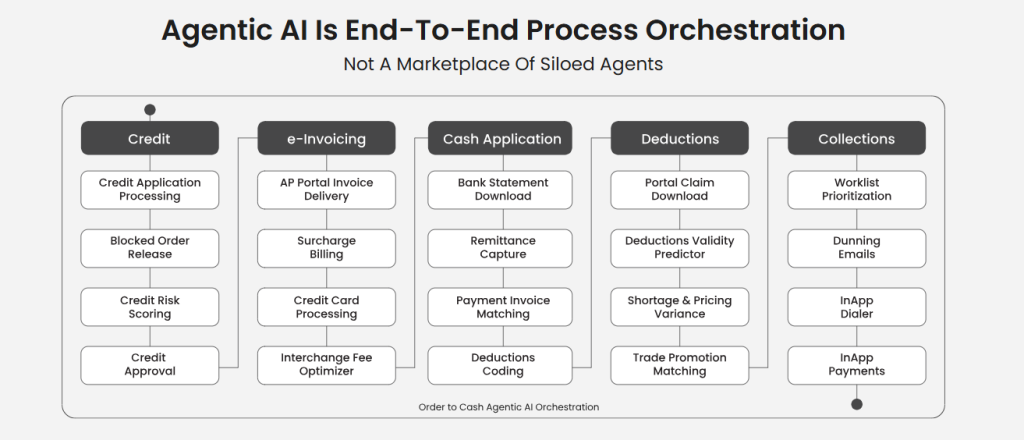
Collections are often where human intervention is highest, and efficiency is lowest. AI in accounts receivable replaces the one-size-fits-all email blast with Behavior-Based Collections.
Cash application is historically the most manual, error-prone part of Accounts Receivable. Agentic AI payments reconciliation solves the missing remittance problem that plagues global enterprises.
Deductions can account for 5-10% of total revenue in some industries, and manual resolution is a massive drain on resources. Artificial intelligence in accounts receivable turns this cost center into a recovery engine.
Traditional credit management is reactive, often relying on stale credit agency reports that are 30 to 90 days old. AI for accounts receivable shifts the focus to real-time, 360-degree risk monitoring.
The final pillar Electronic Invoicing is about removing the friction of how a customer pays. AI in receivables management ensures the invoice gets to the right person, in the right format, at the right time.
| Capability | Legacy Automation (RPA) | Standard AI/ML | HighRadius Agentic AI |
| Logic Type | Linear/Rules-based | Predictive/Statistical | Goal Oriented/Reasoning |
| Data Source | Structured (CSV/Excel) | Structured + OCR | Unstructured (Emails/Voice/Portals) |
| Dispute Handling | Flags it for a human | Categorizes the dispute | Resolves the dispute autonomously |
| Learning | None | Model retraining required | Continuous Reinforcement Learning |
| ROI Metric | Hours saved | DSO reduction | Working Capital Optimization |
Agentic AI represents more than just an incremental upgrade to finance automation; it is the transition from rules-based tasks to goal-oriented reasoning. By moving beyond the rigid boundaries of legacy RPA, AI in Accounts Receivable now empowers teams to build systems that learn from every payment, adapt to customer behavior, and resolve complex exceptions without manual intervention.
For modern finance leaders, the evolution toward Agentic AI means moving past the friction of paper trails and chasing payments. It is about transforming the AR department into a high-velocity liquidity engine. Organizations that embrace artificial intelligence in receivables management today aren't just saving hours they are gaining the agility and precision needed to drive strategic business growth in an increasingly volatile global market.
AI improves AR by automating repetitive tasks, predicting customer payment behavior, and providing real-time visibility into cash flow. By using Agentic AI, companies can resolve disputes and apply cash with minimal human intervention, leading to significantly lower DSO.
Agentic AI payments reconciliation involves autonomous software agents that can log into portals, read emails, and reason through complex remittances to match payments to invoices. It handles short payments by identifying and resolving deductions automatically.
Yes. HighRadius’s AI platform is ERP-agnostic. It integrates via API to extract data and push cleared payments and credit decisions back into your system of record, acting as an intelligent layer on top of your existing tech stack.
No. AI in receivables management augments human staff. It handles 80-90% of routine, transactional work, allowing your finance team to focus on high-value strategic tasks like customer relationship management and complex financial planning.
The primary benefits include a 15-30% reduction in DSO, a 50% reduction in operational costs, increased cash application accuracy (90%+), and improved customer satisfaction through faster dispute resolution.

Positioned highest for Ability to Execute and furthest for Completeness of Vision for the third year in a row. Gartner says, “Leaders execute well against their current vision and are well positioned for tomorrow”

Explore why HighRadius has been a Digital World Class Vendor for order-to-cash automation software – two years in a row.

HighRadius stands out as an IDC MarketScape Leader for AR Automation Software, serving both large and midsized businesses. The IDC report highlights HighRadius’ integration of machine learning across its AR products, enhancing payment matching, credit management, and cash forecasting capabilities.

Forrester acknowledges HighRadius’ significant contribution to the industry, particularly for large enterprises in North America and EMEA, reinforcing its position as the sole vendor that comprehensively meets the complex needs of this segment.

Customers globally
Implementations
Transactions annually
Patents/ Pending
Continents
Explore our products through self-guided interactive demos
Visit the Demo CenterPlease fill in the details below
Please fill in the details below

We have seen financial services costs decline by $2.5M while the volume, quality, and productivity increase.

Colleen Zdrojewski
Trusted By 1300+ Global Businesses


