Soumyadeep Paul is an Order-to-Cash (O2C) Content Expert at HighRadius, with hands-on experience in product marketing and finance-focused content creation. He enjoys breaking down complex O2C and SaaS concepts into simple, engaging narratives for modern finance teams. His goal is not just to inform, but to 'empower with content,' ensuring every piece of analysis helps finance teams move from theory to actionable strategy.
Outside of work, he’s passionate about exploring trends in finance and marketing, bike riding and gaming.
2026 Automation Benchmark Report
HighRadius 2026 Automation Benchmark Report For The Office Of The CFO
Understand if your performance is on par with top 10% of the organizations. Identify gaps, best practices and know how you can drive value through Agentic AI-Driven Automation.
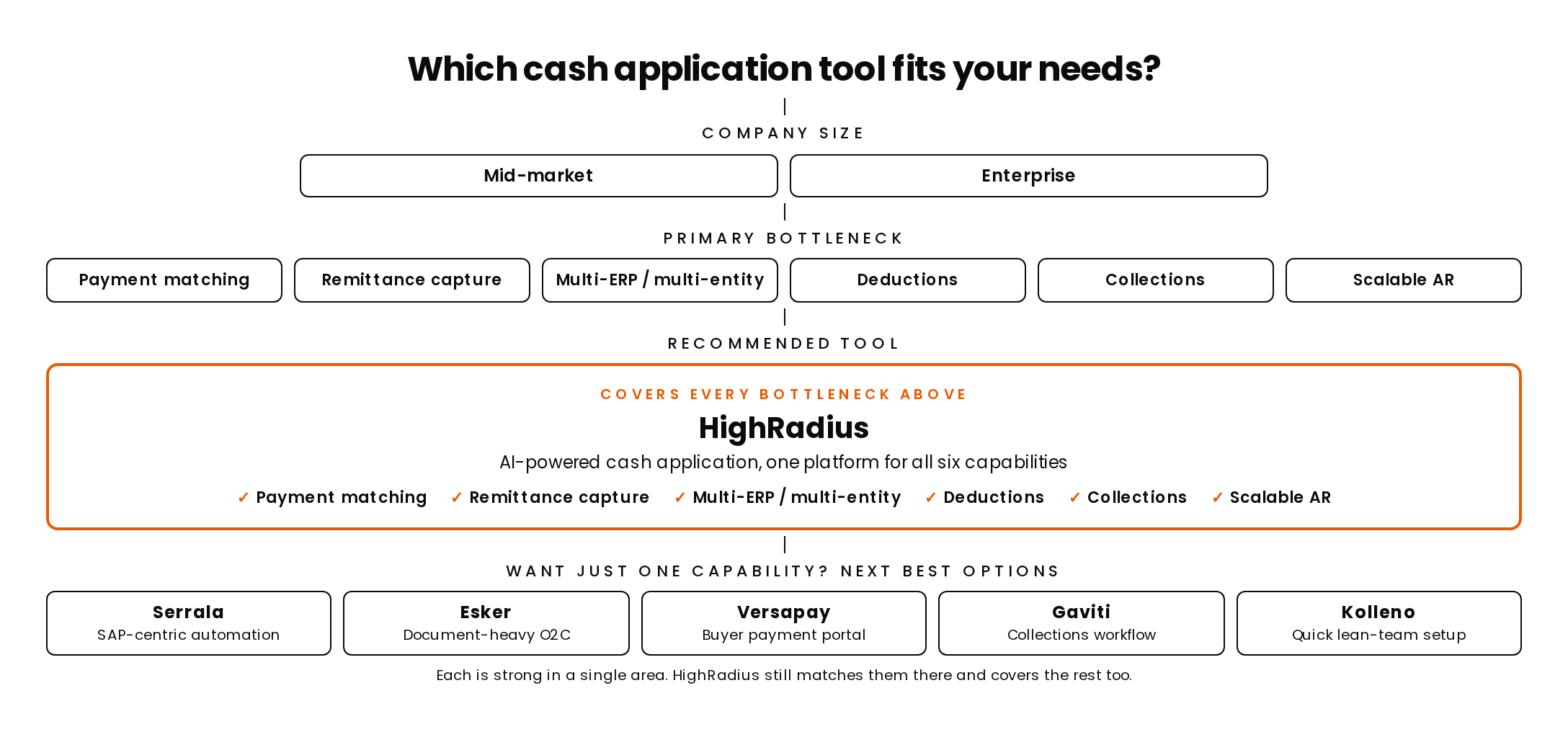
Best Overall for Mid-Market & Enterprise Cash Application: HighRadius Cash Application Software helps finance teams achieve 90%+ touchless cash posting on a unified Agentic AI system that connects cash application, deductions, and collections. A 3-time Gartner-recognized leader, HighRadius handles enterprise-level complexity while going live in as early as 4 weeks, so organizations across all sizes realize ROI faster.
Best for SAP-Centric Environments: Serrala – native integration for organizations running SAP landscapes.
Best for Document Capture & OCR: Esker – AI-driven extraction of remittance data from emails, checks, and portals.
Best for Billing & Invoicing Network: Billtrust – standardizes how invoices and payments move through hard-to-reach customer AP portals.
Best for AR Collaboration Portals: Versapay – a portal-first approach where buyers and sellers resolve payment issues in real time.
Best Lightweight Collections + Cash Tracking: Gaviti or Quadient A/R (YayPay) — fast-deploying tools for follow-ups and aging visibility.
Best for Simple, Fast Setup: Kolleno – a straightforward matching tool for organizations that want automation and doesn’t have much complex data.
By 2026, the mandate for finance leaders has shifted from "managing cash application" to "unlocking working capital." According to NACM's State of AR Automation Survey, 44% of organizations still rely on little to no automation, leaving finance teams to match payments to invoices manually across remittance data fragmented between emails, PDFs, lockboxes, and portals - while only 13% of businesses get paid on time.
This guide is designed to help you navigate that shift with the right cash application software. We've analyzed the top 9 cash application tools for 2026, evaluating them on automation depth, integration capabilities, scalability, and pricing - from lean AR teams to organizations running multi-ERP environments processing millions of transactions annually.
Top-Rated Cash Application Automation Tools at a Glance
Modern cash application tools lean on AI, machine learning, and ERP integrations to simplify what used to be a manual, error-prone workflow. Here's a quick snapshot of where each of the 9 tools in this guide fits before we get into the details.
Platform
Best Suited For
HighRadius
Best for Mid-Market & Enterprise cash application, with 90%+ automation, faster ROI, AI-driven multi-ERP standardization, and global AR process efficiency, with the flexibility to scale into an end-to-end accounts receivable system.
Esker
Best forAI-powered remittance capture from emails and PDFs, althoughorganizations with complex cash application needs deeper automation for payment matching and exception handling.
Billtrust
Best for businesses that want invoicing, payments, and cash application in one tool, but it's more payment-focused than a complete accounts receivable automation solution.
Gaviti
A good fit for teams seeking fast deployment and straightforward collections management, though companies will eventually need more advanced AI automation and analytics.
Quadient (YayPay)
Well suited to finance teams that prioritize collections visibility alongside cash application, while organizations with complex payment matching will need a more specialized automation system.
Versapay
Best for organizations that value customer self-service and collaborative AR workflows, yet high-volume finance teams require more advanced AI-driven matching and automation.
Kolleno
A good choice organizations needing a simple cash application solution with multi-entity support, although businesses with broader receivables processes needs deeper workflow automation.
Serrala
Best for SAP-centric organizations managing global payment processing, though companies operating across multiple ERP systems will require broader automation capabilities.
Emagia
Well suited to enterprises looking to add AI-driven receivables automation to existing systems, but organizations needing highly configurable workflows and extensive ERP connectivity will require additional customization.
See if HighRadius is the right fit for your business
Every finance team has different payment volumes, ERP environments, and remittance challenges. Schedule a personalized demo to explore how HighRadius fits your existing processes and automation goals.
How to Evaluate an Automated Cash Application Tool
Choosing the right cash application solution in 2026 isn't just about finding a tool that matches a payment to an invoice - it's about finding a system that can absorb the messiness of real-world remittance data without constant manual intervention.
Here's what to weigh:
Agentic AI vs. rule-based matching
A unified system vs. a point solution
How well it integrates with your ERPs, banks, and portals
How fast can you actually go live
Whether it scales with you
Total cost of ownership
How pricing is structured
Compliance and security posture
1. Agentic AI vs. Rule-Based Matching
Rule-based tools follow simple logic: if the payment amount matches an open invoice exactly, post it. That's fine until a customer sends one payment covering four invoices with no remittance advice attached, which happens constantly.
Modern remittance automation solutions powered by Agentic AI goes further. It interprets unstructured remittance data, works out short pays and deductions automatically, and gets better over time by learning from how analysts have historically handled exceptions. That difference is usually what separates a tool stuck around 60 to 70% straight-through processing from one clearing 90%.
2. A Unified System vs. a Point Solution
Some tools are built to do one job in the cash application process really well, like capturing remittance documents or giving customers a payment portal. If that one task is genuinely your only pain point, a focused tool can be a perfectly sound choice.
The catch is that most AR teams have more than one pain point. A tool built around remittance capture, for example, typically still needs a separate system for deduction coding and another for collections follow-up, which means more integrations to maintain and more chances for data to drift out of sync between systems. A unified system keeps matched cash, open deductions, and collections activity in the same place, so a short pay identified during matching can flow straight into the next step without anyone re-entering it.
3. Integration With ERPs, Banks, and Portals
A cash application tool is only useful if it connects cleanly to the systems you already run.
Look for native integrations across 50 or more ERPs (SAP, Oracle, NetSuite, Sage, Microsoft Dynamics). If a vendor tells you they'll need to build a custom connector, budget for extra time and cost. Beyond the ERP, check that the tool connects directly to your banks for reconciliation and to the customer or AP portals (Ariba, Coupa, and similar) where remittance data often actually lives.
4. Speed to Value
Implementations without pre-built integrations can stretch into months. The better tools on the market now get core cash application workflows live in around 3 weeks, which means you start seeing a dent in unapplied cash in the same quarter you sign.
5. Scalability
Whatever tool you pick should handle where your transaction volume is headed, not just where it is today. That means multi-entity, multi-currency, and multi-ERP support without a full re-implementation every time you grow or acquire a business unit.
6. Total Cost of Ownership
The license fee is the easy part to compare. The real cost shows up in implementation, ongoing maintenance (if a simple rule change needs a consultant, that's a red flag), and whether the tool actually lets you avoid hiring as volume grows.
7. Pricing Models
Pricing has been shifting away from flat per-seat licenses toward models tied to results, like a percentage improvement in straight-through processing or a reduction in unapplied cash. That structure gives the vendor a reason to care about your outcomes, not just your renewal.
8. Compliance and Security
You're processing incoming payments at volume, so this isn't optional. Confirm SOC 2 Type II, ISO 27001, and PCI DSS certifications, and check that the tool can handle the bank file formats and regional compliance requirements relevant to where you operate.
Bottom line: if unapplied cash keeps climbing, look hardest at how the tool handles partial and messy payments, not clean matches. If you're already juggling separate tools for matching, deductions, and collections, weigh whether a unified system would remove those manual hand-offs. If your team is buried in exceptions, ask for straight-through processing numbers and have the vendor walk you through an actual exception, not a demo where everything matches perfectly.
Which Cash Application Tool Fits Your Company Size
The "best" tool really depends on where your organization sits and what's actually breaking today.
Enterprise organizations are typically running multiple entities and currencies, with remittance data arriving through hundreds of different channels into several ERPs at once. What they need most is one source of truth across business units and regions.
Mid-market organizations are often growing faster than their AR headcount. Manual matching starts cracking under volume, and they need something that scales without a long IT rollout.
SMBs usually have one specific bottleneck, whether that's slow remittance capture or poor visibility into aging, and want it solved quickly without rebuilding their whole AR stack.
Organization Size
Common Challenge
Primary Pick
Enterprise (global, multi-entity)
High unapplied cash, complex deductions, remittance data scattered across dozens of channels and ERPs.
HighRadius
Mid-Market ($100M to $1B)
Fragmented workflows, scaling without adding headcount, growing exception backlogs.
HighRadius
Leaner AR Teams
One clear bottleneck (capture, portals, visibility) that needs a fast fix.
Focused tools such as Kolleno or Gaviti
Which Tools Extend Beyond Cash Application
These tools cover cash application plus at least one adjacent piece of the receivables cycle, like invoicing, deductions, or a customer portal. Scope varies by vendor, so it's worth checking exactly which pieces are covered before assuming a tool handles the whole cycle.
Tool
What It's Built Around
Adjacent Piece It Covers
HighRadius
Cash application, collections, deductions, and credit in one system, tied into Close, Recon, AP, and Treasury.
Full receivables cycle
Billtrust
A billing and payments network that gets invoices into customer AP portals.
Invoicing and payments
Versapay
A collaboration portal where buyers and sellers work out disputes together.
Customer portal
Quadient A/R (YayPay)
Visual dunning workflows with predictive collections prioritization.
Collections
Specialized & Niche Cash Application System
The rest of the tools on this list are built for a specific slice of the cash application process. None are meant to run your whole receivables cycle, but each is a solid pick for the exact problem it targets.
Tool
Positioning
Best Fit For
Esker
AR automation platform with cash application as part of a broader document automation suite.
Organizations evaluating document-centric AR automation.
Serrala
Treasury and SAP-focused financial operations platform.
Organizations with a strong SAP and treasury focus.
Gaviti
Fast-deploying collections tracking paired with basic cash matching.
You want quick wins on collections visibility.
Kolleno
Straightforward AI matching for multi-entity, multi-currency books.
You want automation live quickly, without a long rollout.
Emagia
An AI layer (Gia) sitting on top of existing bank, ERP, and portal connections.
You want basic AI features to be added, to your systems.
A Quick Strategic Check: go with a unified tool if you want matching, deductions, and collections working off the same data without manual hand-offs. Go with a focused tool if you have one well-defined bottleneck and don't mind maintaining a separate system (and separate data reconciliation) for the rest of your AR stack.
How To Choose The Right Cash Application System by Strategic Use Case
The right system depends on which bottleneck is actually costing you money.
Priority
Best Fit
Why
High-volume manual matching
HighRadius
Targets 90%+ straight-through processing and resolves messy or missing remittance data without manual review.
Multi-ERP, global complexity
HighRadius
Acts as one source of truth across 50+ ERPs and 110+ banks.
Deductions and short pays piling up
HighRadius
Auto-codes deductions using patterns from 600+ implementations and routes them straight into collections.
SAP-only environment
Serrala
Purpose-built native integration for SAP shops specifically.
Remittance stuck in unstructured formats
Esker
OCR and NLP tuned for pulling data out of emails, checks, and scanned documents.
Buyer and seller need to collaborate directly
Versapay
A branded portal where disputes get worked out between AR teams and customers.
You just need better collections visibility
Gaviti or Quadient A/R
Quick to deploy, without a full system overhaul.
One thing worth doing in every demo: ask the vendor to show you an actual exception, not a happy-path walkthrough. A missing remittance, a partial payment, a disputed line item. That's where you'll see whether resolution flows automatically into deductions and collections, or whether you're the one re-keying it somewhere else.
What are the top features to look for in a Cash Application System
1. Coverage across the full workflow. Remittance capture, matching, exceptions, and deduction coding handled in one place rather than several. Disconnected tools add up to roughly 35% more processing bottlenecks than a centralized workflow (Gartner).
2. Matching that handles more than clean payments. AI that can work through partial, bulk, and decoupled payments, not just simple one-to-one matches. This is typically what drives a 35% jump in matching accuracy (IDC).
3. Real ERP integration, not a bolt-on. Native, two-way sync with SAP, Oracle, Microsoft Dynamics, NetSuite, and similar systems. Tools without this see roughly 40% more data sync errors and slower closes.
4. Remittance capture from every channel you actually use. Email, PDF, EDI, bank files, and customer or AP portals, all feeding one workflow. This alone can cut reconciliation time by up to 80% (IOFM).
5. Dashboards you can act on immediately. Real-time visibility into unapplied cash, match rates, and exception volume, not a report that's a week old by the time someone reads it. Teams with this kind of visibility manage cash flow risk about 20% more effectively (The Hackett Group).
6. Room to grow. Multi-currency and multi-entity support, plus global bank formats like MT940, CAMT, and BAI2. Cloud-native tools tend to let organizations scale transaction volume roughly 4x over three years without adding headcount (Accenture).
7. Deductions are handled as part of the same flow. Automatic classification of short pays and deductions that feeds directly into collections, rather than sitting in a spreadsheet somewhere. This is usually what shortens close cycles and clears out backlog.
9 Recommended Cash Application Tools in 2026
Selecting the right cash application tool is a critical step toward improving invoice-to-cash performance, cash forecasting, liquidity management, finance workflows, and financial analytics. While every tool automates payment matching, they differ significantly in AI capabilities, ERP integrations, exception handling, and the breadth of receivables processes they support.
1. HighRadius
HighRadius is an agentic, AI-powered Integrated Receivables tool that transforms cash application from manual matching to a fully autonomous, touchless workflow for global enterprises and mid-market teams. Recognized as a 3× Leader in the Gartner® Magic Quadrant for Invoice-to-Cash, HighRadius uses specialized AI agents to autonomously capture, interpret, and process remittances from 600+ customer portals, emails, PDFs, and bank files, eliminating manual intervention across the cash application lifecycle.
Unlike standalone tools that only match payments, HighRadius connects cash application, collections, deductions, and credit within a unified receivables system, enabling end-to-end cash flow automation across multi-ERP environments.
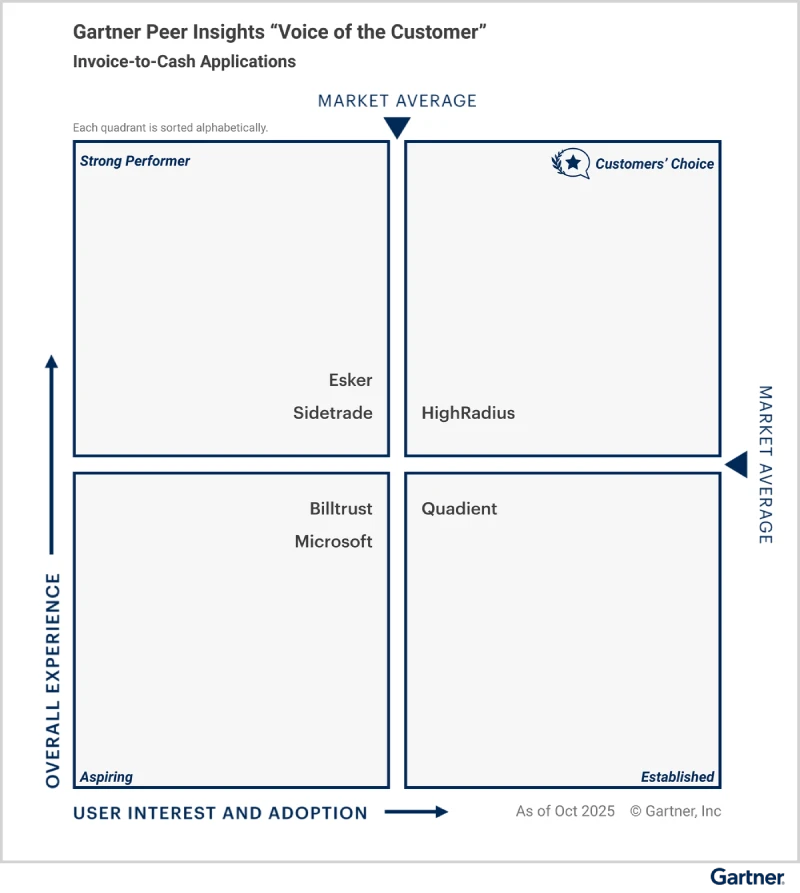
HighRadius: Recognized as Customer's Choice in Gartner® Voice of the Customer for Invoice-to-Cash Applications
Achieves 90%+ straight-through cash posting using agentic AI for invoice-to-payment matching
Automates remittance capture from emails, PDFs, EDI files, and 500+ customer portals
Handles full, partial, and multi-invoice payment matching with minimal manual intervention
Processes global bank formats, including MT940, CAMT, and BAI2 with automated reconciliation
Identifies and codes short pays, deductions, discounts, and overpayments automatically
Integrates seamlessly with 50+ ERPs, 110+ banks, and global billing systems
Provides real-time visibility into unapplied cash, match rates, and AR performance KPIs
Why HighRadius Wins
HighRadius goes beyond cash application by acting as the intelligence layer of Integrated Receivables, unifying fragmented AR processes across ERP environments to support both mid-market teams scaling beyond manual operations and global enterprises managing complex, multi-ERP cash flow ecosystems. Thus helping improvee cash visibility through real-time analytics, automating finance workflows, providing accurate receivables reporting, and helping finance teams strengthen cash forecasting and liquidity management with faster, more accurate cash application to deliver:
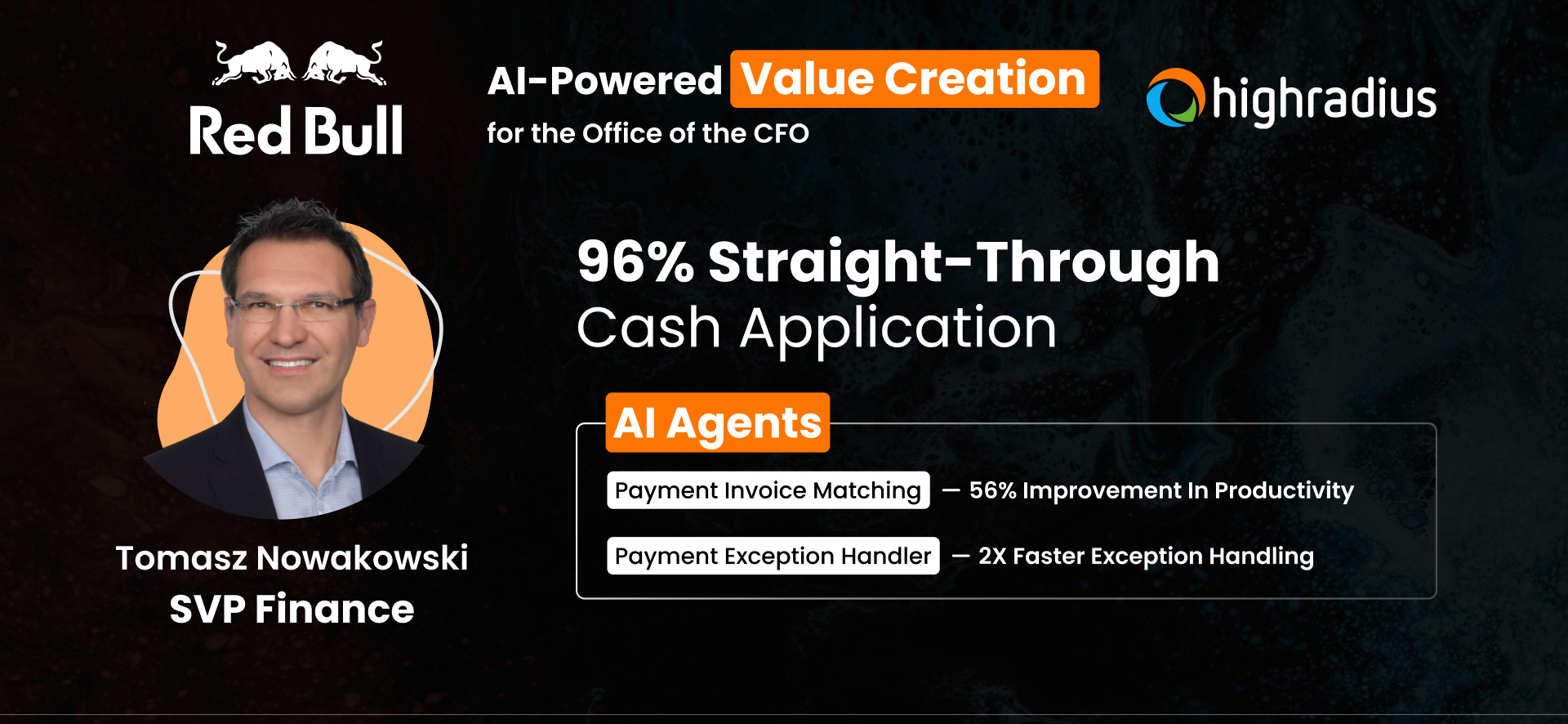
56% productivity improvement in auto-matching workflows
2× faster exception resolution through AI-driven case handling
$6.2M working capital unlocked through improved cash visibility and automation
Up to 96% straight-through cash application accuracy in large-scale deployments
Case Studies
See how HighRadius helped TCL achieve 97% Touchless Cash Posting
Understand the challenges involved in traditional cash application and how it affects the overall cash flow
A solid fit if your organization runs on SAP, Serrala offers deep native SAP integration for payment matching and reconciliation, along with support for a wide range of global payment formats and bank statement types.
Where it falls Short: Organizations running multiple ERP environments or looking for broader AI-driven finance workflows, analytics, and cash forecasting require additional solutions outside the core system.
3. Esker
If unstructured remittance data is the main thing slowing your team down, Esker's OCR and NLP capabilities are built to pull payment information out of emails, checks, and portals, with collaborative workflows for resolving exceptions and disputes.
Where it falls Short: While document capture is a strength, organizations with cash application requirements need deeper automation for multi-invoice matching, and liquidity management.
4. Billtrust
A long-standing name in B2B billing, Billtrust gets invoices and payments moving through complex customer AP portals via its Business Payments Network, with an AI-driven cash application module built on top.
Where it falls Short: Businesses looking for a single tool that unifies the entire accounts receivable workflow including, cash application, collections, credit, deductions, and AR analytics will find the tool more focused on payments than end-to-end receivables automation.
5. Versapay
Built around what it calls "Collaborative AR," Versapay gives customers a branded portal to view, dispute, and pay invoices directly, with automatic flagging and routing of short pays and unmatched payments.
Where it falls Short: Companies processing high transaction volumes across multiple business units require more advanced automation, AI-driven matching, and cash forecasting capabilities.
6. Quadient A/R (YayPay)
A good option for teams that want predictive, visual collections alongside cash application. It ranks customer risk and prioritizes daily outreach, with AI-powered payment matching included.
Where it falls Short: Its strengths lie in collections, while organizations with complex payment matching requirements need a cash application automation module and broader finance workflow orchestration.
7. Gaviti
Built for fast deployment, Gaviti focuses on collections tracking and basic cash matching, including support for legacy systems, for teams that find their current tools too slow or rigid to work with.
Where it falls short: Organizations requiring AI-powered automation, advanced analytics, or integrated liquidity management will eventually outgrow the tool as transaction complexity increases.
8. Kolleno
A straightforward matching tool for organizations juggling multiple entities and currencies, pairing AI-driven remittance processing with real-time ERP integrations and a centralized view of cash positions.
Where it falls short: Organizations often need deeper automation across deductions, collections, cash forecasting, and AI-driven finance workflows than the tool currently provides.
9. Emagia
Emagia layers its AI copilot, Gia, on top of your existing bank, ERP, and AP portal connections to automate remittance capture, deduction handling, and dispute resolution for organizations running global operations.
Where it falls short: While it supports multiple receivables processes, organizations seeking configurable workflows, extensive ERP connectivity, and deeper operational analytics require additional customization.
**This blog reviews 9 cash application tools. The order they're listed in is for reference only and doesn't reflect ranking or quality.
Implementation & Support: What to Expect When Deploying Cash Application System
Selecting the right cash application system goes beyond comparing features and pricing. A successful implementation depends on how easily the solution integrates with your existing finance ecosystem, how quickly your team can start automating cash application, and the level of support you receive after go-live.
While implementation timelines vary by organization, evaluating the following areas can help you choose a tool that delivers long-term value.
1. Deployment & Implementation Approach
Different vendors offer different deployment models. Some solutions are designed for rapid cloud deployment with pre-built integrations, while others support more complex enterprise environments with multiple ERPs, business units, and global operations.
When evaluating vendors, ask:
Is the solution cloud-native or on-premise?
Does it support phased rollouts across business units?
How much IT involvement is required during implementation?
Can additional entities or regions be added without major redevelopment?
The right deployment model should align with your organization's existing IT strategy and future growth plans.
2. ERP & Financial System Integration
Cash application tool should fit into your existing technology stack rather than requiring significant process changes.
Look for vendors that provide native or pre-built integrations with leading ERP systems such as: SAP, NetSuite, Microsoft Dynamics 365, Infor, Workday, Sage, Oracle.
Beyond ERP connectivity, evaluate how the solution exchanges customer, invoice, payment, and journal data, as well as how frequently data is synchronized between systems.
Pre-built integrations typically reduce implementation effort and simplify ongoing maintenance.
3. Bank & Payment Channel Connectivity
Most organizations receive payments and remittance information through multiple channels. A successful implementation should consolidate these sources without requiring extensive manual intervention.
Consider whether the tool supports:
Bank statement formats (BAI2, CAMT.053, MT940, etc.)
Lockbox providers
ACH and wire payment files
EDI remittances
Customer payment portals
Email remittances
PDF remittance documents
Broader connectivity reduces integration complexity and helps automate a larger percentage of incoming payments.
4. AI Configuration & Historical Learning
Modern cash application tools use artificial intelligence to improve invoice matching and reduce manual work over time.
Instead of relying solely on static matching rules, evaluate whether the solution can learn from historical payment behavior and continuously improve matching accuracy.
Questions worth asking include:
Does the system learn from previous analyst decisions?
Can it recognize customer-specific payment patterns?
How does it handle short pays, deductions, and unapplied cash?
How much ongoing rule maintenance is required post deployment?
Tools that continuously learn typically require less manual configuration as payment complexity increases.
5. Data Migration & Go-Live Readiness
Historical payment and remittance data often play an important role in achieving strong automation from day 1.
Before implementation, understand:
What historical data is required?
Who is responsible for data migration?
How are existing matching rules migrated?
What validation and testing process is followed before go-live?
A structured implementation plan helps minimize disruption while ensuring users can begin processing payments confidently from the first day of production.
6. Time to Value
Implementation success should be measured by business outcomes rather than project duration alone.
Instead of asking: "How long will implementation take?"
Ask: "How quickly can we begin increasing straight-through processing and reducing manual cash application effort?"
The answer often depends on factors such as: Number of ERP systems, Payment volume, Number of legal entities, Bank integrations, Data quality, Complexity of customer payment behavior
Understanding these variables helps set realistic expectations for automation improvements after deployment.
7. Ongoing Support & Customer Success
Implementation is only the beginning. Continuous optimization is essential as payment volumes grow, new customers are added, and business processes evolve.
Look for vendors that provide:
Dedicated implementation consultants
Customer success managers
Technical support with defined service level agreements (SLAs)
Product training for finance teams
Regular optimization reviews
Continuous product enhancements and security updates
Strong post-implementation support helps organizations sustain high automation rates while adapting to changing business requirements.
Cash Application Implementation Checklist
Use the following checklist when evaluating different cash application system providers.
Evaluation Area
What to Look For
Deployment
Cloud-based deployment, phased rollout options, minimal IT effort
ERP Integration
Native connectors for your ERP and financial systems
Bank Connectivity
Support for bank files, lockboxes, EDI, portals, and email remittances
AI Capabilities
Learns from historical payment behavior and continuously improves matching
Data Migration
Structured migration, validation, and go-live planning
Scalability
Ability to support additional entities, regions, and payment volumes
Support
Dedicated implementation team, customer success, training, and technical support
Business Outcomes
Clear plan to improve straight-through processing and reduce manual effort
Key Takeaway: The best cash application tool isn't simply the tool with the longest feature list, it's the one that integrates smoothly with your finance ecosystem, scales with your business, and delivers measurable improvements in cash application efficiency after deployment. Evaluating implementation, integration, and ongoing support alongside product capabilities will help you choose a solution that provides lasting value rather than a successful go-live alone.
Key Benefits of Cash Application Automation Tool
Cash application automation uses AI and automation to match payments to invoices, capture remittance data, and post cash with minimal manual effort. It replaces time-consuming manual tasks with faster, more accurate processing. If you're new to the workflow, learn more about the cash application process.
1. Faster cash conversion: Automatically matches payments to invoices, accelerating cash posting and reducing manual effort.
2. Real-time visibility: Provides live visibility into unapplied cash, match rates, and exceptions for faster decision-making.
3. Lower operational cost: Captures remittance data automatically, reducing manual lockbox key-in costs and enabling teams to manage higher payment volumes.
4. Better accuracy, fewer disputes: Improves match accuracy, reduces posting errors, and minimizes customer disputes.
Templates
Build Your Business Case for Cash Application Automation
Project your ROI and build a data-backed case for automated cash application with our Excel template.
Why Top Enterprises & Scaling Mid-Market Teams Choose HighRadius Automated Cash Application Tool
Agentic AI Powered HighRadius's cash application tools, is widely recognized as a market leader for automating complex cash application workflows. It enables both mid-market teams scaling beyond manual processes and global enterprises managing multi-ERP complexity to accelerate cash flow, reduce manual effort, and gain real-time visibility into receivables.
AI Remittance Aggregation
Feature: Leverages AI and NLP to extract remittance data from emails, attachments, portals, and check images.
Mid-Market Benefit: Eliminates manual data entry for lean AR teams, enabling faster cash posting and freeing analysts from repetitive tasks. Enterprise Benefit: Aggregates remittance data across hundreds of channels globally, standardizing inputs across business units and enabling high automation at scale.
Feature: Pre-built integrations with 500+ customers and AP portals via APIs and RPA.
Mid-Market Benefit: Removes the need for analysts to log into multiple portals, saving hours each week and ensuring no remittance is missed. Customer Success Story: American Greetings achieved 99% automated cash application across both Mid-market and SMB customer payment behaviors with a hit rate of 96%.
Enterprise Benefit: Scales portal data extraction across regions and customers, eliminating one of the biggest bottlenecks in global cash application. Customer Success story: Johnson & Johnson achieved a 95%+ cash application hit rate within 3 months by automating remittance aggregation, payment matching, and deduction coding across 800,000 remittance lines annually
Remittance Auto-Matching
Feature: Agentic AI automatically matches payments to invoices even for partial, bulk, or decoupled payments.
Mid-Market Benefit: Reduces unapplied cash and accelerates reconciliation cycles without increasing headcount. Customer Success Story: Milliken achieved 84% straight-through cash posting with 64% productivity boost.
Feature: AI suggests matches and automates outreach for missing remittance data. Mid-Market Benefit: Enables small teams to resolve exceptions faster without constant customer follow-ups. Enterprise Benefit: Automates exception handling across large volumes, reducing manual intervention and improving turnaround times.
Feature: Uses a pre-built library from 600+ implementations to automatically classify deductions and short-pays. Mid-Market Benefit: Reduces backlog and improves close cycles without requiring dedicated deduction teams. Enterprise Benefit: Standardizes deduction coding across regions and business units, reducing manual effort at scale.
Automatically capture remittances – from any source, in any format.
Remittance Auto-Matching
Cut down manual effort by 95%. Payments auto-matched before your first coffee.
AI Guided Exception Management
Staying late to manage exceptions? Manage exceptions at 2X speed with AI predictions.
FAQs: AI-Powered Cash Application Tool
1. What is the best cash application system in 2026?
The best cash application system depends on your business size, payment complexity, and ERP environment. If you need AI-powered payment matching, multi-ERP support, and the flexibility to automate the entire accounts receivable process, HighRadius is one of the strongest choices for both mid-market and enterprise organizations.
The best cash application system depends on your business size, payment complexity, and ERP environment. If you need AI-powered payment matching, multi-ERP support, and the flexibility to automate the entire accounts receivable process, HighRadius is one of the strongest choices for both mid-market and enterprise organizations.
2. What features actually matter in a cash application tool?
AI-based remittance capture, automated matching, exception workflows, ERP integration, bank connectivity, deduction and dispute linking, real-time dashboards, and rules you can actually configure yourself.
AI-based remittance capture, automated matching, exception workflows, ERP integration, bank connectivity, deduction and dispute linking, real-time dashboards, and rules you can actually configure yourself.
3. What payment types can these tools handle?
Bank transfers, checks, credit cards, lockbox files, digital wallets, ACH, and partial or multi-invoice payments. The better ones also pull remittance from email, portals, and EDI into one workflow.
Bank transfers, checks, credit cards, lockbox files, digital wallets, ACH, and partial or multi-invoice payments. The better ones also pull remittance from email, portals, and EDI into one workflow.
4. How do cash application tools integrate with ERP systems?
Most cash application tools integrate with ERP systems through APIs, SFTP connections, or pre-built connectors that enable secure data exchange. These connections enable real-time syncing of invoices, payments, and customer data. Matched payments are automatically updated in the ERP.
Most cash application tools integrate with ERP systems through APIs, SFTP connections, or pre-built connectors that enable secure data exchange. These connections enable real-time syncing of invoices, payments, and customer data. Matched payments are automatically updated in the ERP.
5. How do I choose the right cash application tool?
Compare solutions based on remittance capture, payment matching accuracy, ERP integrations, exception handling, reporting, and scalability. Also consider whether you need a standalone cash application tool or a broader accounts receivable system that can support collections, deductions, credit, and future business growth.
Compare solutions based on remittance capture, payment matching accuracy, ERP integrations, exception handling, reporting, and scalability. Also consider whether you need a standalone cash application tool or a broader accounts receivable system that can support collections, deductions, credit, and future business growth.
6. How much does cash application tool cost?
HighRadius offers an Outcome-Based Pricing model with $0 implementation fees, $0 fees until go-live, and gain-sharing only after agreed business outcomes are achieved, reducing upfront investment and implementation risk.
HighRadius offers an Outcome-Based Pricing model with $0 implementation fees, $0 fees until go-live, and gain-sharing only after agreed business outcomes are achieved, reducing upfront investment and implementation risk.
7. Which cash application tool is best for mid-market vs. enterprise?
Mid-market businesses typically benefit from solutions that are quick to deploy and easy to scale. Enterprise organizations often need AI-powered matching, multi-ERP support, and global payment processing. HighRadius supports both, offering cash application as a standalone solution or part of an end-to-end accounts receivable system.
Mid-market businesses typically benefit from solutions that are quick to deploy and easy to scale. Enterprise organizations often need AI-powered matching, multi-ERP support, and global payment processing. HighRadius supports both, offering cash application as a standalone solution or part of an end-to-end accounts receivable system.
Resource Library
Resource Hub
Order to Cash
Order to Cash software data sheet
Disconnected workflows can leave teams chasing data, while automated O2C has delivered 20% lower past dues.
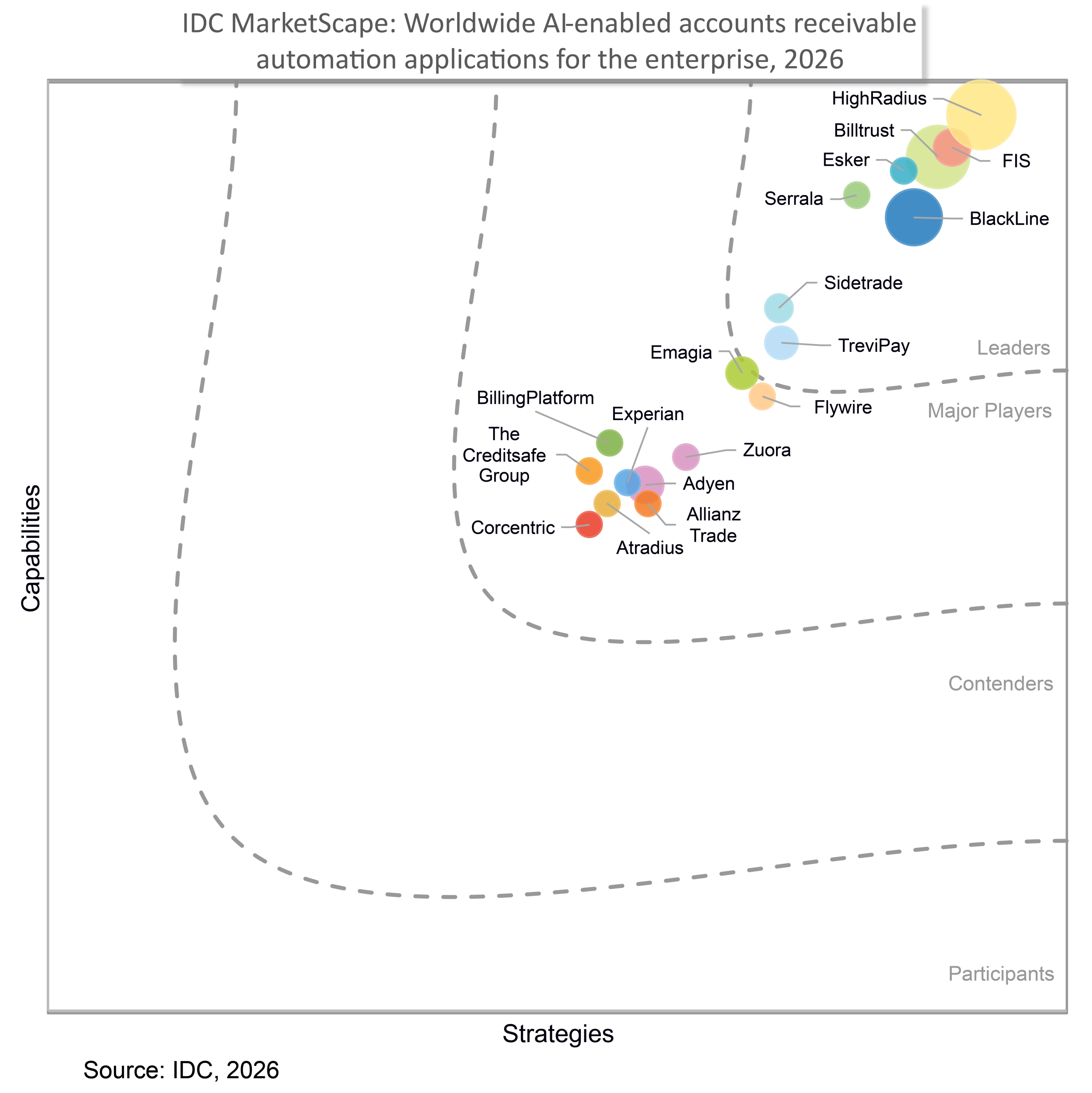
HighRadius recognized as a "Leader" in IDC Marketscape: Worldwide AI-enabled accounts receivable automation applications for the enterprise 2026 vendor assessment
Recognized as a Leader in 2026 Vendor Assessment for unifying credit, collections, cash application, deductions, e-invoicing, and payments on one AI platform to advance enterprise-wide invoice-to-cash transformation.
Forrester Recognizes HighRadius in The AR Invoice Automation Landscape Report, Q1 2023
Forrester acknowledges HighRadius’ significant contribution to the industry, particularly for large enterprises in North America and EMEA, reinforcing its position as the sole vendor that comprehensively meets the complex needs of this segment.