Divya Verma specializes in finance transformation strategy, bringing a content-driven perspective to the rapidly changing FinTech space. With seven years of experience navigating the B2B SaaS landscape, she understands how modern finance leaders think and delivers insights that speak directly to their priorities. When she is not analyzing the latest in enterprise finance, Divya enjoys traveling and getting lost in a good book. Her writing is rooted in sharp domain thinking and a deliberate focus on clarity that finance leaders can act on.
2026 Automation Benchmark Report
HighRadius 2026 Automation Benchmark Report For The Office Of The CFO
Understand if your performance is on par with top 10% of the organizations. Identify gaps, best practices and know how you can drive value through Agentic AI-Driven Automation.
Still Taking Days to Approve New Customers? See how finance teams automate 80–90% of routine credit approvals with automated credit application platform.
Credit scoring agencies play a crucial role in determining the financial health of the business, as they provide business credit scores. The scores are evaluated by analyzing a variety of factors like payment history, credit utilization, credit history, and much more. This score helps businesses secure loans, negotiate favorable terms, and build robust relationships with suppliers and partners.
So, if you are wondering which agencies are these and how they work, keep reading. In this blog, we will discuss the top 5 business credit bureaus and explain how they work.
Guessing your next credit management partner?
Use this Excel-based scorecard to confidently evaluate credit management partners—because top finance teams don’t guess, they measure.
Credit scoring companies are organizations that evaluate the creditworthiness of an individual or a business by providing a credit report along with a credit score. These companies gather information related to your financial history and current financial situation to generate a credit score.
Credit scoring companies play a critical role in the financial ecosystem by providing the tools and data needed to make informed credit and lending decisions. For businesses, accessing their credit reports provided by these agencies is crucial, as lenders use these scores to assess lending risk. Higher credit scores generally lead to better loan terms and lower interest rates.
5 Top Business Credit Scoring Companies
Different credit bureaus have different scoring ranges, different scoring models and different ways to assess the creditworthiness of the business. Experian, Equifax, D&B, CreditSafe and Ansoinisa are top five business credit rating agencies which provide business credit scores.
Here is brief about these top business credit bureaus:
Experian
Widely renowned among both small-scale and large-scale businesses, Experian is a prominent credit scoring company that provides comprehensive credit reports for businesses. It is a multinational data analytics and consumer credit reporting agency headquartered in Dublin, Ireland.
Experian offers business scoring models like Intelliscore Plus, which predict the likelihood of timely debt repayment and overall credit risk. The agency collects business credit data from various sources, including creditors, lenders, and public records. It provides business credit scores, ranging from 0 to 100, reflecting varying levels of risk: 0 signifies high risk, while 100 indicates low risk.
Along with financial data, credit scores, and risk factors, the agency also provides additional services for businesses to protect against fraud, identity theft, and unauthorized transactions, including advanced analytics and decision-making tools.
Equifax
Equifax is a global data, analytics, and technology company known primarily for its role as one of the major credit reporting agencies in the United States. The business credit reports provided by Equifax offer comprehensive insights into the credibility, financial robustness, and operational performance of a wide array of businesses.
Like other credit scoring companies, Equifax considers businesses’ payment trends, credit history, and public records to evaluate the credit score.
However, unlike other agencies, Equifax provides three different scores for businesses: the Payment Index, which ranges from 1 to 100; the Business Credit Risk Score, which ranges from 101 to 992; and the Business Failure Score, which ranges from 1,000 to 1,610.
Dun and Bradstreet (D&B)
Dun & Bradstreet is one of the leading agencies that holds the largest volume of business-credit information. This vast repository enables D&B to provide nuanced assessments of creditworthiness, risk management solutions, and strategic insights crucial for businesses, lenders, and suppliers.
The agency assigns a unique nine-digit D-U-N-S number to each business, which helps track and manage the company’s credit profile consistently across various platforms and reports.
D&B evaluates the creditworthiness by using proprietary scoring models, such as the PAYDEX score. The score ranges from 1 to 100, with 100 being the highest and excellent rating.
CreditSafe
CreditSafe is a global provider of business credit reports and risk management solutions. Compared to other reporting agencies, CreditSafe provides predictive credit scoring. It predicts 70% of insolvencies up to 12 months in advance.
Along with credit scores and limits in the business credit report, the agency also provides core business data and payment data. The comprehensive credit report helps creditors gain better insights into how the company functions and indicates how its future performance is going to be.
The agency helps creditors and lenders evaluate the risk associated with the potential business with a credit score, a number between 0 and 100. To simplify decision-making, the agency uses a color-coded system for scores: green represents low risk, and red indicates high risk.
Ansonia
Ansonia is a business credit reporting and risk management agency acquired by Equifax. It provides credit information and services similar to those offered by other business credit bureaus. The company operates by providing detailed information about companies’ creditworthiness, financial stability, and risk factors.
The agency offers tailored reports that are easy to understand, allowing businesses to grasp the essential details about a company’s creditworthiness quickly.
Ansonia’s credit risk score functions similarly to other systems, utilizing a scale from 0 to 100. Generally, a score of 70 or above suggests a low-risk borrower, while a score of 69 or below indicates a higher level of risk.
How Do Credit Scoring Companies Work?
Top business credit bureaus like Equifax, Experian, and D&B operate by compiling detailed financial information about your business from various sources, such as banks, lenders, and public records. This data includes loan repayments, outstanding debts, and any instances of defaults or bankruptcies.
Using advanced algorithms and statistical models, these companies analyze this data to generate credit scores—numeric summaries that evaluate an individual’s or business’s creditworthiness and likelihood of repaying debts on time.
Factors considered
Here are some of the common factors that these agencies consider to generate the credit scoring:
Payment history (whether you pay bills on time).
Credit utilization ratio (how much credit you use compared to your total available credit).
Debt levels relative to credit limit.
Length of credit history (how long you’ve had credit accounts).
Types of credit used (credit cards, loans, mortgages).
New credit accounts and recent inquiries.
Credit scoring range
The credit scoring range of different credit agencies differs. Each agency uses a different scoring model based on which they provide the corporate credit rating
For businesses
The credit scoring range for business credit scores across various scoring models is typically from 0 to 100. Higher scores indicate lower credit risk, while lower scores suggest higher risk.
For individuals
For individuals, the broad credit scoring range typically used by major credit scoring models such as FICO Score and VantageScore is from 300 to 850.
Ultimately, these scores help lenders assess the risk associated with extending credit, influencing decisions on loan approvals, interest rates, and credit limits.
Here, it is important to note that all the major credit bureaus, like Equifax and Experian, are regulated primarily by the Fair Credit Reporting Act (FCRA). The FCRA is enforced by the Federal Trade Commission (FTC), which oversees the accuracy, fairness, and privacy of consumer credit reports.
Moreover, businesses can get their credit reports from these agencies and verify whether the information in the report is accurate or not. In case, they find any inaccurate data or error, they can get it rectified by writing acredit dispute letter to the respective agency. Doing so is essential, as any discrepancy in the credit report can negatively affect the credit rating of the company, ultimately impacting the reputation of the business.
How Can Businesses Check Their Credit Scores?
Checking business credit scores is crucial for understanding the financial health of the company and managing risk effectively. It helps businesses improve their creditworthiness and make more strategic decisions.
Typically, credit reports from most of these agencies can be easily obtained directly through their websites or customer service channels. Many agencies also offer online platforms where you can create an account to access your credit report and score easily.
Additionally, different agencies offer different types of business credit check services, paid and free. For instance, D&B offers free credit insights and a paid service tier for monitoring scores. Similarly, Experian has different business credit report products, providing various services at different prices. Therefore, depending upon the requirement, you can choose whether to go for a free service or a paid one.
Conclusion
By understanding how credit scoring companies evaluate your financial behavior and leveraging their insights, you can make informed decisions that bolster your company’s creditworthiness. With top agencies like Experian, Equifax, Dun & Bradstreet, CreditSafe, and Ansonia offering various services, you have the resources to stay on top of your credit health.
How HighRadius Credit Risk Software Helps Improve Credit Risk Assessment
HighRadius Credit Management Platform helps mid-market finance teams automate credit decisioning, standardize risk evaluation, and gain real-time visibility into customer exposure without increasing analyst headcount. Built for organizations scaling beyond spreadsheet-driven approvals, the platform combines AI-driven credit scoring, automated workflows, and continuous monitoring to accelerate onboarding, reduce manual reviews, and improve control over credit risk.
With real-time credit risk management tools and AI-powered credit management solutions, finance teams can receive alerts for changes in customer credit profiles and make faster, data-driven decisions using unlimited credit reports. The platform integrates with ERP systems and can begin monitoring customers in as little as 30 days.
With real-time credit risk analysis software and credit decisioning software, you can receive alerts for any changes in your customers’ credit profile and make data-driven credit decisions from unlimited credit reports. Our software integrates with your ERP system and can start monitoring your customers in just 30 days.
We offer configurable credit scoring software and approval workflows that can be customized based on geography, customer segments, business units, and other factors. You can fast-track credit approvals through complex corporate hierarchies, making the credit application process more efficient and streamlined.
Our highly configurable online credit application allows you to onboard customers across the globe with multi-language, customized credit applications embedded on your website. You can automatically capture financials, personal guarantees, and check bank references, reducing the need for manual data entry.
Our software also automatically extracts credit data from over 40+ global and local agencies, including credit ratings, financials, and credit insurance information. You can configure the auto-extracted data in your preferred currency, making it easier to analyze and interpret.
With AI-based blocked order management, you can auto-predict blocked orders based on the customers’ credit limit utilization and payment history. You can leverage AI-based release or partial payment recommendations for faster credit decisions, reducing the need for manual intervention.
Struggling With Slow Credit Approvals and Credit Reviews?
Explore the #1 software that makes onboarding customer faster and easier
Accelerate payment recovery from delinquent customers and boost cash flow through automated collection workflows.
Cash App
Achieve same day cash application with automated remittance aggregation
Credit
Mitigate credit risk, reduce bad debt, and streamline customer onboarding with AI-powered insights.
Deductions
Reduce Revenue Leakage with AI Prediction models that identify valid and invalid deductions.
Online Credit Application
Onboard customers seamlessly with a configurable online credit application. Cut down on back-and-forth and collect all customer details in one go.
Frequently Asked Questions (FAQs)
1. Who provides business credit scores?
Business credit scores are provided by major agencies like Experian, Equifax, and Dun & Bradstreet (D&B). They evaluate how well a business handles its financial commitments, like timely paying bills and managing debt. These scores help creditors assess the business’s creditworthiness.
Business credit scores are provided by major agencies like Experian, Equifax, and Dun & Bradstreet (D&B). They evaluate how well a business handles its financial commitments, like timely paying bills and managing debt. These scores help creditors assess the business’s creditworthiness.
2. What is an acceptable business credit score?
An acceptable business credit score typically varies by the creditor and industry but generally falls above 75 on a scale of 0 to 100. Higher scores indicate lower credit risk, increasing the chances of securing favorable c of favorable credit terms and financing options.
An acceptable business credit score typically varies by the creditor and industry but generally falls above 75 on a scale of 0 to 100. Higher scores indicate lower credit risk, increasing the chances of securing favorable c of favorable credit terms and financing options.
3. What is a good Dun and Bradstreet score?
A good Dun & Bradstreet (D&B) PAYDEX Score is typically 80 or above. This score reflects consistent and timely payment behavior, demonstrating reliability in meeting financial obligations and managing credit responsibly. Besides, the higher the score, the better it is for the business.
A good Dun & Bradstreet (D&B) PAYDEX Score is typically 80 or above. This score reflects consistent and timely payment behavior, demonstrating reliability in meeting financial obligations and managing credit responsibly. Besides, the higher the score, the better it is for the business.
4. What is the highest credit rating for a business?
The highest credit rating for a business varies among credit bureaus. For instance, for Experian, a score above 80 is generally considered excellent; for Equifax, a score above 90 is typically considered very good; and for D&B, a score of 80 and above is considered good.
The highest credit rating for a business varies among credit bureaus. For instance, for Experian, a score above 80 is generally considered excellent; for Equifax, a score above 90 is typically considered very good; and for D&B, a score of 80 and above is considered good.
5. What is the most accurate credit rating agency?
Determining the most accurate credit rating agency depends on the specific needs of the business and context. Each major credit bureau has strengths in data collection, scoring models, and industry-specific insights, making them reputable sources for business credit assessments.
Determining the most accurate credit rating agency depends on the specific needs of the business and context. Each major credit bureau has strengths in data collection, scoring models, and industry-specific insights, making them reputable sources for business credit assessments.
Resource Library
Resource Hub
Order to Cash
Order to Cash software data sheet
Disconnected workflows can leave teams chasing data, while automated O2C has delivered 20% lower past dues.
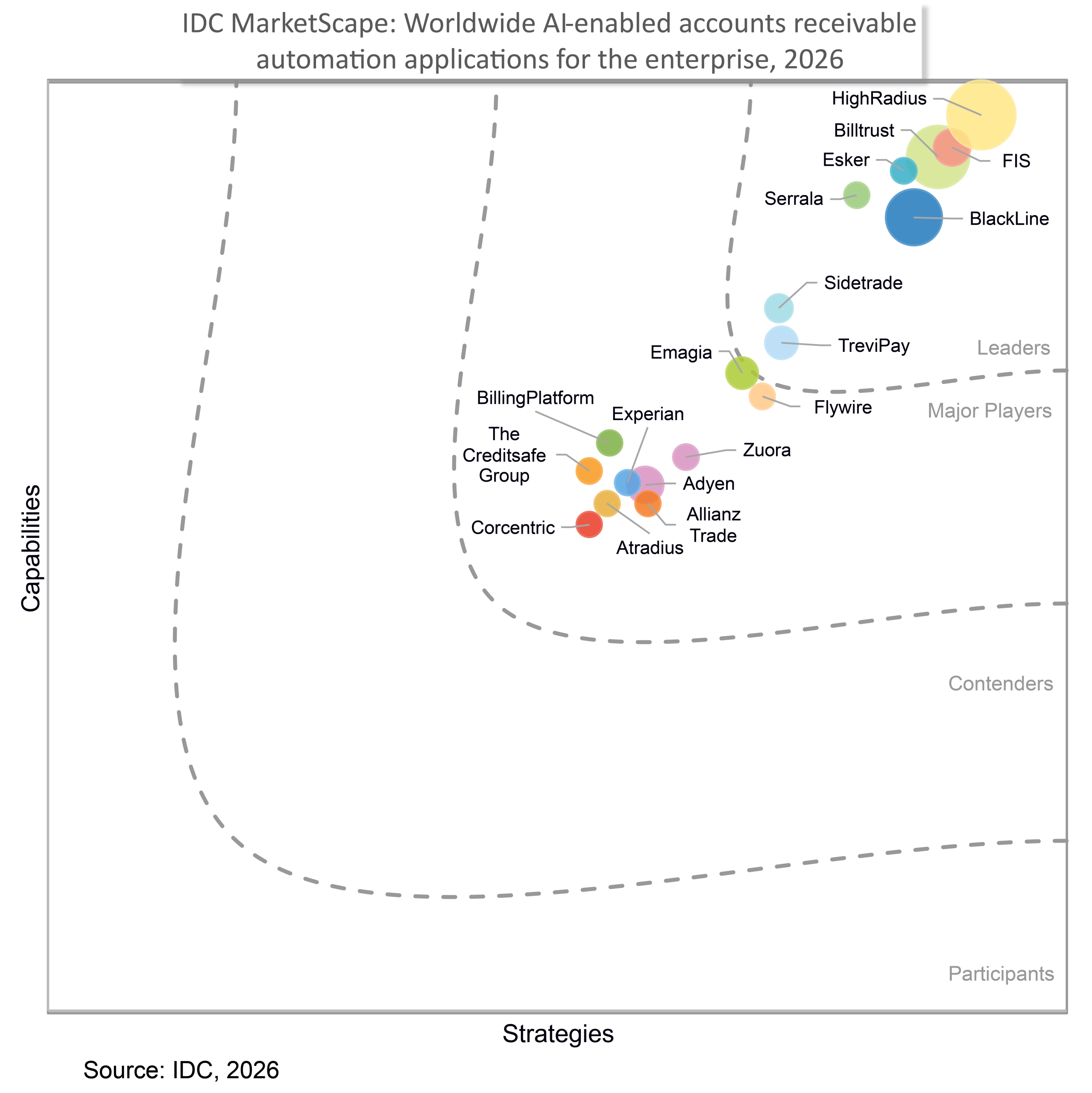
HighRadius recognized as a "Leader" in IDC Marketscape: Worldwide AI-enabled accounts receivable automation applications for the enterprise 2026 vendor assessment
Recognized as a Leader in 2026 Vendor Assessment for unifying credit, collections, cash application, deductions, e-invoicing, and payments on one AI platform to advance enterprise-wide invoice-to-cash transformation.
Forrester Recognizes HighRadius in The AR Invoice Automation Landscape Report, Q1 2023
Forrester acknowledges HighRadius’ significant contribution to the industry, particularly for large enterprises in North America and EMEA, reinforcing its position as the sole vendor that comprehensively meets the complex needs of this segment.