For decades, the CFO’s office has operated under a "pay-for-access" mandate. You bought a seat, you got a login, and you hoped your team used it well enough to justify the line item. But as we move into 2026, the traditional software as a service pricing model is facing a reckoning.
The rise of the Agentic AI Workforce has fundamentally decoupled labor from value. When an AI agent can autonomously resolve a deduction, reconcile a bank statement, or optimize a cash forecast without a human "sitting in the seat," the per-user license becomes an obsolete metric.
According to Gartner, by the end of 2025, at least 30% of GenAI projects will be abandoned due to unclear business value. The "hype tax" is expiring, and finance leaders are demanding a shift from predatory "vendor lock-in" to a model with genuine skin in the game: Outcome-Based Pricing (OBP).
The history of enterprise software pricing models is a story of shifting risk.
The "per-seat" model is increasingly viewed by CFOs as a tax on efficiency. For a finance department, the goal of automation is to reduce the manual workload. However, under traditional Saas software pricing models, if a company uses AI to automate 50% of its accounts receivable tasks, they might actually need fewer seats.
In this scenario, a legacy vendor’s incentives are opposed to the customer’s success. If the vendor helps you become more efficient, they might lose out on revenue. This creates a "Conflict of Interest" where vendors prioritize complex, seat-heavy implementations over streamlined, autonomous results.
EY research suggests that "value-to-cost" satisfaction among enterprise buyers remains below 40%. The "per-seat" model lacks because it measures input (how many people are logged in) rather than impact (how much DSO was reduced).
As we integrate an Agentic AI Workforce into the back office, pricing saas software must reflect the reality of autonomous work. An AI agent doesn't need a "seat." It needs a mission.
Gartner predicts that by 2026, 60% of large IT services contracts will include "AI clawback" clauses or outcome-linked levers. This is because enterprise software pricing is no longer about buying a dashboard; it is about buying an autonomous workflow.
| Feature | Traditional SaaS (Per-Seat) | Outcome-Based AI (OBP) |
| Primary Metric | Number of User Licenses | Mutually Agreed Success Criteria (MASC) |
| Implementation | High Upfront "Professional Services" Fees | $0 Setup Fees |
| Risk Profile | Sunk Cost / Vendor Lock-in | Shared Risk / Pay-for-Impact |
| Value Timing | Pay Before You Use | $0 Subscription till Go-Live |
The complexity of ai software pricing has led to the rise of specialized ai pricing software tools designed to track "tokens," "API calls," or "compute." However, for the CFO, these are just new versions of the same old problem: unpredictability.
Deloitte’s 2025 technology outlook highlights that the "growing gap between estimated and actual cloud costs" is a major pain point. If a finance team uses an AI agent to process 10,000 invoices, they don't want to be billed based on the "tokens" the AI consumes. They want to be billed based on the percentage of invoices processed without human intervention.
This is where the distinction between saas pricing software and true outcome-based models becomes clear. True ai software pricing shouldn't be a meter on the machine; it should be a reflection of the P&L impact.
At HighRadius, we believe the only way to eliminate the friction between vendor and customer is to align incentives through Outcome-Based Pricing (OBP). This model is built on the philosophy that a software vendor should only win when the customer wins.
The most significant barrier to digital transformation has always been the "leap of faith" required by implementation fees. Our OBP model removes this hurdle:
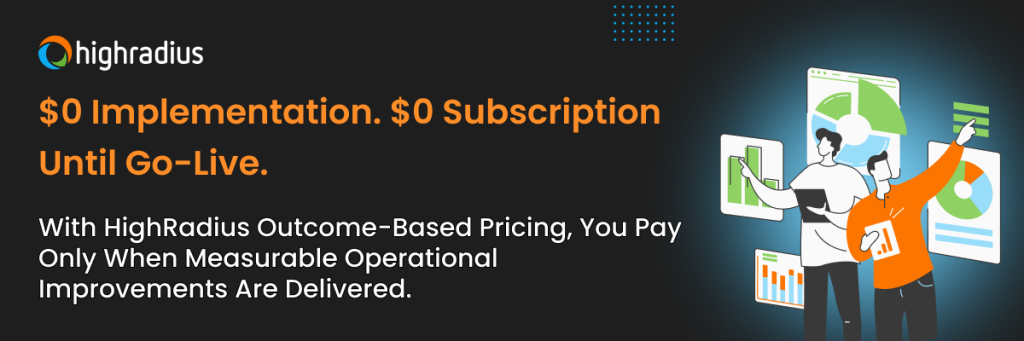
Success is no longer a vague concept. We utilize Mutually Agreed Success Criteria (MASC)- KPIs and metrics tied directly to your financial performance. Whether it is a reduction in DSO (Days Sales Outstanding), an increase in Straight-Through Processing, or a decrease in Past Due %, the fees are tied to these specific, auditable metrics.
Traditional SaaS often relies on "switching costs" to keep customers. OBP turns this on its head. When a vendor’s earnings are tied directly to the impact on a customer’s P&L, the "conflict collapses." The vendor becomes a strategic partner, incentivized to constantly tune the AI agents to deliver better, faster, and more accurate outcomes.
When both parties are focused on a shared financial outcome rather than a "go-live date," the probability of achieving double-digit ROI increases by over 60%.
The transition from software as a service pricing to outcome-based models is more than a change in billing, it’s a change in accountability. As AI agents take over the heavy lifting of the Order-to-Cash and AP cycles, the role of the vendor must evolve from a "tool provider" to a "results guarantor."
In the age of Agentic AI, don't pay for the software's potential. Pay for its performance.
Outcome-Based Pricing is a model where you pay for results rather than access. Unlike traditional software as a service pricing, which charges per user seat, OBP ties your costs to Mutually Agreed Success Criteria (MASC), such as a specific reduction in DSO or an increase in cash application accuracy. If the software doesn't deliver the agreed-upon value, you don't pay the performance fee.
OBP is the ultimate antidote to "shelfware." Most enterprise software pricing models require massive upfront implementation fees. Under our OBP model, we offer $0 Setup Fees and $0 Subscription Fees until your system is live and delivering results. This ensures the vendor carries the risk of successful deployment, not your finance team.
MASC (Mutually Agreed Success Criteria) are the specific performance benchmarks used to trigger payment. These are collaboratively defined during the discovery phase and are tied directly to output achieved. Common examples include hitting a target "Straight-Through Processing" (STP) rate for invoices or reducing bad debt by a defined percentage.
Traditional saas software pricing models assume that more users equals more value. However, with an Agentic AI Workforce, the goal is often to automate tasks so that fewer human touches are required. A per-seat model creates a conflict of interest where the vendor is penalized for making your team more efficient. OBP aligns the vendor’s revenue with your efficiency gains.
Actually, OBP often makes the ROI more predictable. Because costs are tied to successful outcomes (like collected cash or saved labor hours), your software spend scales in lockstep with the value you are generating. Shifting to value-based models helps finance leaders better justify technology spend because every dollar on the invoice is directly linked to a realized gain on the balance sheet.
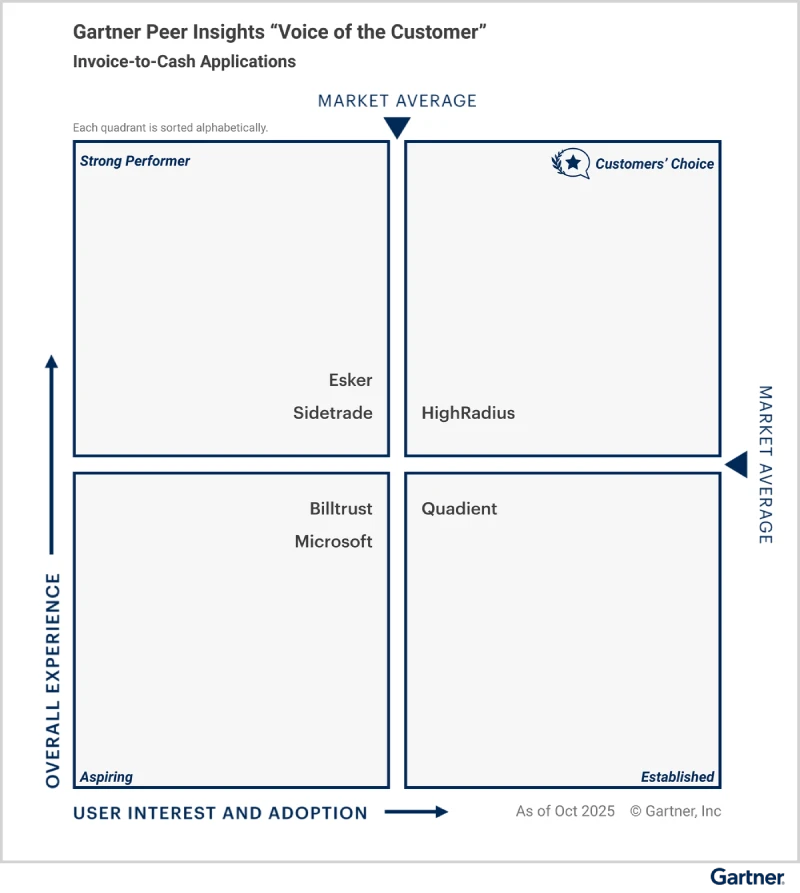
Positioned highest for delivering comprehensive automation across collections, credit, deductions, disputes, and multi-ERP integration - enabling standardized, scalable I2C transformation.
Explore why HighRadius has been a Digital World Class Vendor for order-to-cash automation software – two years in a row.

HighRadius stands out as an IDC MarketScape Leader for AR Automation Software, serving both large and midsized businesses. The IDC report highlights HighRadius’ integration of machine learning across its AR products, enhancing payment matching, credit management, and cash forecasting capabilities.

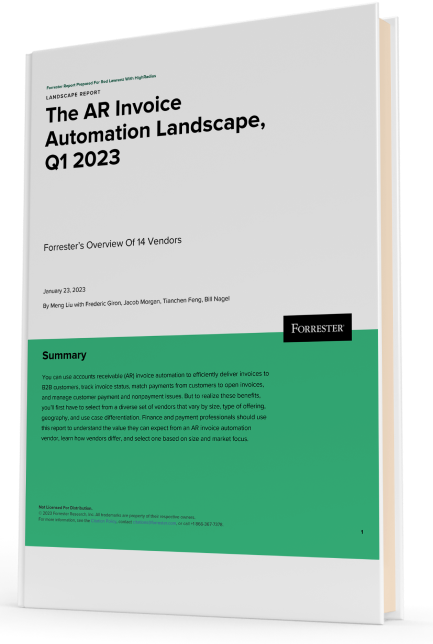
Forrester acknowledges HighRadius’ significant contribution to the industry, particularly for large enterprises in North America and EMEA, reinforcing its position as the sole vendor that comprehensively meets the complex needs of this segment.
Customers globally
Implementations
Transactions annually
Patents/ Pending
Continents
Talk with a finance expert about the processes, KPIs, and business outcomes that matter most to your organization.
Talk to a Finance ExpertExplore self-guided demos and see how finance workflows can move from manual execution to intelligent automation.
Explore the Demo CenterPlease fill in the details below
Please fill in the details below

We have seen financial services costs decline by $2.5M while the volume, quality, and productivity increase.

Colleen Zdrojewski
Trusted By 1300+ Global Businesses


