Order to Cash (O2C) optimization is the strategic alignment of sales, fulfillment, and accounts receivable (AR) processes to accelerate cash flow and minimize Days Sales Outstanding (DSO). By leveraging AI-driven credit scoring, automated invoicing, and integrated B2B payment rails, enterprise finance teams can transform O2C from a manual back-office function into a touchless, revenue-generating engine.
To understand how these optimizations fit into your overarching financial architecture, read our definitive guide on the Order to Cash process. If you are looking to automate your Order To Cash process with Agentic AI, check out our Order To Cash Software.
| O2C Stage | Optimization Strategy | Expected Outcome |
| Credit | 1. AI-Driven Credit Scoring | Instant approvals, reduced bad debt. |
| Order | 2. Bi-Directional CRM/ERP Sync | Elimination of manual data entry errors. |
| Billing | 3. Touchless E-Invoicing | Zero-day delivery to AP portals. |
| Payments | 4. Embedded B2B Payment Rails | Faster settlement via ACH or FedNow. |
| Collections | 5. Autonomous Dunning | Higher collection rates with fewer FTEs. |
| Disputes | 6. AI-Assisted Deduction Coding | Faster resolution of short-pays. |
| Data | 7. Master Data Management (MDM) | Clean customer data for accurate analytics. |
Friction in the O2C cycle usually stems from human intervention and disconnected legacy systems. If your cycle times are lagging, the root causes generally fall into these specific technical debt categories:
To achieve semantic completeness in your O2C strategy, you must measure performance against standardized financial entities. Here are the core metrics required for a best-in-class AR dashboard:
| KPI Entity | Definition | Target Benchmark |
| Days Sales Outstanding (DSO) | The average number of days it takes to collect revenue after a sale. | < 30-45 Days (Industry dependent) |
| Best Possible DSO (BPDSO) | The DSO achievable if all customers paid exactly on their invoice due date. | Within 3-5 days of actual DSO |
| Collection Effectiveness Index (CEI) | The percentage of receivables collected within a specific timeframe versus total receivables available. | > 85% |
| Average Days Delinquent (ADD) | The average number of days an invoice is past its strict due date. | < 10 Days |
Transitioning to a modernized, HighRadius-style autonomous finance model requires executing these seven best practices:
Shift from reactive to proactive credit management. Instead of manual reviews, utilize Machine Learning (ML) algorithms that automatically pull real-time bureau data, analyze historical payment behaviors, and instantly assign credit limits. This ensures low-risk customers bypass manual holds, accelerating the order-to-fulfillment pipeline.
Your O2C cycle cannot be efficient if data is trapped in silos. Utilize robust APIs or middleware to connect your sales front-end directly to your finance back-end. When a quote is approved, the system should automatically trigger order creation, allocate inventory, and stage the billing schedule without human touchpoints.
Paper invoices and manual PDF emails are obsolete. Implement e-invoicing solutions that automatically push formatted billing data directly into your clients' procure-to-pay (P2P) networks. Touchless delivery prevents invoices from getting lost in spam folders and automatically bypasses basic AP validation rules.
Reduce payment friction by embedding secure, one-click payment gateways directly within your digital invoices. Support modern, low-cost rails like ACH, SEPA (for European markets), and instant payment networks like FedNow, alongside traditional Level 3 credit card processing.
Replace manual email chasing with Robotic Process Automation (RPA). Configure your AR systems to segment customers by risk profile and automatically trigger tailored dunning workflows. High-risk accounts might receive aggressive pre-dunning notices 5 days before the due date, while low-risk, strategic accounts receive a softer, automated check-in.
Disputes and short-pays paralyze cash flow. Deploy AI tools that can read remittance advice, automatically identify deduction codes (e.g., pricing errors, damaged goods), and route the dispute to the appropriate departmental workflow for instant approval or denial.
A high-performing O2C process relies on immaculate data. Establish strict governance over your customer master files. Regularly audit and update billing addresses, tax identification numbers, and AP contact details to ensure that automated invoices do not bounce back due to systemic inaccuracies.
How Top 1% Companies Modernized Their O2C Process
Learn how to build lasting cash flow impact through smarter O2C.
Download The WhitepaperA best-in-class Order to Cash (O2C) cycle time is typically between 30 to 45 days, depending heavily on your industry and standard Net 30 payment terms. However, to benchmark effectively, enterprise finance teams should measure their actual cycle time against their Best Possible DSO (BPDSO) rather than relying solely on a flat, industry-average number.
You can reduce DSO quickly by implementing autonomous dunning workflows, transitioning to touchless e-invoicing, and embedding direct B2B payment rails (such as ACH, SEPA, or FedNow) inside your digital invoices. Eliminating manual follow-ups and removing friction from the payment gateway forces the accounts receivable cycle to close faster.
Quote-to-Cash (Q2C) encompasses the entire sales process starting from the initial customer configuration, pricing, and quoting (CPQ) inside a CRM like Salesforce. Order-to-Cash (O2C) is a narrower subset of that lifecycle; it begins only after the customer commits to the purchase and the data moves into an ERP system like SAP or Oracle NetSuite for fulfillment and billing.
The biggest bottleneck in the O2C process is manual data entry during the handoff from the sales department to the finance department. When CRM platforms and ERP systems lack bi-directional API integration, teams must manually re-key purchase orders, which inevitably leads to fulfillment errors, delayed invoicing, and disrupted cash flow.
Artificial Intelligence (AI) improves O2C management by eliminating manual, rule-based tasks across the accounts receivable workflow. Machine Learning (ML) algorithms can instantly assess B2B credit risk using real-time bureau data, predict which customers are likely to pay late, and automatically code and route short-pay deductions for faster dispute resolution.

Positioned highest for delivering comprehensive automation across collections, credit, deductions, disputes, and multi-ERP integration - enabling standardized, scalable I2C transformation.
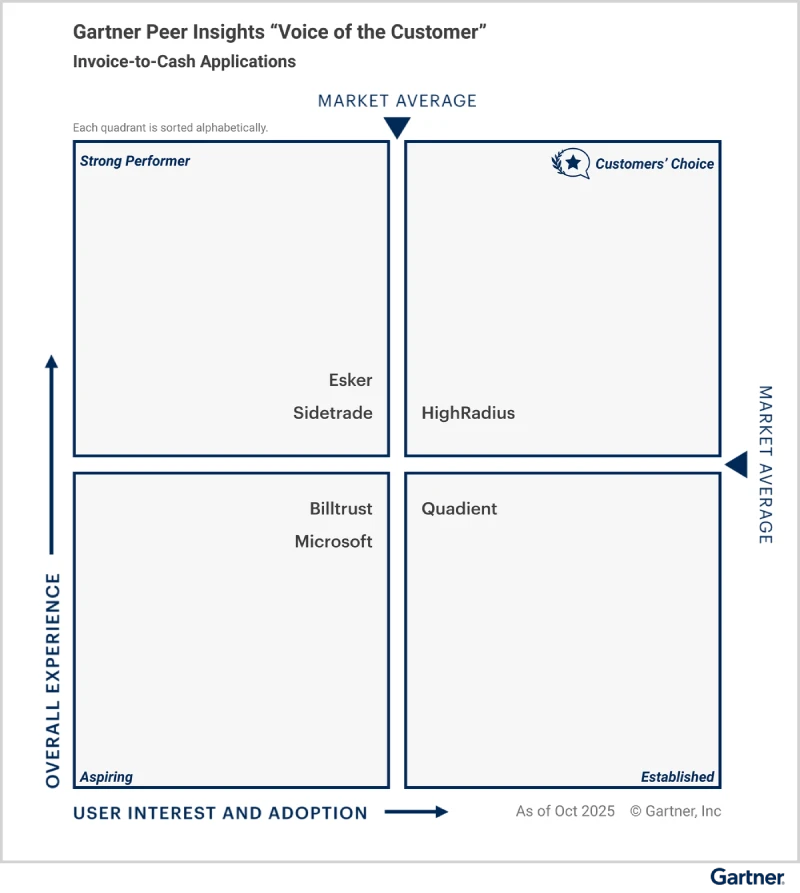
Explore why HighRadius has been a Digital World Class Vendor for order-to-cash automation software – two years in a row.

HighRadius stands out as an IDC MarketScape Leader for AR Automation Software, serving both large and midsized businesses. The IDC report highlights HighRadius’ integration of machine learning across its AR products, enhancing payment matching, credit management, and cash forecasting capabilities.

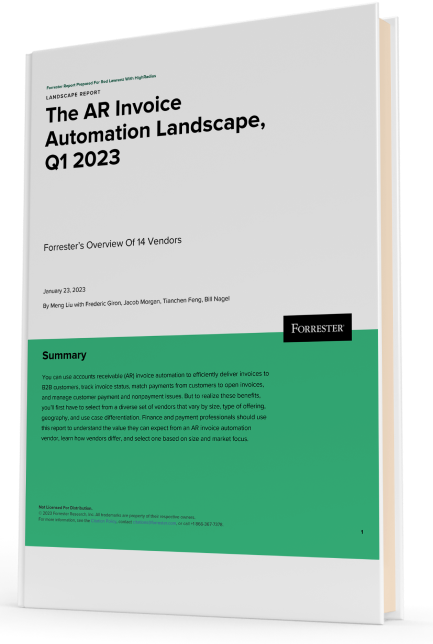
Forrester acknowledges HighRadius’ significant contribution to the industry, particularly for large enterprises in North America and EMEA, reinforcing its position as the sole vendor that comprehensively meets the complex needs of this segment.
Customers globally
Implementations
Transactions annually
Patents/ Pending
Continents
Talk with a finance expert about the processes, KPIs, and business outcomes that matter most to your organization.
Talk to a Finance ExpertExplore self-guided demos and see how finance workflows can move from manual execution to intelligent automation.
Explore the Demo CenterPlease fill in the details below
Please fill in the details below

We have seen financial services costs decline by $2.5M while the volume, quality, and productivity increase.

Colleen Zdrojewski
Trusted By 1300+ Global Businesses


