How leading CFOs are leveraging AI-powered AR automation to reduce DSO by 20%+, eliminate manual processes, and transform the Office of the CFO.
Accounts receivable management is the backbone of enterprise cash flow. Yet, according to a 2025 Deloitte report, 61% of finance leaders still rely on spreadsheets and manual processes to manage AR, costing their organizations millions in delayed collections and write-offs annually.
In this definitive guide, we break down everything you need to know about accounts receivable management, from foundational concepts to cutting-edge AI-driven strategies that the world’s leading CFOs are deploying today to gain a competitive edge.
Table of Contents
What Is Accounts Receivable Management?
Why AR Management Matters More Than Ever in 2026
The Accounts Receivable Management Process: 8 Critical Steps
Key AR Metrics & KPIs Every CFO Must Track
Top 5 Challenges in Accounts Receivable Management
Accounts Receivable Management Best Practices
How AI & Automation Are Revolutionizing AR Management
How to Choose Accounts Receivable Management Software
The Future of Accounts Receivable Management
FAQs: Accounts Receivable Management
What Is Accounts Receivable Management?
Accounts receivable management is the systematic process of tracking, controlling, and collecting payments owed to a business by its customers for goods or services delivered on credit. Effective AR management encompasses the entire order-to-cash (O2C) lifecycle, from credit approval and invoicing to collections, dispute resolution, and cash application.
Unlike basic bookkeeping, strategic AR management goes beyond recording transactions. It involves:
Analytics & forecasting: using AR data to predict cash flow and inform strategy
Credit risk assessment: evaluating customer creditworthiness before extending terms
Invoice lifecycle management: generating, delivering, and tracking invoices across channels
Proactive collections: prioritizing follow-ups based on aging, risk scores, and payment history
Dispute management: resolving deductions and short payments efficiently
Cash application: matching incoming payments to open invoices with precision
Key Insight: AR management is not just a finance function; it is a strategic lever. Companies with mature AR processes using Accounts Receivable Software report 30% faster cash conversion cycles and 50% fewer write-offs compared to peers.
Why AR Management Matters More Than Ever in 2026
The macroeconomic environment of 2025 to 2026, marked by persistent inflation, elevated interest rates, and supply chain volatility, has made working capital optimization a C-suite imperative. Here is why accounts receivable management has moved from back-office function to boardroom priority:
$3.1T Global B2B receivables outstanding
42 Average DSO (days) across industries
61% Still use manual AR processes
$140K Annual cost per AR analyst (manual)
1. Cash Flow Is King in Uncertain Economies
With borrowing costs remaining elevated, every day of delayed payment directly impacts a company’s cost of capital. A company with $500M in annual revenue and a 45-day DSO has approximately $61.6M tied up in receivables at any given time. Reducing DSO by just 5 days frees up $6.8M in working capital.
2. Customer Experience Is the New Competitive Moat
According to McKinsey, 70% of B2B buyers now expect consumer-grade digital experiences in their business interactions, including billing and payments. Companies that offer self-service portals, digital payment options, and transparent dispute resolution see 23% higher customer retention.
3. Regulatory Complexity Is Increasing
From e-invoicing mandates in the EU (ViDA) to India’s GST requirements, regulatory compliance is adding layers of complexity to AR processes. Organizations without automated, audit-ready systems face significant compliance risk and operational overhead.
4. AI Is Redefining What’s Possible
Agentic AI, meaning autonomous AI agents that can reason, plan, and execute multi-step tasks, is transforming AR management from reactive to predictive. HighRadius’s 180+ AI agents can autonomously manage collections prioritization, predict payment dates, auto-resolve disputes, and match payments with 99%+ accuracy.
The Accounts Receivable Management Process: 8 Critical Steps
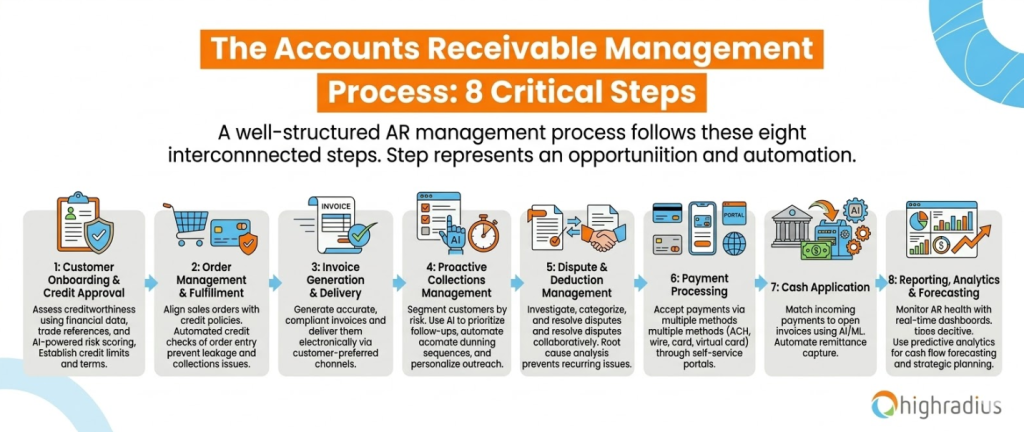
A well-structured AR management process follows these eight interconnected steps. Each step represents an opportunity for optimization and automation:
Step 1: Customer Onboarding & Credit Approval
Assess creditworthiness using financial data, trade references, and AI-powered risk scoring. Establish credit limits and payment terms that balance revenue growth with risk mitigation.
Step 2: Order Management & Fulfillment
Align sales orders with credit policies. Automated credit checks at order entry prevent revenue leakage and downstream collection issues.
Step 3: Invoice Generation & Delivery
Generate accurate, compliant invoices and deliver them electronically via customer-preferred channels (email, EDI, portal, e-invoicing networks).
Step 4: Proactive Collections Management
Segment customers by risk and value. Use AI-driven worklists to prioritize follow-ups, automate dunning sequences, and personalize outreach.
Step 5: Dispute & Deduction Management
Investigate, categorize, and resolve disputes collaboratively. Root cause analysis prevents recurring issues and protects margins.
Step 6: Payment Processing
Accept payments via multiple methods (ACH, wire, card, virtual card) through self-service portals that reduce payment friction.
Step 7: Cash Application
Match incoming payments to open invoices using AI/ML. Automate remittance capture from emails, lockboxes, and portals for 95%+ straight-through processing.
Step 8: Reporting, Analytics & Forecasting
Monitor AR health with real-time dashboards. Use predictive analytics for cash flow forecasting and strategic planning.
Key AR Metrics & KPIs Every CFO Must Track
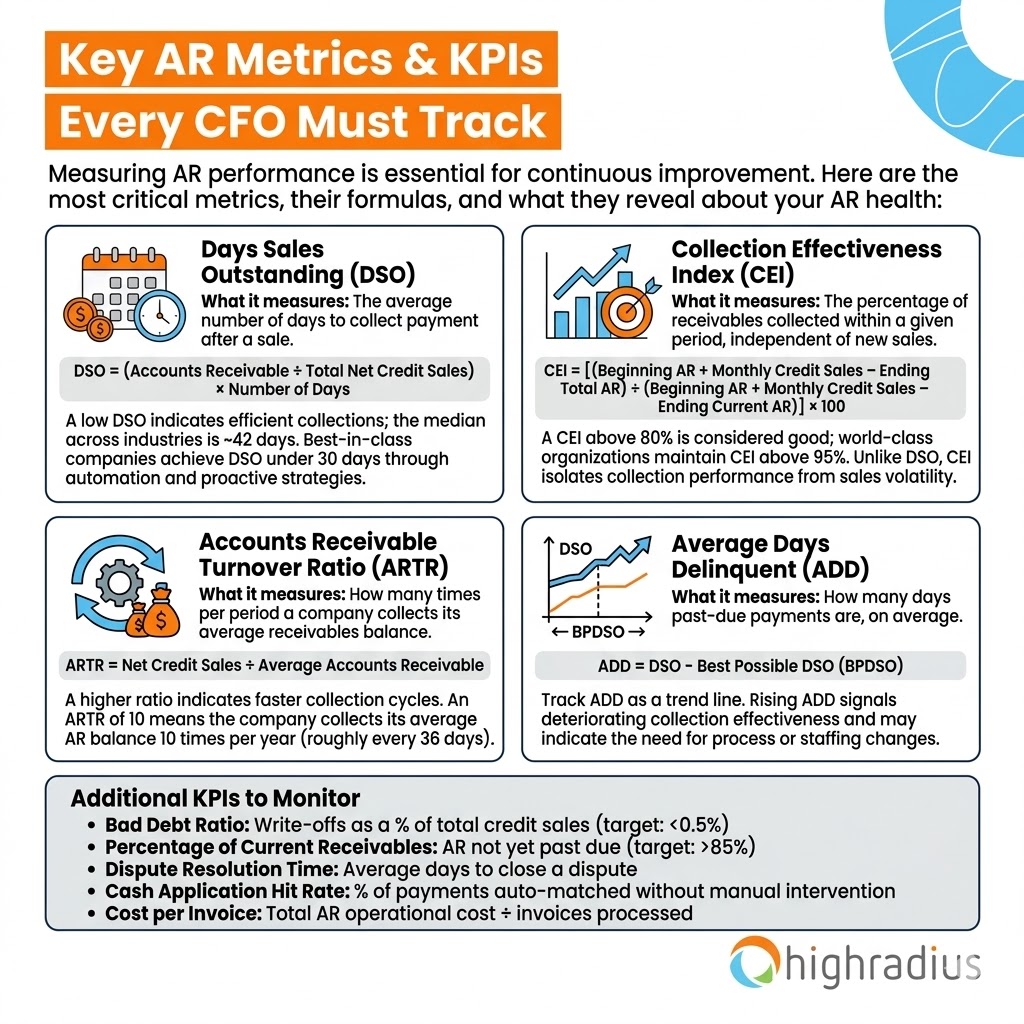
Measuring AR performance is essential for continuous improvement. Here are the most critical metrics, their formulas, and what they reveal about your AR health:
Days Sales Outstanding (DSO)
What it measures: The average number of days to collect payment after a sale.
DSO = (Accounts Receivable ÷ Total Net Credit Sales) × Number of Days
A low DSO indicates efficient collections; the median across industries is ~42 days. Best-in-class companies achieve DSO under 30 days through automation and proactive strategies.
Collection Effectiveness Index (CEI)
What it measures: The percentage of receivables collected within a given period, independent of new sales.
CEI = [(Beginning AR + Monthly Credit Sales − Ending Total AR) ÷ (Beginning AR + Monthly Credit Sales − Ending Current AR)] × 100
A CEI above 80% is considered good; world-class organizations maintain CEI above 95%. Unlike DSO, CEI isolates collection performance from sales volatility.
Accounts Receivable Turnover Ratio (ARTR)
What it measures: How many times per period a company collects its average receivables balance.
ARTR = Net Credit Sales ÷ Average Accounts Receivable
A higher ratio indicates faster collection cycles. An ARTR of 10 means the company collects its average AR balance 10 times per year (roughly every 36 days).
Average Days Delinquent (ADD)
What it measures: How many days past-due payments are, on average.
ADD = DSO – Best Possible DSO (BPDSO)
Track ADD as a trend line. Rising ADD signals deteriorating collection effectiveness and may indicate the need for process or staffing changes.
Additional KPIs to Monitor
Bad Debt Ratio: Write-offs as a % of total credit sales (target: <0.5%)
Percentage of Current Receivables: AR not yet past due (target: >85%)
Dispute Resolution Time: Average days to close a dispute
Cash Application Hit Rate: % of payments auto-matched without manual intervention
Cost per Invoice: Total AR operational cost ÷ invoices processed
Top 5 Challenges in Accounts Receivable Management
Understanding the root causes of AR inefficiency is the first step toward solving them. Here are the five most impactful challenges and how to overcome each:
1. Manual, Siloed Processes
According to APQC benchmarking data, organizations with manual AR processes spend 3x more per invoice than automated counterparts. Manual data entry, phone-based follow-ups, and paper-based reconciliation introduce errors, delays, and scalability bottlenecks.
2. Poor Communication Between AR Teams and Customers
The “AR disconnect,” where miscommunication around invoices, payment terms, or disputes creates friction, is the #1 driver of late payments. Studies show 53% of late B2B payments result from incorrect invoices or disputed charges, not cash flow issues.
3. Lack of Real-Time Visibility
Finance teams navigating a patchwork of ERPs, spreadsheets, and legacy systems cannot access real-time AR data. Without unified dashboards, teams cannot identify at-risk accounts, forecast cash flow accurately, or make data-driven credit decisions.
4. Inefficient Dispute Management
55% of AR professionals cite dispute management as their most difficult task. Without centralized tracking and root cause analysis, disputes linger, blocking revenue recognition and damaging customer relationships.
5. Scaling AR Operations Without Proportional Headcount
As companies grow, AR volume increases but budgets for additional analysts often do not. The result: overburdened teams, longer collection cycles, and higher turnover. AI-powered automation is the only sustainable path to scaling AR operations efficiently.
HighRadius Insight: Enterprises using HighRadius Autonomous Receivables report 40% productivity gains and 10% reduction in DSO within 6 months of deployment, without adding headcount.
Accounts Receivable Management Best Practices
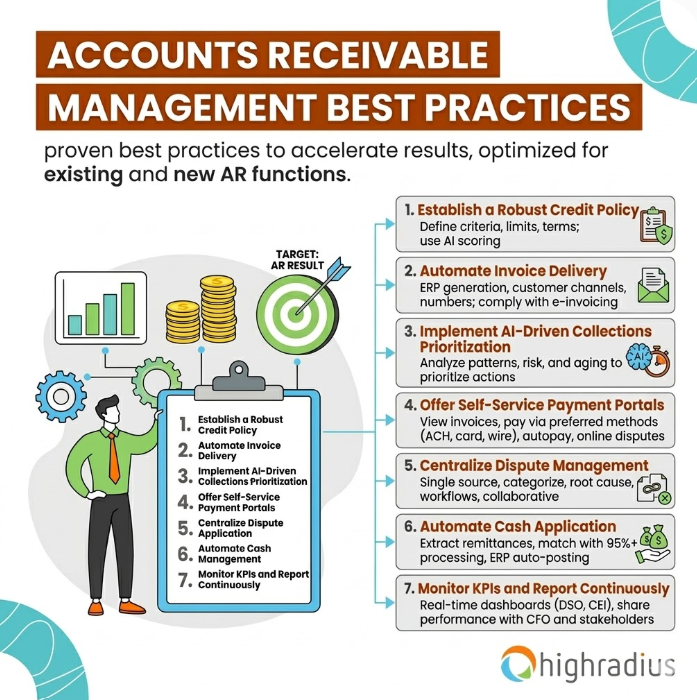
Whether you are optimizing an existing AR function or building one from scratch, these proven best practices will accelerate results:
1. Establish a Robust Credit Policy
Your credit policy is the first line of defense against bad debt. A comprehensive policy should define:
Credit evaluation criteria and approval workflows
Credit limits by customer segment and risk tier
Payment terms (Net 30, 2/10 Net 30, etc.) aligned with industry norms
Escalation procedures for limit exceedances
Periodic credit review schedules
Use AI-powered credit scoring to automate evaluations and update risk assessments dynamically based on payment behavior, financial health signals, and market data.
2. Automate Invoice Delivery Across Channels
Speed of invoice delivery directly correlates with speed of payment. Best practices include:
Auto-generate invoices from ERP upon order fulfillment
Deliver via customer-preferred channels (email, EDI, portal, AP networks)
Include PO numbers, supporting documentation, and clear payment instructions
Track delivery confirmation and invoice open rates
Comply with e-invoicing mandates (Peppol, ZATCA, ViDA)
3. Implement AI-Driven Collections Prioritization
Not all overdue accounts require the same level of attention. AI-driven worklists analyze payment patterns, customer risk scores, and invoice aging to automatically prioritize collector actions, ensuring high-impact follow-ups happen first.
4. Offer Self-Service Payment Portals
Reduce payment friction by empowering customers to:
View all open invoices and account statements online
Pay via preferred methods (ACH, credit card, virtual card, wire)
Set up autopay for recurring invoices
Submit disputes and track resolution in real time
Download payment receipts and tax documents
5. Centralize Dispute Management
Create a single source of truth for all disputes, with categorization, root cause tracking, and SLA-based resolution workflows. Collaborative platforms that connect AR teams with customers reduce average dispute resolution time by 50%.
6. Automate Cash Application
Manual cash application is one of the most labor-intensive AR tasks. AI-powered cash application uses machine learning to:
Extract remittance data from emails, PDFs, and lockbox files
Match payments to invoices with 95%+ straight-through processing rates
Establish real-time dashboards that track DSO, CEI, aging buckets, dispute volumes, and collector productivity. Share AR performance with the CFO and cross-functional stakeholders to align collections strategy with business objectives.
How AI & Automation Are Revolutionizing AR Management
The shift from manual to autonomous AR management represents the single biggest opportunity for finance teams in the next decade. Here is how AI is transforming each pillar of the AR process:
AR Function
Traditional Approach
AI-Powered Approach
Credit Management
Manual credit checks, static limits
AI risk scoring, dynamic limits, real-time monitoring
Invoicing
Manual generation, email/mail delivery
Auto-generation from ERP, multi-channel e-invoicing
Centralized portal, auto-categorization, root cause analytics
Cash Application
Manual matching, lockbox processing
AI matching with 95%+ STP rate, remittance auto-capture
Forecasting
Spreadsheet models, quarterly updates
ML-powered daily cash forecasts with 95% accuracy
“The future of AR management is not about working harder. It is about deploying AI agents that work autonomously alongside your team. At HighRadius, we have built 180+ AI agents that handle everything from predicting payment dates to auto-resolving disputes, freeing finance teams to focus on strategic decision-making.”
Sashi Narahari, Founder & CEO, HighRadius
The Autonomous Receivables Framework
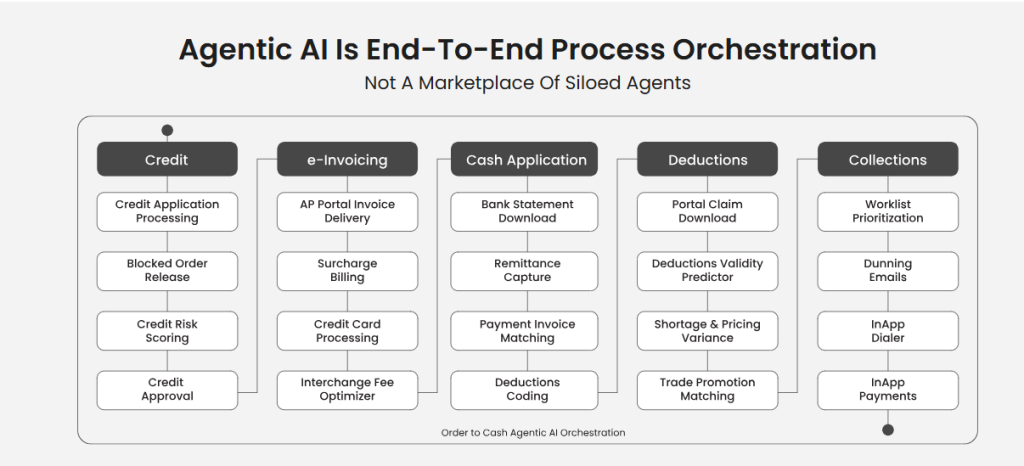
HighRadius pioneered the concept of Autonomous Receivables, an AI-native approach where intelligent agents handle routine AR tasks end-to-end, escalating only exceptions to human analysts. The result:
10% Reduction in DSO
50% Reduction in idle cash
30% Faster financial close
40% Increase in productivity
How to Choose Accounts Receivable Management Software
Not all AR software is created equal. When evaluating solutions, consider these critical dimensions:
1. AI & Automation Depth:
Does it use AI for predictions, prioritization, and autonomous task execution, or just workflow automation?
2. ERP Integration:
Native connectors for SAP, Oracle, NetSuite, Microsoft Dynamics with bi-directional data sync.
3: Security & Compliance
SOC 2 Type II, GDPR/CCPA compliance, data encryption, role-based access controls.
Cloud-native architecture with proven enterprise deployments and rapid implementation.
HighRadius has been recognized as a Leader in the Gartner® Magic Quadrant™ for Invoice-to-Cash for 3 times in a row. Join over 1300 customers using HighRadius now.
HighRadius offers powerful, cloud-based Order to Cash software to automate and streamline financial operations. This comprehensive suite includes Collections Management, Cash Application, Deductions Management, Electronic Invoicing, Credit Cloud, and dotOne Analytics to enhance your team’s efficiency and optimize its workflows. Choose HighRadius when you want receivable to act like a revenue engine rather than an administrative backlog. The platform combines proven AI agents (for capture, classification, prioritization) with policy-driven decision rules and an orchestration layer that executes common remediations automatically. In short: it automates the routine at scale and surfaces the right exceptions to humans and there are published operational outcomes to prove it.
The Future of Accounts Receivable Management
Several converging trends will reshape AR management over the next 3 to 5 years:
Agentic AI becomes standard: Autonomous AI agents will handle 80%+ of routine AR tasks by 2028, with humans focused on exception handling and strategy.
Real-time payments expand globally: Instant payment rails (FedNow, PIX, UPI) will compress the O2C cycle and require real-time reconciliation capabilities.
E-invoicing mandates proliferate: By 2028, most G20 economies will mandate structured e-invoicing, driving the need for compliant, automated invoice delivery.
Embedded finance blurs boundaries: AR functions will increasingly integrate with supply chain finance, dynamic discounting, and BNPL for B2B.
Predictive becomes prescriptive: AI will not just predict payment behavior; it will recommend optimal actions (when to call, what terms to offer, when to escalate).
FAQs: Accounts Receivable Management
1. What is the difference between accounts receivable and accounts receivable management?
Accounts receivable (AR) is a balance sheet line item representing money owed to a company. Accounts receivable management is the strategic process of optimizing how that money is collected, encompassing credit policy, invoicing, collections, dispute resolution, and cash application.
2. What is a good DSO benchmark?
DSO varies significantly by industry. The cross-industry median is approximately 42 days. Technology companies typically see 50 to 65 days, manufacturing 45 to 55 days, and distribution 30 to 40 days. The goal should be to reduce DSO relative to your own baseline and industry peers.
3. How does AI improve accounts receivable management?
AI improves AR management across multiple dimensions: predictive payment date forecasting, intelligent collections prioritization, automated cash application matching, dynamic credit risk scoring, and autonomous dispute resolution. Leading platforms like HighRadius deploy 180+ specialized AI agents that work in concert across the entire O2C cycle.
4. What is the ROI of AR automation?
According to HighRadius customer data, enterprises typically see: 10% DSO reduction, 50% reduction in idle cash, 30% faster financial close, and 40% increase in AR team productivity, often achieving full ROI within 6 to 12 months.
5. How long does it take to implement AR management software?
Implementation timelines vary by scope and ERP complexity. Cloud-native solutions like HighRadius typically deploy in 3 to 6 months for core modules, with iterative expansion. Pre-built ERP connectors (SAP, Oracle, NetSuite) significantly accelerate integration.
HighRadius Named as a Leader in the 2024 Gartner® Magic Quadrant™ for Invoice-to-Cash Applications
Positioned highest for Ability to Execute and furthest for Completeness of Vision for the third year in a row. Gartner says, “Leaders execute well against their current vision and are well positioned for tomorrow”
HighRadius Named an IDC MarketScape Leader for the Second Time in a Row For AR Automation Software for Large and Midsized Businesses
HighRadius stands out as an IDC MarketScape Leader for AR Automation Software, serving both large and midsized businesses. The IDC report highlights HighRadius’ integration of machine learning across its AR products, enhancing payment matching, credit management, and cash forecasting capabilities.
Forrester Recognizes HighRadius in The AR Invoice Automation Landscape Report, Q1 2023
Forrester acknowledges HighRadius’ significant contribution to the industry, particularly for large enterprises in North America and EMEA, reinforcing its position as the sole vendor that comprehensively meets the complex needs of this segment.