Top 6 Automated Credit Decisioning Platforms: A Buyers’ Guide
Last Updated: 12 October, 2026
•
Soumi Sarkar Fintech content strategist
S
Soumi Sarkar
Soumi specializes in O2C, finance, and accounting transformation with a focus on bringing a domain-led perspective to accounting, finance and order-to-cash transformation. She crafts insight-driven, CFO-aligned content that helps finance teams optimize operational workflows and drive measurable outcomes. Beyond her professional work, Soumi is a published author of two books, a poetess, an avid reader, and a storyteller who enjoys exploring narratives across both B2B and creative formats.
2026 Automation Benchmark Report
HighRadius 2026 Automation Benchmark Report For The Office Of The CFO
Understand if your performance is on par with top 10% of the organizations. Identify gaps, best practices and know how you can drive value through Agentic AI-Driven Automation.
Best automatic credit decisions solution now combines AI-driven approvals, automated credit scoring, continuous risk monitoring, and blocked-order prevention instead of relying on spreadsheet-driven reviews and static credit bureau data.
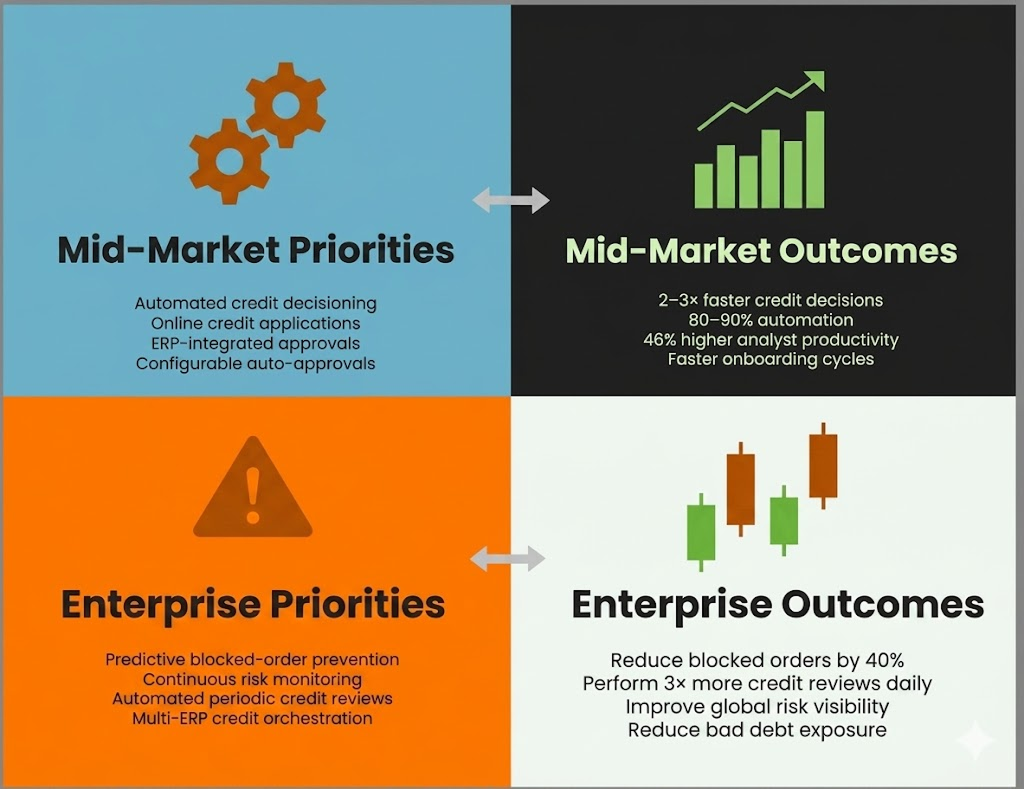
Mid-market businesses when evaluating credit decision engine prioritize faster onboarding, scalable low-risk auto-approvals, and operational efficiency, while enterprises focus on predictive risk monitoring, enterprise-wide policy governance, and real-time visibility.
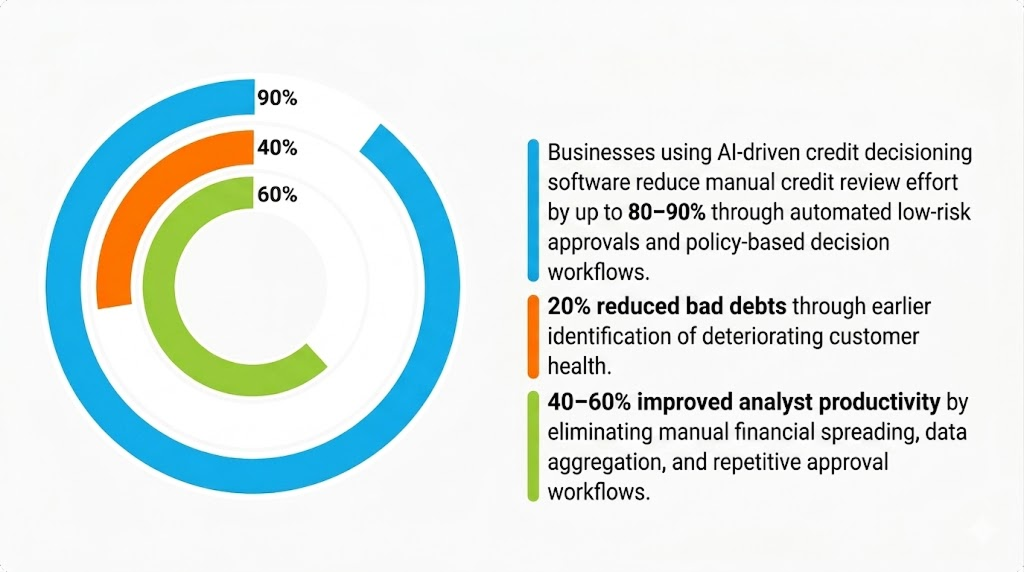
Platforms like HighRadius’ credit decisioning platform helps finance teams automate up to 80–90% of low-risk credit decisions, accelerate onboarding by up to 70%, reduce blocked orders by up to 40%, and improve enterprise-wide credit visibility through AI-driven credit decisioning and predictive risk analysis.
Credit Decisioning Has Shifted From Manual Approvals to Real-Time AI Decisioning
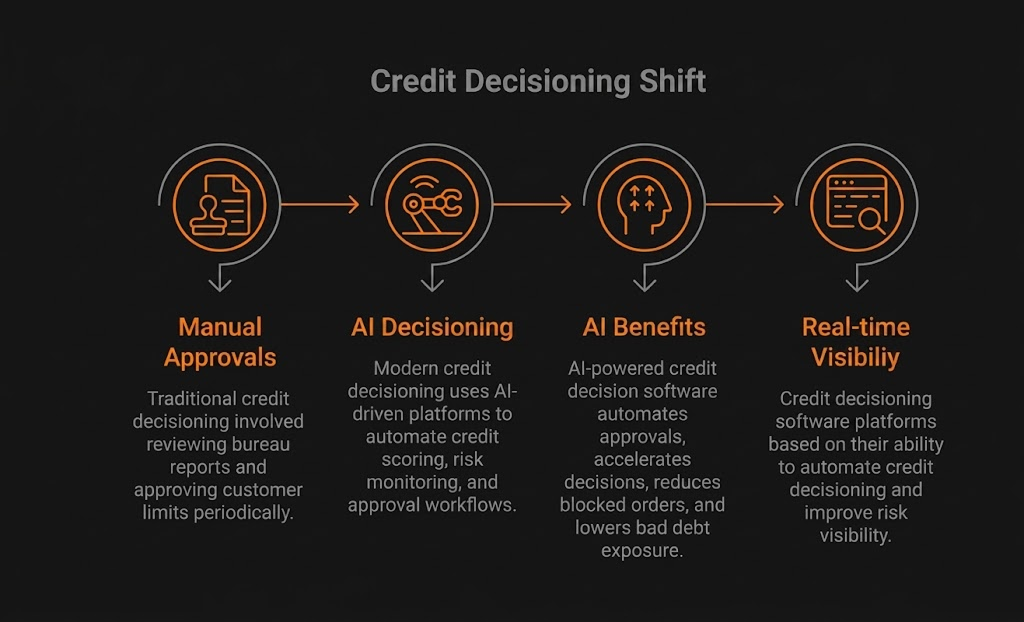
Credit decisions are no longer a periodic exercise of reviewing bureau reports, checking customer history, and approving limits. As payment behavior shifts faster and credit portfolios become more complex, manual reviews and fragmented decision processes can create bottlenecks precisely when finance teams need to move faster. The right credit decision tools need to do more than assess risk—they need to help finance teams make faster, more consistent decisions without compromising control.
A modern credit decisioning platform brings the pieces together: aggregating customer, payment, financial, and external credit data; applying business policies and risk rules; using AI-powered credit decisioning to assess changing risk; and automating approvals, exceptions, and workflows. This turns automated credit decisioning from a point solution into a connected credit decision system that can support decisions throughout the customer lifecycle.
In this guide, we evaluate leading automatic credit decisions solutions, including HighRadius, Esker, Gaviti, Serrala, Sidetrade, and Quadient, based on their ability to automate credit decisioning, improve real-time risk visibility, reduce operational bottlenecks, and scale credit operations across both mid-market and enterprise environments.
Best Platforms for Automated Credit Decisions
Businesses evaluating credit decision tools are increasingly prioritizing platforms that can aggregate financial data, apply policy-driven rules, and support consistent risk evaluation across customer portfolios. The best platforms for automated credit decisions combine analytics, solutions for credit risk monitoring, workflow automation, and governance controls to help credit teams make faster and more transparent decisions.
Below is a snapshot of widely used credit decision tools and platforms helping organizations modernize credit approvals and risk monitoring.
Platform
Best For
ERP Integration
AI / Automation
Key Limitation / Trade-Off
HighRadius
Mid-market and enterprise credit operations
SAP, Oracle, NetSuite, Microsoft Dynamics
AI scoring, 80–90% low-risk automation, predictive monitoring
A credit decisioning platform brings customer data, risk assessment, business rules, and decision-making into a single workflow. Instead of relying on disconnected reviews, a modern credit decision system can aggregate customer payment behavior, financial information, credit bureau data, and exposure to create a more complete view of credit risk. With credit bureau integration, teams can bring external risk intelligence into the same decisioning process as internal customer data.
Additionally, an automatic credit decisions solution applies configurable business rules and AI-powered analysis to evaluate risk, recommend or execute credit decisions, and route exceptions through decisioning workflows. This gives finance teams greater control over decision logic while enabling real-time decisioning as customer risk changes.
A modern credit decisioning solution can therefore connect risk assessment to approvals, credit-limit management, and ongoing monitoring. By combining AI-powered decisioning, risk modeling, and decision management, it helps teams make every decision faster, more consistently, and with greater confidence, while supporting a decision in seconds where policy and risk conditions allow.
6 questions to ask before investing in AI for Credit and AR.
Use this decision-maker’s guide to evaluate AI and automation across 6 critical vendor criteria and build a business case for measurable A/R transformation.
Credit teams need to make faster credit decisions without compromising risk controls. But manual reviews, fragmented data, and inconsistent policy interpretation can slow approvals, constrain scalability, and create unnecessary friction across sales and finance. Modern, AI credit decisioning platforms address this by bringing customer and financial data together, applying configurable decision management and business rules, and enabling AI-powered decisioning across approval workflows. This allows finance teams to move from periodic, analyst-dependent reviews toward real-time decisioning and more consistent risk decisioning. Learn more about the credit decision-making process and how modern approaches help teams make faster, data-driven credit decisions.
What Makes an AI-Powered Credit Decisioning Platform Different?
AI-powered credit decisioning goes beyond automating existing approval workflows. The best AIcredit decisioning platforms combine AI risk assessment, predictive decisioning, and real-time customer data to evaluate changing credit risk and recommend the right action.
Key capabilities include:
Predictive credit decisions: Identify emerging risk using payment behavior, financial data, and exposure signals.
Automated approvals: Apply policy thresholds to approve low-risk accounts while reserving analyst time for exceptions.
Explainable recommendations: Surface the risk factors and decision logic behind each recommendation.
Continuous monitoring: Detect changes in customer risk instead of relying on periodic reviews.
Next-best action: Recommend appropriate credit actions based on current risk and business rules.
Exception routing: Automatically escalate higher-risk or policy-exception cases for analyst review.
Top 6 Automated Credit Decisioning System
The credit decisioning platform landscape for B2B trade credit is evolving as finance teams move away from manual reviews and fragmented risk assessments. Modern credit decision tools now combine financial data aggregation, policy-driven automation, and predictive analytics to evaluate customer risk faster and more consistently. For credit leaders, comparing a credit decisioning solution requires looking beyond basic scoring capabilities and examining factors such as data integration, risk decisioning, decision management, and scalability across large customer portfolios.
In the following section, we review several vendors offering capabilities related to credit evaluation and decision automation in accounts receivable environments, outlining their strengths, positioning, and functional focus areas, from AI-powered decisioning and real-time decisioning to decisioning workflows and policy controls.
HighRadius
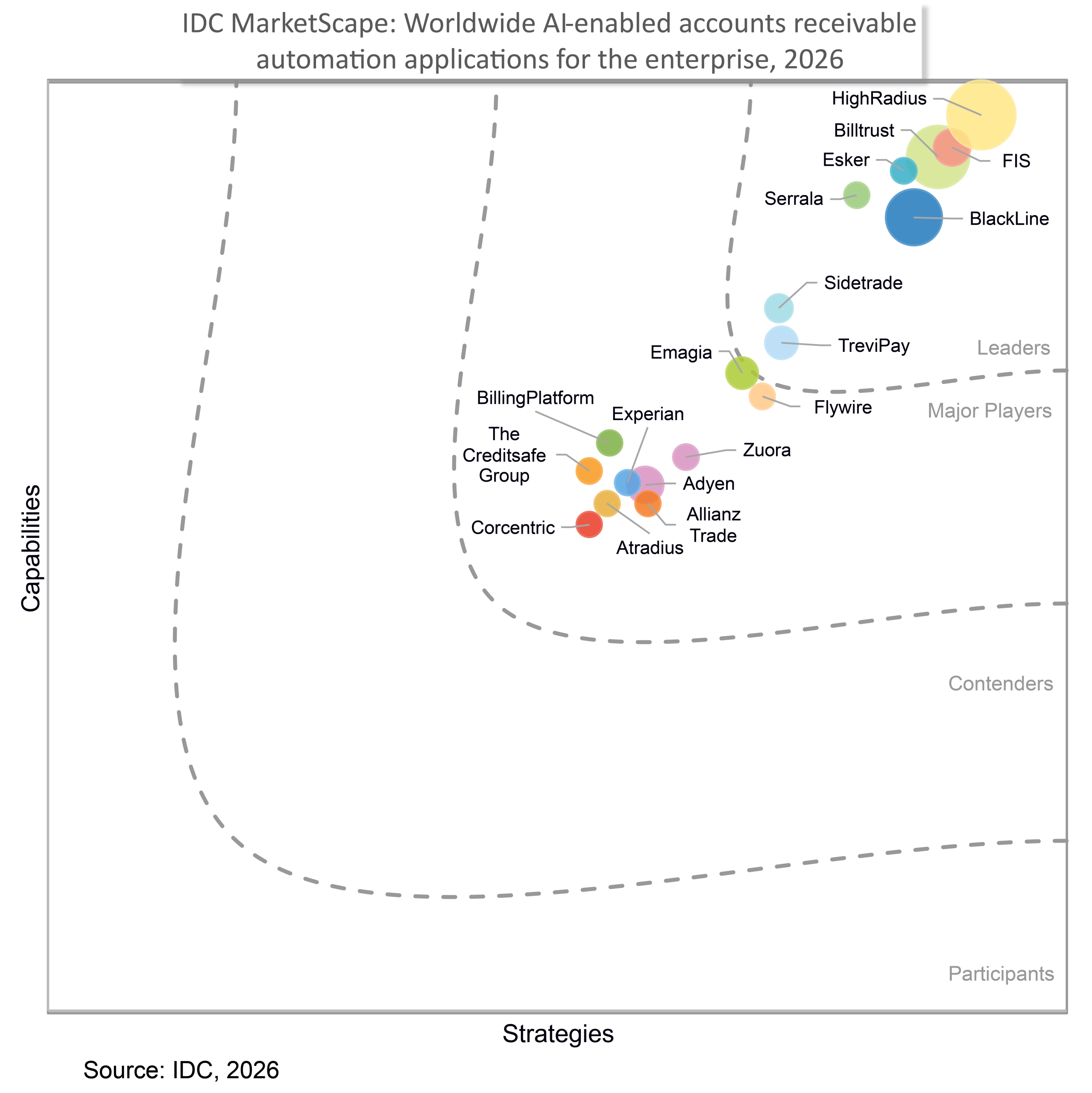
HighRadius is the IDC MarketScape-recognized Agentic AI automatic credit decisions solution built to automate credit decisioning and credit scoring for both fast-growing mid-market companies and complex global enterprises. The platform combines AI-driven credit decisioning, online credit applications, predictive risk monitoring, blocked-order prevention, and ERP-integrated approval workflows into a unified credit decision platform.
For growing mid-market businesses, HighRadius replaces spreadsheet-driven reviews with AI-powered scoring, automated approvals, and real-time monitoring to accelerate onboarding, standardize approvals, and scale credit operations without increasing analyst headcount.
For enterprises managing complex global receivables portfolios, HighRadius leverages AI agents to automate periodic reviews, standardize policy enforcement, continuously monitor customer exposure, and proactively prevent blocked-order disruption across multiple ERPs and business units.
Analyst Reports
Recognized as an IDC MarketScape Leader in AR Automation
IDC recognized HighRadius for AI-driven AR automation across both enterprise and mid-market organizations.
80–90% of low-risk credit decisions are automated, allowing analysts to focus on higher-risk accounts and strategic reviews.
90% faster credit approvals, reducing delays in customer onboarding and order processing.
70% faster customer onboarding through automated credit application processing and approval workflows.
30% reduction in blocked orders through predictive monitoring and automated order risk evaluation.
20% reduction in bad-debt exposure using AI-driven credit risk scoring and continuous monitoring.
2–3× more credit reviews per analyst, increasing operational efficiency across large customer portfolios.
60%+ productivity improvement for credit analysts by eliminating manual data gathering and spreadsheet-based workflows.
15–25% improvement in predictive risk accuracy through machine learning models trained on financial and behavioral signals.
Automated credit limit assignment and decision workflows that enforce policy-based governance across portfolios.
Explainable AI decision trails that document the data and logic used for every credit approval or decline.
Business Outcomes
2–3× faster credit decisions
80–90% automation of low-risk approvals
up to 70% faster onboarding
30–40% reduction in blocked orders
20% reduced bad debt exposure through predictive monitoring
Consideration
HighRadius combines credit scoring, decisioning, monitoring, data integration, and broader credit-management workflows. Teams evaluating it should consider the breadth of capabilities they need today and the level of automation and scalability required as their credit operations grow.
BillTrust
Billtrust provides credit management capabilities within its broader invoice-to-cash platform, helping finance teams connect credit evaluations with billing, invoicing, and collections processes. Rather than functioning solely as a dedicated credit decisioning platform, Billtrust positions its credit capabilities as part of a wider receivables automation environment.
Features
Digital credit application and onboarding workflows.
Centralized customer credit profiles combining financial and payment data.
Policy-based credit approval and review workflows.
Risk monitoring to track changes in customer credit health.
Integration with billing, invoicing, and collections processes.
Collaboration tools to manage credit reviews across finance teams.
Consideration
Billtrust connects credit activity closely with invoicing, payments, and receivables workflows. Organizations evaluating it should consider reporting flexibility, integration requirements, and whether its credit capabilities provide the depth of risk analysis and governance needed across their portfolio.
Esker
Esker provides credit management capabilities as part of its broader order-to-cash automation suite. The platform supports finance teams in digitizing credit applications, integrating external financial data, and managing approval workflows connected to receivables operations. Esker’s approach centers on improving how organizations collect credit information and apply structured approval processes rather than functioning as a dedicated credit decisioning platform.
Features
Electronic credit application forms that allow customers to submit financial information digitally.
Integration with external credit bureaus and financial data sources to support credit evaluation.
Automated approval workflows designed to standardize credit reviews and decision routing.
Centralized dashboards providing visibility into customer credit requests and account status.
Collaboration tools that allow finance teams to manage credit reviews and approvals in a shared workflow.
Integration with invoicing and receivables processes within the broader order-to-cash cycle.
Consideration
Esker is well suited to organizations connecting credit with broader O2C workflows and external risk data. Buyers with more complex credit processes should assess how its workflow design, integrations, and customization options align with their operating model.
Gaviti
Gaviti focuses primarily on receivables and collections operations, offering tools that help finance teams manage customer communications, monitor outstanding invoices, and improve cash flow visibility. Within its receivables platform, the company provides capabilities related to credit monitoring and customer account oversight. For organizations evaluating credit decisioning solution, Gaviti’s approach centers on improving coordination between credit monitoring and collections activities rather than functioning as a standalone credit decisioning platform.
Features
Customer credit monitoring to track changes in account risk signals.
Customer communication tools designed to centralize email interactions and outreach.
Payer portal that allows customers to access invoices, make payments, and manage disputes.
Dashboards and reporting that provide visibility into receivables performance and cash flow trends.
Integration with AR processes to connect credit monitoring with collections operations.
Consideration
Gaviti’s usability and receivables-focused workflows make it relevant for teams modernizing day-to-day credit and collections. Organizations with increasingly complex portfolios should evaluate its reporting flexibility, performance requirements, and customization needs.
Serrala
Serrala offers credit risk management capabilities within its broader finance automation platform focused on working capital optimization and order-to-cash processes. The platform supports credit evaluation and monitoring by connecting customer financial data, payment behavior, and ERP signals within a unified workflow. Serrala’s credit functionality is often used in environments where finance teams seek to align credit risk controls with broader treasury, payments, and receivables processes.
Features
Credit risk monitoring that provides visibility into customer financial exposure and payment behavior.
Policy-based approval workflows designed to standardize credit evaluations and limit assignment. Integration with ERP systems to consolidate customer financial data and transaction history.
Dashboards and reporting that help finance teams monitor credit exposure across portfolios.
Working capital visibility tools that connect credit risk insights with receivables performance.
Integration with order-to-cash and AR automation processes within broader finance workflows.
Consideration
Serrala brings credit risk, financial data, analytics, and workflow automation into a broader finance environment. Teams with highly customized credit policies should consider the configuration and implementation effort required to support more complex decisioning processes.
SideTrade
Sidetrade provides credit risk management capabilities within its broader augmented order-to-cash platform. The company focuses on helping finance teams evaluate customer risk signals, monitor payment behavior, and support credit decisions using data aggregated across receivables and external sources. Its approach connects credit evaluation with working capital performance and collections processes rather than positioning itself solely as a standalone credit decisioning platform.
Features
Credit risk monitoring that analyzes payment behavior and financial indicators to support credit evaluations.
Data aggregation from internal receivables systems and external risk sources for customer credit insights.
Credit scoring capabilities designed to help finance teams evaluate customer creditworthiness.
Automated workflows that support structured credit reviews and decision routing.
Dashboards that provide visibility into credit exposure and receivables performance.
Integration with ERP and order-to-cash processes to connect credit evaluation with broader finance operations.
Consideration
Sidetrade connects credit risk with collections, payment intelligence, and broader O2C analytics. Buyers should assess the depth of its credit-specific scoring, monitoring, decisioning, and governance capabilities for their particular risk-management requirements.
Templates
Choosing the Wrong Credit Vendor Can Increase Bad Debt by 20%.
Use this credit management vendor evaluation scorecard to compare credit decisioning platforms and identify the best solution for faster, safer credit decisions.
Not all credit decision tools deliver the same operational impact. While many platforms automate portions of the credit review process, the most effective credit decisioning platforms combine automation, analytics, and governance to support consistent decision-making across large customer portfolios.
Here are the capabilities finance teams should prioritize when evaluating credit decisioning solutions.
1. Automation and Decision Velocity
Credit approvals should support revenue growth rather than delay it. AI credit decisioning platforms automate data gathering, risk scoring, and approval routing through decisioning workflows, helping teams evaluate customers quickly without manual coordination.
This level of automation allows organizations to process higher volumes of applications while maintaining consistent risk controls and accelerating the credit decisioning process.
2. AI and Predictive Risk Capabilities
The best AI credit decisioning platforms use predictive models to identify risk signals across payment behavior, financial health, and external credit data.
These capabilities enable credit teams to move beyond static scoring models toward AI-powered decisioning, predictive risk assessment, and real-time decisioning, where changing customer risk can inform credit decisions continuously.
3. Data Aggregation and Integrations
One of the most common challenges in credit operations is fragmented data. Financial statements, ERP data, and bureau reports often exist in separate systems.
Modern credit decisioning solutions consolidate these inputs into a single environment, enabling faster and more informed credit decisions through connected data and credit bureau integration.
4. Policy Governance
Credit policies should be applied consistently across regions, teams, and portfolios. Advanced credit decision tools allow organizations to define decision thresholds, escalation rules, and approval matrices that automatically enforce policy compliance.
Configurable decision management gives finance teams greater control over decision logic while maintaining governance across credit portfolios.
5. Governance and Compliance
Transparency is critical when automating risk decisions. Modern platforms provide audit trails and decision-logic visibility, helping credit teams understand the factors behind every decision and explain or review automated recommendations when required.
6. Scalability for Growing Portfolios
As customer portfolios grow, manual credit reviews become increasingly difficult to scale. Advanced, AI credit decisioning platforms should support high volumes of applications and reviews while maintaining consistent risk decisioning, governance, and workflow automation across growing portfolios.
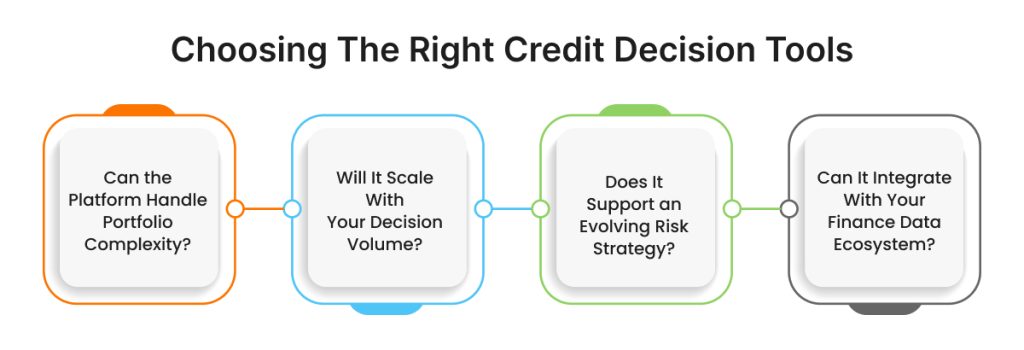
How to Choose the Right Automated Credit Decisioning System
Selecting the right credit decisioning platform requires more than comparing feature lists. Finance teams must evaluate how well a solution supports their customer portfolio structure, decision volume, risk decisioning strategy, and data environment. The most effective credit decision tools enable organizations to standardize credit evaluations, maintain control over decision logic, and scale decisioning workflows as portfolios grow.
1. Can the Platform Handle Portfolio Complexity?
Organizations with diverse customer bases often manage multiple credit policies, regional compliance requirements, and industry-specific risk profiles. A strong credit decisioning solution should allow finance teams to configure flexible policies, apply differentiated credit rules, and define approval thresholds across customer segments while maintaining consistent risk decisioning.
2. Will It Scale With Your Decision Volume?
As portfolios grow, manual credit reviews quickly become operational bottlenecks. Companies processing high volumes of credit applications, reviews, and limit adjustments benefit from credit decision tools that automate data collection, scoring, and approval workflows while ensuring consistent policy enforcement. The right platform should also support decision management across growing volumes without adding proportional manual effort.
3. Does It Support an Evolving Risk Strategy?
Credit decision frameworks evolve as organizations mature their risk management practices. While some teams rely mainly on financial statements and bureau data, others incorporate predictive analytics, risk modeling, and behavioral signals. A scalable credit decisioning platform should support both structured, rule-based approvals and AI-powered decisioning, enabling teams to adapt their risk decisioning strategy as customer risk changes.
4. Can It Integrate With Your Finance Data Ecosystem?
Credit decisions depend on information from multiple systems, including ERP platforms, financial statements, payment history, and external credit bureaus. A well-designed credit decisioning solution should integrate seamlessly with these sources through credit bureau integration and connected data workflows, allowing finance teams to consolidate risk signals and make faster, more consistent, data-driven decisions.
Ebooks
39% of Invoices Are Paid Late! All Due To Weak Credit Workflows.
See how leading finance teams use 5 structured credit workflows to standardize credit reviews and reduce operational delays.
What Integrations Should a Credit Decisioning Platform Support?
Modern credit decisioning platforms should connect with the ERP systems like Netsuite, SAP, etc. and data sources finance teams already rely on, including ERP and CRM platforms, credit bureaus, financial statements, payment history, customer master data, and APIs. Bringing these inputs together gives teams a more complete view of customer risk and supports faster, more consistent data-driven credit decisions.
The right ERP integrations should also enable real-time decisioning by continuously bringing updated customer and payment information into the credit decisioning workflow. This reduces fragmented data, limits manual data gathering, and helps ensure credit decisions reflect current customer risk rather than outdated information.
Real-World Use Cases of AI-Driven Credit Decisioning Software
Modern credit decision software is no longer limited to static scoring and approval workflows. Organizations now use AI-driven credit decisioning platforms to automate onboarding, standardize approvals, predict blocked orders, and continuously monitor customer risk across complex receivables portfolios. From lean finance teams scaling beyond spreadsheets to enterprises managing global credit operations, the focus has shifted toward real-time, automated decisioning that protects both revenue and working capital.
1. Accelerating Customer Onboarding and Automating Low-Risk Approvals
Fast-growing finance organizations often struggle with manual approvals, fragmented customer data, and delayed onboarding that creates friction between sales and finance. HighRadius automates online credit applications, AI-driven scoring, approval routing, and policy-based auto-decisioning to accelerate onboarding while reducing analyst workload.
Organizations using AI-powered credit decisioning software now achieve:
2–3× faster credit approvals
80–90% automation of low-risk approvals
significantly faster onboarding cycles
Case Studies
How BlueLinx Achieved 70% Faster Onboarding with AI-led Credit Solution
See how this firm managed high-volume credit operations across 15,000+ customers.
2. Standardizing Global Credit Decisioning Across Enterprise Portfolios
Large enterprises managing multiple ERPs and business units often struggle with fragmented approval policies and inconsistent credit governance. HighRadius centralizes scoring, approvals, customer hierarchies, and real-time monitoring into a unified enterprise credit decision platform.
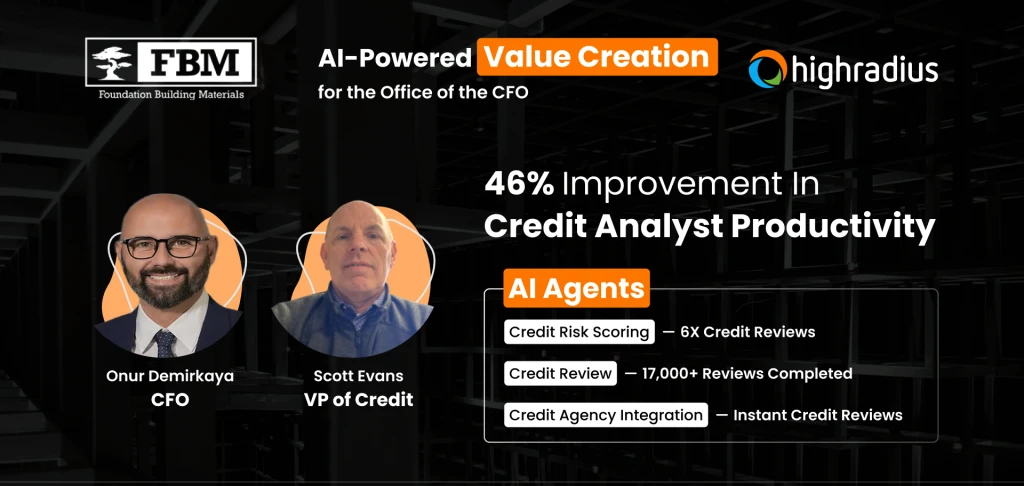
Foundation Building Materials increased analyst productivity by 46%, completed 17,000+ annual reviews, and achieved 6× more credit reviews through AI-driven credit automation.
Case Studies
How this manufacturing giant unlocked 17,000+ annual credit reviews
Learn how FBM modernize credit operations with AI-driven scoring, automated workflows, and centralized visibility across entities.
3. Preventing Blocked Orders Before Revenue Disruption Occurs
Blocked orders remain a major operational bottleneck for enterprise finance teams. Instead of reacting after disruption occurs, HighRadius uses predictive AI models to forecast blocked orders using payment behavior, utilization trends, and evolving customer risk signals.
BlueLinx achieved 30% fewer blocked orders, 70% faster onboarding, and 3× more credit reviews per day using AI-powered credit workflows and predictive monitoring.
Case Studies
How Chevron Phillips Achieved Zero Bad Debt for 4 Consecutive Years
Learn how this industry pioneer modernized enterprise credit operations with continuous risk monitoring and predictive workflows
How HighRadius Helps Modernize Credit Applications and Credit Scoring
HighRadius Credit Management Software helps mid-market finance teams automate credit decisioning, standardize risk evaluation, and gain real-time visibility into customer exposure without increasing analyst headcount. Built for organizations scaling beyond spreadsheet-driven approvals, the platform combines AI-driven credit scoring, automated workflows, and continuous monitoring to accelerate onboarding, reduce manual reviews, and improve control over credit risk.
With real-time credit risk management software and AI-powered credit management solutions, finance teams can receive alerts for changes in customer credit profiles and make faster, data-driven decisions using unlimited credit reports. The platform integrates with ERP systems and can begin monitoring customers in as little as 30 days.
With real-time credit risk analysis software and credit decisioning software, you can receive alerts for any changes in your customers’ credit profile and make data-driven credit decisions from unlimited credit reports. Our software integrates with your ERP system and can start monitoring your customers in just 30 days.
We offer configurable credit scoring software and approval workflows that can be customized based on geography, customer segments, business units, and other factors. You can fast-track credit approvals through complex corporate hierarchies, making the credit application process more efficient and streamlined.
Our highly configurable online credit application allows you to onboard customers across the globe with multi-language, customized credit applications embedded on your website. You can automatically capture financials, personal guarantees, and check bank references, reducing the need for manual data entry.
Our software also automatically extracts credit data from over 40+ global and local agencies, including credit ratings, financials, and credit insurance information. You can configure the auto-extracted data in your preferred currency, making it easier to analyze and interpret.
With AI-based blocked order management, you can auto-predict blocked orders based on the customers’ credit limit utilization and payment history. You can leverage AI-based release or partial payment recommendations for faster credit decisions, reducing the need for manual intervention.
Learn more about HighRadius' Credit Management Software
Mitigate credit risk, reduce bad debt, and streamline customer onboarding with AI-powered insights.
Reduce bad debt with a prioritized worklist of high-impact customer accounts demanding immediate attention.
Credit Agency Integration
Identify risky customers by getting alerts on mergers and bankruptcies from credit agencies.
Online Credit Application
Improve onboarding time for your new customers with fully completed credit applications, tailored to your customer branding & requirements.
FAQs on Best Credit Decisioning Tools
1. What is a credit decisioning platform?
A credit decisioning platform helps finance teams evaluate customer credit risk and automate approval decisions. It aggregates financial data, payment history, and external credit information to apply policy-based rules or analytics, enabling faster, consistent credit evaluations and improved risk visibility across accounts receivable portfolios.
A credit decisioning platform helps finance teams evaluate customer credit risk and automate approval decisions. It aggregates financial data, payment history, and external credit information to apply policy-based rules or analytics, enabling faster, consistent credit evaluations and improved risk visibility across accounts receivable portfolios.
2. How do credit decision tools improve credit management?
Credit decision tools streamline how finance teams assess customer creditworthiness by automating data collection, scoring, and approval workflows. These tools help standardize credit policies, reduce manual reviews, accelerate credit approvals, and provide better visibility into customer risk across large credit portfolios.
Credit decision tools streamline how finance teams assess customer creditworthiness by automating data collection, scoring, and approval workflows. These tools help standardize credit policies, reduce manual reviews, accelerate credit approvals, and provide better visibility into customer risk across large credit portfolios.
3. What should businesses look for in a credit decisioning solution?
A strong credit decisioning solution should support automated credit evaluations, centralized financial data aggregation, policy-driven approvals, and continuous risk monitoring. Organizations should also consider scalability, analytics capabilities, and integration with ERP and receivables systems to ensure consistent credit decisions across customers.
A strong credit decisioning solution should support automated credit evaluations, centralized financial data aggregation, policy-driven approvals, and continuous risk monitoring. Organizations should also consider scalability, analytics capabilities, and integration with ERP and receivables systems to ensure consistent credit decisions across customers.
4. What data sources can credit decisioning software integrate with?
Modern credit decisioning platforms can connect ERP and CRM systems, credit bureaus, financial statements, payment data, customer master data, and APIs to consolidate risk signals and support real-time, data-driven credit decisions.
Modern credit decisioning platforms can connect ERP and CRM systems, credit bureaus, financial statements, payment data, customer master data, and APIs to consolidate risk signals and support real-time, data-driven credit decisions.
5. What are the use cases for credit decisioning software across different industries?
Credit decisioning platforms help manufacturers, CPG, retail, and technology companies automate credit assessments, approvals, and risk monitoring while adapting decisioning workflows to customer portfolios, policies, and industry-specific risk.
Credit decisioning platforms help manufacturers, CPG, retail, and technology companies automate credit assessments, approvals, and risk monitoring while adapting decisioning workflows to customer portfolios, policies, and industry-specific risk.
6. Who uses automated credit decisioning software?
Credit managers, CFOs, controllers, and O2C leaders use automated credit decisioning to standardize risk assessment, accelerate approvals, automate low-risk decisions, and maintain control over decision logic across growing customer portfolios.
Credit managers, CFOs, controllers, and O2C leaders use automated credit decisioning to standardize risk assessment, accelerate approvals, automate low-risk decisions, and maintain control over decision logic across growing customer portfolios.
Resource Library
Resource Hub
Order to Cash
Order to Cash software data sheet
Disconnected workflows can leave teams chasing data, while automated O2C has delivered 20% lower past dues.
HighRadius recognized as a "Leader" in IDC Marketscape: Worldwide AI-enabled accounts receivable automation applications for the enterprise 2026 vendor assessment
Recognized as a Leader in 2026 Vendor Assessment for unifying credit, collections, cash application, deductions, e-invoicing, and payments on one AI platform to advance enterprise-wide invoice-to-cash transformation.
Forrester Recognizes HighRadius in The AR Invoice Automation Landscape Report, Q1 2023
Forrester acknowledges HighRadius’ significant contribution to the industry, particularly for large enterprises in North America and EMEA, reinforcing its position as the sole vendor that comprehensively meets the complex needs of this segment.