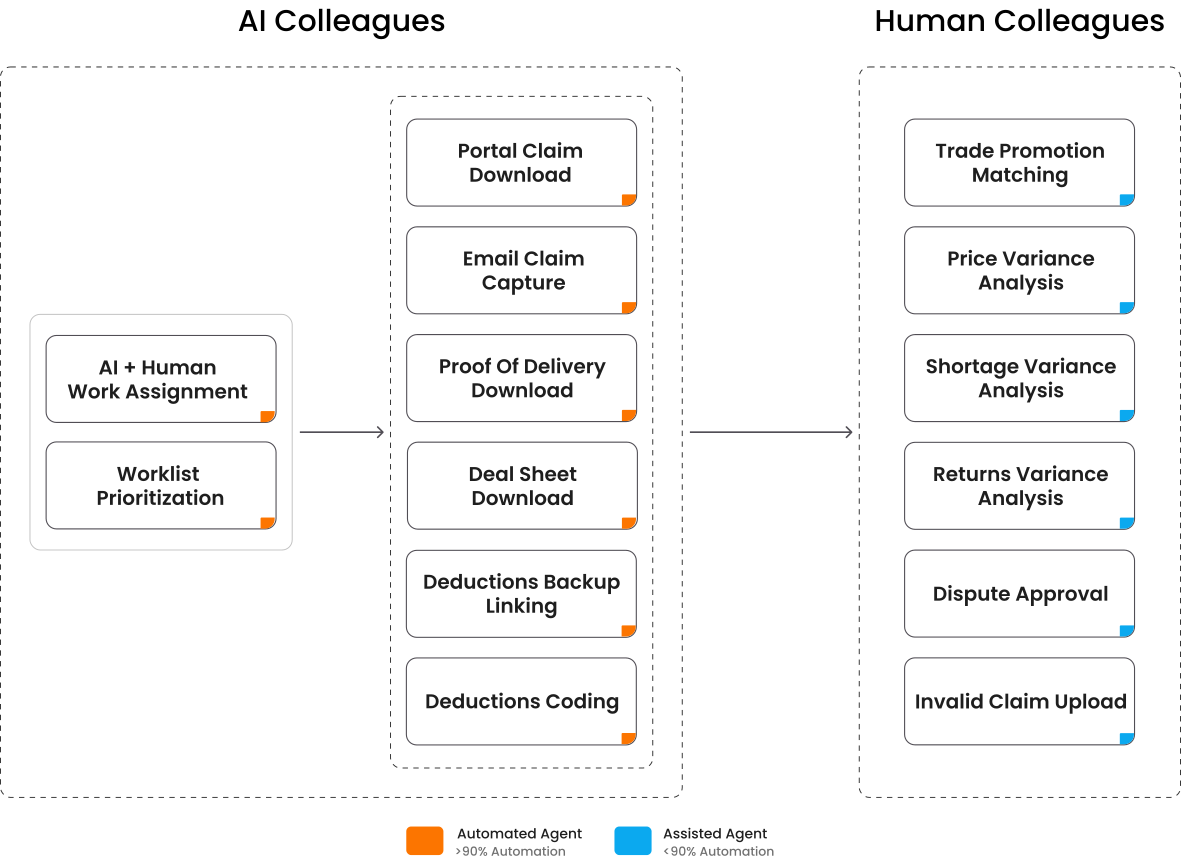
Improve net recovery by 30% with 12 AI Agents
Automation in deductions management offers transformative benefits, empowering businesses to optimize efficiency, enhance accuracy, and improve cash flow. At the core of these advantages is AI deductions workflow automation, which removes manual handoffs, accelerates resolution cycles, and enables teams to focus on high-value recovery work. Together, these capabilities unlock clear deduction recovery software benefits for finance and A/R teams. Key benefits include:
Maximize Recovery by Predicting Deduction Validity

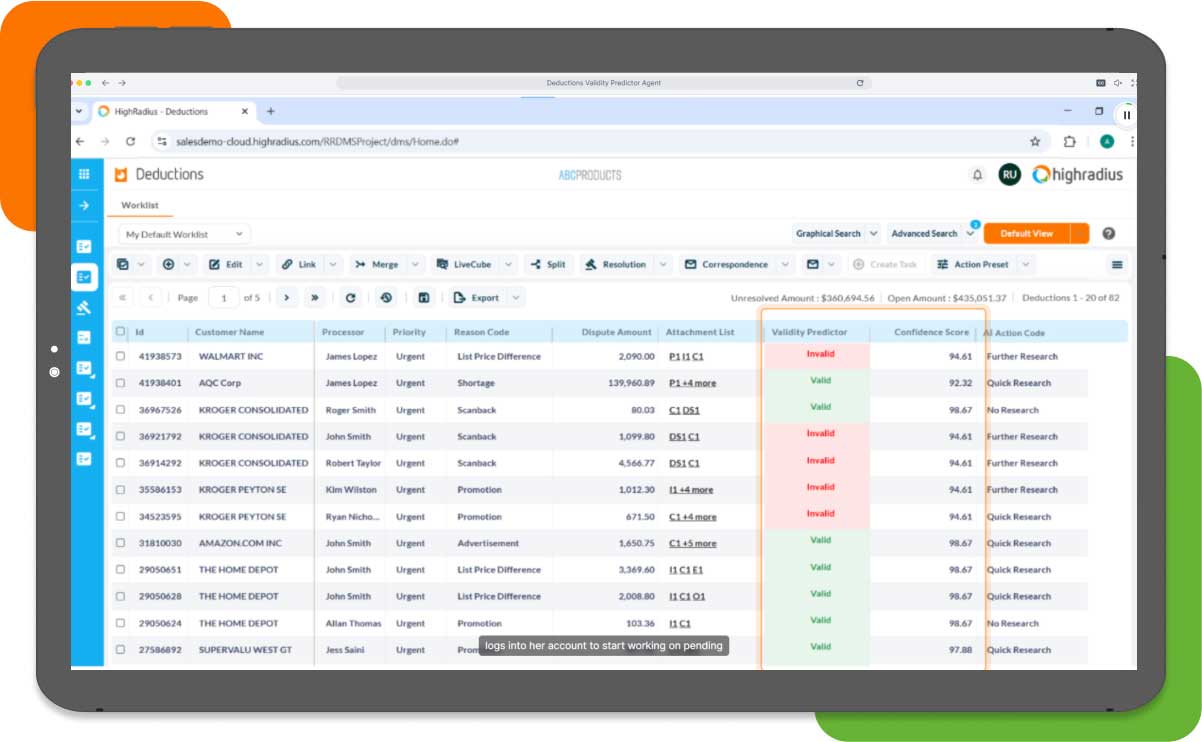
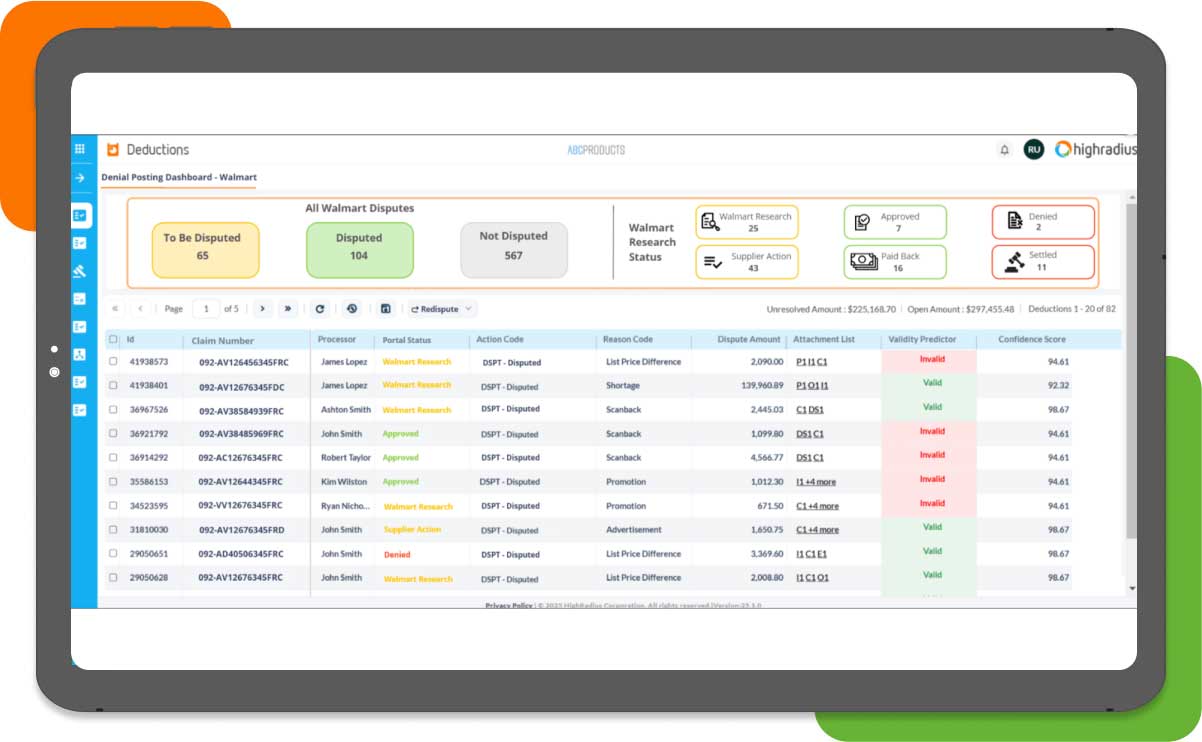
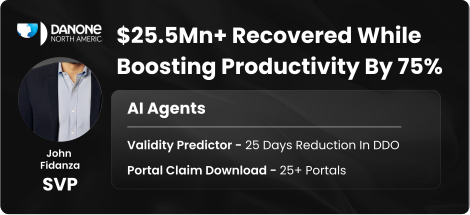
Our AI-powered Deductions Validity Predictor analyzes key variables such as dispute type, amount, and resolution history to predict whether deductions are valid or invalid. This eliminates the need for manual research, allowing teams to focus on invalid deductions and maximize deduction recovery rates.
Save Time with Automated Claim Backup Collection
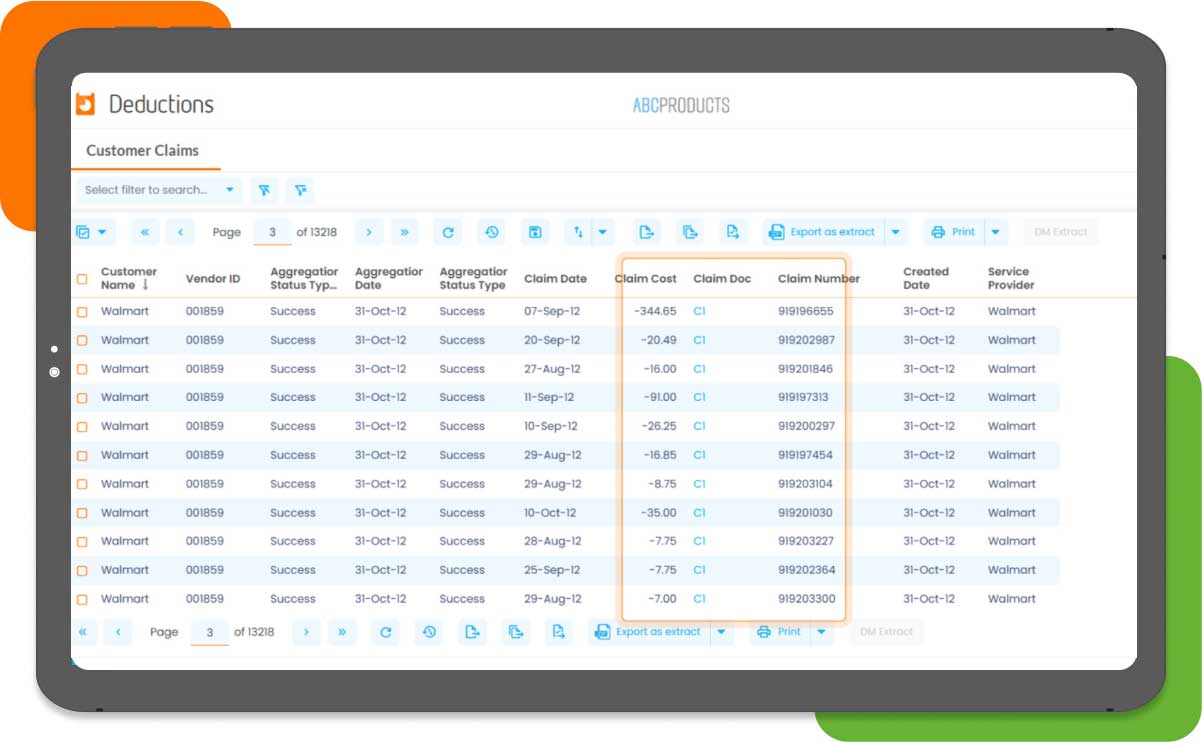
Claim backup automation aggregates supporting documents from customer portals and emails, linking them directly to deductions. By automating this time-consuming task, analysts can focus immediately on research rather than document collection, improving deductions management efficiency.
Resolve Deductions Faster with Auto-Coding
With insights from 200+ implementations, deductions auto-coding uses a robust algorithm library to identify reason codes and route deductions to the right teams. This automation strengthens AI deductions workflow automation by ensuring faster resolution and real-time visibility across all deduction types.
Eliminate Research Time with Pricing Deduction Automation
Pricing deduction research automation identifies discrepancies between customer claims and internal records. Features like LiveCube automate 4-way matches among deductions, claim backup items, sales invoices, and pricing contracts, ensuring accuracy and pricing deduction validation.
Speed Up Trade Deduction Validation with Auto-Matching
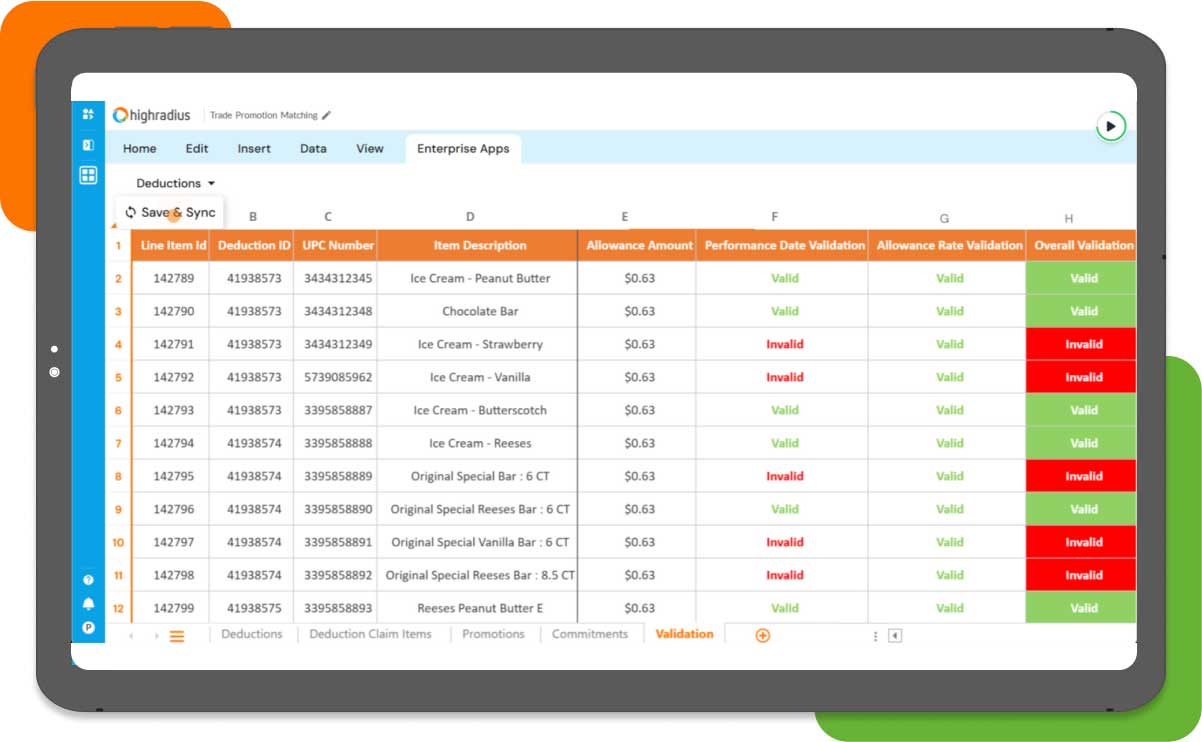
Our trade deduction auto-matching algorithm compares trade promotions, claim backup line items, and item master data to validate trade deductions. This automation eliminates time-intensive manual research and ensures accurate trade deduction resolution.
Simplify Collaboration with Automated Workflows
Approval workflows and interdepartmental collaboration are made seamless with automated workflows. Teams can share updates and documents via a unified platform, streamlining deductions workflow management and approval processes.
Simplify Claim Validation with POD Automation
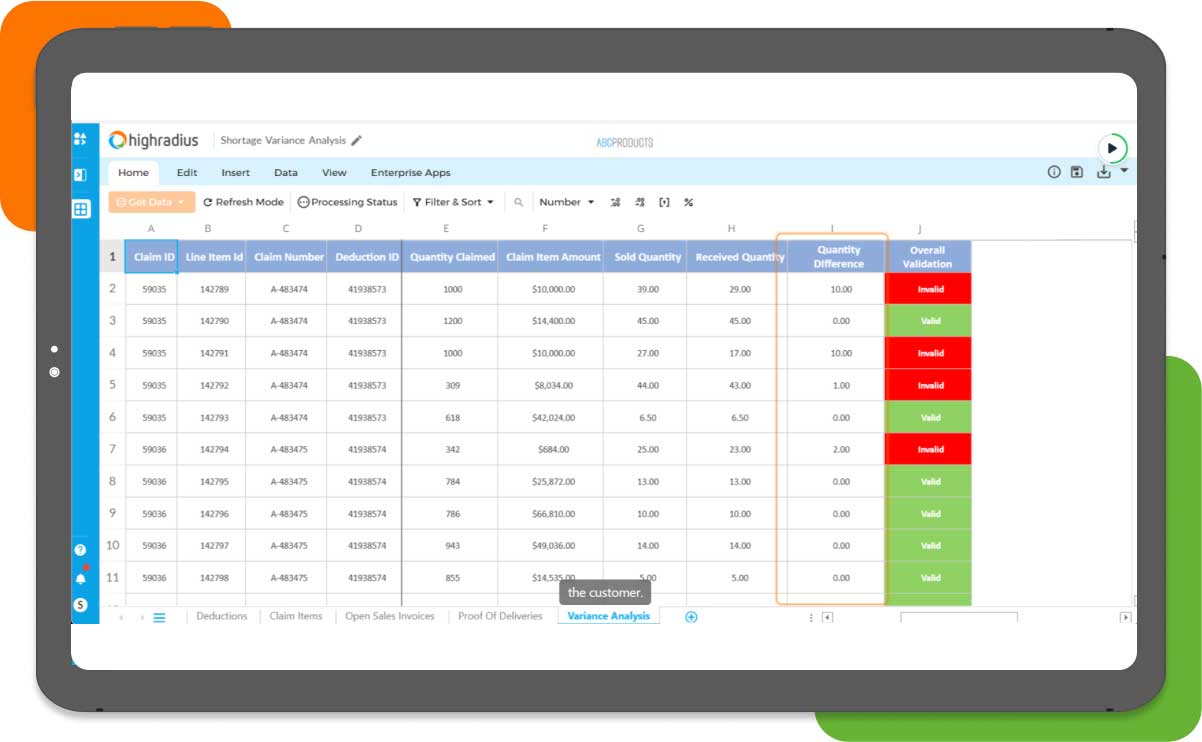
POD automation collects and links delivery documents, such as signed or unsigned PODs, directly to deductions. This simplifies the validation process for shortage-based claim validation.
Reduce Manual Effort with Automated Dispute Denials
Automated dispute denials enable teams to send denial notices and supporting documents like invoices or PODs via pre-configured email templates. For portal-based denials, RPA technology posts data directly to customer websites, further reducing manual effort and improving deductions dispute management.
HighRadius' automated deductions management solution is ERP-agnostic, seamlessly integrating with any ERP system to ensure streamlined financial processes.
Learn how automating deductions workflows, such as document aggregation, claim matching, and resolution tracking, can cut deduction cycle times in half, reduce revenue leakage, and boost productivity for A/R teams.
Download NowUse this RFP template to define your requirements, ask the right questions, and systematically evaluate deductions management software vendors, helping you choose a solution that automates dispute resolution, improves recovery rates, and maximizes ROI.
Download NowLearn how automating deductions research and resolution eliminates manual, low‑value tasks; boosting recovery rates, reducing Days Deductions Outstanding (DDO), and improving operational efficiency in your order‑to‑cash process.
Download NowDeductions Management Software is a tool designed to streamline the process of identifying, validating, and resolving customer payment deductions. This tool manages deductions related to pricing discrepancies, shortages, returns, or trade promotions by automating data gathering and tracking deductions.
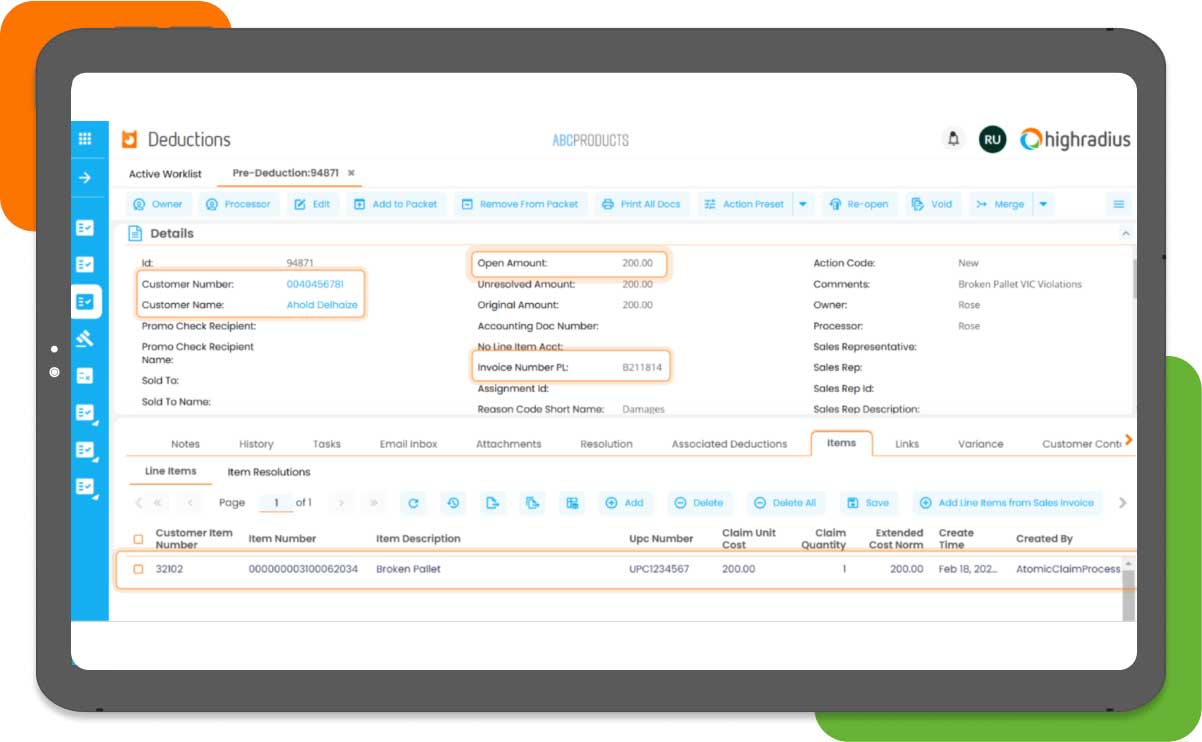
For example, the software can detect instances like the $100 pricing discrepancy highlighted above, automatically categorize the deduction, validate it against agreements or supporting documents, and assign it for resolution. By leveraging automation and analytics, deductions management software reduces resolution time, enhances accuracy, and minimizes revenue leakage while improving customer relationships.
A direct discount (cents-off or percentage off) on the price of the goods listed on the invoice
A deduction where the retailer bills the supplier for the actual quantity of discounted units scanned and
sold to consumers
A fixed fee paid to retailer to secure shelf space or slots for new products
A deduction when the retailer claims the supplier charged them the wrong price
A type of financial incentive where a retailer earns a percentage of their money back after hitting a specific purchase milestone
A reconciliation process where a distributor is reimbursed by the supplier for the "price gap" between the standard wholesale cost and a lower, pre-negotiated contract price for a specific end-customer
A deduction taken when customer receives more product than what was listed on the shipping documents or
Purchase Order (PO)
A deduction taken when the retailer claims the quantity of goods received is less than the quantity listed on the invoice
A deduction taken for goods that arrived at the retailer’s location in a damaged, unsellable or broken condition
Penalties for system downtime or failure to meet service level agreements
Deducting the value of "out of tolerance" parts rather than returning the
entire shipment
If an agency owes the carrier for net premiums (money collected from customers), the carrier will deduct those owed premiums from the agency's monthly commission payout
Deductions initiated by third-party auditors reviewing historical data to find missed promotions, pricing errors, or duplicate payments
Managing deductions manually can be complex, time-consuming, and prone to errors for businesses. With increasing deduction volumes, diverse claim formats, and evolving customer disputes, manual processes often result in delays, inefficiencies, and inaccurate resolution. These challenges not only affect cash flow but also place additional strain on accounts receivable teams, increasing operational costs and impacting overall productivity. Let’s explore the key challenges businesses face with manual deductions management.
Manually investigating deductions requires reviewing multiple documents, contracts, and claim details. This slows down resolution, delaying revenue recognition and cash recovery.
Manual coding and validation of deductions increase the likelihood of mistakes, such as incorrect reason codes or mislinked claims, leading to inaccurate reporting and potential financial losses.
Supporting documents for deductions; emails, portal downloads, invoices, and PODs, often arrive from multiple sources, making consolidation tedious and error-prone.
Analysts spend hours on repetitive tasks like claim aggregation, coding, and dispute tracking instead of focusing on high-value work such as research, dispute resolution, or process improvement.
Validating trade promotions and pricing-related deductions manually requires cross-referencing contracts, item-level data, and claims, which can slow down settlement and increase the risk of revenue leakage.
Automated deduction software revolutionizes how businesses handle disputes by streamlining workflows and reducing manual intervention. From faster resolution times to improved recovery rates, automation delivers measurable results that directly impact your bottom line.
Automate document collection using embedded RPA bots that integrate with 1000+ customer and carrier websites, freeing up 80% of analysts' time.
Leverage AI-powered matching algorithms to validate customer eligibility for promotions, rebates, and variance analysis for non-trade deductions like pricing and shortages.
Achieve up to 50% higher net recovery rates by focusing on deductions with a high probability of recovery.
Simplify denial correspondence with pre-configured email packages and automated denial letters, ensuring complete and professional communication with customers.
Proactively gather backup documents and resolve deductions faster, improving overall deduction resolution efficiency
Selecting the right deductions management software can make a significant difference in recovering revenue efficiently and reducing manual effort. With a wide variety of tools available, businesses need to focus on features that not only streamline operations but also improve accuracy, collaboration, and scalability. Here are the key factors to keep in mind:
Look for software that automates claim capture, reason code mapping, trade promotion matching, and dispute resolution. The more tasks the system can handle automatically, the less manual effort your team spends.
Ensure seamless connectivity with your ERP, trade promotion systems, and customer portals. This allows real-time data aggregation, faster claim linking, and accurate deduction validation.
AI-powered deduction validity prediction and automated matching algorithms reduce errors and help prioritize high-value claims, maximizing recovery.
Software should support multi-level approvals, role-based work assignments, and shared dashboards to streamline teamwork across departments.
Look for tools that provide actionable insights, track KPIs like deduction resolution time and recovery rates, and enable continuous process improvement.
The system should handle high volumes of deductions and adapt to evolving business processes, new customers, or additional sales channels without disrupting operations.
Duplicate claims. Invalid deductions. Endless research and approval delays. Finance teams cut through the chaos with Agentic AI-powered Deductions Management, automating claim capture, reason code mapping, trade promotion matching, and dispute resolution across every channel.
The result is tangible deduction recovery software benefits: faster deduction resolution, higher recovery rates, reduced write-offs, and millions in recovered revenue within six months.
Book a Discovery CallDeduction management involves tracking, categorizing, and resolving claims or disputes, typically from customers. It ensures businesses effectively identify valid and invalid deductions, thereby minimizing financial losses, streamlining the deductions process, and improving recovery.
AI improves deduction recovery by automatically capturing and validating claims, predicting deduction validity, matching deductions to invoices or promotions, and prioritizing high-value disputes. This reduces manual research, speeds resolution, and helps teams recover more revenue faster.
Deductions management cloud software helps track short-term paid items by categorizing them separately, ensuring proper allocation. It automates the process of matching payments to the appropriate accounts, reducing human error and helping in the timely resolution of short-term deductions.
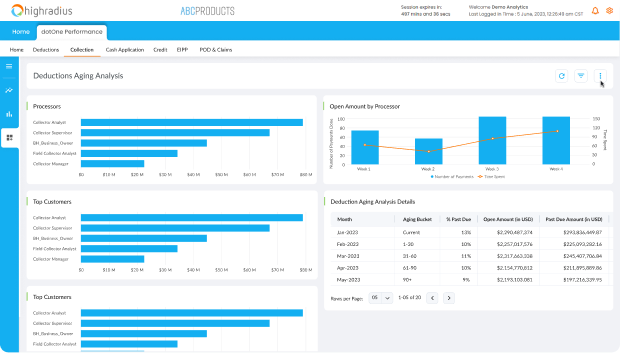
Additionally, it provides visibility into aging deductions and highlights discrepancies for faster follow-ups. This ensures that short-term items are resolved before they escalate into disputes, maintaining smooth cash flow management.
Yes, deductions management software automatically collects and aggregates supporting documents from multiple sources, such as invoices, purchase orders, and contracts. This documentation is linked to the corresponding deductions, allowing for quicker dispute resolution.
The system reduces manual effort by centralizing documents and ensuring they are readily available for audits or customer communication. This not only accelerates resolution times but also improves the accuracy of deduction processing.
For small businesses, automated deductions management systems reduce manual workload, improve accuracy, and speed up deduction resolutions. By minimizing time spent on administrative tasks, small businesses can focus on growth while reducing costs and improving cash flow management.
The automation tools also enhance scalability, allowing small businesses to handle increased deduction volumes as they grow. This ensures better resource utilization and positions the business for sustainable financial success.
Automated deductions management helps enterprise businesses by streamlining complex processes across multiple departments and locations. The system provides real-time data, enables faster dispute resolution, and improves compliance, ultimately boosting productivity and maximizing financial recovery.
It also integrates seamlessly with ERP systems to provide detailed insights into deduction trends and recovery performance. These insights allow enterprises to implement data-driven strategies, leading to enhanced operational efficiency and profitability.
SAP deduction management helps businesses track, analyze, and resolve customer payment deductions within SAP systems. It identifies short payments, assigns them for investigation, and supports faster resolution using workflows, reason codes, and visibility into deduction status.
To choose the best deduction management software, evaluate SAP integration depth, automation capabilities, AI-driven deduction classification, flexible workflows, reporting features, and scalability to handle growing deduction volumes without increasing manual effort.
The best deduction management software includes AI-based deduction validity prediction, automated claim capture, SAP deduction management integration, trade promotion matching, shortage validation, and collaborative workflows. These features reduce research time, improve recovery rates, and scale with growing volumes.
Deductions management software is ideal for finance, AR, and shared services teams handling complex customer claims. Companies using SAP deduction management benefit most, as automation helps manage high volumes, reduce manual work, and recover cash faster with the best deduction management software.
Deductions are handled in the ERP through workflow-based approvals where claims are reviewed, validated, and either approved, disputed, or cleared. Approved deductions are settled, disputed ones trigger dispute workflows with backup, and cleared deductions update records for accurate tracking and reconciliation.