Trusted by global finance organizations to automate deduction validation, accelerate
resolution workflows, and recapture revenue faster.
Trusted by leading companies worldwide

Proven impact of AI-driven deductions management designed for complex manufacturing supply chains.
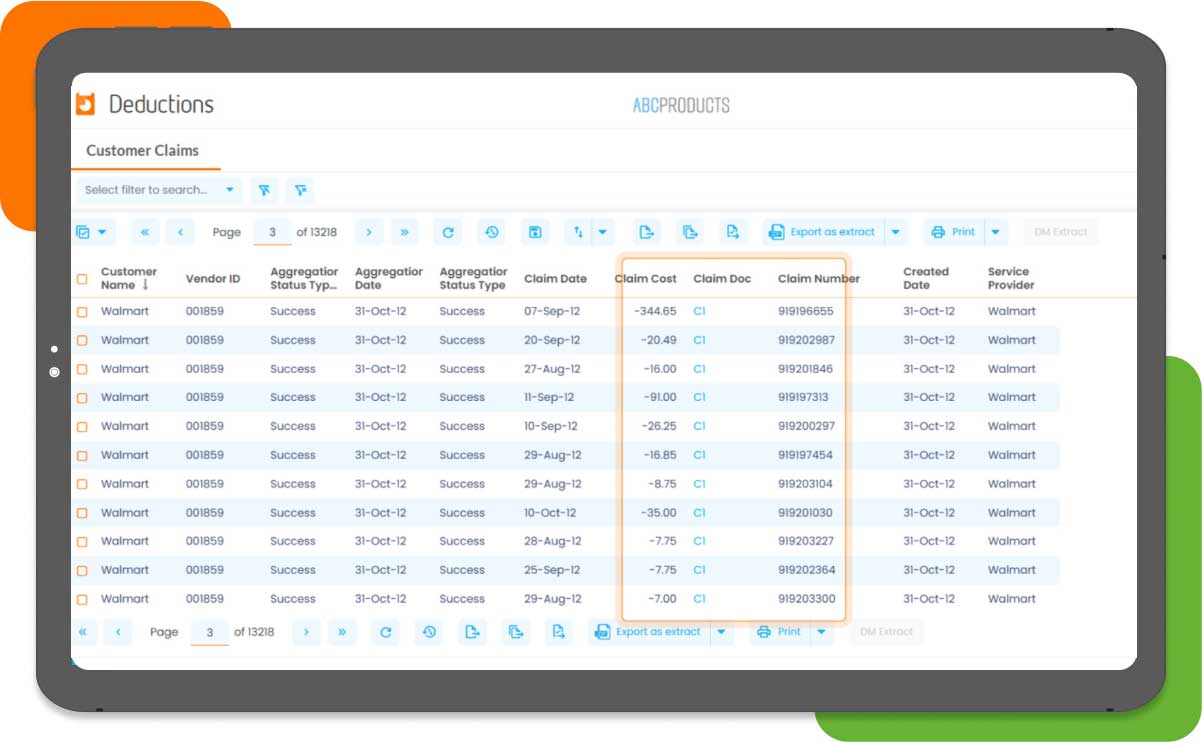
AI agents automatically retrieve backup documents, claims, and Proof of Deliveries (PODs) from 100+ carrier portals and emails, reducing manual research time by 50% for manufacturing teams.
Automatically validate shortage and pricing claims by cross-referencing shipping data and contracts. AI-powered validation helps manufacturers identify and recover twice as many invalid deductions.
Accelerate the dispute lifecycle by automating deduction coding and improving cross-team collaboration with Sales and Logistics, leading to a 30% reduction in Days Deductions Outstanding (DDO).
Eliminate repetitive manual tasks like data entry and document matching. Re-allocate your credit and collections team to high-value strategic disputes, driving a 40% increase in overall FTE productivity.
Deductions management in manufacturing is more than just resolving disputes, it’s about protecting your margins. By automating the labor-intensive process of claim research and document retrieval, HighRadius enables finance teams to resolve disputes faster, recover more revenue, and strengthen relationships with retail partners.
Stop leaving money on the table. Our AI-driven engine automatically identifies invalid shortage and pricing claims by cross-referencing your internal ERP data with shipping documents. This ensures your team spends time fighting the claims you should win, rather than getting buried in valid ones.
Eliminate the "portal crawl." AI agents automatically log into 100+ carrier and retailer portals to download claims, debit memos, and Proof of Deliveries (PODs). Manufacturers can save thousands of hours annually by having all supporting backup documentation automatically attached to the dispute.
Accelerate the path to "Closed." By automating deduction coding and streamlining cross-departmental workflows between Sales, Logistics, and Credit, you can significantly reduce your Days Deductions Outstanding (DDO) and free up trapped working capital.
Identify why deductions are happening in the first place. Advanced analytics help you spot trends, like recurring shipping errors from a specific plant or persistent pricing discrepancies, allowing you to fix the underlying issues and prevent future revenue leakage.
Integrations
HighRadius integrates natively with leading ERPs to eliminate data silos and automate the end-to-end deduction resolution lifecycle for manufacturers.
Seamless integration with SAP S/4HANA and ECC to automate claim creation, reason code mapping, and the posting of credit memos or write-offs in real-time.
Explore IntegrationDeep integration with Oracle ERP Cloud and NetSuite to synchronize disputed line items, ensuring your sub-ledger and general ledger always reflect accurate claim statuses.
Explore IntegrationNative connector for Dynamics 365 to automate the retrieval of customer debit memos and streamline the internal approval workflow for manufacturing price adjustments.
Explore IntegrationBuilt-in integration for NetSuite to help manufacturers automate the complex reconciliation of "Short-Pays" and "Debit Memos" directly within their unified business suite.
Explore IntegrationKnowledge Hub
Download expert insights to accelerate your cash application transformation.
Learn how automating deductions workflows, such as document aggregation, claim matching, and resolution tracking, can cut deduction cycle times in half, reduce revenue leakage, and boost productivity for A/R teams.
Download eBookUse this RFP template to define your requirements, ask the right questions, and systematically evaluate deductions management software vendors, helping you choose a solution that automates dispute resolution, improves recovery rates, and maximizes ROI.
Download TemplateLearn how automating deductions research and resolution eliminates manual, low‑value tasks; boosting recovery rates, reducing Days Deductions Outstanding (DDO), and improving operational efficiency in your order‑to‑cash process.
Download WhitepaperDeduction management involves tracking, categorizing, and resolving claims or disputes, typically from customers. It ensures businesses effectively identify valid and invalid deductions, thereby minimizing financial losses, streamlining the deductions process, and improving recovery.
AI improves deduction recovery by automatically capturing and validating claims, predicting deduction validity, matching deductions to invoices or promotions, and prioritizing high-value disputes. This reduces manual research, speeds resolution, and helps teams recover more revenue faster.
Deductions management cloud software helps track short-term paid items by categorizing them separately, ensuring proper allocation. It automates the process of matching payments to the appropriate accounts, reducing human error and helping in the timely resolution of short-term deductions.
Additionally, it provides visibility into aging deductions and highlights discrepancies for faster follow-ups. This ensures that short-term items are resolved before they escalate into disputes, maintaining smooth cash flow management.
Yes, deductions management software automatically collects and aggregates supporting documents from multiple sources, such as invoices, purchase orders, and contracts. This documentation is linked to the corresponding deductions, allowing for quicker dispute resolution.
The system reduces manual effort by centralizing documents and ensuring they are readily available for audits or customer communication. This not only accelerates resolution times but also improves the accuracy of deduction processing.
For small businesses, automated deductions management systems reduce manual workload, improve accuracy, and speed up deduction resolutions. By minimizing time spent on administrative tasks, small businesses can focus on growth while reducing costs and improving cash flow management.
The automation tools also enhance scalability, allowing small businesses to handle increased deduction volumes as they grow. This ensures better resource utilization and positions the business for sustainable financial success.
Automated deductions management helps enterprise businesses by streamlining complex processes across multiple departments and locations. The system provides real-time data, enables faster dispute resolution, and improves compliance, ultimately boosting productivity and maximizing financial recovery.
It also integrates seamlessly with ERP systems to provide detailed insights into deduction trends and recovery performance. These insights allow enterprises to implement data-driven strategies, leading to enhanced operational efficiency and profitability.
SAP deduction management helps businesses track, analyze, and resolve customer payment deductions within SAP systems. It identifies short payments, assigns them for investigation, and supports faster resolution using workflows, reason codes, and visibility into deduction status.
To choose the best deduction management software, evaluate SAP integration depth, automation capabilities, AI-driven deduction classification, flexible workflows, reporting features, and scalability to handle growing deduction volumes without increasing manual effort.
The best deduction management software includes AI-based deduction validity prediction, automated claim capture, SAP deduction management integration, trade promotion matching, shortage validation, and collaborative workflows. These features reduce research time, improve recovery rates, and scale with growing volumes.
Deductions management software is ideal for finance, AR, and shared services teams handling complex customer claims. Companies using SAP deduction management benefit most, as automation helps manage high volumes, reduce manual work, and recover cash faster with the best deduction management software.
Deductions are handled in the ERP through workflow-based approvals where claims are reviewed, validated, and either approved, disputed, or cleared. Approved deductions are settled, disputed ones trigger dispute workflows with backup, and cleared deductions update records for accurate tracking and reconciliation.