5 Best Dispute Management Tools for Mid-Market & Enterprise in 2026
3 March, 2026
14 minute read
Arjobi Gautam, Finance Content Expert
A
Arjobi Gautam
Arjobi specializes in finance transformation, crafting content that bridges the gap between traditional financial operations and modern, technology-driven processes. With a strong focus on automation, efficiency, and strategic value creation, Arjobi brings clarity to complex transformation journeys within the B2B SaaS and FinTech landscape. Leveraging deep domain expertise, Arjobi translates evolving financial practices into actionable insights for forward-thinking finance teams. Beyond work, Arjobi has a keen interest in exploring emerging trends in digital finance and enjoys content that challenges conventional thinking. Their writing style combines analytical depth with a practical, results-oriented perspective on the future of finance.
Last updated: 15 July, 2026
Standardize Your Dispute Management RFP with a Proven Evaluation Model
This guide evaluates top 5 dispute management solutions based on AI-driven deduction validity prediction, automated claim backup aggregation, intelligent case routing, ERP integration depth, automation maturity, and resolution performance across high-volume B2B finance environments.
HighRadius’ dispute management software helps both mid-market and enterprise businesses leverage AI-led validity prediction, automated claim capture from 90%+ of customer portals and emails, predictive worklist prioritization, and seamless integration with leading ERP systems and trade promotion management platforms.
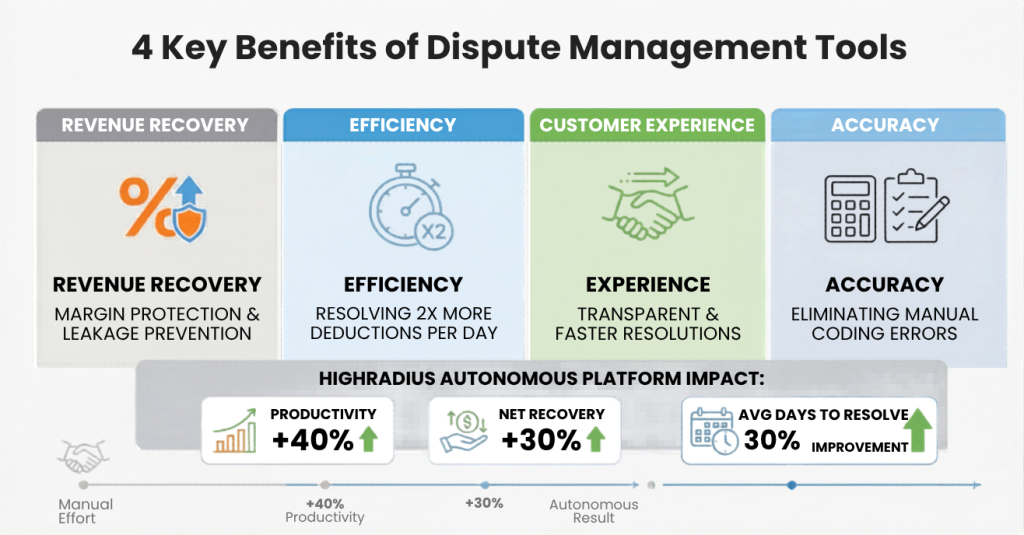
Modern deduction management platforms go far beyond basic case tracking. Organizations now use AI-driven deduction software to automate up to 90% of claim backup aggregation, improve net recovery rates by up to 30%, increase analyst productivity by up to 40%, and gain continuous, real-time visibility in dispute status and resolution performance across the entire deductions portfolio.
Every AR leader knows the number they don't talk about in board meetings: the dollar value sitting in unresolved disputes. At Finning, a global equipment and services distributor, that number was $94 million. Over 4,000 open disputes. An average resolution cycle of 56 days. And analysts spend their days not analyzing, but manually logging into 86 customer portals to download PDFs.
This is not an edge case. According to Gartner's 2025 AI in Finance survey, 59% of finance organizations are already using AI across their functions, yet dispute management remains one of the last workflows where manual effort still dominates. The tools exist. The gap is in what those tools are actually built to do. The scale looks different for growing mid-market firms, the open balance may be $5M, not $94M, and the portal count may be 12, not 86. But the underlying problem is identical: analysts spending their most productive hours on document retrieval instead of resolution decisions, and disputes aging past the point where recovery is realistic. The dollar amounts differ. The dysfunction is the same.
Most dispute management software were designed just to track disputes. The next generation is built to resolve them - autonomously, at scale, without a human initiating every step. The difference between those two categories is what this comparison is actually about.
Table of Contents
5 Best Dispute Management Platforms at a Glance
5 Best Dispute Management Platforms: A Comprehensive Review
What is a Dispute Management Platform?
9 Key Features to Look For in a Dispute Management Platform
Why Do Businesses Need Dispute Management Tools?
How to Choose the Best Dispute Management Tools?
How HighRadius Dispute Management Software Helps Improve Dispute Resolution?
Mid-market firms scaling deductions management without adding headcount, and global enterprises managing multi-ERP complexity, the platform delivering 40% productivity gains and 30% net recovery improvement at both stages of growth.
Organizations aiming to accelerate dispute resolution cycles and maintain better visibility across their dispute portfolio.
5 Best Dispute Management Platforms: A Comprehensive Review
In 2026, AI has fundamentally raised the bar for what constitutes "good" in dispute management. The best platforms don't simply log and track disputes; they classify them, predict validity, route cases intelligently, and recommend resolution actions with minimal human intervention. Each platform in this review was assessed across the following criteria:
AI and Automation Depth
End-to-End Workflow Coverage
ERP and System Integration
Claim Backup Automation
Analytics and Reporting
Collaboration and Escalation Tools
1. HighRadius
HighRadius is the 3x Gartner Magic Quadrant-leading Agentic AI Deductions Management platform, built not to organize disputes, but to resolve them. Its AI agents automatically capture claims from portals and email, extract and link over 90% of claim backup documents, perform validity checks against trade promotions and pricing data, and identify invalid short-pays in real time. The result is a platform that prevents multi-million dollar margin leaks for both organizations, without requiring teams to grow headcount as dispute volumes scale.
For growing mid-market firms: HighRadius delivers out-of-the-box automation that removes the manual research burden from day one. Analysts stop chasing documents and start making decisions. The outcome: 40% improvement in analyst productivity, 2x more deductions resolved per day, and up to 30% improvement in net recovery, measurable within the first billing cycle post-implementation.
For global enterprises managing multi-ERP complexity: HighRadius deploys AI agents to standardize deduction workflows across entities, currencies, and business units, automating matching against trade promotions and pricing data to catch invalid short-pays before they age out. The outcome: 30% reduction in average resolution time, up to 30% improvement in recovery rates, and 40% increase in FTE productivity.
Key Features: -
Deductions Validity Predictor - Leverages AI and trained ML models to predict the validity of a deduction based on historical data.
Automated Claim Capture & Download - Automatically captures and consolidates deduction claims from customer emails and portals into one system.
AI-Driven Coding - Automatically identifies, classifies, and maps customer dispute reasons to ERP codes for faster resolution.
Price Variance Match - Automatically conducts three-way matching between claims, POs, and pricing contracts to identify and flag pricing disputes.
Trade Promotion Matching - Automatically validates and matches trade promotion claims to deductions, highlighting promotional disputes for resolution.
Automated Dispute Approval Workflow - Streamlines review and approval of deduction disputes with configurable rules and exception handling.
ERP Integration - Integrates with existing ERPs and financial systems to unify dispute and AR workflows.
Analyst Reports
Recognized as an IDC MarketScape Leader in AR Automation
IDC recognized HighRadius for AI-driven AR automation across both enterprise and mid-market organizations.
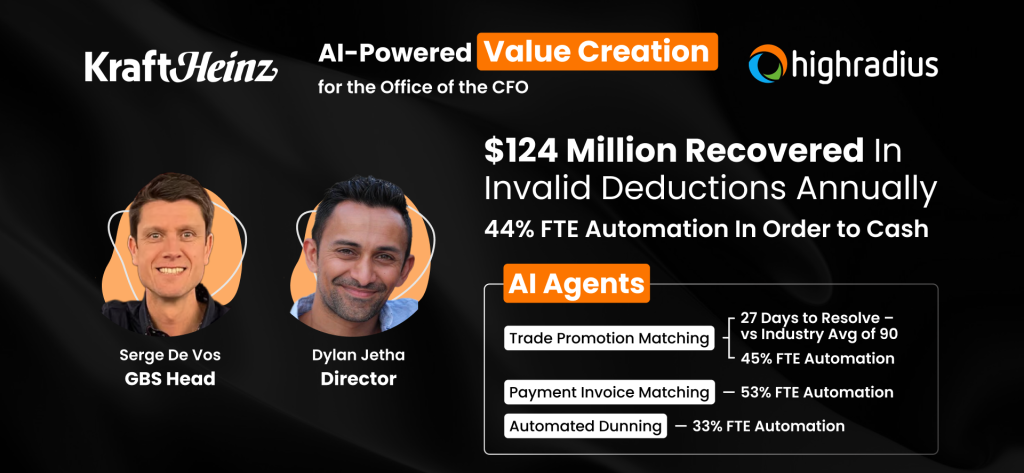
Before implementing automation, Kraft Heinz GBS faced massive trade deduction volumes and a 90-day industry-standard resolution cycle. Analysts performed manual "portal crawls" across dozens of retailer sites to retrieve claim backups, leading to delayed resolutions and significant revenue leakage from invalid claims. By deploying HighRadius’ AI-powered platform and 45 retailer-specific AI agents, Kraft Heinz automated end-to-end trade promotion matching and claim processing to streamline global dispute workflows, resulting in:
3.3× faster dispute resolution (reducing the cycle from the 90-day CPG average to just 27 days)
$124M in invalid deductions recovered annually through AI-driven validation and auto-resolution
44% overall FTE automation across GBS, significantly reducing OPEX and manual overhead
75% trade automation for major retailers including Kroger, SuperValu, Albertsons, and Ahold Delhaize
Turn Every Dispute into a Faster Recovery Opportunity
Here’s how 12 AI agents can automatically capture, validate, and resolve disputes to stop revenue leakage at scale.
Gaviti’s Dispute Management capability is built to centralize and streamline dispute handling within AR workflows. The platform enables finance teams to capture, track, and resolve disputes in a structured environment, replacing manual emails and spreadsheets with standardized workflows. Designed for finance teams looking to improve dispute visibility, accountability, and recovery.
Key Features:-
All dispute data and communications are centralized to improve visibility, collaboration, and resolution speed.
Automatically assigns disputes by rules to the right teams, reducing delays and accelerating resolution.
Enables centralized collaboration with customers and teams to resolve disputes faster and protect cash flow.
Maintain a complete audit trail with securely stored dispute documents, communications, and resolution history.
3. Kolleno
Kolleno’s dispute management functionality focuses on simplifying dispute tracking and resolution within a unified AR interface. The platform leverages AI to detect disputes early and ensures all dispute-related information is captured, routed, and resolved through automated workflows. Designed for growing finance teams, Kolleno provides clear visibility into dispute status and reduces manual follow-ups through structured case handling.
Key Features: -
Enables customers to log, view, and track disputes directly against outstanding invoices.
Automatically ranks and prioritizes dispute codes, highlighting the most urgent cases.
Uses AI to detect chargebacks and deductions early and validate underlying reasons faster.
Tracks and classifies dispute root causes, generating reports to identify and address recurring issues.
4. Quadient
Quadient’s Dispute Management solution enables finance teams to manage disputes through automated workflows, real-time tracking, and analytics-driven insights. The platform supports the full dispute lifecycle, from intake and categorization to resolution and closure, helping teams maintain control over dispute backlogs and resolution timelines. Its configurable workflows and reporting capabilities make it well-suited for organizations seeking structured dispute handling with strong visibility.
Key Features: -
Gain deep insights into billing errors, payment history, and dispute drivers to inform decisions and reduce future disputes.
Shorten dispute resolution times and help meet SLAs with automated workflows and prioritization.
See and manage open disputes clearly with real-time data to prioritize cases and prevent escalation.
Automate routine approvals and eliminate repetitive tasks to boost operational efficiency.
5. Esker
Esker’s Dispute management software is designed to automate and standardize the end-to-end dispute resolution process within the AR function. The platform helps finance teams capture, classify, investigate, and resolve customer disputes efficiently, replacing fragmented emails, spreadsheets, and manual follow-ups with AI-driven workflows. It is well-suited for businesses looking to improve dispute visibility, reduce resolution time, and protect revenue at scale.
Key Features: -
Automatically extracts, interprets, and categorizes dispute data from remittances, emails, and documents.
Matches disputes with invoices, payments, and promotions to validate claims and identify root causes.
Routes disputes to appropriate teams using rules based on type, value, and responsibility.
Provides visibility into dispute aging, trends, KPIs, and resolution performance across teams.
What is a Dispute Management Platform?
A dispute management platform is a centralized system that handles the full lifecycle of customer disputes and deductions, from identification and case creation, through investigation and validation, to resolution and closure.
But that definition covers a wide spectrum. At one end are tracking systems: they replace your spreadsheets with a cleaner interface, give you visibility into open disputes, and route cases to the right team. At the other end are autonomous resolution engines: they monitor disputes proactively, create cases without human triggers, retrieve claim documentation automatically, predict whether a deduction is valid before an analyst touches it, and execute resolutions based on rules and AI recommendations.
Both call themselves dispute management platforms. They are not the same category of software, and choosing between them is the most important decision in this evaluation.
Tracking Disputes vs. Resolving Them Through AI
Not all dispute management platforms deliver the same level of value. Many solutions marketed as “dispute management” function primarily as tracking systems, while new age AI platforms act as autonomous resolution engines that actively drive outcomes. HighRadius is the only platform in the autonomous resolution category. The difference between a simple tracking system and an autonomous resolution engine is as follows: -
Dimension
Simple Tracking System
Autonomous Resolution Engine
Primary Role
Logs and monitors disputes
Resolves disputes end-to-end
Automation Level
Low - Manual follow-ups
High - AI driven workflows
Data Capture
Manual entry or uploads
Auto-ingests data from email portals, ERPs
Decision-Making
Fully human-led
AI-led with human oversight
Root-Cause Analysis
Manual investigation
AI identifies patterns and root causes
Action execution
Users act manually
System recommends or executes actions
Scalability
Limited at high volumes
Built for scale disputes
Business impact
Visibility and reporting
Faster Resolution, higher recovery
In simple terms, a tracking system shows where a dispute stands, while an autonomous resolution engine determines what should happen next and executes it automatically.
9 Key Features to Look For in a Dispute Management Platform
When evaluating dispute management software, focus on features that drive efficiency and results. The best solutions combine automation, flexibility, and scalability, simplifying workflows while adapting to your organization’s size, complexity, and customer base.
Centralized Dispute Hub – Stores all disputes, communications, and supporting documents in one place for complete visibility and cross-team collaboration at scale.
Automated Backup Document Collation (PODs, Claims, Invoices) – Automatically gathers and matches PODs, claims, invoices, and contracts from ERP systems, emails, and customer portals.
Comprehensive Audit Trail & Documentation – Maintains a complete, time-stamped history of dispute actions, communications, evidence, and resolutions for compliance and analysis.
Automated Workflow & Routing – Assigns disputes by reason code, customer type, SLA, or team, reducing manual handoffs and resolution delays.
AI-Powered Dispute Validity Scoring & Prioritization – Uses historical outcomes, contracts, and pricing rules to predict validity, assign confidence scores, and prioritize high-impact disputes.
Real-Time Visibility & Reporting – Real-time visibility is an absolute must for finance teams. Dashboards and analytics highlighting dispute trends, bottlenecks, and financial impact allow teams to continuously improve processes.
Integration with ERP & AR Systems – Integrates with existing ERPs and financial systems to unify dispute and AR workflows.
Why Do Businesses Need Dispute Management Tools?
Disputes can disrupt cash flow, strain customer relationships, and burden teams with repetitive tasks like document retrieval, claim validation, and follow-ups. Automation eliminates these inefficiencies by using AI-driven workflows to categorize disputes, route them to the right teams, and trigger timely resolutions. This ensures disputes are handled promptly and accurately, improving overall operational efficiency. Here are a few reasons why businesses need it:-
Faster Resolution Times - With intelligent workflows and auto-routing capabilities, disputes are instantly directed to the right teams, reducing delays and bottlenecks.
Improved Accuracy - By standardizing dispute workflows and automatically linking accurate data from ERP systems, the system significantly minimizes human errors. Thus, ensuring cleaner records and more reliable resolution outcomes.
Enhanced Efficiency - When disputes are handled promptly and accurately, overall operational efficiency is greatly improved.
Better Customer Relations - Faster and accurate dispute resolution enhances customer satisfaction by offering quicker and more transparent resolutions.
How to Choose the Best Dispute Management Tools?
As dispute volumes grow and finance teams prioritize working capital optimization, selecting the right dispute management platform in 2026 requires more than comparing feature lists. Modern dispute management platforms must combine AI-driven automation, enterprise scalability, and deep ERP integration to truly transform resolution outcomes. Here are the key criteria enterprises should evaluate:
Level of AI & Automation Maturity: Not all dispute management platforms are built the same. Some only track and assign cases, while advanced platforms automate the entire lifecycle, from dispute intake to resolution and recovery. Look for platforms that:
Automatically create cases from remittances, emails, and portals
Classify disputes using AI-driven reason coding
Predict deduction validity using historical outcomes
Recommend or trigger next-best actions
End-to-End Dispute Lifecycle Coverage: The right dispute management platform should support the full process:
Dispute capture and case creation
Document aggregation (PODs, contracts, invoices)
Intelligent routing and approval workflows
Resolution, rebilling, or write-off
Root-cause analysis and reporting
ERP & AR Ecosystem Integration: A dispute management platform must integrate seamlessly with ERP and Accounts Receivable systems to eliminate data silos. Evaluate:
Real-time sync with ERP data (invoices, payments, pricing)
Integration with trade promotion and pricing modules
Deep integration ensures accuracy, faster validation, and reduced manual reconciliation.
Scalability for High Volumes: As organizations expand globally, dispute complexity increases. The right platform should handle:
High-volume dispute environments
Multi-entity, multi-currency operations
Region-specific compliance requirements
Configurable workflows across business units
Scalability ensures consistent performance without increasing headcount.
Advanced Analytics & Root-Cause Intelligence: Modern dispute management platforms should not only resolve disputes but also prevent them. Prioritize solutions that offer:
Real-time dashboards on dispute aging and backlog
Recovery rate tracking and financial impact analysis
AI-driven root-cause identification
SLA performance monitoring
How HighRadius Dispute Management Software Helps Improve Dispute Resolution?
HighRadius dispute management software helps finance teams automate dispute identification, accelerate claim resolution, and gain real-time visibility across the entire dispute lifecycle, without adding headcount. Built for organizations managing high volumes of deductions and chargebacks, the platform combines Agentic AI, automated workflows, and continuous learning to reduce manual research, eliminate revenue leakage, and drive faster cash recovery. With AI handling claim capture, validity prediction, and intelligent case routing, analysts can shift focus from data entry to strategic recovery; resolving disputes faster, with greater accuracy, and at scale.
With AI-powered dispute management, finance teams can automatically capture, classify, and route dispute cases from remittance data, inbound emails, and ERP inputs; eliminating the need for manual case creation and ensuring disputes are logged and categorized before they fall through the cracks. Here's what HighRadius dispute management software can do for your team:
Automatic Case Creation and Categorization — AI agents continuously monitor remittance data, inbound emails, and ERP inputs to automatically create and classify dispute cases without waiting for human review, ensuring every dispute is logged and categorized from the moment it arrives.
Intelligent Root-Cause Analysis - AI scans historical data to pinpoint recurring pricing errors and shipment discrepancies before they compound. For teams: disputes are prevented at the source rather than just managed after the fact.
Predictive Resolution and Prioritization - AI forecasts resolution timelines and escalation risks to rank high-value claims based on financial impact. For teams: worklists are ranked by urgency, ensuring critical disputes are resolved before they age.
Automated Recommendations and Workflows - AI suggests the next-best action for each case and triggers automated approval workflows for instant routing. For teams: manual decision-making is replaced by one-click execution, slashing resolution cycles across the board.
Continuous Learning and Improvement - AI analyzes every resolved case to refine its own classification accuracy and reduce manual intervention over time. For teams: the system gets smarter with every dispute, constantly shrinking the manual workload.
Enhanced Analytics and Forecasting - AI aggregates dispute data to visualize recovery rates and identify hidden operational bottlenecks in real-time. For teams: reporting is instant and predictive, replacing manual spreadsheets with actionable, data-driven insights.
Case Studies
How this dairy giant recovered $5 M in invalid deductions
Learn how HP Hood achieved high-impact recovery by automating manual research, streamlining dispute resolution, and enhancing visibility into invalid claims.
Dispute management is capital preservation, not administration. Treating deductions as an unavoidable cost of business is a strategic failure. Finance leaders must pivot from passive tracking to autonomous recovery to halt margin erosion.
Every day a dispute lingers is effectively an interest-free loan to the customer. Failing to deploy AI-driven automation isn't just an efficiency gap, it is a choice to accept millions in preventable revenue leakage. Automation is no longer an operational upgrade; it is a financial imperative.
Learn more about HighRadius' Deductions Management Software
Reduce Revenue Leakage with AI Prediction models that identify valid and invalid deductions.
Claim documents at your fingertips – Auto-download 90% of your claims, PODs, and BoLs
Deductions Auto Coding
Eliminate manual coding errors with automated, AI-driven deduction categorization.
AI Deductions Validity Predictor
Wasting time chasing valid deductions? Let AI predict and prioritize the right deductions for you
FAQs: Dispute Management Tools
1. What is the difference between chargeback management and dispute management?
Chargeback Management focuses specifically on customer-initiated reversals of payments, often related to credit card or payment disputes. On the other hand, dispute management has a broader scope, covering all types of B2B disputes, including short payments, deductions, pricing errors, or trade promotion claims.
Chargeback Management focuses specifically on customer-initiated reversals of payments, often related to credit card or payment disputes. On the other hand, dispute management has a broader scope, covering all types of B2B disputes, including short payments, deductions, pricing errors, or trade promotion claims.
2. What are dispute management platforms?
Dispute management platforms are software solutions that help businesses capture, track, investigate, and resolve customer disputes and deductions. Modern platforms use AI and automation to accelerate resolution and improve cash recovery.
Dispute management platforms are software solutions that help businesses capture, track, investigate, and resolve customer disputes and deductions. Modern platforms use AI and automation to accelerate resolution and improve cash recovery.
3. Do dispute management platforms integrate with ERP systems?
Yes. The integration depth varies significantly. Basic platforms sync invoices and payment data in batch mode, which introduces lag and limits real-time validation. Platforms like HighRadius maintain real-time, bidirectional sync with SAP, Oracle, and NetSuite, enabling automated three-way matching (invoice × PO × pricing contract) at the moment of dispute intake. For companies managing trade promotion or pricing variance disputes, the difference between batch and real-time integration is often the difference between a 5-day and a 30-day resolution cycle.
Yes. The integration depth varies significantly. Basic platforms sync invoices and payment data in batch mode, which introduces lag and limits real-time validation. Platforms like HighRadius maintain real-time, bidirectional sync with SAP, Oracle, and NetSuite, enabling automated three-way matching (invoice × PO × pricing contract) at the moment of dispute intake. For companies managing trade promotion or pricing variance disputes, the difference between batch and real-time integration is often the difference between a 5-day and a 30-day resolution cycle.
4. Can these platforms handle "Trade Promotion" disputes?
Yes. Advanced platforms like HighRadius can automatically match trade promotion claims with contracts and sales agreements, validate eligibility, and route disputes for faster resolution.
Yes. Advanced platforms like HighRadius can automatically match trade promotion claims with contracts and sales agreements, validate eligibility, and route disputes for faster resolution.
5. What are the key metrics (KPIs) to track in dispute management?
Key KPIs include dispute resolution time, recovery rate, dispute backlog, automation rate, root-cause trends, and customer satisfaction metrics.
Key KPIs include dispute resolution time, recovery rate, dispute backlog, automation rate, root-cause trends, and customer satisfaction metrics.
HighRadius Named an IDC MarketScape Leader for the Second Time in a Row For AR Automation Software for Large and Midsized Businesses
HighRadius stands out as an IDC MarketScape Leader for AR Automation Software, serving both large and midsized businesses. The IDC report highlights HighRadius’ integration of machine learning across its AR products, enhancing payment matching, credit management, and cash forecasting capabilities.
Forrester Recognizes HighRadius in The AR Invoice Automation Landscape Report, Q1 2023
Forrester acknowledges HighRadius’ significant contribution to the industry, particularly for large enterprises in North America and EMEA, reinforcing its position as the sole vendor that comprehensively meets the complex needs of this segment.