Electronic Invoicing: A Strategic Guide for Finance Transformation
Last Updated: 28 August, 2026
•
Nimisha Ghosh B2B Finance Content Strategist
N
Nimisha Ghosh
Nimisha specializes in Order-to-Cash (O2C) transformation, crafting strategic narratives at the intersection of B2B SaaS and FinTech. With over four years of experience, she brings deep expertise in electronic invoicing, receivables automation, and digital payments, translating complex autonomous finance capabilities into actionable insights for modern finance leaders. When she’s not analyzing trends in enterprise finance, Nimisha enjoys reading and traveling. Her approach to writing is rooted in clarity, precision, and a strong understanding of real-world financial challenges.
2026 Automation Benchmark Report
HighRadius 2026 Automation Benchmark Report For The Office Of The CFO
Understand if your performance is on par with top 10% of the organizations. Identify gaps, best practices and know how you can drive value through Agentic AI-Driven Automation.
In a world that’s rapidly going digital, relying on traditional invoicing methods is a huge liability for businesses. Manual processes are slow and error-prone, which causes delays and inefficiencies to pile up, leading to higher operational expenses and limited visibility into cash flow.
That’s where electronic invoicing comes in. Electronic invoicing is transforming the way businesses manage their invoicing process. According to market research, the global electronic invoicing market will likely hit USD 63.93 billion by 2032. This is because companies are now seeing the value of ditching traditional invoicing systems.
Modern e-invoicing solutions help streamline and automate the invoicing process, reduce errors, speed up payments, and lower costs, which is why most businesses are shifting to this digital solution.
In this blog, we’ll discuss what electronic invoicing is, how it works, and what business owners should know when planning to adopt this technology.
Table of Contents
What is Electronic Invoicing?
How Does Electronic Invoicing Work?
The Role of EIPP in Electronic Invoicing
Global E-Invoicing Compliance and Mandates (2026)
Key Benefits of Electronic Invoicing
Common Challenges in E-Invoicing
Future Trends in Electronic Invoicing
The Strategic Next Step: EIPP
What is Electronic Invoicing?
Electronic invoicing refers to the process of digital creation, exchange, and processing of invoices in a standardized electronic format. Unlike sending a PDF attachment by email, e-invoicing uses structured data formats such as XML or EDI, enabling systems to automatically read, validate, and record invoice details without human input.
Evolution of Invoicing: Traditional vs Digital vs Electronic vs EIPP
As invoicing technology has evolved, each stage has introduced new levels of automation, efficiency, and integration. The comparison below highlights how traditional invoicing differs from digital invoicing, electronic invoicing, and EIPP platforms.
Capability
Traditional Invoicing
Digital Invoicing
Electronic Invoicing
EIPP
Invoice format
Paper invoices
PDFs or scanned documents
Structured data formats (XML, EDI)
Structured invoices with embedded payment options
Delivery method
Postal mail or fax
Email attachments
System-to-system exchange
Multi-channel delivery based on customer preference (portals, email, EDI, fax, or paper)
Processing
Manual data entry and validation
Partially manual processing
Automated validation and processing
Automated invoice presentment, payment capture, and reconciliation
Automation level
None
Low
Moderate
High
Error risk
High due to manual entry
Moderate
Low
Minimal due to automation
Regulatory compliance
Limited visibility and control
Minimal compliance capabilities
Supports regulatory e-invoicing mandates
Supports compliance alongside payment workflows
Payment experience
Payment handled outside the invoicing process
Manual payment via separate channels
Payments typically handled separately
Integrated digital payment options (ACH, credit card, debit, etc.)
Visibility & tracking
Limited tracking and reporting
Basic visibility
Improved tracking across invoicing workflows
Real-time dashboards and payment visibility
Scalability
Difficult to scale with high invoice volumes
Moderately scalable
Scalable across business systems
Enterprise-scale automation across global operations
Customer experience
Slow and manual
Faster delivery but limited interaction
Faster processing but limited payment flexibility
Self-service portals with flexible payment options
ERP integration
Minimal or none
Partial integration
Full integration with ERP systems
Full ERP integration with payment and reconciliation capabilities
Your Blueprint to Faster, Smarter, & Stress-Free Invoicing
See how top finance teams cut delays, boost accuracy, and stay audit-ready with automated e-invoicing.
Electronic invoicing automates the process of creating, validating, transmitting, and processing invoices between businesses. Unlike traditional invoicing, where documents are manually created and shared through mail or email, electronic invoicing relies on structured data that allows financial systems to exchange invoice information automatically.
Because the data is standardized and machine-readable, invoices can move seamlessly between enterprise resource planning (ERP) systems, compliance networks, and customer platforms. This reduces manual data entry, improves accuracy, and accelerates the entire invoice lifecycle.
While the exact workflow may vary depending on the country, regulatory model, or technology provider, most electronic invoicing processes follow a similar set of steps.
1. Invoice Data Capture and Generation
The process begins when the e-invoicing platform pulls data from the company’s ERP system. This data typically includes customer details, invoice line items, tax information, payment terms, and other relevant transaction records.
Using this information, the system generates the invoice from predefined templates and attaches any required supporting documents, such as purchase orders or delivery confirmations. This ensures that customers receive a complete and accurate invoice package.
2. Compliance Validation and Formatting
Before the invoice is transmitted, it is validated against internal business rules and regional regulatory requirements. Many countries require invoices to follow specific data standards or reporting frameworks.
Modern e-invoicing systems automatically identify the applicable compliance requirements based on the customer’s location and convert the invoice data into the appropriate structured format. This helps ensure that invoices meet regulatory mandates and are compatible with government portals or electronic invoicing networks.
3. Invoice Routing and Delivery
Once validated, the invoice is routed through the appropriate delivery channel based on customer preferences or regulatory requirements. Invoices may be delivered through government e-invoicing portals, electronic networks, email, customer self-service portals, or even paper invoice delivery.
Delivery tracking provides visibility into whether invoices have been successfully sent, received, or rejected, allowing businesses to quickly address any issues.
4. Payment Processing and Reconciliation (via EIPP)
After customers receive the invoice, they can review the details and complete payment according to the agreed terms. Many businesses enable digital payment options directly within the invoicing process to simplify and accelerate collections.
Once payment is completed, the transaction is recorded and reconciled with the corresponding invoice in the company’s financial system, completing the invoice-to-cash cycle.
Learn more about HighRadius’ EIPP Solution
Reduce DSO and connect buyers and suppliers globally with seamless invoicing & payments.
Cut support calls by 50% as buyers self-serve invoices and payments online.
Email Invoice Delivery
Get paid faster with automated invoices and real-time delivery tracking.
e-Adoption Campaign Management
Drive portal adoption effortlessly with targeted campaigns and real-time insights.
The Role of EIPP in Electronic Invoicing
Electronic invoicing focuses primarily on the creation, validation, and delivery of invoices in a structured digital format. Its main goal is to ensure invoices are generated accurately, comply with regulatory standards, and can be transmitted electronically between businesses and government networks.
However, the invoicing process does not end once an invoice is successfully delivered. Businesses still need to ensure that customers receive the invoice, review it, complete payment, and that the payment is correctly reconciled in financial systems. This is where Electronic Invoice Presentment and Payment (EIPP) plays an important role.
EIPP solutions extend electronic invoicing by managing the entire invoice-to-payment lifecycle. Instead of simply transmitting invoice data, these platforms focus on how invoices are presented to customers and how payments are collected and processed.
For example, an EIPP platform may allow businesses to deliver invoices through multiple channels such as email, customer portals, or electronic networks, while also providing customers with convenient digital payment options. Customers can view invoices, download supporting documents, and complete payments directly through the same interface.
By combining invoice presentment, customer communication, payment processing, and reconciliation, EIPP helps businesses transform invoicing from a back-office administrative task into a streamlined digital experience that accelerates cash flow and improves customer interactions.
Whitepaper
Overcome the Challenges in Electronic Payments
Discover insights from the Federal Reserve on overcoming barriers to electronic payments and remittance processing.
In 2026, government mandates are one of the biggest reasons behind the global adoption of electronic invoicing. Many tax authorities are introducing mandatory e-invoicing frameworks to reduce tax fraud, improve reporting accuracy, and close the VAT gap(the difference between expected and collected tax revenue). As a result, businesses operating internationally must comply with a growing number of country-specific invoicing regulations.
Current Regional Compliance Landscape
Europe (ViDA Initiative) – The VAT in the Digital Age (ViDA) initiative aims to modernize VAT reporting across the European Union. Several countries are introducing Continuous Transaction Controls (CTC), where invoices are reported to or validated by tax authorities before or shortly after being issued. Countries like France and Poland are implementing such frameworks.
The Americas – Countries in Latin America were early adopters of mandatory e-invoicing and operate some of the most mature clearance models globally. Meanwhile, the United States remains largely market-driven, with businesses adopting electronic invoicing through private networks and industry standards.
Asia-Pacific – Across the Asia‑Pacific region, governments are increasingly adopting interoperable frameworks such as the Peppol Network to standardize electronic document exchange between businesses.
As global mandates continue to evolve, organizations must ensure their invoicing processes can adapt to changing regulatory requirements across different regions.
Case Studies
Konica Minolta Success Story
Discover how a global manufacturing leader unlocked $30M in additional cash flow.
Electronic invoicing helps businesses move away from manual, paper-based invoicing processes and adopt faster, more efficient digital workflows. By automating the invoice process, organizations can significantly improve financial operations while reducing administrative overhead. Some of the key benefits of electronic invoicing include:
Faster Invoice Processing – Automated invoice generation and digital delivery eliminate delays caused by manual processing, helping invoices reach customers faster and reducing overall billing cycle times.
Improved Accuracy and Fewer Errors – Structured invoice data and automated validation checks reduce common errors such as missing fields, incorrect calculations, or duplicate invoices.
Better Compliance with Tax Regulations – Many e-invoicing systems support country-specific formats and regulatory requirements, helping businesses comply with government mandates and reporting standards.
Lower Operational Costs – By eliminating paper invoices, printing, postage, and manual data entry, businesses can significantly reduce invoicing and administrative costs.
Greater Visibility and Tracking – Digital invoicing platforms provide real-time visibility into invoice status, allowing teams to track whether invoices have been delivered, viewed, or processed.
Faster Payments and Improved Cash Flow – Electronic delivery ensures customers receive invoices quickly, while digital payment options make it easier for them to complete payments on time.
Common Challenges in E-Invoicing
While electronic invoicing offers significant efficiency and compliance benefits, implementing and managing e-invoicing processes can present several challenges for businesses, especially those operating across multiple regions or systems. Some of the most common challenges organizations face include:
Complex Global Compliance Requirements – E-invoicing regulations vary widely across countries, with different formats, reporting standards, and validation processes. Businesses operating internationally must continuously monitor regulatory updates and adapt their invoicing workflows accordingly.
ERP and System Integration – Integrating e-invoicing platforms with existing ERP systems, billing tools, and financial applications can require technical effort and careful data mapping to ensure accurate invoice generation and reporting.
Customer Adoption and Process Changes – Some customers may still prefer traditional invoicing methods, such as paper invoices or PDF attachments. Encouraging customers to transition to digital invoicing workflows can require communication and change management.
Data Quality and Validation Issues – Inaccurate or incomplete invoice data, such as missing tax details, incorrect customer information, or inconsistent formats, can lead to invoice rejections or processing delays.
Managing Multiple Delivery Channels – Businesses often need to deliver invoices through various channels, including email, portals, networks, and government platforms. Managing these channels efficiently while maintaining visibility can be challenging.
Understanding these challenges helps organizations better prepare for a successful transition to electronic invoicing while ensuring compliance and operational efficiency.
Future Trends in Electronic Invoicing
Electronic invoicing continues to evolve as governments, financial institutions, and businesses push for more efficient and transparent financial processes. Over the next few years, several trends are expected to shape the future of e-invoicing adoption and technology. Some key developments to watch include:
Expansion of Government Mandates – More countries are introducing mandatory e-invoicing frameworks to improve tax reporting and reduce fraud. Businesses operating globally will need to adapt quickly as new regulations continue to emerge across regions.
Growth of Real-Time Tax Reporting – Many tax authorities are moving toward continuous transaction controls (CTC), where invoice data is reported or validated in near real time. This allows governments to monitor transactions more effectively and improve tax compliance.
Standardization Through Global Networks – Interoperable networks such as the Peppol Network are gaining traction as a standardized way for businesses to exchange electronic documents across borders.
Integration with Payment and Financial Systems – Electronic invoicing platforms are increasingly integrating with digital payment systems, helping businesses streamline the entire invoice-to-cash process and reduce payment delays.
Increased Automation and AI Adoption – Automation and artificial intelligence are being used to validate invoice data, detect anomalies, and prevent disputes before invoices are sent to customers.
As these trends continue to develop, electronic invoicing will play an increasingly central role in modern financial operations and global trade.
The Strategic Next Step: EIPP
As businesses adopt electronic invoicing to improve efficiency and meet regulatory requirements, many quickly realize that invoicing is only one part of the broader invoice-to-cash process. Generating and transmitting invoices digitally helps streamline billing, but organizations still need to manage how invoices are presented to customers, how payments are collected, and how transactions are reconciled.
This is where Electronic Invoice Presentment and Payment (EIPP) solutions play an important role. EIPP platforms extend electronic invoicing by enabling businesses to deliver invoices through multiple channels, provide customers with convenient payment options, and track invoice status throughout the payment lifecycle.
By combining invoice delivery, customer communication, payment processing, and reconciliation, EIPP solutions help organizations create a more connected and efficient invoicing experience. This approach not only improves operational visibility but also helps accelerate payments and strengthen customer relationships.
As electronic invoicing adoption continues to grow worldwide, many organizations are exploring EIPP as the next step in building a fully digital and streamlined invoice-to-cash process.
Frequently Asked Questions (FAQs)
1. What is the difference between electronic invoicing and digital invoicing?
Digital invoicing typically refers to invoices sent in digital formats, such as PDF files, through email. While these invoices are created digitally, they often still require manual processing. Electronic invoicing, on the other hand, uses structured data formats such as XML or EDI that allow financial systems to automatically exchange and process invoice data without manual intervention.
Digital invoicing typically refers to invoices sent in digital formats, such as PDF files, through email. While these invoices are created digitally, they often still require manual processing. Electronic invoicing, on the other hand, uses structured data formats such as XML or EDI that allow financial systems to automatically exchange and process invoice data without manual intervention.
2. How does electronic invoicing work?
Electronic invoicing works by automatically generating invoice data from a company’s ERP system, validating the information against regulatory and business rules, and transmitting the invoice through electronic networks or portals. The structured invoice data allows systems to process invoices automatically, reducing manual data entry and improving accuracy.
Electronic invoicing works by automatically generating invoice data from a company’s ERP system, validating the information against regulatory and business rules, and transmitting the invoice through electronic networks or portals. The structured invoice data allows systems to process invoices automatically, reducing manual data entry and improving accuracy.
3. Is sending a PDF invoice considered electronic invoicing?
No. Sending a PDF invoice by email is generally considered digital invoicing, not electronic invoicing. True electronic invoicing involves exchanging structured invoice data that can be automatically processed by financial systems without manual data entry.
No. Sending a PDF invoice by email is generally considered digital invoicing, not electronic invoicing. True electronic invoicing involves exchanging structured invoice data that can be automatically processed by financial systems without manual data entry.
4. What are the benefits of electronic invoicing for businesses?
Electronic invoicing helps businesses automate invoice creation and delivery, reduce manual errors, improve regulatory compliance, lower operational costs, and accelerate payment cycles. It also provides better visibility into invoice status and financial workflows.
Electronic invoicing helps businesses automate invoice creation and delivery, reduce manual errors, improve regulatory compliance, lower operational costs, and accelerate payment cycles. It also provides better visibility into invoice status and financial workflows.
5. What is EIPP and how is it related to electronic invoicing?
Electronic Invoice Presentment and Payment (EIPP) extends electronic invoicing by enabling businesses to present invoices to customers digitally and collect payments through integrated payment channels. While e-invoicing focuses on invoice generation and compliance, EIPP helps manage the entire invoice-to-payment lifecycle.
Electronic Invoice Presentment and Payment (EIPP) extends electronic invoicing by enabling businesses to present invoices to customers digitally and collect payments through integrated payment channels. While e-invoicing focuses on invoice generation and compliance, EIPP helps manage the entire invoice-to-payment lifecycle.
6. Why are governments introducing e-invoicing mandates?
Governments are implementing e-invoicing mandates to improve tax transparency, reduce fraud, and close the VAT gap. By requiring businesses to submit invoices electronically in standardized formats, tax authorities can monitor transactions more effectively and ensure accurate reporting.
Governments are implementing e-invoicing mandates to improve tax transparency, reduce fraud, and close the VAT gap. By requiring businesses to submit invoices electronically in standardized formats, tax authorities can monitor transactions more effectively and ensure accurate reporting.
Resource Library
Resource Hub
Order to Cash
Order to Cash software data sheet
Disconnected workflows can leave teams chasing data, while automated O2C has delivered 20% lower past dues.
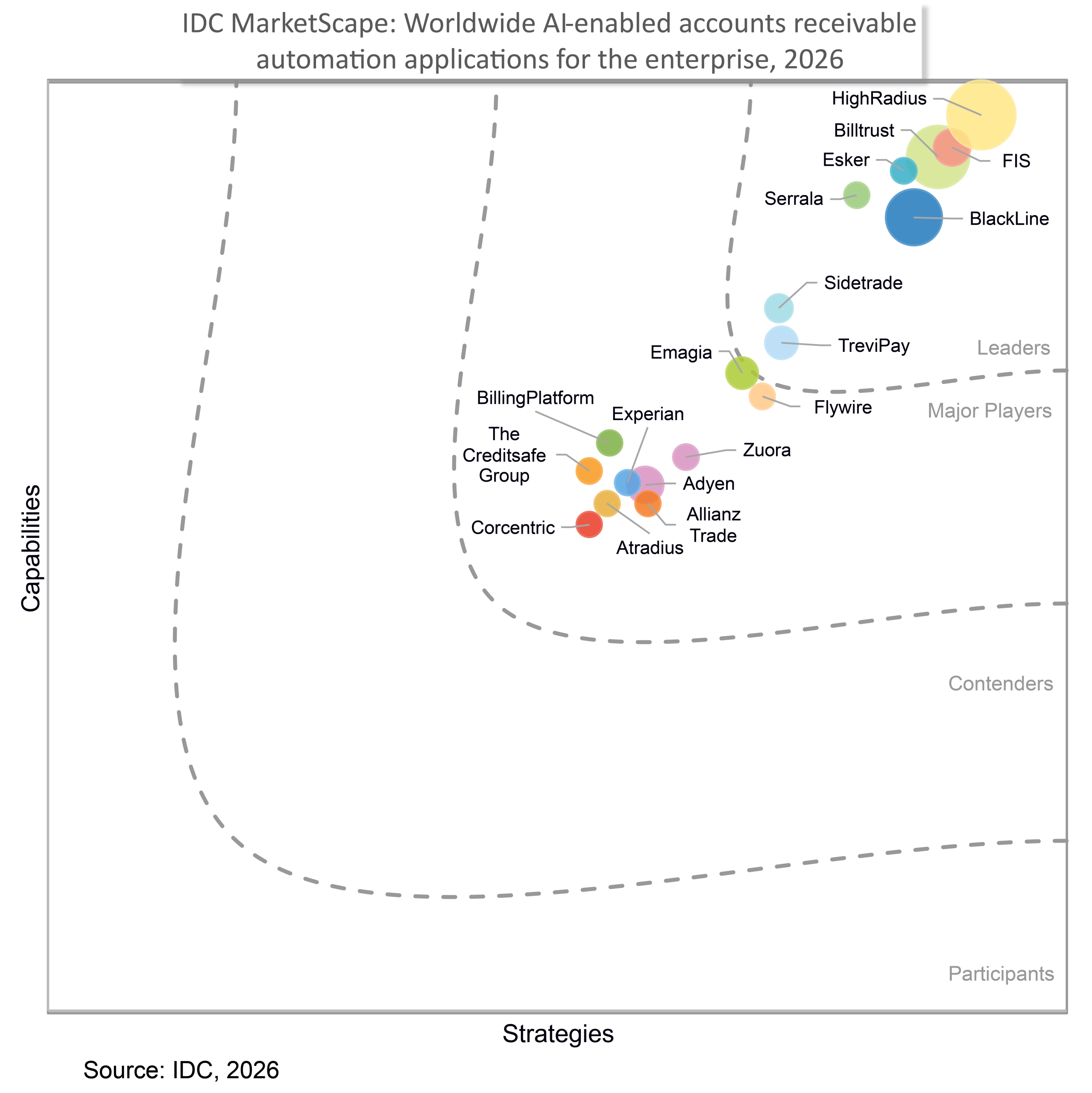
HighRadius recognized as a "Leader" in IDC Marketscape: Worldwide AI-enabled accounts receivable automation applications for the enterprise 2026 vendor assessment
Recognized as a Leader in 2026 Vendor Assessment for unifying credit, collections, cash application, deductions, e-invoicing, and payments on one AI platform to advance enterprise-wide invoice-to-cash transformation.
Forrester Recognizes HighRadius in The AR Invoice Automation Landscape Report, Q1 2023
Forrester acknowledges HighRadius’ significant contribution to the industry, particularly for large enterprises in North America and EMEA, reinforcing its position as the sole vendor that comprehensively meets the complex needs of this segment.