What Is Electronic Invoice Presentment and Payment (EIPP)? A Complete Guide
11 August, 2024
12 minute read
Nimisha Ghosh, B2B Finance Content Strategist
N
Nimisha Ghosh
Nimisha specializes in Order-to-Cash (O2C) transformation, crafting strategic narratives at the intersection of B2B SaaS and FinTech. With over four years of experience, she brings deep expertise in electronic invoicing, receivables automation, and digital payments, translating complex autonomous finance capabilities into actionable insights for modern finance leaders. When she’s not analyzing trends in enterprise finance, Nimisha enjoys reading and traveling. Her approach to writing is rooted in clarity, precision, and a strong understanding of real-world financial challenges.
Last updated: 14 July, 2026
Looking to Simplify Invoicing and Payments? See how leading companies do it right!
Payment delays in B2B transactions represent a systemic failure, not an operational exception. Globally, businesses wait an average of 51 days to get paid against standard terms of 32 days, meaning 37% of every payment cycle runs past due, adding ~19 days to each transaction. With more than 55% of all B2B invoiced sales overdue, late payment is no longer an anomaly. It is the default state of accounts receivable.
Electronic invoicing solved the delivery problem. It didn’t solve the payment problem. Finance teams still chase responses, work through fragmented processes, and have limited visibility into where an invoice stands, leaving cash flow unpredictable and working capital stuck.
This is where Electronic Invoice Presentment and Payment (EIPP)solution plays a critical role. By enabling digital invoice presentment, simplifying the payment experience, and improving visibility across the invoice-to-cash cycle, EIPP helps businesses move from reactive collections to more proactive and predictable cash flow management.
Table of Contents
What Is Electronic Invoice Presentment and Payment (EIPP)?
The Role of EIPP in the Invoice-to-Cash Process
How EIPP Works
Key Capabilities of EIPP Solution
Benefits of EIPP
Challenges Without EIPP
Key Factors to Consider When Adopting EIPP
What Sets HighRadius’ EIPP Solution Apart
What Is Electronic Invoice Presentment and Payment (EIPP)?
Electronic Invoice Presentment and Payment (EIPP) is a digital solution that enables businesses to present invoices to customers electronically, facilitate online payments, and automate the reconciliation of payments with invoices.
While many organizations have adopted electronic invoicing to automate invoice generation and delivery, the invoicing process does not end once an invoice is sent. Businesses still need to ensure that customers can access the invoice, review the details, complete payment, and provide remittance information.
Achieve 100% Automated Invoice Delivery with AI-Powered EIPP
Boost e-payment adoption, ensure compliance, and eliminate manual effort
EIPP extends electronic invoicing by managing this post-invoice lifecycle. It enables businesses to present invoices through digital channels such as customer portals, email, or electronic networks, while also allowing customers to view invoices, access supporting documents, and complete payments through convenient digital methods.
By connecting invoice presentment with payment collection and reconciliation, EIPP helps businesses streamline the invoice-to-cash process, improve visibility, and reduce delays in payment collection.
The Role of EIPP in the Invoice-to-Cash Process
The invoice-to-cash (I2C) process spans the entire lifecycle from invoice creation to payment collection and reconciliation. Many organizations have already adopted electronic invoicing to automate invoice generation, ensure compliance, and streamline how invoices are transmitted to customers.
However, a significant portion of delays occurs after the invoice has been sent. Invoices may not reach customers through their preferred channels, customers may struggle to access supporting documents, or may face friction in completing payments. These post-invoice interactions are often fragmented, creating inefficiencies that slow down collections.
Electronic Invoice Presentment and Payment (EIPP) addresses this gap by extending electronic invoicing into the post-invoice stage. It enables businesses to present invoices through digital channels, provide customers with convenient payment options, and capture remittance information automatically.
By connecting invoice delivery with payment and reconciliation, EIPP helps businesses streamline the invoice-to-cash process, improve visibility, and reduce delays in payment collection.
How EIPP Works
At a high level, an Electronic Invoice Presentment and Payment (EIPP) system sits between a business’s ERP systems and its customers, connecting invoice generation, delivery, interaction, and payment into a unified flow. A typical EIPP workflow looks like this:
ERP and Data Integration – The EIPP system connects with ERP systems to pull invoice data, including customer details, line items, tax information, and payment terms.
Invoice Generation and Formatting – Using this data, invoices are generated or formatted into standardized, customer-ready documents. Supporting documents, such as purchase orders or delivery confirmations, are attached.
Automated Invoice Delivery – Invoices are automatically delivered through multiple channels based on customer preferences or compliance requirements. This may include email, customer portals, electronic networks (EDI), or government e-invoicing platforms.
Customer Access and Presentment – Customers can access invoices through a self-service portal, where they can view account statements, download documents, and raise queries or disputes if needed.
Customer Communication and Interaction – The platform enables ongoing communication, including notifications, reminders, and responses to customer queries, reducing manual follow-ups and improving visibility.
Integrated Payment Enablement – Customers can complete payments directly through the platform using multiple payment methods, making the payment process faster and more convenient.
Remittance Capture and Reconciliation – Once payment is made, remittance data is captured and sent back to the ERP system, where invoices are automatically updated and reconciled.
Key Capabilities of EIPP Solution
At its core, an EIPP solution is designed to remove the inefficiencies that slow down invoice delivery, customer response, and payments. Instead of relying on disconnected systems and manual follow-ups, businesses can leverage EIPP to create a seamless, end-to-end experience that drives faster collections and better customer engagement.
Centralized Invoice and Document Management – EIPP systems provide a single interface where invoices, statements, and supporting documents can be generated, stored, and accessed. Customers can view, download, and manage invoice-related information without relying on manual communication.
Multi-Channel Invoice Delivery – Invoices can be delivered across multiple channels, including email, customer portals, EDI networks, and compliance-driven government systems. This ensures invoices reach customers efficiently while meeting regional and customer-specific requirements.
Customer Self-Service Portal – A built-in self-service portal where customers can view invoices, track status, raise disputes, and manage account activity in real time. This reduces dependency on finance teams and improves overall customer experience.
Integrated Digital Payment Options – Customers can make payments directly within the invoicing interface using multiple methods such as ACH, cards, and other digital payment options, simplifying the payment process and accelerating collections.
Compliance and Multi-Format Support – EIPP solutions support multiple invoice formats (PDF, XML, EDI) and ensure compliance with regional e-invoicing mandates by routing invoices through the appropriate networks and government portals.
Customer Communication and Engagement – Built-in communication capabilities enable structured outreach through invoice notifications, reminders, and targeted campaigns. Some platforms also provide engagement analytics to help improve customer response and payment behavior.
Dispute Management and Collaboration – Customers can raise and track invoice disputes directly within the platform. Built-in workflows and collaboration tools help resolve issues faster and maintain transparency across teams.
ERP and Bank Integration – Seamless integration with ERP systems, billing platforms, and banking networks ensures real-time data flow across the invoice-to-cash process, improving visibility and operational efficiency.
Benefits of EIPP
EIPP does more than digitize invoicing and payments; it fundamentally changes how businesses manage cash flow, customer interactions, and collections. By reducing friction across the invoice-to-cash cycle, it helps organizations move from reactive processes to more controlled and predictable operations.
Faster and More Predictable Cash Flow
By making it easier for customers to access invoices and complete payments, EIPP reduces delays that typically occur after invoice delivery. With fewer bottlenecks in the payment process, businesses can shorten collection cycles and improve cash flow predictability.
Reduced Dependency on Manual Follow-Ups
With automated reminders, centralized communication, and self-service access for customers, finance teams spend less time chasing payments or responding to routine queries, allowing them to focus on higher-value activities.
Improved Customer Payment Experience
EIPP simplifies how customers interact with invoices, providing easy access, clear information, and convenient payment options. A smoother experience reduces friction, leading to quicker responses and fewer disputes.
Better Control Over the Invoice-to-Cash Process
Instead of relying on fragmented systems, businesses gain more control over how invoices are delivered, tracked, and paid. This leads to more consistent processes and fewer operational gaps.
Lower Dispute Volumes and Faster Resolution
Access to supporting documents, structured workflows, and better communication reduces misunderstandings and errors. When disputes do occur, they can be resolved faster with full visibility into invoice details and history.
Stronger Visibility Into Collections and Customer Behavior
EIPP solutions provide insights into invoice status, payment patterns, and customer engagement. This helps teams identify risks early, prioritize collections, and make more informed decisions.
Increased Operational Efficiency Without Scaling Headcount
By automating repetitive tasks and reducing manual intervention, EIPP allows businesses to handle higher invoice volumes without a proportional increase in team size.
Better Alignment Across Finance, Sales, and Customers
With shared access to invoice data and communication history, internal teams and customers operate with the same information, reducing misalignment and improving collaboration.
Case Studies
Konica Minolta Success Story
Discover how a global manufacturing leader unlocked $30M in additional cash flow.
Without Electronic Invoice Presentment and Payment (EIPP), businesses are often left managing invoicing, customer interactions, and payments across disconnected systems. Even with electronic invoicing in place, the lack of an integrated post-invoice solution creates gaps that directly impact cash flow, efficiency, and customer experience.
Slower and Unpredictable Cash Flow
Without a streamlined way for customers to access invoices and complete payments, delays become difficult to control. Payments are often pushed beyond due dates, making cash flow harder to predict and manage.
Increased Time Spent on Payment Follow-Ups
Finance teams spend a significant portion of their time chasing payments, sending reminders, and responding to customer queries. This manual effort reduces productivity and limits the team’s ability to focus on strategic work.
Poor Customer Payment Experience
Customers often face friction when trying to view invoices, access supporting documents, or complete payments. A complicated experience can lead to delayed responses, missed payments, or dissatisfaction.
Limited Visibility Into Collections
Without real-time insight into invoice status and customer actions, businesses struggle to track which invoices are pending, viewed, or at risk of delay. This makes it harder to prioritize collections effectively.
Higher Risk of Errors and Disputes
When invoice data, documents, and communication are not centralized, the chances of discrepancies increase. This leads to more disputes, longer resolution times, and further delays in payments.
Manual and Inefficient Reconciliation
Remittance details are often incomplete or received separately from payments, requiring manual matching. This slows down the reconciliation process and increases the risk of errors.
Operational Inefficiencies at Scale
As invoice volumes grow, manual processes and disconnected workflows become harder to manage. Businesses are forced to scale headcount instead of improving process efficiency.
Key Factors to Consider When Adopting EIPP
Adopting an Electronic Invoice Presentment and Payment (EIPP) solution requires more than evaluating features. It’s about choosing a system that fits the business, its processes, customers, and growth plans. Some key factors to consider include:
Integration with Existing Systems – An EIPP solution should integrate seamlessly with ERP systems, billing platforms, and banking networks.
Customer Experience and Adoption – The success of EIPP depends heavily on how easily customers can use it. A solution should offer an intuitive interface, flexible invoice delivery options, and convenient payment methods to encourage adoption and reduce friction.
Payment Method Flexibility – Support for multiple payment options to accommodate different customer preferences
Multi-Channel Invoice Presentment – Businesses often deal with customers across regions and industries with varying requirements. The ability to deliver invoices through multiple channels, such as portals, email, EDI, and compliance networks, is critical for ensuring reach and consistency.
Compliance and Regulatory Support – With evolving e-invoicing mandates and tax regulations across regions, it’s important to choose a solution that can handle compliance requirements and adapt to changes without requiring constant manual updates.
Scalability – As invoice volumes grow, the solution should be able to handle increased load without impacting performance.
Visibility and Reporting – Access to real-time data and insights is essential for managing collections effectively.
Automation Capabilities – Support for workflows like reminders, dispute handling, and reconciliation
Security and Data Protection – Since EIPP platforms handle sensitive financial data, strong security measures, such as data encryption, access controls, and compliance with industry standards, are essential to protect business and customer information.
What Sets HighRadius’ EIPP Solution Apart
HighRadius is a leading choice for organizations looking to move beyond fragmented invoicing and payment processes to a fully connected, intelligent invoice-to-cash experience. Our AI-powered Electronic Invoice Presentment and Payment (EIPP) solution brings together invoice generation, delivery, customer interaction, payment processing, and reconciliation into a single, unified platform, helping businesses accelerate cash flow, reduce manual effort, and improve overall efficiency.
At its core, the platform is powered by 16 AI agents, along with agents such as a customer self-service portal, government e-invoicing, dispute management, interchange fee optimization, and credit card surcharging. The agents help automate invoice delivery and enable global electronic payments, allowing finance teams to achieve 100% automated invoice delivery and 50% improvement in FTE productivity.
Through AP Portal Invoice Upload, Customer Self-Service Portal, and Government E-Invoicing agents, businesses can fully automate invoice delivery across 600+ AP portals while creating a seamless, customer-centric experience. With an intuitive self-service portal, customers can view, manage, and resolve their accounts independently, while organizations achieve 100% compliant global e-invoicing, ensuring adherence to evolving government regulations without adding operational complexity.
Our EIPP solution’s ACH/Direct Debit Processing, Credit Card Surcharge, and Interchange Fee Optimization agents ensure a seamless and cost-efficient payment experience across customer-preferred methods. Whether customers choose ACH, direct debit, or card payments, businesses can support transactions in 30+ currencies across 40+ global payment processors, delivering true global coverage. At the same time, automated card surcharging helps maximize cost recovery while maintaining regulatory compliance, and intelligent interchange optimization reduces fees by 0.75–0.8%, significantly lowering overall card processing costs.
HighRadius seamlessly connects with 50+ ERP systems, 110+ banks, and multiple billing and accounting platforms, ensuring real-time data flow across every stage of the invoice-to-cash cycle. By combining deep integrations, AI-powered automation, and a customer-centric design, HighRadius delivers more than just an EIPP solution; it provides a scalable, end-to-end platform that transforms how businesses manage invoicing and collections.
Learn more about HighRadius’ EIPP Solution
Reduce DSO and connect buyers and suppliers globally with seamless invoicing & payments.
Cut support calls by 50% as buyers self-serve invoices and payments online.
Email Invoice Delivery
Get paid faster with automated invoices and real-time delivery tracking.
e-Adoption Campaign Management
Drive portal adoption effortlessly with targeted campaigns and real-time insights.
Frequently Asked Questions (FAQs)
1. What is Electronic Invoice Presentment and Payment (EIPP)?
Electronic Invoice Presentment and Payment (EIPP) is a digital solution that enables businesses to present invoices electronically, allows customers to make payments online, and automatically reconciles payments with invoices. It connects invoice delivery, customer interaction, payment processing, and reconciliation into a single workflow.
Electronic Invoice Presentment and Payment (EIPP) is a digital solution that enables businesses to present invoices electronically, allows customers to make payments online, and automatically reconciles payments with invoices. It connects invoice delivery, customer interaction, payment processing, and reconciliation into a single workflow.
2. How is EIPP different from electronic invoicing?
Electronic invoicing focuses on generating, validating, and delivering invoices in a structured digital format. EIPP extends this by managing the post-invoice process, including invoice presentment, customer interaction, payment enablement, and reconciliation.
Electronic invoicing focuses on generating, validating, and delivering invoices in a structured digital format. EIPP extends this by managing the post-invoice process, including invoice presentment, customer interaction, payment enablement, and reconciliation.
3. How does an EIPP solution work?
An EIPP solution integrates with ERP systems to pull invoice data, generates and delivers invoices through multiple channels, enables customers to access invoices via portals, supports digital payments, and automatically captures remittance data for reconciliation.
An EIPP solution integrates with ERP systems to pull invoice data, generates and delivers invoices through multiple channels, enables customers to access invoices via portals, supports digital payments, and automatically captures remittance data for reconciliation.
4. What are the benefits of using an EIPP solution?
EIPP helps businesses accelerate payments, reduce manual effort, improve invoice visibility, enhance customer experience, and streamline the entire invoice-to-cash process. It also reduces errors and improves operational efficiency.
EIPP helps businesses accelerate payments, reduce manual effort, improve invoice visibility, enhance customer experience, and streamline the entire invoice-to-cash process. It also reduces errors and improves operational efficiency.
5. What payment methods are typically supported in EIPP?
Most EIPP solutions support multiple payment methods, including ACH, credit cards, direct debit, wire transfers, and other digital payment options, allowing customers to pay using their preferred method.
Most EIPP solutions support multiple payment methods, including ACH, credit cards, direct debit, wire transfers, and other digital payment options, allowing customers to pay using their preferred method.
6. Can EIPP solutions integrate with ERP systems?
Yes, EIPP solutions are designed to integrate with ERP systems, billing platforms, and banking networks. This ensures seamless data flow for invoice generation, payment updates, and reconciliation without manual intervention.
Yes, EIPP solutions are designed to integrate with ERP systems, billing platforms, and banking networks. This ensures seamless data flow for invoice generation, payment updates, and reconciliation without manual intervention.
7. How does EIPP improve customer experience?
EIPP provides customers with a self-service portal where they can view invoices, access supporting documents, make payments, and track account activity. This reduces friction, improves transparency, and speeds up payment cycles.
EIPP provides customers with a self-service portal where they can view invoices, access supporting documents, make payments, and track account activity. This reduces friction, improves transparency, and speeds up payment cycles.
8. Is EIPP suitable for global businesses?
Yes, many EIPP solutions support multiple currencies, payment methods, and compliance requirements, making them suitable for businesses operating across different regions and regulatory environments.
Yes, many EIPP solutions support multiple currencies, payment methods, and compliance requirements, making them suitable for businesses operating across different regions and regulatory environments.
9. What challenges can EIPP help solve?
EIPP helps address challenges such as delayed payments, lack of invoice visibility, manual follow-ups, fragmented payment processes, and reconciliation inefficiencies.
EIPP helps address challenges such as delayed payments, lack of invoice visibility, manual follow-ups, fragmented payment processes, and reconciliation inefficiencies.
10. What should businesses look for in an EIPP solution?
Businesses should evaluate factors such as ERP and bank integration, customer experience, payment flexibility, compliance support, scalability, automation capabilities, and real-time visibility when selecting an EIPP solution.
Businesses should evaluate factors such as ERP and bank integration, customer experience, payment flexibility, compliance support, scalability, automation capabilities, and real-time visibility when selecting an EIPP solution.
HighRadius Named an IDC MarketScape Leader for the Second Time in a Row For AR Automation Software for Large and Midsized Businesses
HighRadius stands out as an IDC MarketScape Leader for AR Automation Software, serving both large and midsized businesses. The IDC report highlights HighRadius’ integration of machine learning across its AR products, enhancing payment matching, credit management, and cash forecasting capabilities.
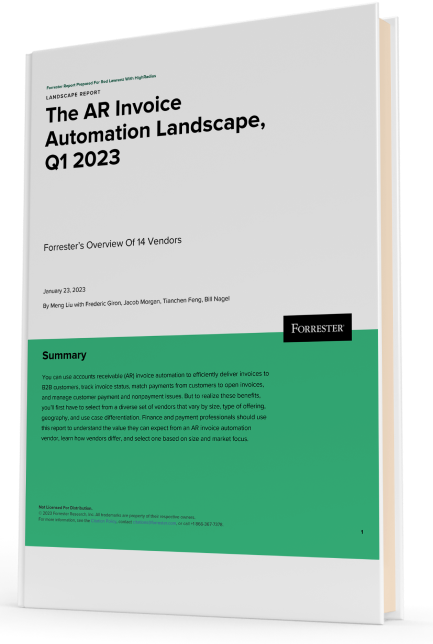
Forrester Recognizes HighRadius in The AR Invoice Automation Landscape Report, Q1 2023
Forrester acknowledges HighRadius’ significant contribution to the industry, particularly for large enterprises in North America and EMEA, reinforcing its position as the sole vendor that comprehensively meets the complex needs of this segment.