3X Faster Credit Reviews | 70% Faster Customer Onboarding
HighRadius Credit Decisioning Software helps mid-market and enterprise finance teams replace manual credit reviews with AI-powered decisioning, automated approvals, and real-time risk monitoring. Powered by 13 AI agents and 35+ credit agency integrations, the platform automates 80–90% of routine credit decisions, accelerates customer onboarding by up to 70%, delivers 90%+ faster approvals, and helps reduce bad-debt exposure by up to 20%.


HighRadius credit decisioning software enables mid-market and enterprise finance teams to automate credit approvals, standardize risk-based decisions, and enforce credit policies at scale through AI-driven workflows and real-time risk intelligence.
AI-powered credit decision software aggregates ERP payment behavior, financial statements, bureau reports, trade references, and customer exposure data to generate a complete risk profile for every credit request.
Configurable credit decisioning engines apply predefined policies, scoring thresholds, delegation-of-authority rules, and approval matrices to automate 80–90% of routine low-risk credit decisions.
Automated approval workflows instantly route exceptions to the right stakeholders, trigger credit limit recommendations, release orders, and accelerate customer onboarding by up to 70% without increasing analyst workload.
Continuous risk monitoring tracks payment behavior, credit utilization, bureau updates, and portfolio risk signals in real time, helping organizations reduce bad-debt exposure by up to 20% while maintaining policy compliance and audit readiness.
Agentic AI credit decisioning software replaces static scoring and manual reviews with real-time, policy-driven decisions, allowing enterprises to approve faster, control risk, and scale credit operations without adding headcount.
Higher Approval Velocity Without Higher Exposure
Approve 80–90% of low-risk credit requests instantly, routing only the critical 10–20% for review. Real-time risk signals and policy thresholds increase approval speed without increasing past-due risk or bad debt.
Material Reduction in Manual Credit Work
Automate 70–80% of credit review steps by eliminating spreadsheets, email approvals, and analyst-led scoring. Credit teams complete 2–3× more reviews per analyst per day using a centralized credit decision engine.
Lower Risk Through Continuous Decisioning
AI-powered credit decisioning engines improve predictive accuracy by 15–25% by monitoring exposure and behavior after approval. Risk shifts surface months earlier than periodic reviews—before losses accumulate.
Faster, Frictionless Customer Onboarding
Issue instant, explainable credit decisions that cut onboarding from days to under 24 hours and reduce blocked orders by 30%+. Automated data aggregation and correspondence remove customer back-and-forth without compromising governance.
The Difference
As customer volumes grow, manual reviews and approval bottlenecks make it difficult to balance growth, risk, and governance. Credit decisioning software helps finance teams automate routine decisions while maintaining policy control.
What Happens Today
What HighRadius Automates
Build a decision-ready credit profile using integrated data sources
Apply AI-driven risk logic within predefined credit policies
Execute consistent, real-time credit decisions across the enterprise
Keep credit decisions aligned with evolving risk conditions
Automate credit scoring and decisioning across complex supply chains with real-time exposure tracking and risk evaluation.
Read MoreScale credit scoring for high-volume customers using dynamic risk models based on payment behavior and demand cycles.
Read MoreAccelerate credit approvals and monitor risk continuously for large, high-transaction customer bases.
Read MoreEvaluate credit risk for subscription and service models using behavioral data, contract exposure, and dynamic scoring.
Read MoreBuilt for enterprises managing high deduction volumes across multiple ERPs, retailer portals, and global shared services environments.
Designed for lean finance teams scaling deduction operations without increasing headcount or manual research effort.
Native integration with SAP ERP enables real-time credit scoring, automated decisions, and synced exposure tracking.
Read MorePre-built connectors for NetSuite support seamless credit scoring workflows, automated risk evaluation, and unified data management.
Read MoreDeep integration enables automated credit scoring, centralized analysis, and consistent decisioning across business units.
Read MoreIntegrated credit scoring platform for Oracle ERP environments, enabling real-time risk monitoring and scoring accuracy.
Read MoreHighRadius credit decision software builds solid partnerships and offers robust integration capabilities by integrating with 110+ banks, 40 credit agencies, 50+ ERPs, and 15+ billing systems globally.
Ready to Connect HighRadius Credit Decisioning Software with Your ERP?
Download ERP FactsheetChoose the right tools that empower your credit risk decisions.
Download Free TemplateLearn how our agentic AI-led O2C reduces past-dues by 20% and accelerates customer onboarding.
Download Data SheetHow to evaluate your O2C automation ROI and improve AR success?
Download EbookCredit decisioning software is an AI-led system that automates how credit decisions are evaluated, approved, or escalated in real time. It combines data aggregation, policy-driven rules engines, and agentic AI to assess credit risk, assign limits, and execute decisions consistently, without manual underwriting or spreadsheet-based reviews.
Instead of relying on static credit scores or periodic reviews, automated credit decisioning software continuously evaluates customer exposure, payment behavior, and external risk signals. For example, when a new customer places an order or requests a limit increase, the credit decision engine instantly determines whether the request can be approved, requires escalation, or should be declined, ensuring faster onboarding, controlled risk, and full auditability at scale.
The Credit Review Agent continuously ranks reviews using live triggers such as blocked orders, new customer onboarding, periodic reviews, expiring collateral, and real-time risk alerts. Instead of manual worklists, analysts see only the reviews that matter most, ranked by exposure and revenue impact.
Outcome: High-risk and revenue-blocking decisions are addressed first, without manual triage.
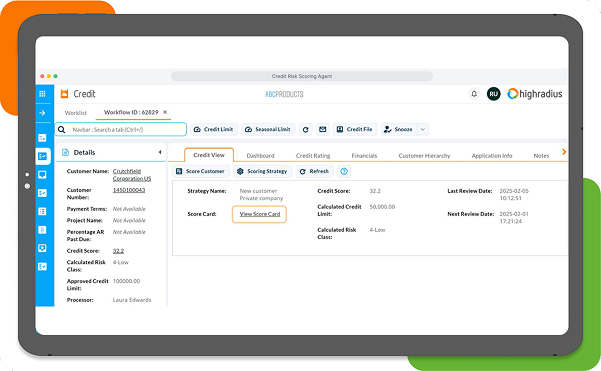
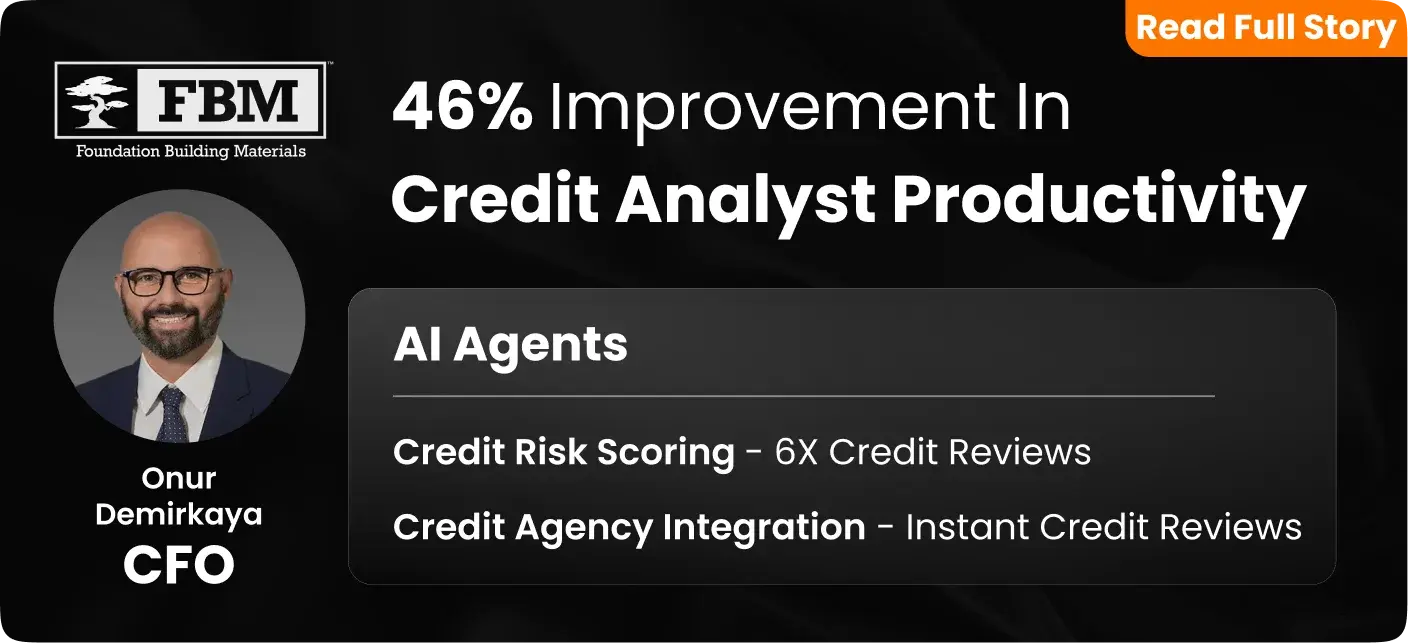
The Credit Risk Scoring Agent evaluates bureau data, public financials, payment behavior, utilization, and ordering patterns in real time. Risk weightings adjust dynamically by segment and region as behavior changes.
Outcome: Risk is reassessed continuously, not just during scheduled reviews.
The automated credit decision engine executes approvals in real time for low-risk customers and minor credit limit changes using predefined policy thresholds. Only exceptions are routed for review.
Outcome: 80–90% of routine decisions are automated, while analysts focus on high-impact cases.
AI agents trigger bank reference requests, decision correspondence, and approval notifications the moment a review starts. All inputs and actions are logged with a complete audit trail.
Outcome: Credit reviews progress without follow-ups, emails, or manual coordination.
Manual credit decisioning relies on analyst judgment, static data, and periodic reviews, making it slow, inconsistent, and difficult to scale. On the other hand, automated credit decisioning software replaces this with real-time, policy-driven decisions executed by AI-powered credit decision engines.
| Capability | Manual Credit Decisioning | Automated Credit Decisioning Software |
|---|---|---|
| Decision Speed | Decisions take days due to manual reviews and back-and-forth approvals. | Automated credit decisioning systems issue approvals or escalations in seconds using AI-powered credit decisioning engines. |
| Risk Evaluation | Relies on static credit reports and analyst interpretation. | Credit risk decisioning platforms continuously evaluate risk using machine learning credit decision tools and real-time data. |
| Data Usage | Limited to bureau pulls and spreadsheets reviewed periodically. | Credit decisioning platforms integrate data aggregation across ERPs, bureaus, payment behavior, and financials. |
| Consistency | Decisions vary by analyst, workload, and region. | Credit decision engine software enforces consistent policy logic across all customers and entities. |
| Scalability | Volume growth requires additional headcount. | Automated credit decision platforms software scales decision volume without increasing operational cost. |
| Audit and Compliance | Decision rationale is difficult to reconstruct. | Automated credit decisioning software maintains complete, defensible audit trails for every decision. |
Choosing the right credit decisioning software is not about finding the most features but selecting a system that can make fast, consistent, and defensible credit decisions as risk changes in real time. Here are some key factors to consider.
Prioritize software that makes credit decisions instantly, not after batch reviews
Look for an automated credit decisioning system that evaluates risk, assigns limits, and routes approvals in real time using AI-powered credit decisioning engines.
Ensure the platform integrates all decision-grade data sources
The right credit decisioning platform should support data aggregation across ERPs, credit bureaus, financials, and payment behavior—not rely on static or partial inputs.
Choose control over black-box automation
Effective credit decision engine software enforces predefined business rules while using AI to evaluate risk, ensuring automation never bypasses governance.
Look beyond rules-based automation to autonomous decision agents
Modern credit decisioning solutions use agentic AI to prioritize reviews, automate low-risk approvals, and trigger actions without manual coordination.
Avoid platforms that stop at approval
A credit risk decisioning platform should monitor exposure and behavior after approval, automatically adjusting limits or triggering reviews as risk evolves.
Make every decision explainable and defensible
Automated credit decisioning software must maintain full audit trails, capturing inputs, logic, and overrides for compliance and executive confidence.
Whether you are scaling customer onboarding with a lean credit team or managing complex credit policies across multiple business units, HighRadius credit decisioning software helps finance teams automate approvals, standardize risk decisions, and reduce manual reviews without sacrificing control.
HighRadius credit decisioning software helps enterprises standardize approval policies across regions, automate periodic and ad-hoc reviews, and continuously evaluate customer risk across multiple ERPs. AI-powered decision engines, blocked-order prevention, and centralized governance improve risk visibility while reducing bad-debt exposure and accelerating enterprise-wide approvals.
As customer volumes increase, manual reviews, email approvals, and spreadsheet-based workflows slow onboarding and create approval bottlenecks. HighRadius credit decision software helps mid-market finance teams automate 80–90% of low-risk approvals, accelerate onboarding by up to 70%, and deliver faster, policy-driven credit decisions without increasing analyst headcount. Prebuilt workflows and ERP integrations help teams achieve rapid time-to-value with minimal IT involvement.
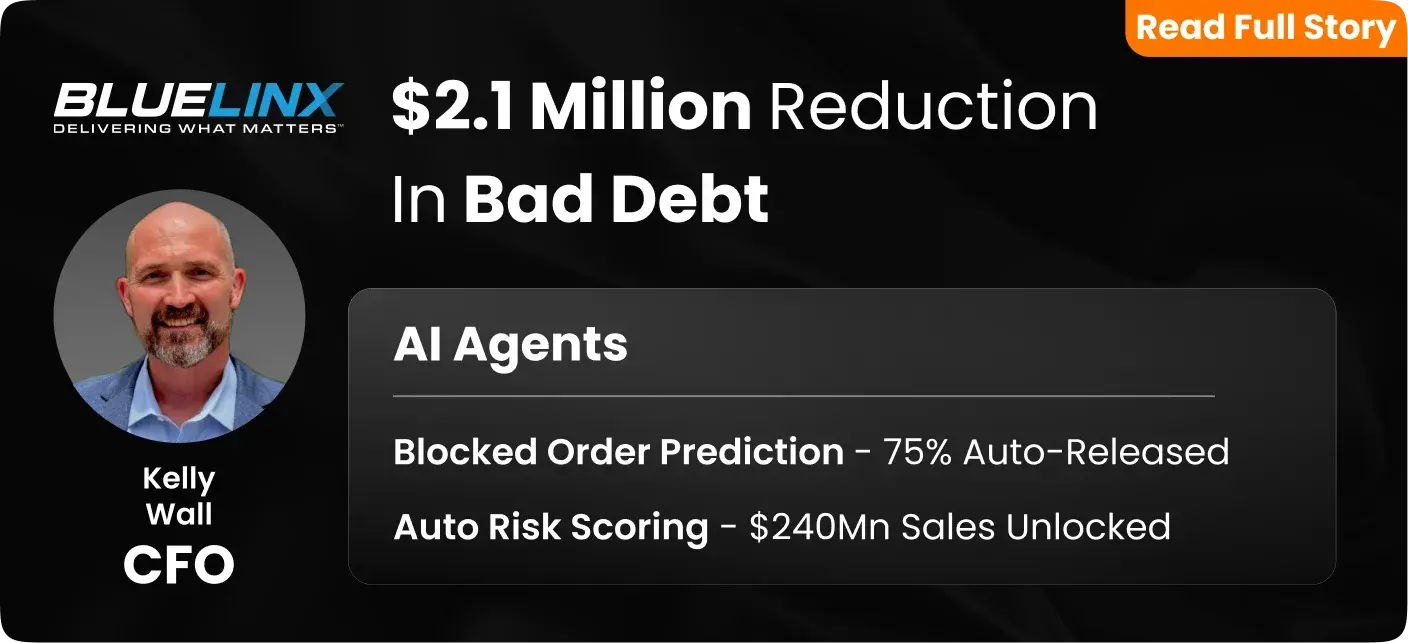
Leading enterprises are rethinking credit and collections with AI—automating everything from credit scoring and blocked order prediction to high-risk account follow-ups and dispute resolution. In just 6 months, they’ve seen 20% drop in bad debt, and unlocked over $2M in additional cash flow.
Book A Discovery CallCredit decisioning software automates credit approvals by combining risk data, scoring models, approval policies, and workflow automation into a single platform. It helps finance teams make faster, more consistent credit decisions while reducing manual reviews and improving governance.
Automated credit decisioning works by aggregating internal ERP data, external credit bureau information, and behavioral signals, then applying AI risk models and predefined credit policies to each request. Low-risk decisions are approved automatically, while higher-risk cases are routed for review—allowing credit teams to act instantly as risk conditions change.
Credit scoring produces a static risk score, while credit decisioning software applies that score within a broader decision framework. It combines risk scores with business rules, exposure limits, customer hierarchies, and approval workflows to determine whether credit should be approved, adjusted, or escalated, making it actionable, not just analytical.
AI improves credit decision accuracy by identifying patterns across large datasets and detecting early risk signals, while deterministic policy rules enforce governance. Every decision follows configurable thresholds, maker-checker workflows, and audit trails—ensuring AI augments decisions without overriding credit policy or regulatory controls.
Credit decision software automatically evaluates customer risk, applies predefined approval rules, and routes only exceptions for manual review. By automating routine approvals, organizations can reduce approval times from days to minutes while maintaining compliance with credit policies.
After a credit decision is made, the system continuously monitors customer behavior, exposure changes, and external risk signals. If risk conditions deteriorate, it can trigger alerts, initiate credit reviews, or adjust credit limits, preventing exposure from accumulating unnoticed.
HighRadius provides an AI-driven credit decisioning platform that scales from fast-growing finance teams to complex enterprise credit operations.
Growth-Focused Finance Teams: Automates online credit applications, low-risk approvals, and workflow routing to accelerate onboarding, improve analyst productivity, and eliminate spreadsheet-driven reviews.
Enterprise Credit Operations: Standardizes approval workflows, blocked-order management, and real-time risk monitoring across multiple ERPs, global entities, and shared services teams using predictive AI and centralized governance.