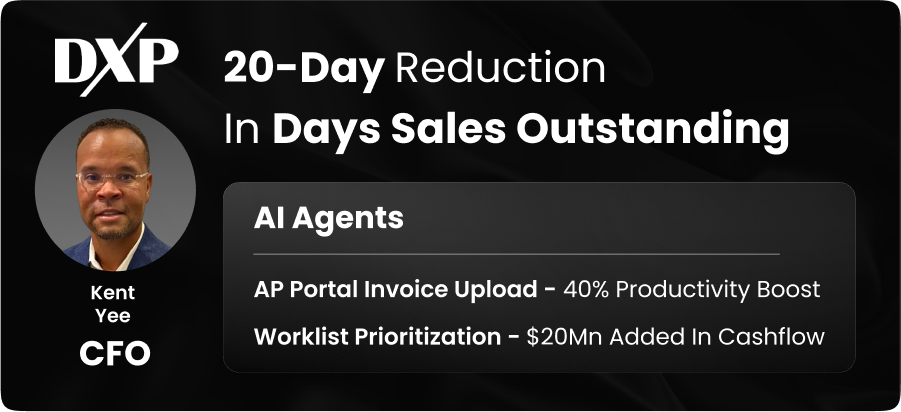
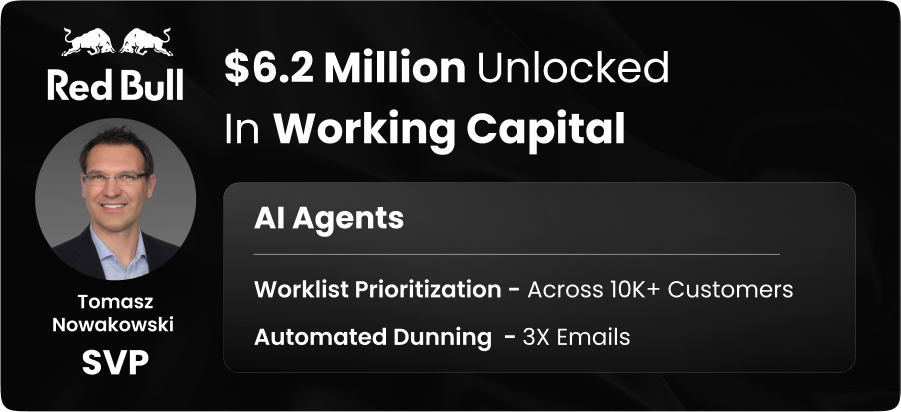
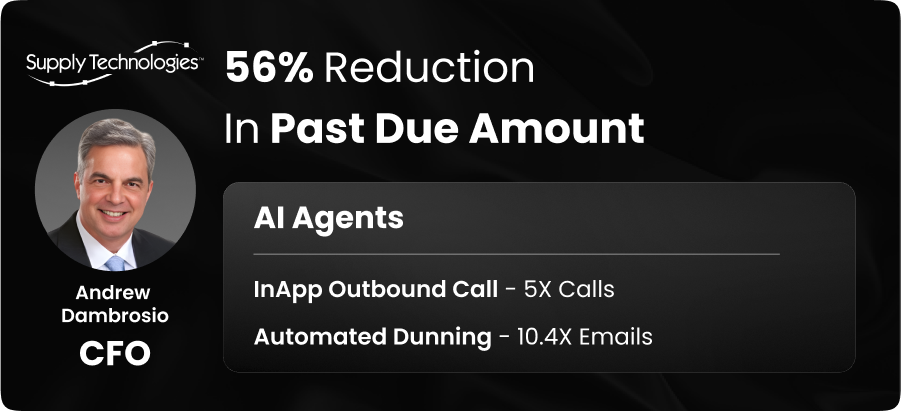
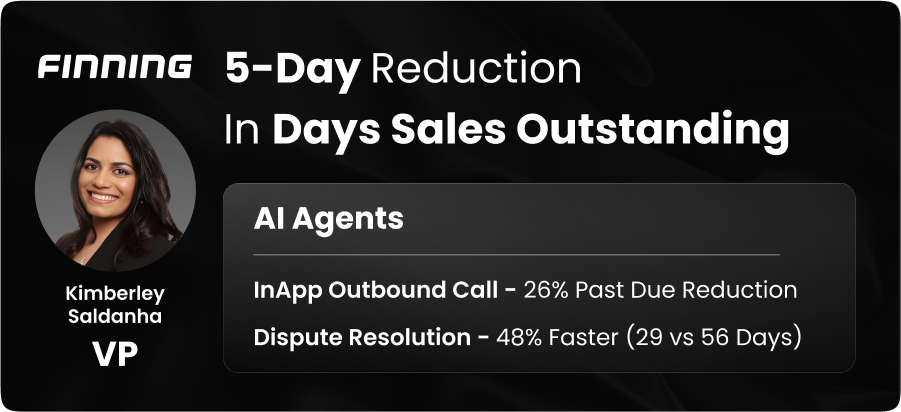
Trusted by Leading Enterprises Worldwide






Eliminate manual receivables tasks, improve collection efficiency, and gain real-time insights into cash flow across complex enterprise accounts receivable operations.
Purpose-built to handle the complexity, volume, and operational demands of enterprise
accounts receivable across global customers, business units, and ERP environments.
Automatically capture remittance data and match payments to open invoices with high accuracy, even across complex customer payment formats.
Prioritize high-risk accounts, automate customer outreach, and equip collectors with insights that improve recovery rates and reduce overdue balances.
Evaluate customer creditworthiness with real-time data and automated risk monitoring to protect revenue and reduce exposure.
Gain complete visibility into receivables performance with analytics that help finance teams track collections, monitor DSO, and improve cash flow.
Connect seamlessly with existing ERP systems to automate receivables processes while maintaining data accuracy and financial control.
Enterprise accounts receivable requires more than basic automation. It demands intelligent
decision-making, real-time visibility, and a platform built to manage complex global receivables operations.
Native integrations with SAP, Oracle, Microsoft Dynamics, NetSuite, and other ERP systems ensure accurate data synchronization and faster deployment across enterprise environments.
Process millions of invoices, payments, and customer transactions annually across multiple entities, regions, and currencies without compromising accuracy or performance.
Machine learning models continuously learn from customer payment patterns to improve cash application accuracy, prioritize collections, and identify payment risks earlier.
Real-time dashboards and predictive insights help finance teams monitor DSO, track collections performance, and make better working capital decisions.
Dedicated implementation specialists, structured onboarding, and global support teams ensure rapid deployment and continuous optimization of receivables processes.
Hundreds of large enterprises rely on HighRadius to modernize accounts receivable, accelerate cash collections, and gain real-time visibility into receivables performance.
Tangible outcomes that enterprise finance teams achieve by automating accounts receivable with HighRadius.
Reduction in Days Sales Outstanding (DSO)
Cash Application Automation Rate
Increase in AR Team Productivity
Reduction in Manual Effort Across Receivables Workflows


Accounts receivable software helps businesses manage invoices, collections, payments, and cash application from one platform. Modern accounts receivable software uses automation and analytics to reduce manual work, improve collection efficiency, and give finance teams real-time visibility into outstanding receivables.
Accounts receivable software helps improve cash flow by automating invoicing, collections, and payment matching. AI-driven accounts receivable automation platforms also provide real-time cash flow visibility and analytics so finance teams can prioritize collections and reduce payment delays.
Key accounts receivable software features include automated invoicing, collections management, AI-driven cash application, receivables analytics, ERP integration, and real-time AR aging dashboards. Advanced platforms also support credit risk assessment and automated workflows to improve collection performance.
Modern accounts receivable management solutions provide real-time cash flow visibility through dashboards, predictive analytics, and AR aging reports. These platforms help CFOs track outstanding invoices, monitor payment behavior, and forecast incoming cash across enterprise receivables operations.
Accounts receivable automation software benefits include reduced manual effort, faster collections, improved cash application accuracy, and better working capital visibility. Automation also helps finance teams manage large invoice volumes while improving DSO and overall receivables performance.
Leading accounts receivable automation platforms offer native ERP integration with systems like SAP, Oracle, NetSuite, and Microsoft Dynamics. These integrations enable two-way sync between financial systems and AR workflows, ensuring accurate receivables data and streamlined financial operations.
CFOs use accounts receivable analytics software, AI collections tools, and automation platforms to improve collection rates. These tools provide insights into customer payment behavior, automate follow-ups, and prioritize high-risk accounts to accelerate cash collections.
Platforms that automate cash application processes use AI and OCR to capture remittance data and match payments to invoices automatically. This reduces manual reconciliation and allows finance teams to process payments faster while improving accuracy.
Businesses can connect accounts receivable software to QuickBooks using native integrations or APIs. This integration synchronizes invoices, payments, and customer data between systems, helping companies automate collections and maintain accurate financial records.
When evaluating accounts receivable automation platforms, enterprises should consider ERP integration, automation capabilities, analytics, scalability, and security. The best accounts receivable software for enterprises also provides real-time visibility and supports high-volume receivables operations.