Credit Scoring Models 101: Types and Examples for a Stronger Financial Future
Last Updated: 26 August, 2026
•
Soumi Sarkar Fintech content strategist
S
Soumi Sarkar
Soumi specializes in O2C, finance, and accounting transformation with a focus on bringing a domain-led perspective to accounting, finance and order-to-cash transformation. She crafts insight-driven, CFO-aligned content that helps finance teams optimize operational workflows and drive measurable outcomes. Beyond her professional work, Soumi is a published author of two books, a poetess, an avid reader, and a storyteller who enjoys exploring narratives across both B2B and creative formats.
2026 Automation Benchmark Report
HighRadius 2026 Automation Benchmark Report For The Office Of The CFO
Understand if your performance is on par with top 10% of the organizations. Identify gaps, best practices and know how you can drive value through Agentic AI-Driven Automation.
Your Credit Team Can’t Scale Manual Scoring. Automated credit scoring with HighRadius Credit Scoring and Risk Monitoring to enable consistent, high-volume credit evaluation.
Credit scoring models form the backbone of how businesses evaluate customer risk. But as transaction volumes increase and decisions need to happen faster, relying on standalone models or manual analysis is no longer enough.
Today, organizations are embedding these models into credit score software to standardize approvals across customers and geographies. This shift enables faster onboarding, more consistent decisions, and better control over credit exposure.
This guide breaks down the different types of credit scoring models, how they work, and how businesses apply them in real-world credit decisioning.
80–90% of Credit Evaluations Don’t Need Manual Review.
Automate routine approvals, focus analysts on high-risk accounts, and improve portfolio visibility with continuous AI-driven risk monitoring.
A credit scoring system uses a defined scoring model, data inputs, and scoring criteria to assess a customer’s creditworthiness. It helps businesses automate risk assessment, improve decision accuracy, and enable faster, policy-driven credit approvals.
What is A Credit Scoring Model?
Credit scoring models are used to calculate a credit risk score based on defined financial and behavioral factors. These models are used by credit bureaus and lenders to assess the risk of lending money or extending credit to individuals or businesses.
The credit scoring model evaluates various factors, including payment history, credit utilization, length of credit history, types of credit accounts, and recent credit inquiries. Each factor is assigned a weight, and the model’s formula calculates a credit score based on the evaluation.
A credit score typically ranges from 300 to 850, with a higher score indicating a lower risk of default. Lenders use credit scores to make decisions about loan terms, including interest rates, repayment periods, and loan amounts. A good credit score can result in favorable loan terms, while a poor score can lead to higher interest rates and less favorable terms.
Why Is the Credit Risk Scoring Model Important?
The credit risk scoring model provides a standardized and objective way for lenders to assess the creditworthiness of individuals and businesses. By using a credit scoring model, lenders can evaluate the risk of lending money or extending credit to a borrower, allowing them to make informed decisions about loan terms and interest rates.
Without a credit risk scoring model, lenders would have to rely on subjective judgments and personal opinions when evaluating a borrower’s creditworthiness. This could result in inconsistencies and potentially discriminatory lending practices. A standardized credit scoring model ensures that all borrowers are evaluated based on the same criteria, creating a fair and transparent lending process.
Ebooks
Slow Credit Scoring = Delayed Approvals = Lost Revenue.
Automated credit scoring enables faster decisions and improves customer onboarding speed at scale.
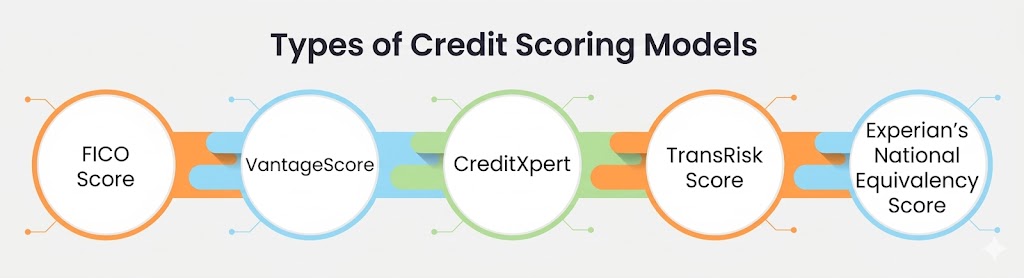
There are various types of credit scoring models used in finance, each with its own unique methodology and criteria. Understanding the different types of credit scoring models can help individuals and businesses make informed decisions about credit and loans.
1. FICO Score:
The FICO score is the most commonly used credit scoring model in the United States. It uses a range of factors to calculate a credit score, including payment history, credit utilization, length of credit history, types of credit accounts, and recent credit inquiries. FICO scores range from 300 to 850, with higher scores indicating a lower risk of default.
Here is a look at each category and the weight it carries in determining the credit score:
Payment history (35%): This factor evaluates how consistently a borrower has made payments on their debts. A borrower who has always made on-time payments will receive a higher score than one who has missed payments.
Credit utilization (30%): This factor evaluates the percentage of available credit that’s being used. A borrower who uses less than 30% of their available credit will receive a higher score than one who uses more.
Length of credit history (15%): This factor evaluates how long a borrower has had credit accounts open. A borrower who has a long history of credit accounts in good standing will receive a higher score than one who is new to credit.
Types of credit accounts (10%): This factor evaluates the types of credit accounts a borrower has, such as credit cards, loans, and mortgages. A borrower who has a diverse mix of credit accounts will receive a higher score than one who only has one type of account.
Recent credit inquiries (10%): This factor evaluates how frequently a borrower has applied for credit. A borrower who has made few recent credit inquiries will receive a higher score than one who has made many. FICO scores are used by a wide variety of lenders, including banks, credit card companies, and mortgage lenders. A good FICO score can result in lower interest rates and better loan terms, while a poor score can lead to higher interest rates and less favorable terms.
2. VantageScore:
The VantageScore is a newer credit scoring model that was developed jointly by the three major credit bureaus. It also uses a range of factors to calculate a credit score, but weighs them differently than the FICO score. VantageScores range from 300 to 850, with higher scores indicating a lower risk of default.
VantageScore 4.0, the latest version of the model, uses six factors to calculate a credit score: payment history, age and type of credit, percentage of credit limit used, total balances and debt, recent credit behavior and inquiries, and available credit. The VantageScore model puts less emphasis on payment history and more emphasis on credit utilization than the FICO model.Here is a look at each category and the weight it carries in determining the credit score:
Payment history (40%): This factor evaluates how consistently a borrower has made payments on their debts, similar to the FICO score.
Age and type of credit (21%): This factor evaluates the borrower’s credit history, including the age of their oldest and newest credit accounts and the mix of credit types.
Percentage of credit limit used (20%): This factor evaluates the borrower’s credit utilization, similar to the FICO score.
Total balances and debt (11%): This factor evaluates the borrower’s total debt, including loans and credit card balances.
Recent credit behavior and inquiries (5%): This factor evaluates recent credit activity, including the number of new credit accounts and credit inquiries.
Available credit (3%): This factor evaluates the borrower’s available credit, or the amount of credit they could access if they needed it. VantageScores are used by a variety of lenders, including banks, credit card companies, and mortgage lenders. Like the FICO score, a good VantageScore can result in lower interest rates and better loan terms, while a poor score can lead to higher interest rates and less favorable terms.
Other Credit Scoring Models
CreditXpert: It is a credit scoring model that’s designed to help lenders evaluate the risk of lending to borrowers with limited credit history. It uses alternative data sources, such as rent and utility payments, to assess creditworthiness.
TransRisk Score: It is a credit scoring model that uses alternative data sources, such as public records and property records, to assess creditworthiness. It’s often used by lenders in the automotive industry to evaluate the risk of lending to borrowers with limited credit history.
Experian’s National Equivalency Score: It assigns users a score of 0-1,000 based on payment history, credit length, credit mix, credit utilization, total balances, and the number of inquiries, but the criteria and weight are not publicly disclosed. The scoring system is different from the FICO model, with a score of 100 indicating a 10% chance of at least one account becoming delinquent in the next 24 months and a score of 900 indicating a 90% chance. A more familiar alternative scoring method of 360 to 840 is also provided.
From Credit Scoring Models to Credit Scoring Software
Credit scoring models are only one part of the credit decisioning process. In practice, businesses rely on AI-led credit scoring to operationalize these models, automating data collection, applying scoring logic, and enabling real-time credit decisions.
Modern credit analysis software integrates multiple scoring models, external data sources, and predefined rules to ensure consistent and scalable creditworthiness evaluation across customers.
How AI Is Transforming Credit Scoring Models
Traditional scoring models rely on static financial data and predefined rules. In contrast, AI-powered credit scoring systems analyze large datasets in real time, identifies hidden risk patterns, and continuously improves prediction accuracy.
This shift enables:
Faster credit decisions
More accurate risk assessment
Real-time monitoring of customer behavior
Traditional Models vs AI-Based Credit Scoring
Feature
Traditional Models
AI-Based Scoring
Data
Limited
Large datasets
Speed
Slow
Real-time
Accuracy
Moderate
High
Scalability
Limited
High
Why Businesses Are Moving to Automated Credit Scoring
As credit portfolios grow, manual scoring becomes inconsistent and difficult to scale. Automated credit scoring systems help standardize decisions, reduce risk, and improve onboarding speed, without increasing operational overhead.
Ebooks
Efficient Credit Management: Zero Bad Debt, Faster Onboarding
Discover how automated credit reviews and faster onboarding streamlined operations and reduced risk for Chevron Phillips.
Credit scoring models evaluate a customer’s creditworthiness by analyzing financial, payment, and other relevant risk factors and assigning a score based on predefined criteria. Different credit scoring models may weigh these factors differently depending on the purpose of the assessment. The resulting credit risk score helps finance teams understand a customer’s likelihood of meeting payment obligations and make more consistent credit decisions. A well-designed credit scoring system combines reliable data, defined scoring rules, and regular updates to reflect changes in customer risk.
The Future of Credit Scoring Models: Innovations and Trends to Watch Out For
As technology continues to advance, credit scoring models and credit decision tools are evolving to keep pace with the changing landscape. Here are some emerging trends and technologies in credit scoring to watch out for:
Big Data:
The use of big data and machine learning algorithms can help lenders analyze vast amounts of data to identify patterns and make more informed lending decisions. According to a study, 76% of lenders are already using machine learning in some capacity to evaluate creditworthiness.
Alternative Data:
The use of alternative data sources, such as utility bill payments and rental history, is becoming more prevalent in credit scoring models. This can help lenders evaluate borrowers who may not have a traditional credit history and improve access to credit for underserved populations.
Real-Time Scoring:
Real-time credit scoring can provide lenders with up-to-date information on a borrower’s creditworthiness, allowing for more accurate and timely lending decisions. This can be particularly useful for small business owners who need access to credit in a timely manner.
Mobile Scoring:
With the rise of mobile banking, lenders are exploring the use of mobile data to evaluate creditworthiness. This includes analyzing a borrower’s mobile phone usage patterns, such as the frequency of calls and text messages.
Financial Health Scoring:
Financial health scoring models are emerging as a way to provide a more holistic view of a borrower’s financial health. These models take into account factors such as savings, investments, and debt levels to provide a more comprehensive picture of a borrower’s creditworthiness.
Overall, the future of credit scoring models is exciting and full of potential. As new technologies and trends emerge, lenders and borrowers alike can expect to see more innovative and effective ways to evaluate creditworthiness and improve access to credit.
Templates
Wrong Vendor = Hidden Costs, Delays, and Risk Exposure.
Structured evaluation frameworks help reduce procurement risk, control costs, and ensure you select vendors that deliver measurable value.
Streamline Your Credit Evaluations with HighRadius’ Automated Scoring Models and Approval Workflows
HighRadius credit management software helps finance teams move from periodic, spreadsheet-driven credit reviews to connected, AI-powered credit decisioning. The platform combines customer payment behavior, external credit intelligence, financial data, configurable scoring, automated approvals, and continuous risk monitoring to give teams a clearer view of changing customer risk. For mid-market companies scaling with lean credit teams, this means automating routine decisions and reducing manual reviews without adding headcount. For global enterprises, it brings credit risk visibility, policy governance, and decisioning across complex customer portfolios, entities, and ERP environments.
With real-time credit risk analysis software and credit decisioning software, you can receive alerts for any changes in your customers’ credit profile and make data-driven credit decisions from unlimited credit reports. Our software integrates with your ERP system and can start monitoring your customers in just 30 days.
We offer configurable credit scoring software and approval workflows that can be customized based on geography, customer segments, business units, and other factors. You can fast-track credit approvals through complex corporate hierarchies, making the credit application process more efficient and streamlined.
Our highly configurable online credit application allows you to onboard customers across the globe with multi-language, customized credit applications embedded on your website. You can automatically capture financials, personal guarantees, and check bank references, reducing the need for manual data entry.
Our software also automatically extracts credit data from over 40+ global and local agencies, including credit ratings, financials, and credit insurance information. You can configure the auto-extracted data in your preferred currency, making it easier to analyze and interpret.
With AI-based blocked order management, you can auto-predict blocked orders based on the customers’ credit limit utilization and payment history. You can leverage AI-based release or partial payment recommendations for faster credit decisions, reducing the need for manual intervention.
Learn More about HighRadius’s Accounts Receivable Software
Lower DSO, boost working capital, and increase productivity with our AI-driven accounts receivable platform, integrated with modern ERPs.
Accelerate payment recovery from delinquent customers and boost cash flow through automated collection workflows.
Cash App
Achieve same day cash application with automated remittance aggregation
Credit
Mitigate credit risk, reduce bad debt, and streamline customer onboarding with AI-powered insights.
Deductions
Reduce Revenue Leakage with AI Prediction models that identify valid and invalid deductions.
Frequently Asked Questions (FAQs)
1. What is the best model for credit scoring?
The best credit scoring model depends on the lender and borrower’s needs. FICO and VantageScore are the most commonly used in the US, based on factors such as payment history, credit utilization, and credit inquiries. However, credit scoring models are only one factor in credit decisions.
The best credit scoring model depends on the lender and borrower’s needs. FICO and VantageScore are the most commonly used in the US, based on factors such as payment history, credit utilization, and credit inquiries. However, credit scoring models are only one factor in credit decisions.
2. What is the most significant component for determining the credit score?
Payment history is the most significant component in determining a credit score. It includes factors such as payment timeliness, number of late payments, and severity of missed payments. Other factors like credit utilization, length of credit history, types of credit accounts, and recent inquiries also play a role.
Payment history is the most significant component in determining a credit score. It includes factors such as payment timeliness, number of late payments, and severity of missed payments. Other factors like credit utilization, length of credit history, types of credit accounts, and recent inquiries also play a role.
3. What does a credit management solution collect and manage?
A credit management solution collects customer financials, credit history, trade references, and payment behavior to assess risk. Modern systems also track real-time data and automate credit decisions to improve accuracy, speed, and control over bad debt.
A credit management solution collects customer financials, credit history, trade references, and payment behavior to assess risk. Modern systems also track real-time data and automate credit decisions to improve accuracy, speed, and control over bad debt.
4. What does HighRadius Credit Management do?
HighRadius Credit Management automates credit scoring, decisioning, and approvals using AI. It centralizes data, standardizes risk evaluation, and enables faster, policy-driven decisions, helping finance teams reduce manual work and improve cash flow predictability.
HighRadius Credit Management automates credit scoring, decisioning, and approvals using AI. It centralizes data, standardizes risk evaluation, and enables faster, policy-driven decisions, helping finance teams reduce manual work and improve cash flow predictability.
5. How does HighRadius improve collections performance?
HighRadius uses AI agents to prioritize accounts, automate follow-ups, and optimize outreach. This improves recovery rates, reduces DSO, and provides real-time visibility into collections performance without increasing manual effort.
HighRadius uses AI agents to prioritize accounts, automate follow-ups, and optimize outreach. This improves recovery rates, reduces DSO, and provides real-time visibility into collections performance without increasing manual effort.
6. What are the benefits of AI-powered credit and collections software?
AI-powered software improves decision speed, accuracy, and scalability. It automates data collection, scoring, and communication, reduces errors, and enables proactive risk management across the credit-to-cash process.
AI-powered software improves decision speed, accuracy, and scalability. It automates data collection, scoring, and communication, reduces errors, and enables proactive risk management across the credit-to-cash process.
7. Is HighRadius suitable for enterprise credit and collections teams?
Yes, HighRadius is built for enterprise teams managing large portfolios. It supports complex credit policies, integrates with ERP systems, and scales automation across credit, collections, and cash application processes.
Yes, HighRadius is built for enterprise teams managing large portfolios. It supports complex credit policies, integrates with ERP systems, and scales automation across credit, collections, and cash application processes.
Resource Library
Resource Hub
Order to Cash
Order to Cash software data sheet
Disconnected workflows can leave teams chasing data, while automated O2C has delivered 20% lower past dues.
HighRadius Named an IDC MarketScape Leader for the Second Time in a Row For AR Automation Software for Large and Midsized Businesses
HighRadius stands out as an IDC MarketScape Leader for AR Automation Software, serving both large and midsized businesses. The IDC report highlights HighRadius’ integration of machine learning across its AR products, enhancing payment matching, credit management, and cash forecasting capabilities.
Forrester Recognizes HighRadius in The AR Invoice Automation Landscape Report, Q1 2023
Forrester acknowledges HighRadius’ significant contribution to the industry, particularly for large enterprises in North America and EMEA, reinforcing its position as the sole vendor that comprehensively meets the complex needs of this segment.